

This particular review was written from a hotel in Ulaanbataar, Mongolia. I was stranded there for weeks.
It turns out that if you crash a motorcycle thousands of miles from home, suffering two broken ribs, a collapsed lung, and traumatic pneumothorax (as well as a few superficial friction burns and bruises on your shoulder and elbow), doctors, airlines, and travel insurance companies will not permit you to fly.
This is because there’s a very high risk that if you fly too soon after experiencing traumatic pneumothorax you’ll suffer cardiac arrest in the pressurized cabin of an airplane. Or, as my Mongolian doctor put it plainly: “You will die.”

So, you’ll be left to sit in a Holiday Inn as you wait for the two-week full recovery window to pass. Inevitably, once you’ve looped your self-pity soundtrack a few times, something uncomfortable will occur to you: this could have been so much worse.
I mean, when I came off my bike at roughly 60 mph and hit the unforgiving surface of Mongolia’s A0301, I hit hard. Harder than I’ve ever before experienced. There was almost no slide, just all the force of my movement ceasing immediately. Effectively, the bike served as a trebuchet, firing me to the ground. And in this crash that broke my ribs and waylaid me for weeks, the first thing to hit the ground was my head.
The fact that you are reading this – and that I was able to write this – kind of tells you everything you need to know about the HJC RPHA 60 that I was wearing on that day. It looks cool, has a lot of cool features, and is sold at an agreeable price. But most importantly it does what it is supposed to do.
Like the RPHA 11 Pro helmet that saved my skull roughly a decade ago, the HJC RPHA 60 is a helmet that I recommend whole-heartedly, knowing from (very painful) personal experience that it will serve its primary purpose (protection) brilliantly.

HJC RHPA 60 specs
| STARTING PRICE | £429.99 |
| MADE IN | Vietnam (No. 133 on the Democracy Index) |
| SAFETY RATING | ECE 22.06 |
| SIZING | XS-2XL |
| WEIGHT | 1600 grams (size M) – Roughly 50g less with peak removed. |
A little background
South Korea-based HJC has been making helmets since the mid-1970s. The internet tells me that HJC stands for “Hong Jin Crown,” and that the company started out as a clothing manufacturer – Hongjin Enterprises – that then took over a failing helmet business – Seoul Helmet – in 1974. That enterprise became Crown Helmet, then something something something and now we have HJC.
HJC is one of the major players in both North America and Europe – thanks in no small part for its reputation of offering affordability and quality.
The RPHA series of helmets – which many people strangely pronounce as “Arffa” – is HJC’s ‘top of the line’ range. They are not cheap, but they still tend to be more affordable than comparative helmets from, say, Shoei or Arai.
The adventure-touring-focused RPHA 60 first arrived in the UK in autumn 2025. I had been using mine since about that time – first putting it to the test in November of that year, when I spent a week riding the Royal Enfield Himalayan 450 Mana Black in India. Before breaking it in Mongolia I also wore it in Spain, Portugal, Iceland, and up and down the UK in all weathers.

Fit, comfort, and interior
Straight out of the box, the RPHA 60 has a feel of quality. It definitely looks the part in terms of adventure touring and comes with an additional ‘long smoke’ tinted visor if you live in a place sunny enough that the combination of clear (external) visor and (internal) sun visor isn’t enough. More on the visors in a bit.
HJC says it uses a proprietary “Premium Integrated Matrix” of high-strength resin and “special fiber tissue” to create a lighter shell. I am not clever enough to understand the particulars, but certainly it’s true that the helmet is noticeably lighter than most. In India and Mongolia I spent multiple back-to-back days wearing the helmet without any sense of discomfort or heaviness.
Inside the lid, you’ve got a fully removable liner that HJC says is made of anti-bacterial, moisture-wicking, quick-drying fabric. It and the removable cheek pads are all washable. Apparently the cheek pads are interchangeable across all helmet sizes, so you could theoretically tailor your fit with some clever mixing and matching. The challenge comes in getting hold of those extra cheek pads. Searching the internet, I’m not able to find a vendor that currently sells them.
Fortunately for me, the fit of the RPHA 60 is excellent. Better, in fact, than I’m used to with HJC. I’m a fan of the company’s lids but it’s always been the case that their fit has been pretty snug; helmets take a while to break in. My RPHA 70, for example, really only got comfortable after about 1,000 miles of wear.
Not so with the RPHA 60. It was instantly comfortable and I was always happy to throw it on.

The gimmick (ie, the removable peak)
I’ll admit that I think the peaks on adventure helmets look cool, but I also tend to think they are generally silly and unnecessary. Like a grown man wearing a replica jersey to a football game, or anyone in Britain wearing cowboy boots, having a peak on an adventure-touring helmet smacks just a little of playing dress-up.
At speeds above 50 mph these peaks can turn into sails (unless the bike you’re riding has a very good windscreen) placing tremendous strain on your neck as you fight the wind’s efforts to twist your head off like some sort of throwaway character in ”Invincible.”
Fortunately, the peak on the RPHA 60 is easy to remove. There are small bolts on each side of the helmet – removable without tools – and a release button in the top vent housing. The whole thing comes off in 30 seconds or less and can be fit into most backpacks.

Perhaps another argument against keeping the peak in place is the fact that the part that connects with the vent housing inherently blocks some air intake. And when the main visor is fully up, it disappears slightly under the peak, making it just a little tricky to find with a gloved hand.
Lastly, the peak is a little flimsy.
But I will admit that in the cutting sun of Mongolia’s Gobi desert I found it to be helpful. Plus, as I say: it looks cool.

A multitude of visors
In addition to a standard clear (external) visor, the RPHA 60 also comes with the so-called “long smoke” tinted visor I mentioned above. Both visors claim to offer 99-percent protection against UV light and come with an anti-scratch coating.
The quirk of the tinted visor, however, is that it is shaped differently to a standard visor, with a section that pulls down over the front vent. It looks cool, but makes the front vent a little difficult to operate.
And, as I say, it’s really only relevant if you live somewhere that’s consistently very sunny. The Mongolian desert, perhaps. For those of us living in the United Kingdom, the internal sun visor is good enough.
In fact, it’s very good. HJC has developed a system that allows the visor to shift forward 10 mm as it is brought down. This means that it is able to drop down lower than other sun visors, which would otherwise bump into your face. A lower sun visor means more coverage. The coverage with the RPHA 60’s sun visor is so good that it encompasses pretty much the entirety of your field of vision. You will forget that you’ve got the sun visor down.

Speaking of the field of vision, it’s excellent – better than what I’m used to with the sport-touring helmets I normally wear (which I feel are pretty damn good).
An included Pinlock antifog insert helps ensure the clarity of that field of vision. At least, for a little while. Mine was worn out when I crashed; I was planning to replace it when I got back home. In fairness, though, it had been subjected to the notorious dust of both Goa and the Gobi.
Only one Pinlock comes with the RPHA 60, despite the fact that you get two external visors. So, you’re forced to choose – or to buy a second Pinlock insert.
One thing to note: this helmet isn’t really designed for aggressive off-road riding. The presence of an internal sun visor should clue you into that fact. Another clear sign is that you may struggle to wear goggles with it. The shape at the rear of the helmet is designed to improve aerodynamics. It is a shape that would likely cause goggle straps to slip.

Ventilation and noise
HJC says that its “Advanced Channeling Ventilation System” offers “three intakes and four exhausts.” The company appears to be counting the face section of the helmet (ie, the bit that’s protected by the visor) as an intake. By that reckoning, there are, in fact, four intakes: the big hole where you put your head, the big hole that you look out of, an adjustable vent at the chin, and an adjustable vent at the crown of the helmet.
Whatever the case, the RPHA 60 is airier than, say, my Shoei Neotec 3, which means it’s well suited to warm-weather rides. I don’t ever remember being hot in the helmet when wearing it in 35ºC+ heat in India.
The other side of the coin to being airy, however, is that the RPHA 60 is louder than a more road-focused helmet. That’s not to say it’s too loud. With a set of good ear plugs in (which you should be wearing anyway) it’s not problematic.
Cue obvious Amazon affiliate link for Honeywell Howard Leight Max Protection ear plugs. That’s what I use; I buy ‘em in packs of 200. They’re pitched as “single use” but I find they’re good for a number of rides. A pack of 200 will last you a few years, even if you ride as often as I do.
Meanwhile, with the vents closed, the helmet isn’t so airy that it can’t be worn in British weather. I have ridden in a few downpours while wearing the helmet and there was no leaking.

Fancy stuff
The RPHA 60 is built to seamlessly integrate with a number of HJC’s “SMART” Bluetooth communications systems. Kudos to HJC here for making the helmet compatible with three of its systems. So, if you have a set-up from a previous HJC helmet you can simply switch it over.
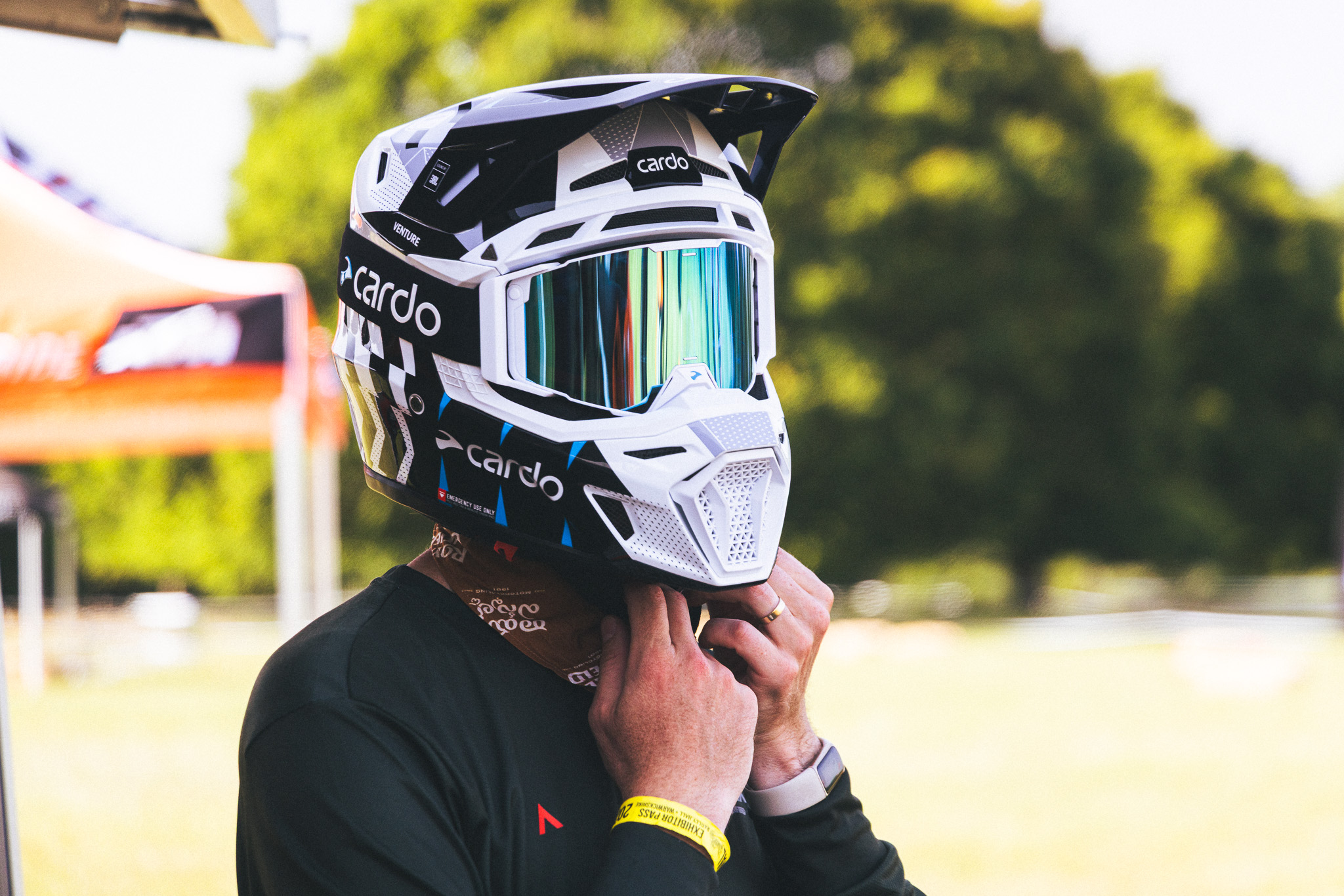
Compare that with the Shoei Neotec 3. My biggest moan about that helmet was the fact that it does not accept the comms system from the Neotec 2. As far as Shoei is concerned, buying a different helmet means also buying a new comms set-up. Still arguably better than the Cardo Venture set-up, which sees you replacing helmet and comms after a crash even though you’re getting the same model of helmet.
Here, though, the RPHA 60 will work with the SMART 11B, the SMART 21B, or SMART 50B systems. I’m afraid, though, that I don’t have any of those systems and HJC didn’t send me one to test. So, I’m not able to tell you how well any of them work within the RPHA 60 context.
Unrelated to communications is a safety feature that’s common to almost all HJC helmets these days: emergency pull tabs. These small red straps allow paramedics or other medical professionals to quickly remove the helmet’s cheek pads in an incident. That gives them a better chance of removing your helmet without upsetting your neck.

An affordable helmet you can trust
I mentioned earlier that I have long been a fan of HJC helmets. That affection stretches back to 2016, when I crashed while wearing an HJC. I hit the road at roughly 70 mph and rolled about 300 feet – my head making contact with the tarmac several times.
A decade later, I got properly messed up from a crash in Mongolia. Yet I’m still here, telling you about it. HJC is a brand that personal experience has taught me I can trust. And so it is a brand that I wholeheartedly recommend.
You can find more focused helmets in this segment that cost more money, sure, but there’s no arguing against the fact that the RPHA 60 is sound.

Verdict
The HJC RPHA 60 is lightweight, comfortable, looks good, and comes from a company that has saved my life multiple times. What more could you ask for?
Its ‘adventure’ qualities are just little more for show than practical use. In Mongolia I would have been served by a more traditional ‘helmet with goggles’ set-up but this is excellent for the sort of adventure riding that sees you exploring fire trails amid longer stints of road work.
Another benefit is that it looks good (and works great) on the road with the visor removed. You get good ventilation and an excellent field of vision. Albeit with the trade off of being a little noisier than a dedicated touring or sport helmet. If you ride an adventure-touring or touring motorcycle – and don’t mind a little extra wind noise – it’s an excellent choice.

Other gear worn in photos
– Weise Navigator jacket
– LS2 X-Master suit
– Spada Vanguard adventure-touring suit
– Richa Atlantic GTX gloves
– Aerostich Elkskin Competition Roper gloves
– Sidi Taurus GTX boots
– Richa Oberon WP boots
Leave a Reply