
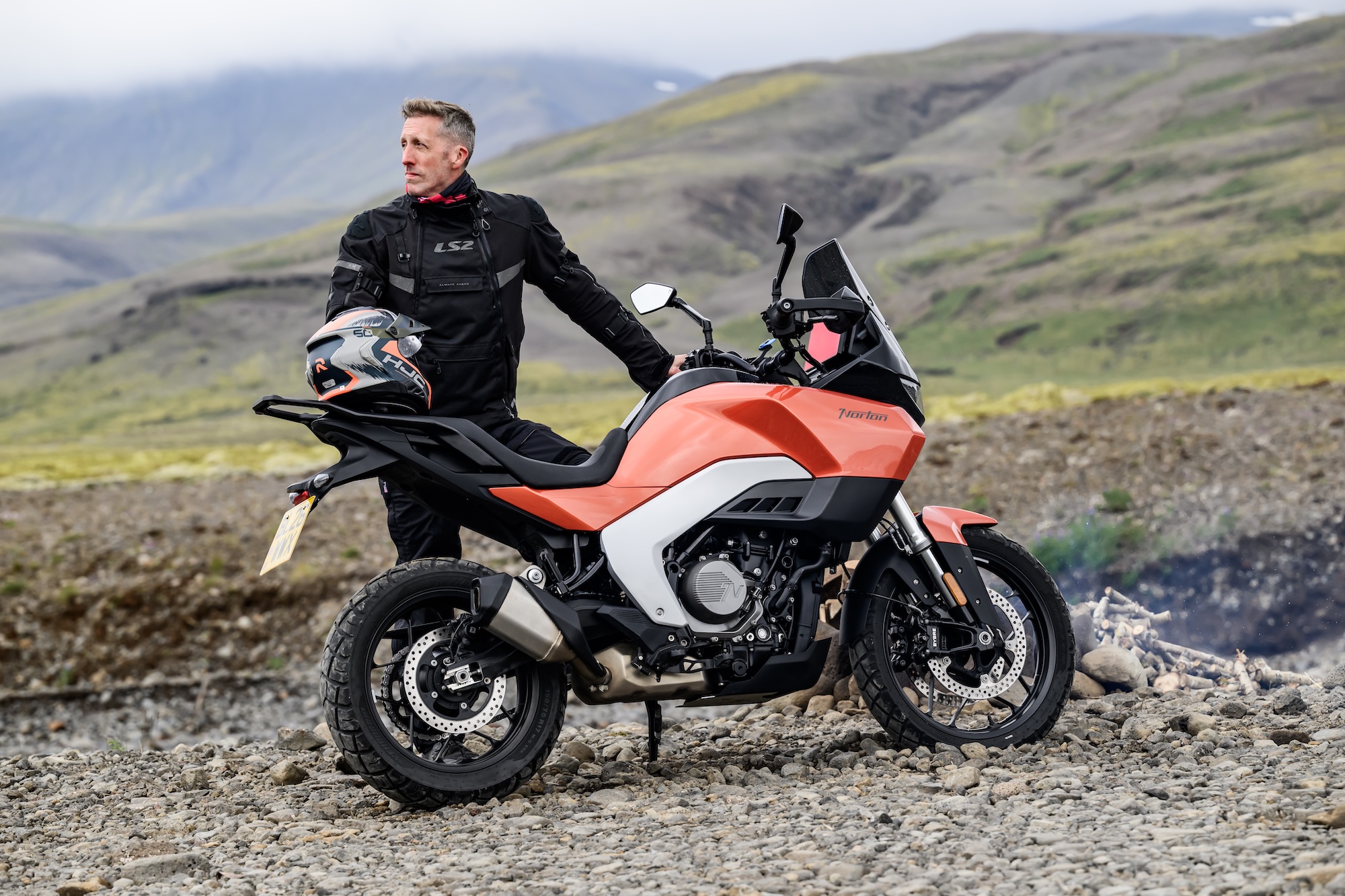
“So, what did you think of the bike?” asks a member of Norton’s team, creating a sudden silence at the table.
There are a lot of things to say about the new Norton Atlas. But when you’re sitting in a restaurant in Reykjavik, tucking into a £57 steak that – along with everything else – was paid for by the company whose representative has just asked your thoughts about said motorcycle, you can’t help but want to give a considered (read: “diplomatic”) answer.
MCN’s Justin Hayzelden is the first to break the silence, with a long intake of breath.
“It’s not a bad motorcycle,” he says. “Foundationally, it is sound…”

This terse, tactful response probably isn’t exactly what the re-resurrected Norton is hoping for in its first foray into the adventure segment. Using Justin’s delicate tone as cover, the rest of us at the table jump in with bullet-point observations:
“Engine mapping…”
“Brakes…”
“Tires…”
However, ours isn’t a universal response. Presenter and moto omnipresence Grace Webb will tell me later that most of the folks at her table were effusive in their praise.
So, exactly how you view Norton’s mid-capacity adventure machine seems to depend somewhat on personal context. Keep that in mind as you read on: it is entirely possible (and acceptable) that you might disagree with me. Certainly it’s true that the Atlas is a motorcycle that deserves a test ride.
Anyhoo, taking in my own long, slow breath now, I’ll tell you that the Norton Atlas exceeded my expectations. Does that mean, however, that it is deserving of its price tag? Read on.

Here’s some of that context…
Credit to Norton, it did not inundate attendees of the Atlas launch with tedious heritage hoorah-ism. There are many, many other brands that would not be able to resist the temptation of spending a solid hour babbling about history and legacy and spirit and heritage and all the other adjectives a marketing team might choose to attach to a brand that built its first motorcycle 124 years ago.
Most people know Norton’s story. If you’ve just arrived from outer space, however, or are somewhat new to motorcycling, here’s a brief overview of how we got here:
Like Triumph, Royal Enfield, BSA, and a surprising number of other British brands, Norton traces its roots to the English Midlands. It was founded in Birmingham in 1898 by James ‘Pa’ Lansdowne, and delivered its first motorcycle in 1902.
The first Norton to run an engine actually made by Norton came in 1908: a 633cc side-valve single that Norton bafflingly called the Big Four. The name apparently came from the UK road tax category into which the machine was slotted.
Lansdowne rode a sidecar-equipped Big Four all across South Africa in 1921-1922, clocking up more than 3,000 miles. This particular excursion provides the modern Norton’s tenuous link to the adventure world.

The brand’s golden years were arguably in the decade before and decade after the Second World War, when it was winning Isle of Man TT races left and right. Norton was perhaps best known for the quality of its frames, which gave rise to the Triton trend of the 1950s – putting Triumph engines into a Norton chassis.
The first bike to carry the Atlas name was produced in 1962, powered by a 745cc air-cooled parallel twin that was basically a bored-out version of the then 13-year-old Dominator engine. The model lasted just six years before being transformed into and replaced by the Commando.
I can find no evidence of the Atlas having been used for or being particularly useful for adventure-style riding. However, the internet tells me its engine was paired with a Matchless frame to create the short-lived Norton Ranger (1967-1969), which was intended for desert racing.
Like every other British motorcycle company of the era, Norton was horribly mis-managed. Across its history it’s had at least nine major changes of ownership. The era that most people think of when they think of Norton came to a whimpering end in 1978. The brand was dragged down in the same miasma of bad decisions that killed Triumph and BSA.
Somewhat related: The baffling case of motorcycles in the UK

Norton limped on in its own weird way through numerous ownership and direction changes until 2008, when now-convicted fraudster Stuart Garner managed to convince a whole bunch of people and government officials to give him lots of money to restore the brand in England.
The brand soon produced a new, attractive, and very expensive Commando model, and even more expensive and attractive V4 race bike, and a whole bunch of empty promises. It wasn’t long before people started asking serious questions. Ultimately, Garner and several of his cohorts were convicted of fraud, leaving the business in tatters. In 2020, the whole kit and caboodle was bought up by Indian motorcycling giant TVS in a reported £16 million cash deal.
The third largest motorcycle manufacturer in India, TVS sells more than 3 million motorcycles a year. It also builds the F 450 GS for BMW. This is a relevant fact that will come up again shortly.
When TVS took over, it brought in a bunch of executives from the automobile world, made what appeared to be an honest effort to do right by customers burned by Garner, and phased out production of all existing models. Things went quiet until last autumn, when Norton unveiled a line-up of four new models at EICMA 2025: the Atlas, Atlas GT, Manx R sportbike, and Manx super naked.
Norton’s press materials are VERY vague about this, but it appears the primary difference between the Atlas and Atlas GT is the size of the front wheel. The Atlas, which is the bike I rode, has a 19-inch front wheel; the Atlas GT, which has not yet been officially launched, has a 17-inch front.

“The Atlas [has] the same powertrain specification as the GT,” explains a media release. “The Atlas GT offers a more road-focused package.”
Within this hair-splitting there are also two different versions of the bikes: the standard version and the Apex, which comes with more fancy stuff. I rode the Apex version of the bike.
Look, fit, and feel
The first time I saw the Norton Atlas was at its unveiling at EICMA 2025. Under the lights of the Fiera Milano Rho, and bedecked in the “Trophy Silver” paint scheme, it struck me as ugly and uninspiring. It looked like a computer-generated Honda Varadero bereft of its charm. I hated it.
Remember when I said that TVS brought in a bunch of people from the automotive world? At least a few of them were part of Jaguar Land Rover when it launched that famously disastrous rebrand. Discuss.
In the light of day, however, and when it’s not painted in a soul-destroying grey, the Atlas is actually a very attractive motorcycle. There are still hints of Varadero – as well as a sprinkling of Kawasaki KLV1000 or early 2000s V-Strom 1000 – but I would not describe its styling as derivative. Norton takes great pride in the fact that the bike was designed entirely via computer, with no traditional clay modeling used, and that kind of shows. There is a coldness in its perfect lines.

Related to that, Norton also takes immense pride in how few bolts and fixings are visible. All the lines are smooth, the attachments imperceptible. Being able to see the bolts and fixings is not a criticism that I have ever heard levied against adventure bikes. And I can think of several servicing/repair-related reasons as to why being able to see/access them might actually be a good thing. But Norton says that doing things this way dramatically reduces noise and improves aerodynamics.
Norton’s website describes the company as a maker of “Premium British Bikes.” I’d argue that with the Atlas only one of those descriptors is correct. Norton is indeed a purveyor of bikes.
Not that the truth of the Atlas is a negative. In fact, I’d argue that the bike’s Indian origin is actually a plus. It’s a dangerous game to apply blanket statements to the products of a given country, but it has long been my feeling that bikes made in India are made by people who actually ride bikes: from the CEO down to the people serving tea in the canteen. So, the decisions behind things like ergonomics or which button to put where feel like they are rooted in someone thinking: “Well, I’m going to ride this thing; how do I want it to be?”
Additionally, I would describe the components as “very good.” Some bits are even “excellent.” But the word “premium” never came to my mind. That might be an example of personal context, though. What does it actually mean for a motorcycle to be “premium?”

Certainly for me the two big detractors in the “Is this premium?” debate are found in the quality of the plastics used for the fairing, and the handguards. Neither look like they would fare well in a drop – especially an off-road drop. The mounting hardware for the handguards is flimsy enough that I can jiggle them about with my hand. Nothing is cheap here or half-assed, just not premium. It’s on par with what I would expect from, say, Kawasaki.
Another point on those handguards: they house turn signals. If you bashed one of those against a rock, I reckon you’d be paying premium for a replacement.
This is not an adventure bike
You don’t really need to go much further than this to start to feel that the Atlas – the idea of this bike as an adventure motorcycle – may have been an afterthought. So much of the styling, tech, and features are better suited to the Atlas GT’s road-focused remit. Imagine this bike as a fancy Kawasaki Versys 650 or Yamaha Tracer 7 or Suzuki SV-7GX and it makes a hell of a lot more sense.
I mean, sure, the bike is refreshingly light and well-balanced – advantageous off road – but there’s so much that’s breakable here, that’s difficult or impossible to work on in the middle of nowhere. Not to mention the fact that the spoked wheels that appeared in original press materials (back in November 2025) are nowhere to be seen on the actual motorcycle.
I suspect that the Atlas GT was always the plan and that at some point along the way, someone (maybe one of those automotive guys) went: “Wait a second. The mid-capacity adventure segment sells really well. Why can’t we tweak this mid-capacity upright sport tourer to hit that segment, too?”

Having said that, remember when I noted that Norton’s parent company, TVS, also builds the F 450 GS for BMW? In its dimensions, the Atlas shares some of the exact same numbers as the F 450 GS: an 845mm seat height, a 19-inch front wheel, a 17-inch rear, a fully adjustable 43mm KYB front fork with 180mm of travel, a KYB rear monoshock with 180mm of travel, a 1466mm wheelbase, and 220 mm of ground clearance…
Either way, it has the makings of a good road bike
The 845mm seat doesn’t feel that tall thanks to a narrow profile. Good news if you’re Grace Webb, who was on her tippy toes at stops, and a piece of cake if you’re 6 feet 1 inch tall like me. Interestingly, both of us found the rider triangle to be comfortable and natural.
The seat is comfortable with a not-too-firm foam that seems like it will hold up for a while. Passenger accommodation is acceptable for day trips, but I wouldn’t want to be a full-sized adult sitting on the back of this thing for a multi-day jaunt to Romania.
Related to that, the accessory luggage looks terrible, completely spoiling the lines of the bike. Nor does it look like it even holds that much. Don’t buy it. If you’re going on a long haul, tell your passenger to buy a bike of their own and just strap a Kriega bag (or a cheaper but reportedly just as good Rhinowalk bag) to the seat.
Hands fall naturally to the ‘bars (there’s one for your motorcycle review bingo card), where you’ll find switchgear that has a lot of buttons but not so many that it feels overwhelming. You’ll probably want to read the bike’s instruction manual to get the tao of things but it feels intuitive thereafter. Which is to say, once you realize/get told that you need to hold down the switchcube to access the bike menu it’s not something you forget because it makes sense.

Navigating the 8-inch touchscreen is also straightforward and, again, it all feels like it was designed by people who actually ride bikes.
Beyond the touchscreen is one of the best OEM windscreens I have ever encountered. It makes use of a so-called NACA duct, which channels high-velocity air behind the screen to meet the air coming over the top, neutralizing the vortexes that cause helmet buffeting.
Easily adjustable (although, you have to be stopped because it requires both hands) the windscreen creates a beautiful pocket of air even at extra-legal speeds. I was wearing the visor on my HJC RPHA 60 helmet, but even at 140 km/h (roughly 87 mph) things were reasonably quiet and relaxed in the cockpit. My visor was not getting caught in the wind, wrenching my neck this way or that.
Engine and transmission
Keen observers will note that in addition to having some of the exact same dimensions as the F 450 GS, the Norton Atlas’ liquid-cooled parallel twin shares some striking visual similarities to the parallel twin that TVS builds for BMW.
Internally, there are differences in terms of capacity and crankshaft configuration, but it’s not difficult to see some Bavarian influence here. And I suppose that’s no bad thing. If you’re going to be ‘inspired’ by another manufacturer’s engineering you might as well choose somebody who’s good at it.

Whereas BMW’s parallel twin is a 420cc engine with a unique 135-degree crank, the Atlas boasts a 585cc capacity and more traditional-to-adventure-bikes 270-degree crank. Norton claims peak outputs of 69 bhp at 9300 rpm and 42 lb-ft at 7500 rpm. Not bad for an engine of such capacity.
The engine’s almost-flat torque curve plays a big part in the Atlas managing to feel ‘bigger’ than it is. You get the majority of torque by 3500 rpm and almost all of it at 5000 rpm. Even at 150 km/h (about 93 mph) the engine didn’t feel wheezy. A little buzzy, yes (as you should expect at that speed from an engine of this capacity), but not out of puff.
There were some serious engine mapping issues, however. Some of my fellow riders experienced pulsing at low speed. Whereas I experienced it at high, steady speeds. Cruising along at 120 km/h the bike had a kind of rhythm as if I were gently pulling in the clutch oh-so slightly and in time to some mystery song. Of the seven other riders I spoke to about this, each had a different experience.
“That tells me these are pre-production models,” Adam Child told the Norton representative at dinner.
The representative conceded that, yes, that was indeed the case – we were riding bikes that had been manufactured just a few weeks before and which had not undergone all the checks and double-checks that a customer’s bike will have experienced.

It’s not uncommon for manufacturers to use pre-production models on press rides but I always find it to be a risky strategy. If there are issues – like, say, wonky engine mapping – it means that you end up with a bunch of reviews highlighting an issue that may not actually exist for the customer. In the case of Norton, there will be A LOT of reviews. The company seems to have invited every moto-journalist, vlogger, and influencer within even the slightest amount of clout.
At any rate, Norton says that the engine mapping will not be a problem on customer bikes. I trust that it’s telling the truth. Or, at least, that it is not deliberately lying. But be sure to be alert to throttle response when you do your own test ride of the bike.
You get five riding modes: Rain, Urban, Sport, Tour, and Enduro. Within each of those you get different levels of throttle response, engine braking, traction control, front ABS, and rear ABS. I tried all of the modes, generally preferring Tour.
One final note on the engine: Norton says it patented a shroud around the radiator fan that ducts hot air directly down to the ground, rather than blowing it backward onto your legs in slow-moving traffic. I was riding in Iceland, quickly, and the temperature never exceeded 11ºC; so I have no idea whether this feature actually works.
The transmission, meanwhile, is excellent. Smooth, easy, and always on point. Clutch pull is fantastic, to the extent that it eliminates the need for the stock quickshifter. So good, in fact, that I didn’t even bother to test it. Because I tend to dislike quickshifters (Give me E-Clutch or just leave the damned thing alone) I shut it off at the very start of my ride and never thought to turn it on again.

Chassis and brakes
Norton took great pride in telling us that the tires for the Atlas were specially made for the bike by TVS subsidiary Eurogrip. Based on the results of the effort, however, I don’t feel it was necessary. I am confident that at least 80 percent of my criticisms about the Atlas’ handling would be resolved by fitting better tires.
The Eurogrip Explo R Plus tires aren’t awful, they’re just not great. If you ride primarily on dry roads at legal speeds you’ll probably never notice or care that they lack feel – especially on a wet, cold, broken-up road of the sort I encountered in Iceland.
But they are unquestionably disappointing on the dirt: squirrely.
As a result, I never managed to fully connect with the Atlas, never felt that I could really trust and push it. A pair of Pirelli Scorpion Rally STR tires would transform the machine if you were keen to hold onto the idea of regular off-road use; a set of Michelin Road 6 tires would turn it into a commendable road bike.
I think that making use of the front fork’s adjustability would have also helped things for me. On the road, it felt just a little soft, a little too willing to dive. Off road, it was the opposite.

Both of the above are issues that can be easily remedied by an owner. And even with things being less than perfect I was still able to identify that the Atlas handles well on road – light, nimble, and well balanced.
Off road, I honestly don’t know; it really needed better tires for loose ground. Even on the totally unchallenging dirt roads we explored (I mean, at one point a family in a Tesla drove by) they were far from confidence-inspiring. As a result, I found it difficult to properly assess other aspects, such as how well the suspension handled bumps.
I will say that I didn’t crash, at least.
Back on the road, the brakes presented an issue that would be a little more difficult for an owner to fix. They felt soft to me, with both the front and rear requiring quite a lot of input. Or, at least, more than I would expect for a “premium” motorcycle.
Again, though, that’s not to say that they are awful. I don’t think it would be a dealbreaker for me if I were considering buying an Atlas; I’d just adjust my riding a bit and get used to it. Also, it may be that it’s an issue that could be resolved with better brake pads. The calipers are ByBre, which I’ve had positive experiences with in the past.

Fancy bits and rider aids
In essence, the Atlas is a bike like the QJMotor SRT 600 S, occupying that weird middle space between a 450/500 and a 650/700; more powerful than a Honda NX500, not quite as face-melting as a Tracer 7. It’s possibly better built than any of the bikes I just mentioned, but where Norton’s moto really stands out is in the dizzying – and sometimes pointless – amount of tech.
In terms of rider aids, alongside the aforementioned riding modes and quickshifter you get:
- Four levels of cornering ABS
- Three levels of cornering traction control
- Drag torque control
- Rear wheel lift control
- Hill hold control
- Rear wheel slide control
- Electronic combined braking
- Cruise control
- Full LED lighting
- Cornering lights
- Dynamic lighting adjustment
I only had one day with the Atlas, so I didn’t get a chance to test all of these features. As with the quickshifter, many of these are features that you can turn off if they’re not your thing. That was the first question I had about the dynamic lighting, for example.
It automatically adjusts the intensity of your headlight beam based on speed. The thinking is that in the city, where you’ll be riding at lower speeds, there is less need to have lighting that dazzles oncoming traffic, so the headlight is a little dimmer. As you pick up speed, the headlight throws more light. Clever, but wholly unwanted if – like me – you live in the countryside. Fortunately, it is easy to turn off.

I managed to set off the combined braking once. I struggled to get the bike to ever do it again, so I think it’s fair to say the system isn’t intrusive.
The hill hold feature is clever, too. Just hold the front brake for 2 seconds and it keeps the brake closed until you put the bike into gear and start to roll off. I’ve encountered this feature before, but on much more expensive machines.
In terms of fancy stuff that you may or may not need, the Atlas (Apex spec) offers:
- Keyless start
- SOS function (The bike will alert a contact of your choice if it detects a crash)
- USB-C port
- Heated grips
- Tire pressure monitoring
- Over-the-air software updates
- Norton app integration (Via the app, you can allegedly get maps, control/select music and texts, and control a GoPro, among other things)
- Ride stats
- A puddle lamp
The puddle lamp. I did not see this because it was daytime, but apparently a little light shines the Norton logo on the ground for a few seconds after you have killed the engine and put down the sidestand. It’s hard to think of a more pointless feature than this, and I can’t help but think it’s another sign of interference from folks who came from the automotive world.

I did not test the Norton Connect app because I hate riding apps and I have never found one that actually works. Even if I had wanted to test it, however, I couldn’t because it was not yet available. It is now.
The keyless start is self-defeating thanks to a security feature that requires you to push an ‘unlock’ button on the fob before you can start the bike. So, you have to dig the fob out of your pocket, press a button on the fob, then put the fob back into your pocket, and press the start button on the bike. What is the point of a keyless start system if you need to have the key in your hand to be able to start the bike?
Meanwhile, the bike’s TFT screen is so slow to boot up that I occasionally thought that it had not registered my pressing of the Start button. So, I’d press it again, which would, of course, turn the bike off. Repeat several times with growing frustration.
In other words, this is not a motorcycle made for quick getaways. If you’re planning to rob banks, like Ryan Gosling in The Place Beyond the Pines, I’d suggest choosing a different bike.
Maintenance and servicing
Service intervals are every 3,000 miles, with valve-clearance checks suggested every 18,000 miles. Those are shockingly small windows, exacerbated by the fact that Norton positions itself as a premium brand and the fairing doesn’t look like it’s particularly easy to disassemble.
Dealerships are going to want to charge you more and the nature of the design means it’s going to take them more time. In motorcycle repair and servicing, time is the thing that costs you the most money.

The average UK motorcyclist, meanwhile, rides about 5,000 miles a year. So, if you’re a slightly above-average rider, you’re looking at dragging this thing into the shop twice a year.
If you want to do the work yourself, you’ll be invalidating the 36-month unlimited mileage warranty. You’re also going to have to contend with the tricky fairing and the fact that, since this bike and this iteration of Norton are so new, there are no Haynes manuals to help you figure things out.
On the plus side, the Atlas offers over-the-air software updates, which means you don’t need to take it into the dealership to get updates. It can all happen as the bike is sitting in your garage. This makes me even less concerned about the engine mapping issues I encountered. Norton says the issues will have been resolved for customer bikes, but even if it’s being overly optimistic in that claim it still has the ability to make things right without inconveniencing you.
Another positive is that the Atlas makes use of a cassette transmission. That means that the whole transmission can slide out and be modified easily. Want to change the gear ratios to get a different feel and performance from the engine? This makes it a little easier to do that.
Alternatively, it means that completely replacing the transmission also takes less time. Which will save you a hell of a lot of money in repair costs.

Verdict
Effectively, what we’ve got here is a Versys 650 that’s been given the electronics and rider aids package of a £30,000 bike. By that latter metric, the Atlas Apex’s £9,450 price is reasonable. By the former, however, it’s overpriced.
If you want the standard Atlas, by the way – which looks and rides exactly the same as the Apex version but lacks the combined braking, hill hold control, cornering lights, puddle lamp, heated grips, adjustable windscreen, tire pressure monitoring, and bash plate – it starts at £8,250.
For comparison, a Suzuki SV-7GX starts at £6,999; a Honda NC750X starts at £7,599; a Kawasaki Versys 650 starts at £8,049; and a Yamaha Tracer 7 starts at £8,908. That puts the Atlas more or less in the mix, while offering so much more tech than the others.
But here’s the problem: the Norton name is iconic, but this version of Norton – the Norton that’s owned by TVS – is an unknown quality. There’s nothing to make me think that TVS won’t be a good steward of the brand, after all, it says it’s invested £200 million so far. But there are just so many things that we don’t know, so many questions that only time will be able to answer.
What, exactly, is a Norton, for example? At the presentation for the Atlas, Norton’s team talked about “Nortoness” but what the hell is that? What defines a modern Norton? What is its spirit? Does the Atlas fit that spirit? Only time and owners’ experiences will actually answer that.

More practically, how reliable is this motorcycle? How durable is it? What does it mean to own a Norton? What is the dealership experience like? What is the aftersales experience like? Are all the parts for those frequent services readily available? How likely is it that they will be readily available in five years? What about bits like fairing? And on and on and on. These are questions that Norton cannot answer right now.
As I say, nothing stands out as a red flag for Norton. I’m simply pointing out the area where Norton presently falls short against established Japanese/European competition.
Meanwhile, you know what else has a bunch of questions hanging over it? The CFMoto 1000MT-X that I put 1,800 miles on last month and thoroughly enjoyed. It’s well built and composed of high-quality components, but it’s wrapped in a similar shroud of ‘only time will tell’ unknowns.
You see the problem for Norton, right? The CFMoto 1000MT-X is considerably more powerful, torquier, more characterful, better balanced, and comes with better tires. It doesn’t have a puddle lamp and more of its bolts are visible, but it’s packed with most of the same technowhizbangery. And it costs almost £750 less than the Atlas Apex.
You can repeat that exercise with a number of Chinese bikes: machines that appear to be built well, which ride reasonably well, and which offer most of what the Atlas offers (or more) for less money.
Somewhat related: Value vs trust: Should you buy a Chinese motorcycle?

If the Norton Atlas were, in fact, a Kawasaki Atlas, carrying the time-earned veritas and reliability of all that Kawasaki ownership entails, I would say that it is priced reasonably. Not priced well. Not priced attractively. But reasonably. Understandably.
But with the Atlas wearing the Norton badge, waging a battle of the unknown against lower-priced and higher-specced competition, I find it hard to imagine who will be rushing to one of the UK’s 13 Norton dealerships to throw their money at one.
As Justin Hayzelden said, however, the Atlas is not a bad motorcycle. Foundationally, it is sound. Pull away all the questions that aren’t directly related to the bike, the questions that can’t be answered right now, then fix the engine mapping, and replace the tires, and you’re left with something that is attractive, unique, and fun.
There’s not really anyone else that’s offering something like this: a lightweight, mid-capacity adventure-sport-tourer that doesn’t skimp on the amenities. With a few exceptions (the fairing, the puddle lamp) it feels like a motorcycle designed and made by people who actually ride. And that translates to an experience that is natural and intuitive.
Is it worth the asking price, though? [**Takes deep breath**] That depends on your context.

The three questions
Does the 2026 Norton Atlas suit my current lifestyle?
Yes. If Norton gave me one of these I’d happily accept it as a replacement for my existing bike. It can go everywhere I want to go and do pretty much everything I want to do. Whether I’d be bold enough to actually take it off road and risk breaking expensive bits is a different question, but with better tires it would be capable.
Did the 2026 Norton Atlas put a smile on my face?
Yes. Though, I’ll admit that it doesn’t have a character that really stands out. It’s more capable than thrilling. Contrary to a famous Norton ad of roughly a century ago, the Atlas is very approachable.
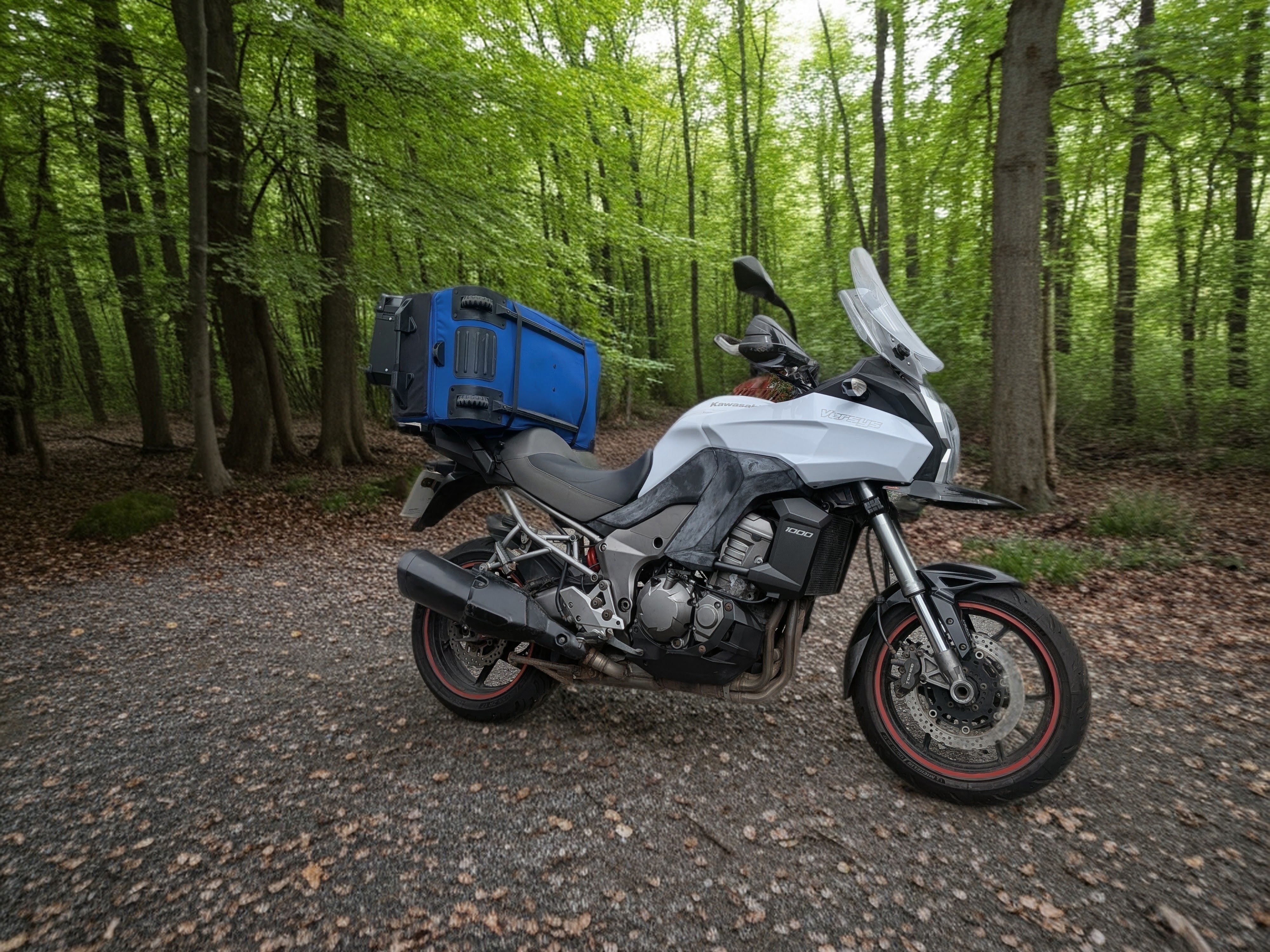
Is the 2026 Norton Atlas better than my current motorcycle, a 2012 Kawasaki Versys 1000?
It’s not as powerful or as comfortable, but, yes, I think it’s safe to say that a brand new Atlas, weighing less than 200 kg wet and packed with all the latest tech, is markedly better than my rusty 14-year-old bike. I wouldn’t buy one, but it’s definitely ‘better.’

Gear seen in photos
Helmet: HJC RPHA 60
Jacket: LS2 X-Master
Gloves: Richa Atlantic GTX
Pants: Aerostich AD-1
Boots: Sidi Taurus GTX
2026 Norton Atlas specs
| ENGINE | 585cc liquid-cooled parallel twin w/ 270-degree firing order |
| POWER | 69 bhp at 9000 rpm |
| TORQUE | 42.4 lb-ft at 7500 rpm |
| TRANSMISSION | Six-speed |
| SEAT HEIGHT | 845 mm |
| GROUND CLEARANCE | 220 mm |
| WEIGHT | 188 kg / 192 kg for Apex |
| FUEL CAPACITY | 15.4 liters |
| FRONT TIRE | 110/80-19 Eurogrip Explo R Plus |
| REAR TIRE | 150/70-17 Eurogrip Explo R Plus |
| FRONT BRAKES | Dual 310mm disc, ByBre calipers |
| REAR BRAKE | 270mm disc, ByBre caliper |
| FRONT SUSPENSION | Fully adjustable 43mm KYB fork with 180 mm of travel |
| REAR SUSPENSION | KYB rear monoshock with 180mm of travel, preload adjustable |
Make a one-time donation
Make a monthly donation
Make a yearly donation
Choose an amount
Or enter a custom amount
Your contribution is appreciated.
Your contribution is appreciated.
Your contribution is appreciated.



Leave a Reply