

It’s a journey of 285 miles from my house to the headquarters of MotoGB, the massive importer/distributor that supports a number of Chinese and Indian brands in the UK. Throw in a few additional miles for navigating to petrol stations and food stops, and you’re comfortably looking at a 600-mile roundtrip.
The only way for a journalist or influencer to get their hands on a bike from one of the many brands that MotoGB oversees is to travel all the way to the far reaches of Lancashire and pick it up in person.
The X-Master suit is sold as two separate pieces. Check pricing below:
That means that pretty much any time you read a review of a QJMotor or Voge or Hero or Morbidelli or Benelli motorcycle on Dancing the Polka, I will have ridden it for at least 600 motorway miles as part of my test.
(In fairness to the very good people at MotoGB, it isn’t the only organization that operates this way. More often than not, reviewing a bike means spending a lot of time getting to the bike.)

It also means that the gear I’ve worn to collect/return that bike is stuff I trust, stuff I feel I can rely on. Now take a look at the photo of me at the MotoGB HQ on a very rainy January morning, encountering the Hero XPulse 200 Pro for the first time (several months before it was released to the UK public).
I was there to pick up the QJMotor SVT650X. You will note that I am wearing the Richa Oberon waterproof boots that I reviewed not too long ago, and the LS2 X-Master jacket and pants. I feel that all of the context of the above photo tells you everything you need to know about the X-Master suit. Yes, it’s made in China and that’s not something I particularly love, but it is still kit that I would recommend. Read on to find out why.
LS2 X-Master suit detail
| PRICE | Jacket: £329.99 Pants: £239.99 (Note that you can actually find these items for less on sites like FC Moto) |
| MADE IN | China (No. 142 on the Democracy Index) |
| SAFETY RATING | JACKET: EN 17092 Class AA, with EN1621 Level 2 shoulder and elbow protection PANTS: EN 17092 Class AA, with EN1621 Level 2 knee protectors and EN1621 Level 1 hip protectors |
| SIZING | JACKET: S-5XL PANTS: S-5XL |
| WEIGHT (according to my bathroom scale) | JACKET: 2800 grams (with thermal and waterproof layers) PANTS: 2500 grams (with thermal and waterproof layers) |
A little background
You’ll probably know of LS2 because of its astonishingly affordable helmets. The company offers feature-rich, ECE 22.06-certified lids at a fraction of the cost as those from other brands. It’s only (relatively) recently that the company has expanded into clothing and luggage. I was unaware of its riding gear until spotting it at LS2’s stand at EICMA last autumn.
“Many people say that clothing is LS2’s best kept secret,” explains Dan Sagar, whose company, The Fabulous Biker Boys, helps to promote LS2 in the UK.
LS2 traces its history all the way back to 1990, when Arthur Liao started a helmet company in Heshan, China (I’m guessing Arthur isn’t his actual first name). His businesses went under a number of names but were always focused on helmets. LS2 as we know it now was founded in 2007.

Look, fit, and feel
Styling of the X-Master suit is derivative. If you’re not seeing Alpinestars designs when you look at the X-Master you aren’t actually looking. Feel free to discuss whether stealing another manufacturer’s aesthetic is a crime punishable by boycott. Maybe it’s the skinflint in me but I tend to be forgiving when one brand is ‘inspired’ by another, as long as the inspired product is actually good. In the case of the X-Master, it is.
I am 6 feet 1 inch tall; I have a 40-inch chest and 32-inch waist. When I gave these numbers to LS2’s UK distributor they sent over a size L jacket and size L pants.

The fit of the jacket is pretty much spot-on at the shoulders. The sleeves are comfortable but not too generous and although there’s a good bit of room in the lower part of the jacket (belly and hips), reliable adjusters at the hem mean that it fits properly. I do not have, for example, the same issue of air getting into the jacket that I did with the Weise Navigator jacket I reviewed back in January.
You might also want to read: Weise Navigator textile jacket review
Another issue that I had with the Navigator was that its neck was huge. No such problem with the LS2; strong Velcro straps allow a wide range of adjustment.
The X-Master makes use of the three-in-one system that seems to be popular among gear manufacturers at the moment. For example, Oxford, Richa, and Spada (and Weise) do something similar with a number of their products.
I’ll dive into this further in a moment, but the idea is that you have the shell – the bit with all the abrasion resistance and armour – a thermal layer, and a waterproof layer. With the X-Master, the waterproof layer can be worn either inside or outside the shell.

If you wear it on the inside you may find the fit pretty cosy – the thermal and waterproof layers leaving little space for anything more than a base layer. The fix for this is obvious and easy: don’t wear the waterproof layer on the inside.
Outside of that, the suit is forget-about-it comfortable. Which is to say, you can wear it all day, for multiple days, without ever really noticing it. You can’t always say that about protective gear. I’ll sing the praises of my Hideout Touring jacket all day, but I’ll admit, too, that after a full day of riding in it there is a little sense of relief when I get to take it off.
The 3-in-1 gimmick
Apart from aesthetics (and perhaps ease of accessing external pockets), there is no good reason to wear the X-Master’s waterproof layer on the inside of the suit. Manufacturers offering this alternative are selling you a gimmick that no one’s really asked for.
Because the waterproofs have to be big enough to fit on the outside of the shell layer, they are – as I say – too bulky to be worn inside it.

In addition, the effectiveness of the waterproof layer decreases dramatically when worn on the inside. Doing things this way means the external shell (which is not waterproof) will get saturated in wet weather, making it heavy and creating a cooling effect. Plus, none of the pockets are 100-percent waterproof, so your stuff will get wet.
In my experience, it takes the suit roughly 24 hours to fully dry after being completely saturated (eg, when I’ve washed it). If you were wearing it on a multi-day adventure, it would mean having to throw on a cold, wet suit each morning.
It’s better to simply think of the X-Master as a suit that comes with a free set of waterproofs. And in that sense, it’s probably wise to remember the old adage: “You get what you pay for.”
There are no adjusters on either the waterproof jacket or pants, meaning you don’t get as snug a fit as you’d like. The pants do not have an elastic waistband, and ride lower than waterproof pants should (usually, it’s best to have waterproof pants with a waistband that sits above your belly – old-man style). The jacket allows damp to creep in and up the belly of the shell layer; if you’ve accidentally stored receipts in the main zip pocket – which is not waterproof – they will be mush by the time you finish your roundtrip to/from Chorley, and your editor will refuse to reimburse your fuel expenses because you don’t have proof of how much you spent.
You might also like to read: How to ride in the rain

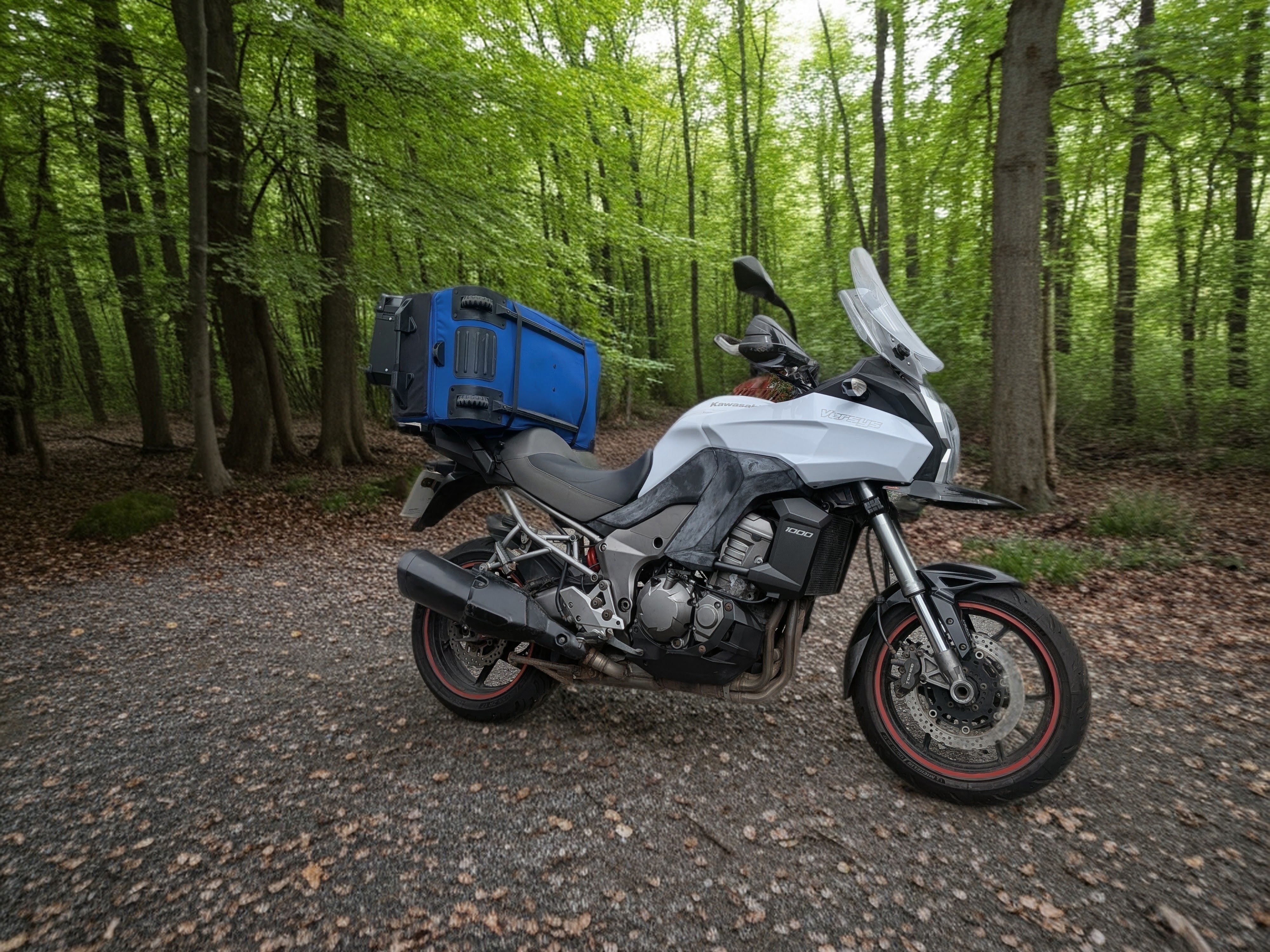
Additionally, there is almost no reflective material on the waterproof layer. In other words, the free waterproofs that come with the X-Master are good in a pinch (and light enough that I reckon they could be packed under the seat of my Kawasaki Versys 1000), but you’re better off buying some proper waterproofs (I recommend Scott Ergonomic Pro DP).
(SIDE NOTE: There is an argument for wearing waterproofs on the inside of a shell layer in winter. When temperatures drop to single digits, I often wear an old Dainese D-Crust waterproof jacket as one of my mid-layers. It’s lost some of its waterproof effectiveness but remains windproof, so it serves the same function as one of those ludicrously expensive KLIM Zephyr jackets – helping to trap in heat. When I do this, though, I also wear waterproofs on the outside of my shell layers, to ensure the wet stays as far away from my body as possible.)
28 ways to get wet
By my count, there are 12 zippers on the LS2 X-master jacket. Thirteen if you count the zipper for the removable map pocket. The X-Master pants have 11 zips. None of these zips are seam-sealed. Which means they are not waterproof.
And that means each of those zips – along with the bits that your head, waist, hands, and feet go through – represents a potential point of ingress for water. Even if you coated this thing with Gardian Spray-On Waterproofer it still wouldn’t be reliable in the rain on its own.

That’s not an issue for me – I almost always carry waterproofs – but it’s something to be alert to. As far as water is concerned, you should not think of the outer shell as being viable protection against anything more than a passing Super Soaker.
In that same spirit, I’d advise against putting too much faith in the suit’s handful of too-small waterproof pockets. These pockets have a ‘looks like it should be waterproof’ liner, with fold-over closure that is sealed by both Velcro and a snap. On the jacket, there is one over your breastbone, and one on each side. On the pants, there is one on each leg.
None of these pockets is really big enough to hold a Pixel 10 (15.2 cm x 7.2 cm) and their waterproofing leaves something to be desired. For the sake of experiment, I rode through a deluge employing the ‘waterproofs on the inside’ method and allowing the jacket to saturate. A receipt that I had in one of the pockets was still legible afterward, but definitely not dry.
If you are a spy tasked with carrying incredibly important documents, don’t put them in these pockets.

While I’m moaning about the waterproof pockets, their placement on the jacket is a little impractical. They look like the cargo pockets that are seemingly required on all adventure jackets, but they are located more or less over your obliques – on the sides of your torso.
Try touching your obliques right now. It’s kind of awkward isn’t it? Forcing you to do the funky chicken. Now imagine doing that in a motorcycle jacket. While wearing a helmet. Getting stuff in and out of the pockets isn’t easy.
In addition to the three ‘waterproof’ pockets, the X-Master jacket has a kangaroo pocket that zips on either side, a zipped pouch pocket, and the aforementioned removable map pocket (you can take it off and wear it on its own as a small hip pack). There is also a small pocket in the thermal liner.
In addition to all this, the jacket has a chest protector pocket (chest protector not included) that could theoretically be used as storage. It also has a pocket in the back – over your shoulder blades – to hold a water bladder.
The pants, meanwhile, have two “waterproof” pockets and two zippable hand pockets. Because the waterproof pockets are positioned in such a way that their fold-over flaps can catch the wind, I’m particularly unsure about putting important stuff in them.

The features I like most
Enough criticism. Remember when I said that this is kit I would recommend? Here’s some of the reasons why:
Firstly, I like the fact that you get a full zip to connect the jacket and pants. Interestingly, both the jacket and pants also have half zips, so you get to choose.
On the subject of zips, I’m particularly fond of the so-called “IDEAL” magnetic front zip that serves as the main closure of the jacket. Being magnetic means that the slider (the bit you pull) is able to find the stop and line up more easily. To the extent that you can almost zip up the jacket one-handed. I love this feature and want other manufacturers to start using it.
Another useful feature is small patches of Velcro that help keep cuffs and hems open.

There is a little flap of fabric on the cuffs of the jacket and hems of the pants that has Velcro and can be used to cinch those openings shut. Most jackets and pants have this feature or something similar. But with other brands’ gear it’s usually the case that if you have the flap open (as you might choose it to be at a coffee stop) it just sort of… uhm… flaps. And the Velcro ends up catching things.
The X-Master has a solution to that: Velcro to keep it open. It’s a solution that is utterly simple but one that shows this is a suit that was designed by someone who actually rides.
I’m also a fan of how light and flexible the Level 2 armour is – in the shoulders, elbows, back, and knee. The hip armour is Level 1. Ever since that infamous FortNine video about motorcycle body armour came out more than two years ago, I’ve found myself rethinking my relationship with armour. I still think it’s an incredibly good idea, but I find myself less willing to tolerate uncomfortable, race-spec armour.
I love the lighter, more flexible stuff that’s been coming out over the last few years. LS2 doesn’t have a clever marketing-manufactured name for the stuff it uses but I really like it.

Brilliant in the heat
Not too long ago, I did a feature for Visordown that saw me spending four days travelling up and down the UK amid a historic heatwave. High temperature records were broken, then surpassed the next day, then surpassed again the day after that. I wore my X-Master jacket (with Aerostich AD-1 pants because I was travelling very light and didn’t want to pack a pair of jeans; the AD-1 pants look a little more ‘normal’ when walking around off the bike) the whole time without complaint.
You might also like to read: Aerostich AD-1 riding pants review: Rugged and reliable gear
Many of those zippers I mentioned above are for opening a ridiculous number of vents. On the jacket, you get vents at the biceps and forearms, an enormous chest vent that’s about the size of an Agatha Christie novel, and an equally huge vent at the back.
The end result is ridiculously good airflow. Really. It’s almost as good as you’d get when wearing no jacket at all, but with the benefit of Level 2 armour and AA-rated abrasion resistance. The pants are equally airy, with huge vents at the calves and the thighs.
I wish I’d had this suit when I rode in India last year.

Verdict
If you’re a longtime reader of Dancing the Polka (Hello to both of you) you’ll know that I don’t love the idea of buying stuff that’s made in China. I think there are genuine questions to ask about the effect of allowing one country to be the world’s provider of everything.
But, it’s also a reality that unless you are buying expensive Aerostich stuff or bespoke gear from somewhere like Hideout Leather your riding gear was made in China or by a Chinese company operating out of Vietnam for tariff-avoidance purposes. So, I don’t love it but I acknowledge the reality of it.
And similar to my feelings about ZXMOTO, I find it’s a little more tolerable when the Made in China aspect isn’t hidden. I have clothing from Indian Motorcycle that is festooned with American flags but it’s all made in China. I really dislike when brands do that – trying to obfuscate the country of origin. LS2, on the other hand, is a Chinese company that makes gear in China and acknowledges that it’s a Chinese company that makes gear in China. Points for honesty, y’all.
Meanwhile, the gear is attractively designed, well-built, comfortable, functional, and affordable. Will it last as long as expensive Aerostich gear? No, probably not. But it costs so, so, so much less.
Increasingly, I’m of the mind that one of the greatest threats to motorcycling at the moment is the fact that it costs too damn much. It has become prohibitively expensive. The LS2 X-Master suit goes against that tide, offering a quality product at a good price. As such, I can’t help but recommend it.
The X-Master suit is sold as two separate pieces. Check pricing below:

Other gear worn in photos
Helmet: HJC RPHA 60
Helmet: Shoei Neotec 3
Gloves: Richa Atlantic GTX
Boots: Richa Oberon WP


Leave a Reply