
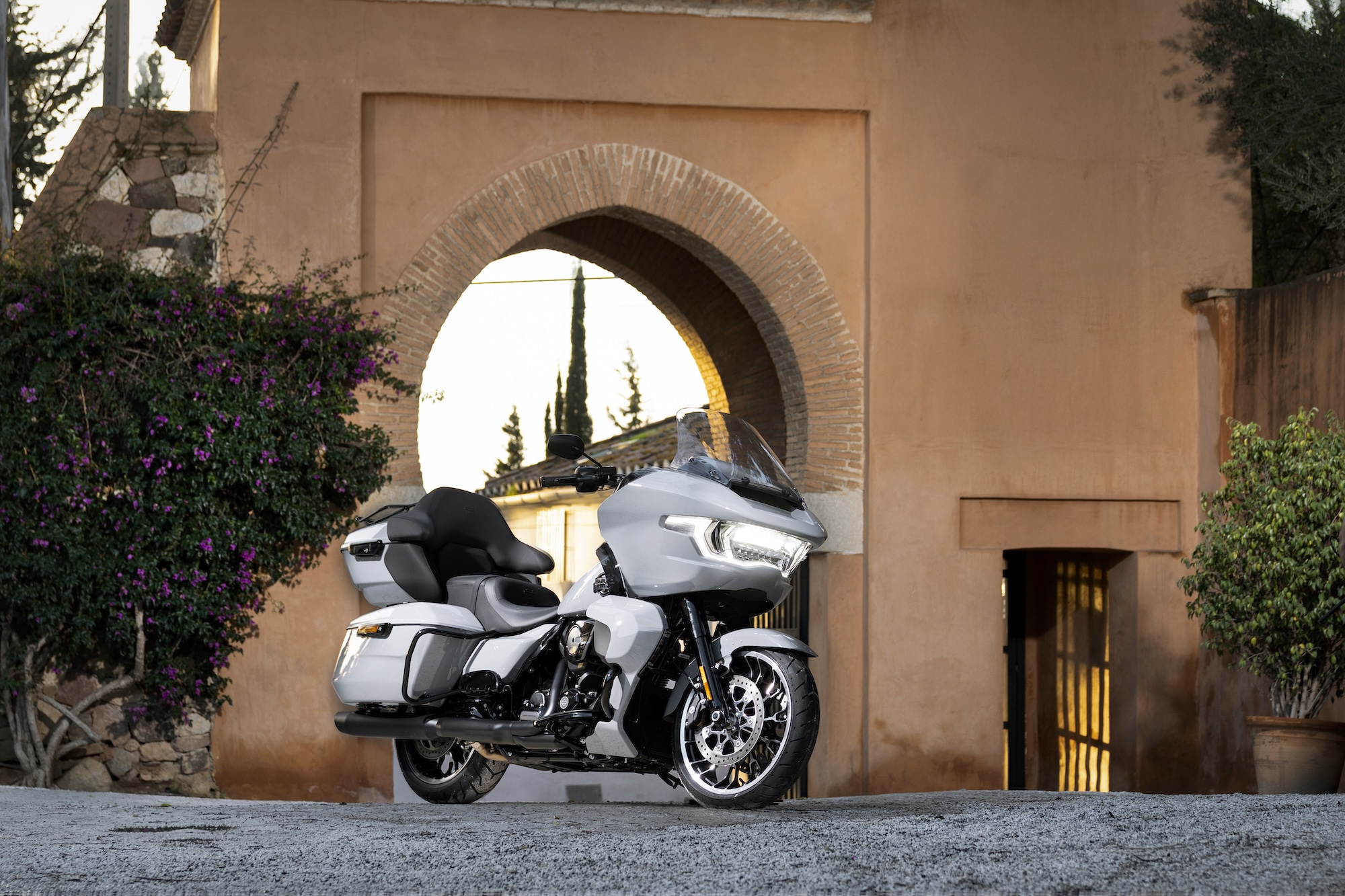
Not too long ago, in the conclusion of my review of the 2026 Harley-Davidson Street Glide Limited, I said that owning a big-twin touring motorcycle is a bit like owning a motorhome: “eye-wateringly expensive, cumbersome, and inappropriate for everyday use.”
If you aren’t 100-percent committed to the specific lifestyle of long-haul touring, it’s just a terrible, expensive idea. But if you are into it, there is almost nothing better. The same thing can be said about the 2026 Harley-Davidson Road Glide Limited.
That’s not surprising: the two bikes are very similar, sharing an engine, frame, components, and electronics. The only real difference is the front fairing – not just the fairing’s styling, but the way that it’s mounted.
Unbelievably, it makes a huge difference. And it’s why the Road Glide Limited is unquestionably the better bike.

Some background
Within the Church of Jesus Harley Latter-day Davidson, the statement that I made above about the Road Glide being “unquestionably better” than the Street Glide is contentious. This is Catholic vs. Protestant stuff and Harley faithful have been arguing about it since 1998, when the Road Glide was first introduced.
Actually, they’ve probably been arguing about it since 1979, when the Road Glide’s predecessor, the FLTC Tour Glide, first went into production. Both bikes feature(d) frame-mounted or ‘fixed’ fairing, whereas the fairing on the Street Glide is fork-mounted.
That means that when you turn the handlebars on a Road Glide, the fairing doesn’t move. Whereas if you move the handlebars on a Street Glide you’re also moving the fairing. We’ll get into why the Road Glide’s set-up is better in a moment.
Both the Road Glide and the Street Glide share the FL designation in Harley’s lettering code, which means they are touring models powered by a big-bore V-twin engine – in this case, the Milwaukee-Eight VVT 117 engine. The addition of “Limited” to the name means that this is a Road Glide with a top box and pretty much all the bells and whistles that Harley offers. It is the most premium version of a Road Glide that you can buy outside of the MoCo’s CVO program.

Engine and transmission
I used to be a copywriter at The Royal Mint. Every year, The Royal Mint issues a new Sovereign – the coin traditionally embedded into rings worn by chavs, Eastend gangsters, and British racists. And every year since 1817, that coin has featured a “St. George and the dragon” design by Italy-born artist Benedetto Pistrucci. Same coin, year after year, but with a different date on it.
Because reasons, The Royal Mint felt it was necessary to have copywriters churn out all-new materials for the Sovereign each year. This became one of the least-favorite jobs among the copywriting corps, because how the hell are you supposed to write anything new or different? Everything that can possibly be written or said about Pistrucci’s “iconic” design has already been written and said at least 200 times.
This is how I’m starting to feel about Harley-Davidson’s “iconic” Milwaukee-Eight platform. Engine capacities change. Riding modes and specific tuning (as found on the current Softail line-up) can tweak the experience, but on the whole this is the same big V-twin engine that I first experienced back in 2016 when the platform was first introduced.
I have experienced the Milwaukee-Eight on the 2017 Road Glide, 2017 Street Glide, 2017 Limited CVO, 2018 Sport Glide, 2018 Heritage Classic, 2018 Street Bob (a bike that I loved so much that not owning one sparked mental health issues), 2018 Fat Bob, 2018 Breakout, 2019 FXDR, 2020 Low Rider S, 2020 Sport Glide (which I rode to Britain’s furthest points north, south, east, and west), 2025 Street Bob, 2025 Low Rider ST, 2025 Street Glide Ultra, and, as mentioned, 2026 Street Glide Limited.

In every case, the Milwaukee-Eight V-twin platform was (and probably always will be) the best thing about the bike. It is a powerplant of soul and gravity. Perhaps literal gravity, considering its size.
The particular flavor of “M-8” powering the Road Glide Limited is the Milwaukee-Eight VVT 117: a 1923cc twin-cooled V-twin engine with variable-valve timing. It claims 106 bhp at 4600 rpm and 131 lb-ft of torque at 3500 rpm.
The variable-valve timing is the newest ‘new’ thing here, the first time it’s been offered on a non-CVO model. Harley says there’s a boost in performance but it’s not anything I was able to notice.
There is an occasional and very (very) slight low-speed surging that may be the result of VVT, but it may also be rear cylinder deactivation. I really only noticed it once the bike was hot.

Whatever the case, it’s as good here as it’s always been. If you’ve liked the Milwaukee-Eight engine elsewhere, you’ll like it here. If you don’t like the Milwaukee-Eight, check your pulse – you may be dead.
If you don’t like the Road Glide Limited’s six-speed transmission, however, I can see where you’re coming from. It’s a bit agricultural for a machine that is supposed to be the height of luxury. Not awful, but not slick. You will need a reasonable amount of grip strength to pull the clutch lever.
At the European press launch of Harley’s Limited models (which also included the Street Glide Limited and Pan America 1250 Limited) a clever Polish journalist (I apologize for forgetting his name) asked MoCo officials why they haven’t brought in some sort of DCT-like set-up for big touring bikes. The head honchos said their research shows that Harley riders don’t want it.
I doubt that’s true. It’s more likely that Harley riders don’t want to pay for it. These bikes already cost a hell of a lot.

Handling: Why the Road Glide is better
The Road Glide Limited is a heavy old thing – forged out of collapsed stars and old anvils. Harley-Davidson claims a “in running order” weight of 417 kg. I don’t know whether “in running order” means “with a full tank of fuel,” so potentially, you’re looking at a bike that weighs closer to 440 kg (based on the fact it has a 22.7-liter tank and one liter of petrol weighs roughly a kilogram) before you throw a leg over.
Add a passenger and stuff to fill the bike’s 144 liters of luggage space, and you’re balancing more than half a tonne of machine, man, and underpants. Within this context, the Road Glide Limited’s chassis performs brilliantly. On the move, the bike is notably more agile than lighter Softail models. I’d even go so far as to say it’s easier to wrangle than the Pan America 1250 Limited.
Assuming you don’t break the “flow.”

In my review of the Street Glide Limited, I mentioned that there is an art to riding big-twin touring bikes.
“The key to riding a massive motorcycle like this comes in developing and maintaining a flow, making sure that every action smoothly transitions into the next,” I wrote. “Point-and-shoot riding doesn’t work here; you want to achieve a zen through anticipation and preparation rather than reaction.”
All of that holds true here since the Road Glide and Street Glide platforms are so similar.

It is here, though, that the strength of the Road Glide platform – frame-mounted fairing – comes into play. Steering on the Road Glide Limited is easier because you’re not wrestling the weight of the fairing. The internet tells me that the Street Glide’s fairing weighs about 11 kg. That’s roughly the weight of my 1-year-old son (he’s a big lad). As much as I think he’d enjoy being strapped to the bars of a motorcycle (he’s also a wild lad) I’m pretty sure it wouldn’t aid in the bike’s steering. There is a reason you’ll never see race bikes with fork-mounted fairing.
All of this means that when you’re getting things right, the Road Glide Limited is an absolute joy to ride. It hustles through corners in a way that it absolutely has no right to. Zipping through too-tight corners in the mountains overlooking Malaga, I found myself thinking of that old Steve Jobs quote: “Do one thing well.”
Harley really does touring bikes well.
At least, as long as you stay in the flow. Go into a corner too hot, or do something else that forces you to jam the brakes and the whole very big show can become distressingly unsettled. You need to stay focused on a Harley.

Brakes
On the whole, Harley’s brakes are excellent, managing to rein in all that weight with relatively little effort. You won’t be doing any endos or stoppies on this thing but there’s more than enough whoa.
I am not a fan, however, of Harley’s Electronically Linked Brakes (ELB) set-up. It’s something I first noticed when spending time with the Street Glide Ultra last year. At speeds above roughly 27 mph, the system will attempt to “dynamically balance braking across both the front and rear wheels,” regardless of whether you are applying only one or both of the brakes. Below 27 mph, the brakes are not linked and thereby respond more directly to your input.
Where I’ve noticed it being awkward is in situations where I transition between those two states relatively quickly. For example, if I’m slowing down to head into a roundabout. Let’s say I’m approaching the roundabout at 60 mph. Maintaining a steady application of the brakes means that ELB will actually remain active below 27 mph – working until the bike comes to a stop or I stop applying the brakes.
But let up just once and the system cuts out, and suddenly the feel of the brakes changes because it’s no longer being guided by an electronic hand. The end result is that controlled but rapid braking from high to low speed feels unsteady.

Bells and whistles (and bells)
Harley has gone all-in on extensive (but arguably minor) improvements to the Road Glide Limited platform. The company’s media release offers up more than 1,700 words on the topic of “new” features and technowhizzbangery. Reading through them is tedious. When I asked AI to summarize it appears to have gotten exhausted, too, offering up only: “Harley has redesigned the fairing and added a 4-inch taller windshield.”
It’s also reduced weight by roughly 6 kg from the previous Road Glide Limited, offered new styling, installed new heated grips and heated seats, restyled the luggage, and upgraded the bike’s Skyline OS.
At an Indian Motorcycle Riders Group meeting in Colorado last week, Indian Motorcycle CEO Mike Kennedy acknowledged that the company’s RideCommand system was glitchy and promised to fix it. That must have warmed the hearts of folks at Harley-Davidson, as their infotainment and navigation system is pretty much flawless.

It takes a hell of a long time to boot up, but it works well. It doesn’t accommodate Android Auto yet in the way it integrates with Apple CarPlay, but I had no trouble connecting my Android to the Road Glide Limited to play music through its blaring Rockford-Fosgate speakers.
One of the highlights of my year so far has been rolling through Malaga blaring Van Halen’s “Running with the Devil.”
Competition
The biggest competition to the Road Glide Limited comes from inside Harley-Davidson’s house: the Street Glide Limited if you like more awkward steering, or a standard Road Glide bagger if you’re happy to live without a top box.
Outside of that, you’ve got the usual ‘big tourer’ suspects. To my knowledge, the gargantuan Souo S2000 is still not available in Western markets.
| SPECS | PRICE | |
| Indian Roadmaster PowerPlus Dark Horse | • 1834cc liquid-cooled PowerPlus V-twin • 120 bhp • 133.8 lb-ft torque • 672mm seat height • 423 kg wet weight • 22.7 liters of fuel | £30,755 |
| BMW K 1600 Grand America | • 1649cc liquid-cooled inline six • 158 bhp • 132.7 lb-ft torque • 750mm seat height • 367kg wet weight • 26.5 liters fuel | £25,825 |
| Honda Gold Wing Tour | • 1833cc liquid-cooled flat six • 125 bhp • 125 lb-ft torque • 745mm seat height • 393kg wet weight • 21 liters of fuel | £33,499 |
| Harley-Davidson Street Glide Ultra | • 1923 twin-cooled V-twin • 107 bhp • 129 lb-ft • 725mm seat • 393 kg • 22.7 liters | £28,495 |
| Harley-Davidson Road Glide | • 1923 twin-cooled V-twin • 106 bhp • 131 lb-ft • 720mm seat • 380 kg • 22.7 liters | £27,745 |
Verdict
When people learn that I am a moto-journalist, one of the most common questions they ask is: “What’s the best bike you’ve ridden?”
I usually tell them that that is a difficult question to answer because it really depends on the conditions. For example, when I spent a day riding the Zero XE recently, it was genuinely the best bike I have ever ridden in those conditions: narrow, dusty trails meandering through a private forest. On a motorway I would have hated every second of it.

So, I usually choose to answer the question this way: if God peered down from the heavens and told me that I could have any motorcycle I wanted but that it would be the only motorcycle I could ever ride for the rest of my life, my very easy answer would be the Harley-Davidson Road Glide.
So it goes without saying that I f’cking loved the Road Glide Limited. It’s the platform that I like with all the bells and whistles, and a top box. I personally would be happy to live without the weight and aerodynamic drag of the Limited’s top box but to each their own.
Having said that, the caveat that I gave at the beginning of this article still applies. The more agile nature of a Road Glide Limited means that it is a little easier to use as a “stylin’ and profilin’” machine – something you can ride to the local biker cafe or down to the seaside for ice cream – but for the most part it is a lifestyle choice.
Harley-Davidson does long-haul highway touring bikes really, really well. Better than anyone else. But if that’s not the kind of riding you want to commit yourself to you should save some money and buy a Low Rider ST instead.

The three questions
Does the 2026 Harley-Davidson Road Glide Limited suit my current lifestyle?
Not so much. I wish it did. In the back of my head I daydream of taking my daughter on a big American road trip when she’s 13 or 14: old enough to sit on the back of a bike but still just young enough to want to hang out with her father. This is the kind of bike that I daydream about taking on such an adventure.
At present, however, she is 2 and a half years old. Her brother is just 1-year-old. Big-miles trips aren’t really my thing these days.
Did the 2026 Harley-Davidson Road Glide Limited put a smile on my face?
Yes. As I say, riding it has been one of the highlights of my motorcycling year.
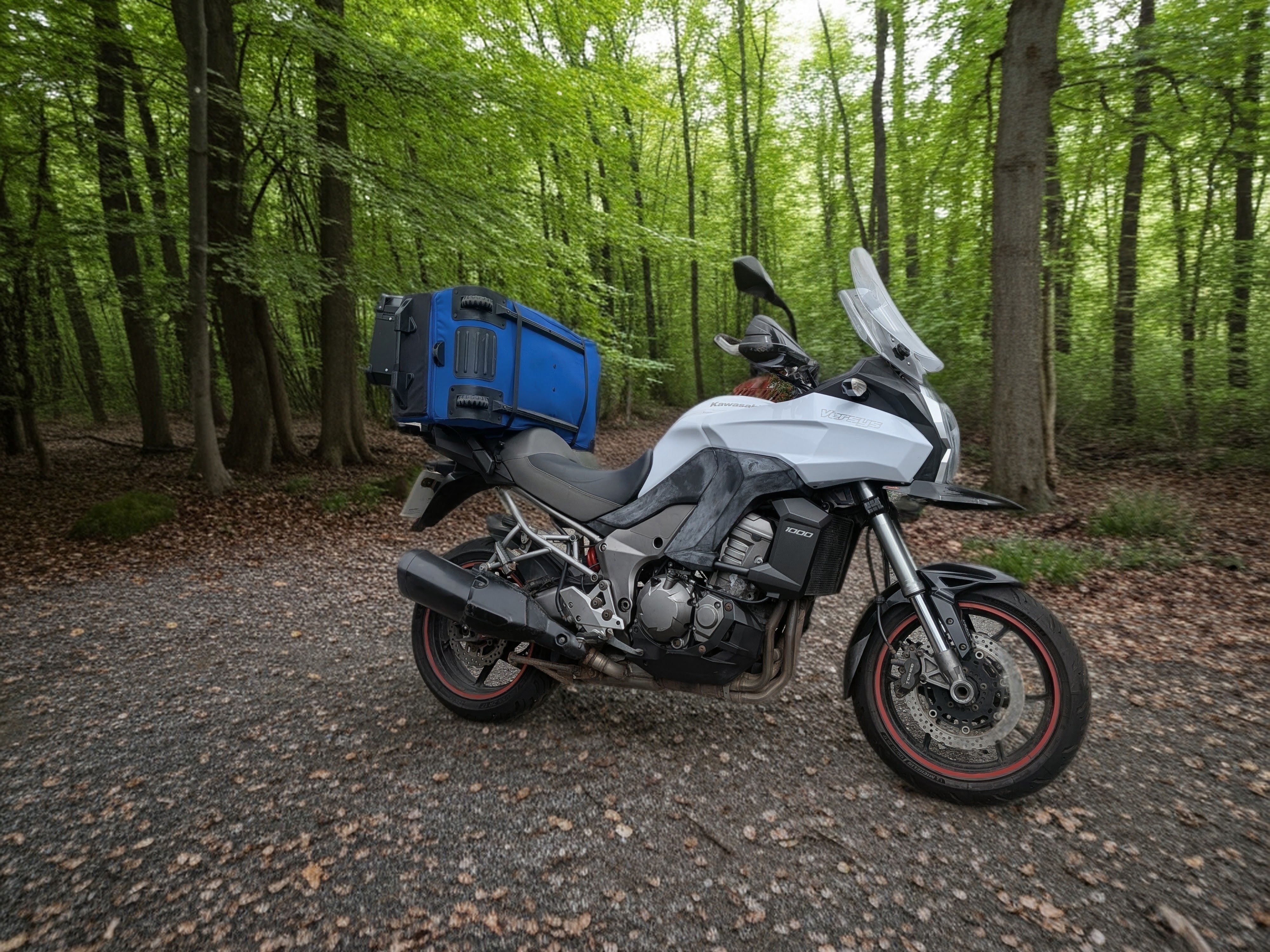
Is the 2026 Harley-Davidson Road Glide Limited better than my current motorcycle, a 2012 Kawasaki Versys 1000?
Yup. My rusty, 14-year-old adventure tourer with 40,000 miles on the clock is only better in the sense that I’d be less upset to see it attached to a trebuchet and flung into the sea.

Gear seen in photos
Helmet: Shoei Neotec 3
Jacket: 55 Collection Hard
Waterproofs: Scott Ergonomic Pro DP
Gloves: Richa Atlantic GTX
Jeans: Pando Moto Boss 105
Shoes: Spada Strider S

2026 Harley-Davidson Road Glide Limited specs
| PRICE | £29,995 |
| ENGINE | 1923cc twin-cooled Milwaukee-Eight VVT 117 V-twin |
| TRANSMISSION | Six speed |
| POWER | 106 bhp at 4600 rpm |
| TORQUE | 131 lb-ft at 3500 rpm |
| TOP SPEED | n/a |
| SEAT HEIGHT | 740 mm |
| GROUND CLEARANCE | 150 mm |
| WEIGHT | 417 kg |
| FUEL CAPACITY | 22.7 liters |
| FRONT TIRE | 130/60B19 M/C 61H |
| REAR TIRE | 180/55B18 M/C 80H |
| FRONT BRAKES | Dual disc, four-pistons calipers |
| REAR BRAKE | Single disc, |
| FRONT SUSPENSION | 49mm dual bending valve forks |
| REAR SUSPENSION | 76.2mm dual adjustable emulsions suspension with remote preload adjustment on the left shock, and threaded preload on the right shock |

Leave a Reply