

The Spada Vanguard adventure suit is markedly better than I was expecting. But I’ll admit that’s not quite the glowing praise that it might initially seem. Having never before encountered Spada gear, my expectations were quite low.
It was the Dash jacket and trousers that put me off. Those two items are urban wear, combining to look almost exactly like the sort of ‘stolen from JD Sports’ tracksuit favored by a subsection of British society that rides around major cities on maxi-scooters – sometimes delivering curry, but just as often stealing phones and motorcycles.
Safety for chavs is, admittedly, the logical conclusion of my feeling that the motorcycle industry needs to put more effort into welcoming riders from across the socio-economic spectrum. But still: no likey.
Anyhoo, that not-so-egalitarian thinking clouded my perception of the Vanguard jacket and pants when they were first offered to me back in March. I agreed to test them because, hey, free stuff is free stuff, but I wasn’t expecting great things.
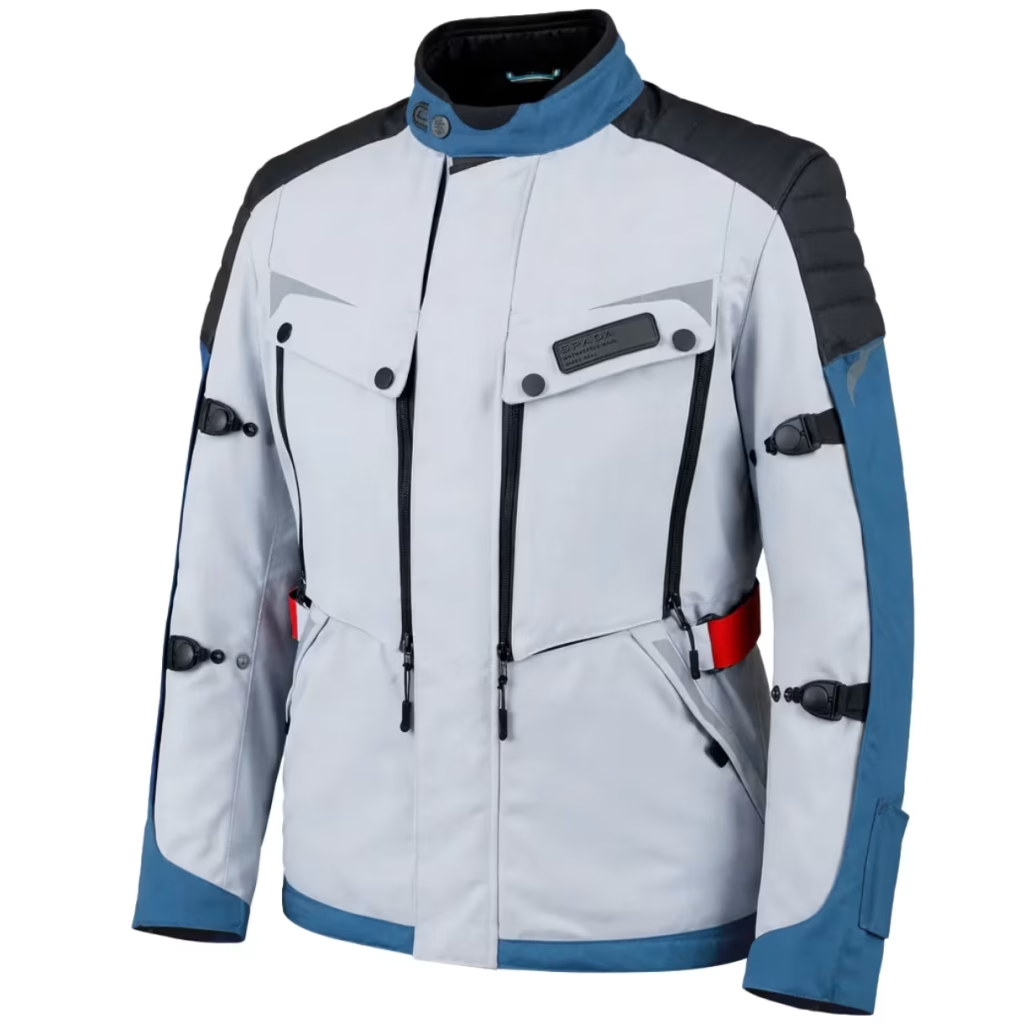
Almost six months on – and having ridden the suit in the dirt of West Sussex, mud of Lancashire, and dust of Spain’s Tabernas Desert – I find myself pleasantly surprised. This kit is comfortable, functional, and looks great.
It’s also heavy, and suffers here and there from design decisions that appear to be style over substance.
Nothing is perfect, though. The question is: is this gear worth its very reasonable asking price? Read on, friends…

Spada Vanguard specs
| MADE IN | Pakistan (Ranked 139 in the Economist Democracy Index) |
| JACKET PRICE | £289.99 |
| JACKET SIZING | S-5XL (UK 40-54 / EU 50-64) |
| JACKET WEIGHT | 3.5 kg* (with waterproof thermal layer)* Size M jacket |
| JACKET SAFETY RATING | EN 17092 Class AAEN1621 Level 2 back, shoulder, elbow protection |
| PANTS PRICE | £229.99 |
| PANTS SIZING | S – 5X (UK 30-44 / EU 50-64)Regular and short leg options available; regular leg is 34 inches, short leg is 32 inches |
| PANTS WEIGHT | 2.7* kg (with waterproof thermal layer)* Size M pants |
| PANTS SAFETY RATING | EN 17092 Class AAEN1621 Level 2 hip and knee protectors |
A little background
Contrary to what you might guess, Spada is a British company, based in the West Midlands. The founder chose the name, which means “sword” in Italian, because it sounded cool. Or, at least, that’s what I suspect. Spada’s official reasoning is that: “The movement of a blade slicing through the air is synonymous with the freedom of hitting the open road.”
Is it?
Has anyone on either side of that statement ever made such a connection? I mean, when a LARPer shows up at a gathering and starts twizzling his or her broadsword about do they think: “This is very much like riding a Harley-Davidson through Nevada.”
Spada was founded in 1994. That’s the year I first got my license. Yet, I’d never heard of the company until recently. Perhaps that’s down to the fact that about four years ago, founder Tony Taylor handed the reins over to his daughter, Anna. It’s really only since then that the brand has been on an upward trajectory. In 2024, the company brought in Production Development and Design Manager James Kent, who had previously worked for Fat Face, Jack Wills, Superdry, and Ruroc.
The Vanguard, Spada’s people tell me, represents a big step forward for the brand – in terms of what it offers and what it can offer. It was first revealed at last year’s MCL (the annual Birmingham-based event formerly known as Motorcycle Live, formerly known as the International Motorcycle and Scooter Show) and it finally started showing up in shops in late March.

Heavy and handsome: Look, fit, and feel
You’ll note that I link to Sportsbikeshop in this article. That’s because I have an affiliate account with them. Wherever you choose to order the Spada suit from, however, I would suggest that you make sure that, like Sportsbikeshop, they offer free delivery. The jacket and pants are sold separately, but collectively they weigh 6.2 kilograms. That’s 13.6 lbs in old money – about the weight of a female raccoon – and costs a lot to ship.
When you heave the Vanguard out of its box, the first thing you’ll notice is that it is soft. The material of the shell layer doesn’t have the robust, slightly stiff feel that you expect from motorcycle jackets. It feels like a decade-old jacket that’s already been washed many times over.
Spada says the Vanguard is “constructed from the lightest nylon fabric we could source that still offers excellent tear and abrasion resistance.” Note the phrasing of that statement: Spada is not claiming to use the lightest fabric, just the lightest fabric it could source. I also half suspect that some of the garment’s AA safety rating comes from the very thick mesh liner of the shell layer.
Spada says that “the Vanguard skips lamination – allowing the fabric to breathe naturally.”

I call shenanigans on this. The reason Spada, or any other brand, for that matter, offers a garment that “skips” waterproofing lamination is because it is expensive. A brand like Spada has to make a calculation in everything it does: what it can give the customer vs. what the customer will pay for.
So, instead of creating a laminated jacket that Spada’s traditional customer base would not buy, it has adopted a layering system similar to the one used in the LS2 X-Master suit that I reviewed earlier this month.
YOU MIGHT BE INTERESTED IN:
LS2-X-Master suit review: Brilliant budget touring gear
But whereas the X-Master employs a three-layer system – shell, waterproof layer, and thermal layer – the Vanguard offers only two: the outer shell and a removable waterproof thermal layer.
Throw on the jacket, and it is very comfortable, once again feeling like an old, worn, favorite jacket. The armor at the back, shoulder, elbow, hip, and knee is all pliable and soft, making it comfortable enough to wear all day.
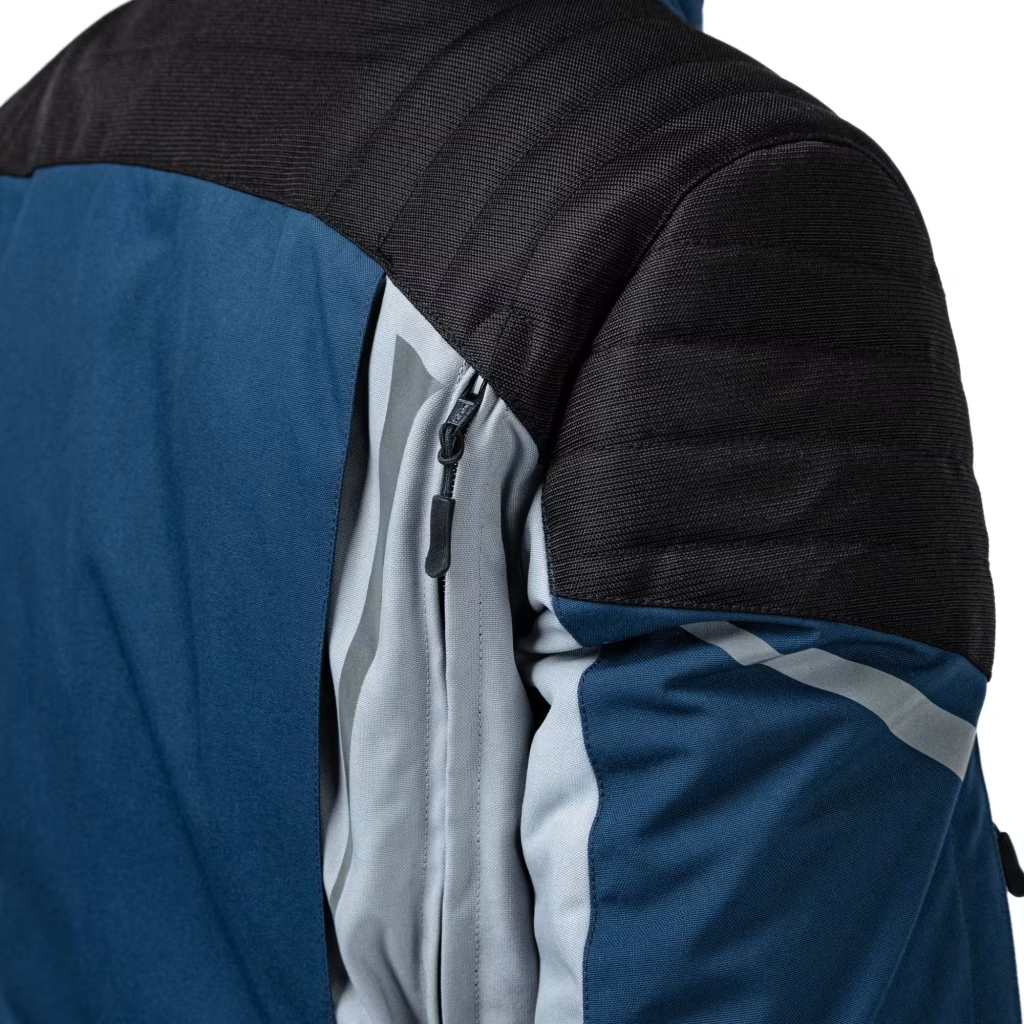
The Vanguard is available in four color schemes: Stealth Black, Desert Sand, Forest Green, and Racing Grey. My suit is in the latter scheme. Red, blue, and black highlights give the whole thing a distinctly Bavarian feel; I look like all the riders in BMW’s press materials. That’s not a criticism. I really like the look of it.
The only drawback of that colorway, I’ve learned, is that you will need to stock up on Nikwax Tech Wash (technically that’s for waterproof garments but it works really well for any textile riding gear). The light grey of the suit highlights every bit of mud or grime that you encounter.
The styling is very Adventure. Brands like Richa are offering some great new takes on the adventure suit, which are sleeker and more stylish (I am a huge fan of the Richa Orion jacket, for example), but there’s still a rugged charm in the more traditional ‘I’ve Got All The Pockets” styling. On an adventure bike it looks the part; on a more pure touring bike it might feel a little silly.

I also like the fit. I am 6 feet 1 inch tall and lanky. It is hard to find gear that fits me properly. Multiple adjustment points mean that the Vanguard offers one of the best fits I’ve encountered with an off-the-rack product. It’s still a little baggy in some spots, but I’d prefer that over it being too short.
Related to that, the pants are available in two leg lengths: regular or short. Regular leg length is 34 inches; Short is 32 inches. The jacket, meanwhile, has adjustment at the waist and the hem, meaning it doesn’t billow out and let air in, as was my main complaint of the Weise Navigator jacket I tested last year.
WANT TO LEARN MORE?
Weise Navigator affordable laminated jacket review
Fit is also helped by the presence of a three-quarter zip to connect the jacket and pants.
The removable waterproof thermal liner is particularly comfortable. One aspect I like about it is that it is effectively a fleece-lined windbreaker tracksuit, rather than a traditional liner. You don’t have fiddly connectors at the end of sleeves and legs. So, in practice it means that you can pull off the shell layer at a coffee stop without having to take off and lose the warmth of the thermal layer.
If you’ve ever shivered through a cup of tea in a poorly heated cafe (which, in the United Kingdom is ALL the cafes), you will appreciate this aspect of the Vanguard.
One potential drawback to the Vanguard’s liner layer is that it is both a thermal layer and a (nominally) waterproof layer. Not either or, as with the LS2 X-Master (eg, you can’t wear just the thermal layer or just the waterproof layer). Also unlike the X-Master, the liner is not intended to be worn outside of the shell layer.

This is not a waterproof suit
I’ve noticed that some sellers will describe the Vanguard as waterproof. Spada makes no such claims on its website nor in any of the materials I’ve seen. Good on Spada for being honest. The thermal layer does have a 10K waterproofing rating, but when you dig into what that means it is a rating given to garments that offer “some resistance” and can really only be trusted to hold up for a short while in light rain.
This not-really-waterproof layer is worn beneath a thick, heavy, not-at-all-waterproof shell layer that will become very heavy (and cold) if saturated. In addition, because of all the ventilation, the Vanguard has a whole lot of zips, each one representing a potential point of water ingress.
On the jacket, I count 13 zips that are not waterproof. On the pants, I count eight, plus two pockets that are closed simply by popper fasteners. So, even if the lightest nylon fabric that Spada could source were laminated, the jacket would be undermined by other aspects of its design.
It is best to think of the Vanguard’s liner as a lovely windproof thermal layer, which in cold and wet weather should be paired with a good set of waterproofs. I personally recommend the Scott Ergonomic Pro DP jacket and pants but I know that Richa and Dainese also make really good waterproofs.
A final note: I have washed this suit a few times, so I know that if it is saturated it will take up to 30 hours to dry completely.

Ventilation
The Vanguard has the makings of a good hot-weather suit. The jacket has two massive chest panels, and zip-open vents in the biceps, forearms, and shoulder blades. The pants have large panels at the thighs, and zip-open vents at the calves.
In application, however, these are not as good as you’d like them to be. The mesh used in the panels is the same thick fabric used in the lining of the shell jacket. And for some reason there appears to be three layers of it on the large vents at the chest and thighs.
As a result, airflow isn’t really what you’d like it to be. Or, at least, it’s not as good as the airflow one gets from the vents in the LS2 X-Master jacket.
When I was planning my Wick to Wick ride across the UK I was initially planning on wearing the Vanguard because it is just that tiny bit more comfortable and better-looking than the X-Master, but with the threat of another heatwave looming I decided against it for fear of the Vanguard’s ventilation not being up to snuff (The thought of wearing such a heavy suit in the heat also made it less appealing).
Adjustability: The good, the bad, and the flappy
I mentioned above that the Vanguard has a good amount of adjustability. Not all of that adjustability is good, however.
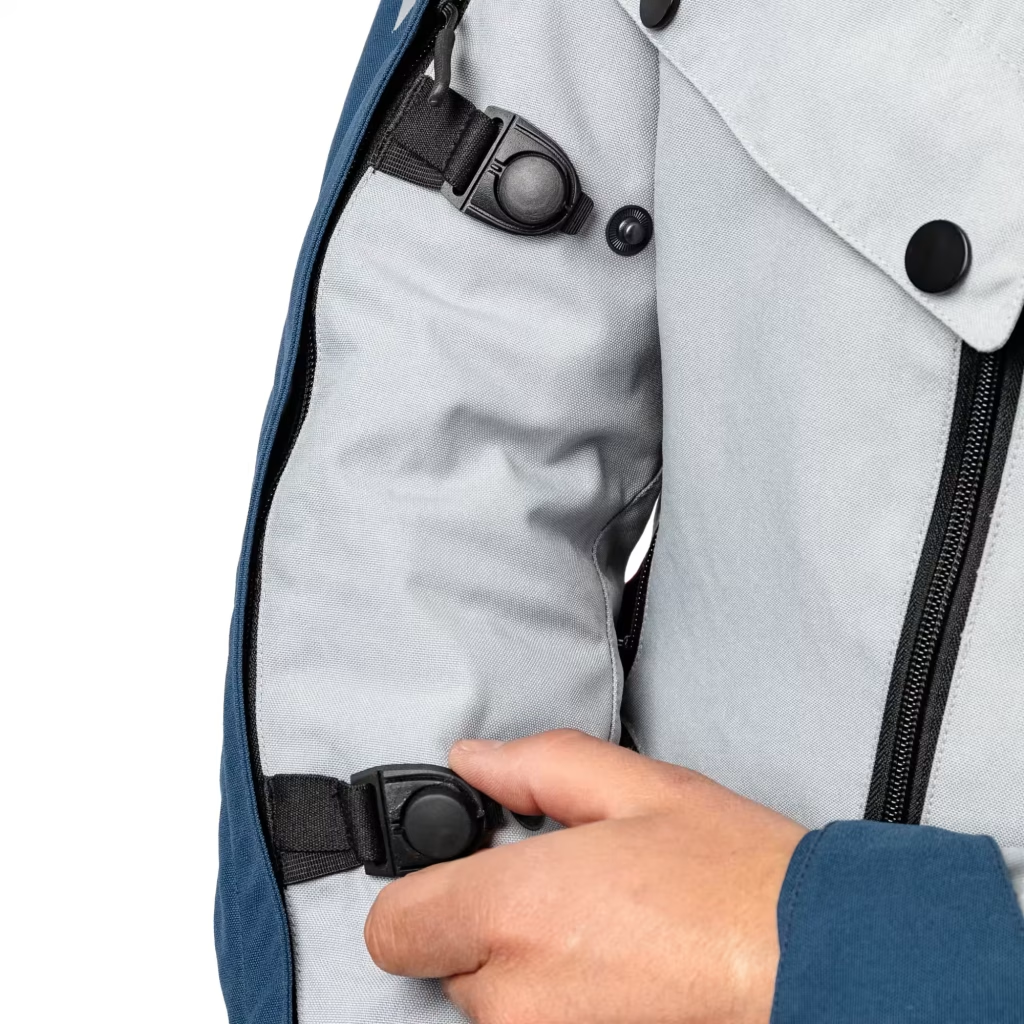
In the jacket, you have a sliding popper closure at the neck, two popper-fastened adjustment straps on each arm (roughly at the bicep and forearms), Velcro adjustment straps at the waist, zipper and Velcro adjustment straps at the cuff, and elastic pull cord adjustment at the hem. On the pants, you’ve got Velcro adjustment straps at the waist, and zipper and Velcro adjustment straps at the hem.
(NOTE: Velcro is a trademarked hook and loop fastener product. I don’t know if Spada actually uses Velcro or just something like it. I’m using the name because that’s what everyone calls it)
The closure at the neck is very similar to the one used on the Weise Navigator, and exactly as with that jacket, it is useless. The slider moves too freely, which means that no matter where you want it to be, it soon defaults to the largest, most-open position.

Meanwhile, the popper buttons for the jacket’s arm adjustment straps are not robust enough. Wind at speeds above 40 mph will pull them open, leaving the strap and the bulky plastic housing for the ‘female’ part of the popper flapping about in the wind. The straps are so frustratingly ineffective that I am very close to just cutting them off.
The Velcro adjusters at the waist of the jacket and pants, meanwhile, are good and hold well. I like the presence of the elastic pull cord, though I do wonder how long it will hold up.
One thing I like about the leg of the pants is that it zips wide but there is cloth all the way around the leg. Usually, a zipper connects two pieces of cloth, here it simply brings two sections of the same cloth together. This means that you can wear the pants over some pretty chunky boots. The drawback to this system is that you do not have an opening wide enough that you could pull the pants on while wearing boots.
There is a similar zipper set-up at the top end of the pants. The fly simply brings together two sections of the same cloth. This is bad design. It means that when you unzip the fly you can’t do the thing that a fly is partially there to do, ie, provide access to your junk. This makes it difficult to pee while standing up, unless you’re one of those very weird guys (every school had at least one boy like this) who is happy to stand at a urinal with his pants around his ankles.

A tale of useless pockets
The Vanguard jacket has 12 pockets. The pants have six pockets. However, only a third of those pockets are particularly useful. Whereas another third are, in my opinion, useless or very close to it.
Let’s start with the good. The handwarmer pockets offer a two-in-one system. Pull back the (too small) Velcro closure and your hand is presented with a lovely, fleece-lined handwarmer pocket. Not enough manufacturers give consideration to the experience of standing around at a ferry terminal or roadside cafe with no good, warm place to put one’s hands.
Within these handwarmer pockets you will find a waterproof zipper (the only waterproof zippers on the jacket or pants), which access a decent-sized waterproof pocket. Or, let’s say water-resistant; I wouldn’t put a tremendous amount of faith in the pocket in and of itself. At any rate, it is large enough to hold a wallet, a glasses case, or a phone (not all at the same time).
There are equally decent-sized waterproof pockets on each leg of the pants. Here, though, the closure is a little less confidence-inspiring. The top of the pocket folds over and is secured by a strip of Velcro that runs the length of the pocket.

I’m relatively confident the Velcro is robust enough to stay closed at high speeds but not completely confident. In addition, I can imagine how water would be able to work its way in. So, I wouldn’t put anything particularly valuable in there.
The zipped hip pockets of the pants are, of course, more secure but they are not waterproof.
Moving back to the jacket, the map pocket is also, unfortunately, not waterproof. It is large and features both a zipper and a fold-over Velcro closure. It’s reasonably sized – large enough to stuff one of those Klim Zephyr windshirts into. Or a few of those Real Turmat freeze-dried meals (I genuinely like those things).
You could probably (just barely) stuff a Real Turmat packet into each of the jacket’s internal pockets, as well. And that’s arguably the best sort of thing to go there. The Velcro closure doesn’t run the length of the pocket, so I wouldn’t trust it to hold a wallet, passport, phone, keys, or any other ‘life really sucks if you lose this’ item.
The front of the jacket closes via a zipper and a fold-over section of fabric that is secured by three strips of Velcro. Hidden underneath that section of fabric is a Napoleon pocket large enough to hold a passport and secured by a zip, but it is not waterproof.
Moving on to the less-useful pockets:
On each side of the jacket, just below the collarbone, there is a smallish pocket, roughly large enough to hold a beer mat. The pocket is secured by a zip but it is not waterproof and is very awkwardly placed. For the most part, I choose to treat it as an additional vent.
Equally unhelpful are the two back pockets on the pants. They are too small to hold a wallet, not waterproof, and are secured only by a single popper – so even if you could think of something to put in them, it wouldn’t be particularly safe.

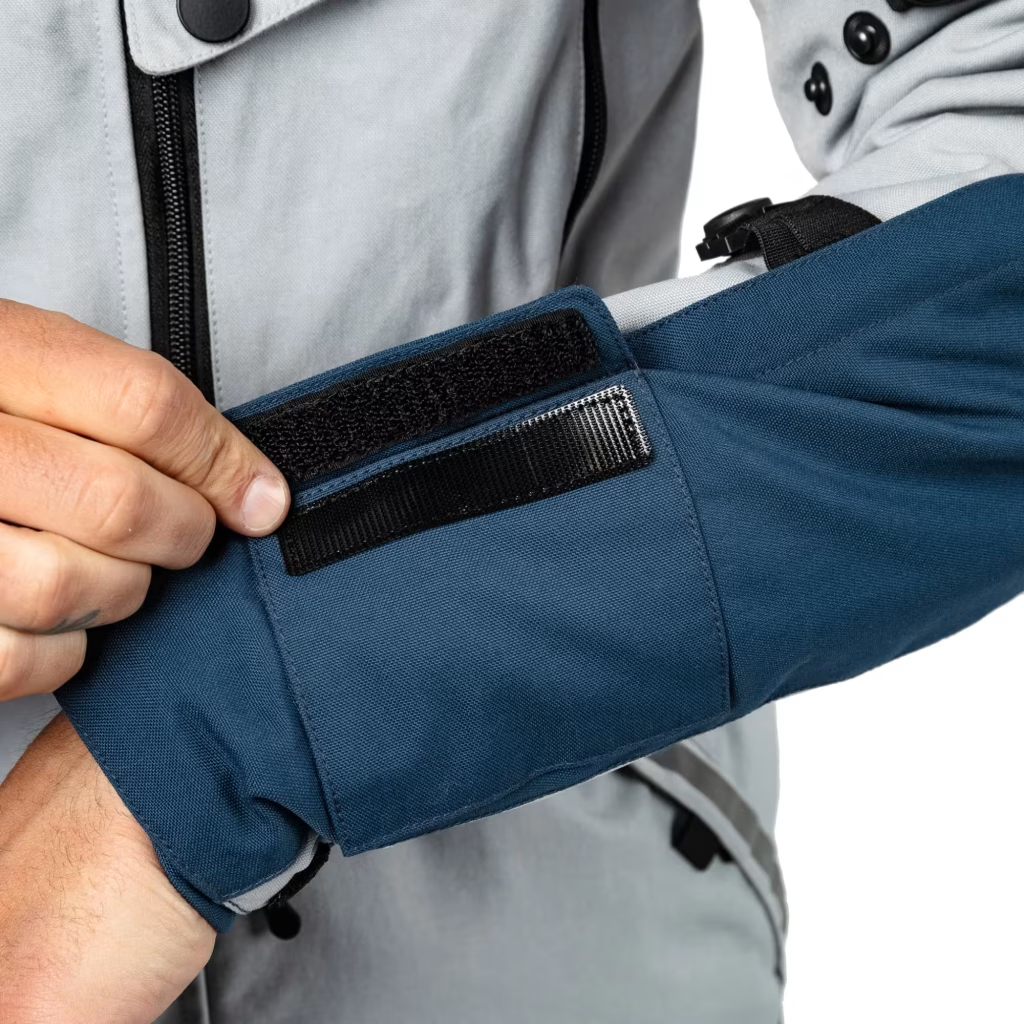
Taking the prize for Most Questionable Pockets, however, are those on each sleeve of the jacket. Located near the cuff, they are very small with a fold-over Velcro closure. They are not waterproof.
I spent a long time thinking that they were completely useless until – in the process of trying to find something give a sense of scale – I discovered that they are each just the right size for holding a single credit card.
So, if you trust the Velcro (and I’m not totally sure I do), these pockets could house a credit or debit card that you could use for paying tolls. Just tap your sleeve against the contactless card reader instead of having to deglove and dig into pockets with an impatient driver breathing down your neck. Potentially a very useful feature.

Verdict
There’s a lot to like about the Spada Vanguard suit. And I’m sure many of my criticisms could be seen as little more than a matter of personal taste.
Certainly it’s true that the Vanguard is comfortable, stylish, and – most importantly – affordable. Only £520 for the full suit. Of course, you will also need to factor in the cost of a good set of waterproofs and a good textile cleaner if you get it in a color scheme other than Stealth Black.
The main issue for me, though, is the fact that there are so many other options available. If you were to ask me if I recommend the Spada Vanguard suit, my most honest answer would be: I don’t not recommend it. But I can’t entirely see why you wouldn’t choose an LS2 X-Master instead, or pay that tiny bit extra for an Oxford Mondial 2.0 jacket and pants combo, which has laminate waterproofing.
All that said, I suspect I’ll be holding on to my Vanguard suit for quite a while. Paired with a good set of waterproofs, its bulkiness, windproof thermal layer, and general feeling of worn-in comfiness will make it a good choice for the long, dark months of British winter. And I suppose that makes sense; the Vanguard was made in Pakistan but designed in Britain. Perhaps its designers knew what they were doing after all.

Other gear seen in photos
Helmet: HJC RPHA 60
Gloves: Richa Atlantic GTX
Gloves: Aerostich Elkskin Competition Roper
Boots: Sidi Taurus GTX
Make a one-time donation
Make a monthly donation
Make a yearly donation
Choose an amount
Or enter a custom amount
Your contribution is appreciated.
Your contribution is appreciated.
Your contribution is appreciated.



Leave a Reply