
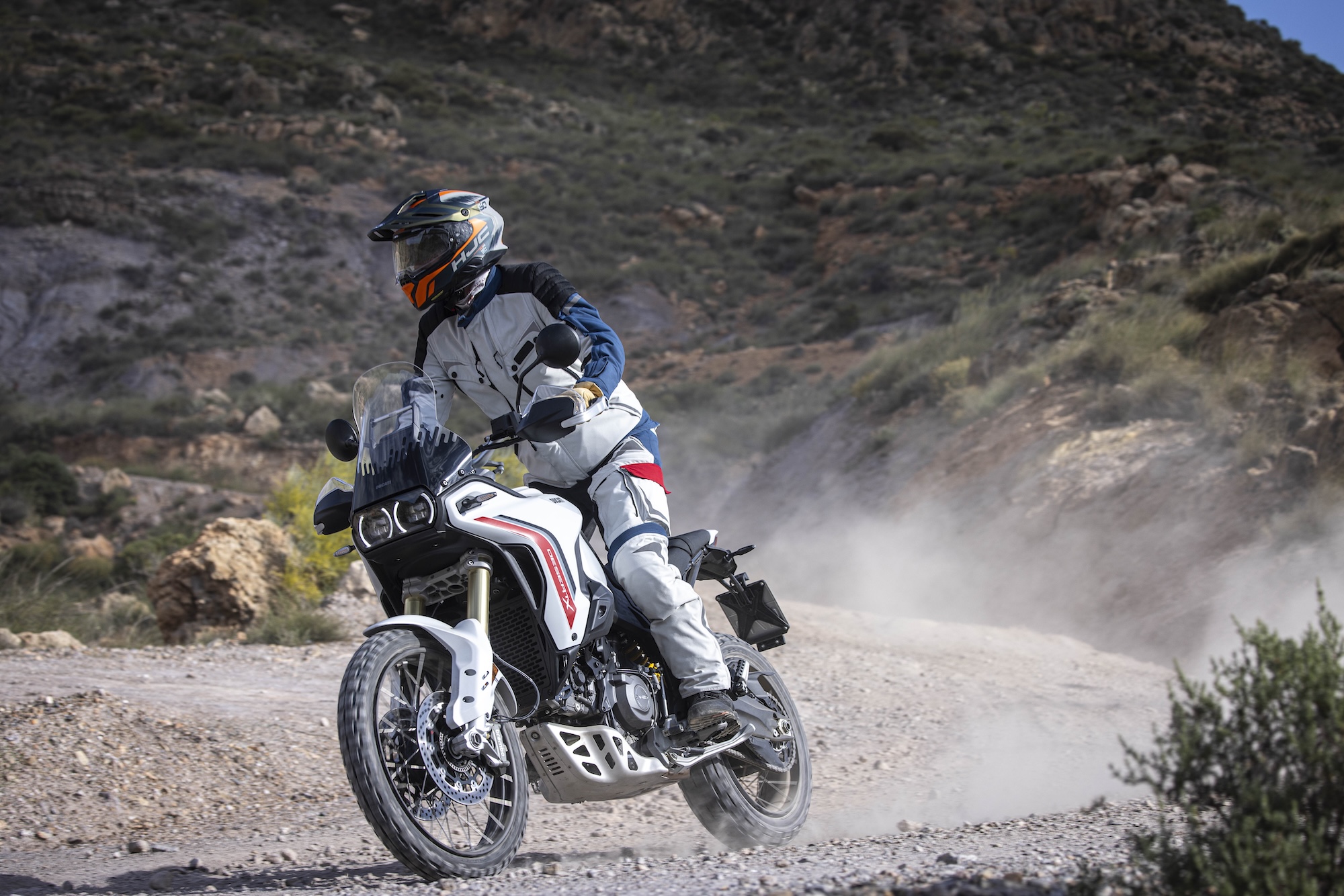
I will be honest that I approached the 2026 Ducati DesertX with a certain amount of skepticism. Italian brands have a long, dubious history of over-promising.
Media releases are often full of superlatives about spirit, passion, and heart. At presentations, various company representatives applaud each other with an enthusiasm that would make a British person uncomfortable. And there is always loud music. Always.
Ducati delivered all of the above when it brought the world’s press to southern Spain recently to test ride the all-new DesertX. But it also – to my surprise and delight – delivered a very good middleweight adventure touring motorcycle. A bike that is so good that it (mostly) lives up to the hype.
After a full day of riding on- and off-road, here’s what I learned:
Sorta related: Five top adventure tourers for less than £5,000

How we got here
The concept of the DesertX was first introduced at EICMA back in 2019. Initially, it was just intended as yet another Scrambler variant – revealed in that weird era when Ducati was seemingly churning out a new take on the Scrambler theme every other week.
The boys and girls in Bologna soon realized, however, that they had the tools and know-how to produce something better: something a little more… relevant. The Scrambler range, after all, is largely intended to be seen and heard rather than ridden hard through dirt and mud.
When the DesertX went into production in 2022, it was driven not by a Scrambler powerplant but the same 937cc Testastretta V-twin that it had been using in the Multistrada 950. It also looked decidedly more legitimate for off-road use.
But perhaps because it had been tarred by the Scrambler brush, or because there are approximately 238 billion different adventure-touring motorcycles, the first-gen DesertX didn’t become a huge seller. But the people who actually did buy them praised them with such fervor that Ducati has held onto the idea and given the model a full makeover for 2026.

Its goal for gen-2, Ducati says, was “improving off-road performance without sacrificing the riding pleasure typical of Ducati.”
New engine, new chassis, updated suspension, even a new rear axle bolt. Ducati’s gone all in. The company says it feels its bike is now even more fit for purpose: better suited for long hauls, more capable off-road, and even more resistant to (light) off-road crashes.
Look, fit, and feel
One of the few things that hasn’t been dramatically overhauled for 2026 is the DesertX’s styling. From five paces it looks pretty much the same as the outgoing version. Feel free to discuss the wisdom of that decision. On one hand, it creates a narrative consistency across two markedly different motorcycles. On the other hand, it dulls or hides the dramatic changes that Ducati has made.
Whatever the case, it’s a good looking machine, managing to be instantly recognizable as a dirt-ready adventure bike while simultaneously standing out from a very, very crowded field. There are clear and intentional styling cues from the Cagiva Elefant (remember that Cagiva owned Ducati from 1985 to 1996) but the DesertX looks unique.

It also looks robust. The build quality here is superior to what I was expecting. Ducati makes beautiful, premium motorcycles, but sometimes there is a difference between ‘premium’ and ‘made to last.’ in the DesertX V2, Ducati has delivered a motorcycle that is built to be used.
As mentioned above, special effort has been put into crash resilience. The most obvious example of this thinking comes in the plastic tank, which, along with the surrounding bits of fairing, feels to be constructed of something far more durable than your standard fairings plastic. It almost feels rubberized.
And it seems to do the trick. Through the course of the day, our group experienced three crashes. Nothing too serious – everyone was able to carry on riding – but enough to demonstrate that Ducati is telling the truth. Indeed, at least one of the incidents was dramatic enough that lesser bikes would have to be written off (it took five of us to haul a bike off the berm onto which it had been thrown).
There was a broken lever, a foot pedal that needed to be bashed back into place with a rock (that’s the bike that got thrown into the air), and a broken spring on a shifter, but no shattered fairings, bent handlebars, or snapped frames. Nothing so dramatic that it couldn’t be sorted out on the spot.

Standard seat height on the DesertX is 880 millimeters. If you’ve got the money, honey, Ducati has solutions that can raise or lower that height: offering a range between 840 mm and 900 mm. The seat is narrow – rally-esque – which means that getting feet down is easier. Being a 6-foot-1 rider, I was able to get both feet flat on the ground.
Although narrow and somewhat firm, the seat is reasonably comfortable. I spent a full day in the saddle without complaint. I reckon I’d be happy to spend multiple days riding the DesertX. But, as mentioned in my recent reviews of the Royal Enfield Himalayan 450 Mana Black, Honda WN7, and Voge DS800X Rally, I don’t seem to have as much tail-end sensitivity as some riders.
Ducati says it has altered the rider triangle from the first-generation model, but the chart its team showed demonstrating this suggests a change of single-digit millimeters. At any rate, it is relaxed and not too sporty (which is my primary complaint about the Multistrada riding position).
Everything is geared well to riding in a standing position, as well. A consistent theme of the DesertX is that it is magically able to offer both worlds (on-road and off-road) without much compromise.

Continuing that theme, the 5-inch TFT screen is (just barely) visible while standing, which is a rarity on adventure bikes. Normally, standing up on an ADV means forgoing any precise knowledge of your speed. Meanwhile, the screen is clear and easy to read when seated – even in the very bright Spanish sun.
The windscreen is not adjustable but – genuinely – does not need to be. I found it very effective even at extra-legal speeds.
The switchgear is a little cluttered, however, with the indicator switch particularly difficult to find without looking. It’s still not as bad as the indicator switch on the Harley-Davidson Pan America 1250 Limited, however, and I suspect that an owner would eventually get used to it.
Pulling the bike off the sidestand, it is well balanced and the center of gravity relatively low. Ducati claims a wet weight of 209 kg. The company is very cheeky in offering this figure, because its wet weight is, in fact, very dry; it doesn’t include fuel.
The DesertX has an 18-liter fuel tank. According to my kitchen scales, a liter of water weighs 920 grams. If we assume a similar weight for dino juice, that adds roughly 16.5 kg to Ducati’s number. No, you wouldn’t want 225.5 kg of motorcycle falling on your ankle, but it is balanced well enough that the bike is just on the right side of manageable when tackling uneven and loose ground.

The new V2 engine: Sound, power, and… stalling?
The DesertX’s new engine isn’t new to Ducati. It’s the same 890cc liquid-cooled V-twin (or ‘V2’ in Ducati-speak) that the company’s put into a number of its models in recent years: Multistrada V2, Streetfighter V2, Panigale V2 and Monster. In this guise, claimed peak outputs are 110 bhp at 9000 rpm, and 68 lb-ft of torque at 7000 rpm.
Ducati says that 70 percent of that torque arrives by 3000 rpm. That checks out; the engine has strong pull from the get-go but doesn’t offer much more wallop at motorway speeds, where the digital tachometer sits at about 5000 rpm.
Indeed, for a bike claiming 110 bhp, I was a little surprised at how wheezy the DesertX is above 85 mph. It will definitely achieve and exceed 100 mph, but doing so will feel more like crossing the finish line of a marathon than a sprint.
That’s not a criticism that means much in this context, of course. Speed is not the point here. Ducati offers plenty of other bikes that can rocket you toward the horizon to greater effect. And the nature of the DesertX’s torque delivery means that it is capable of providing all kinds of fun for those of us who take pride in maintaining a points-free license.

Power delivery is relatively smooth. Within the Ducati context. All Ducati engines have character and the DesertX is no different.
“Character” is a double-edged sword in motorcycling. It is often the thing about a bike that speaks to the heart, that makes you want/need to ride again and again. But it can also be the thing that annoys the hell out of you.
There is a certain rawness to the character of a Ducati engine – a kind of impatience and readiness to support you in ill-planned endeavors. So, power delivery on the DesertX is smooth and linear, but in a snarling sort of way. Wheelies are possible and encouraged.
Exactly how much character you experience will be determined in part by which of the six (Six!) riding modes you choose: Sport, Touring, Urban, Wet, Enduro, or Rally. On the road, I was happy to keep the bike to the full-power setting of Touring. Off-road, I preferred the slightly more subdued input of Enduro mode. Emphasis on slightly. Casual off-roaders like me might wish for an even gentler throttle on loose and uneven ground.

The engine’s sound is fantastic: dirt bikey on acceleration and offering up an addictive burble and pop on overrun. One possible concern I have, however, is that this engine has a bit of the traditional Ducati temperamental nature. It doesn’t like being cold, it puts out a lot of heat, and doesn’t appear to like being too hot.
As the day wore on, with the external temperature increasing and the engine being worked hard, I noticed that it took longer and longer for the engine to turn over when pressing the starter (On press rides we stop and start bikes a lot, having to wait several minutes between photo passes). This may have been an oil issue, though; perhaps a different viscosity would have seen internal parts better coated and the engine more willing to fire up. Discuss.
The touchy quickshifter and the crunchy gearbox
I’m going to give Ducati the benefit of the doubt here and point out that transmissions on brand-new bikes are often a little clunky. That is especially true, it seems, with V-twin motorcycles. But it is often the case that things smooth out over time.
Nonetheless, it is a simple fact that the transmission on the brand-new bike I rode was clunky. This was particularly true in the first three gears. And on a handful of occasions, finding neutral was nigh impossible.

Clutch pull is light but requires a full-hand grab of the lever. If you do the two-finger thing, the two fingers that remain on the grip (your ring and pinky finger) will block the clutch lever from actuating fully enough. This is primarily only an issue when riding off road.
The good news is that the quickshifter works surprisingly well off-road, meaning you often don’t have to fuss with a lever. It’s not as faff-free as the E-Clutch system on the Honda Transalp 750, but it’s pretty good.
On the road, my opinion of the quickshifter is more mixed. When it’s good, it’s good; but when it’s bad, it’s awful. And there doesn’t appear to be any consistency in terms of the conditions under which it performs one way or another.
Also, it may be that the quickshifter is sensitive to a fault. Throughout the first part of the day, I suffered stalling to an infuriating degree. Between 9 am and 2 pm, I probably stalled out more times on the DesertX than I had on all the other bikes I’ve ridden over the past three years.
I mentioned this to Ducati’s team at lunch and they suggested that I may have been unintentionally tapping the gear shifter with my toe, fooling the quickshifter into wanting to activate. That’s possible; the Sidi Taurus GTX boots I was wearing are pretty thick. Fortunately, it is possible to turn off the quickshifter. I did that and didn’t stall once for the rest of the day. See above comment about Ducati bikes having ‘character.

Chassis and brakes
The DesertX’s chassis is another area where huge changes have been made. It has a new monocoque frame and the suspension is now fully adjustable. In addition, the rear shock now uses a “full-floater” set-up. That sounds like something that you might find in the toilet, but it’s actually just an explanation of how the shock is mounted, allowing it to be compressed at both ends.
As Elton John sings in Rocket Man, “all the science I don’t understand,” but I do know that when it comes to the DesertX suspension Ducati has nailed it. The bike will take whatever you throw at it off road – ruts, rocks, sand – then magically feel planted and firm on road, ie, the Ducati experience you’d expect.
Brakes, meanwhile, are pretty well set-up. The front can feel just a teensy, teensy bit bitey at times but not so much that a rider can’t quickly adjust to the DesertX’s way of thinking. Additionally, within the six riding modes there are five different ABS settings to choose from, so there’s a lot of opportunity for customization. Too much, in fact. See below.

Electronics and fancy bits
Sometimes too much is too much. Ducati has crammed the DesertX with so much technowhizzbangery that it is overwhelming and effectively impossible to fully make use of.
I mentioned earlier that there are six different riding modes. Within each of those modes, you have the option of eight different traction control settings (EIGHT!), five different cornering ABS settings, four different power settings, four different “wheelie control” settings, three different engine braking settings, and, of course, the ability to turn the quickshifter on and off. That works out to 23,040 different possible riding set-ups.
That is stupid. It reminds me of the plot of A Short Stay In Hell, in which a man must search through an infinite library to find the story of his life. Although, I suppose it provides Ducati with a great response to any criticism riders may have: “Actually, this bike is perfect for you; you just haven’t found the right combination of settings yet.”
Meanwhile, in addition to the (overly sensitive) quickshifter, you get full LED lighting, a steering damper, cruise control, and the aforementioned 5-inch TFT screen. Turn by turn navigation is reportedly possible via the Ducati Link app. I didn’t get a chance to test it but I am willing to bet that it doesn’t work properly, based on the fact that I have never encountered one of these apps that works properly.

Just buy a Quadlock mount and use your phone directly.
Back on the subject of the TFT screen, I will give Ducati credit for the fact that its impossible array of setting options are reasonably easy to navigate.
Maintenance: ¿Dónde está el oil filter?
Ducati’s team made a point of talking about how changes have been made from the previous generation to meet the servicing and maintenance expectations of an adventure-touring rider. Recommended oil changes are now 9,000 miles apart. Recommended valve checks come every 28,000 miles.
Depending on riding conditions, you’ll want to check (and clean) your air filter more frequently. To facilitate this, Ducati has made it more accessible: remove just three screws on the internal part of the cowling and it slides right out.

The company also takes pride in now offering a rear axle that can be removed with a standard hex socket. Apparently, you needed a special tool – bought from Ducati – to remove the rear wheel on the previous-generation DesertX. Now you can change tires using the same old metric socket set you use for everything else (Cue obvious Amazon affiliate link to a 138-piece Bahco socket set).
Add to this the fact that Ducati has designed an element that connects the frame and subframe which is removable and thereby makes access to the engine headers easier. Ostensibly that reduces the amount of time/effort needed to do valve checks.
But changing the oil is markedly less straightforward. Take a look at the bike and ask yourself: Where is the oil filter?
I couldn’t find it. Neither could any of my fellow moto-journalists. Folks with a memory will recall that I had the same issue last year with the XDiavel V4.

After a fair bit of YouTube research into other V2-engined bikes (eg, the Streetfighter V2), and a conversation with Ducati test rider Andrea Rossi, I was able to determine that the oil filter sits in a cartridge just below the engine cover on the left side of the bike. To access that oil filter you need to remove an oil filter panel that is held in place by two bolts.
The housing for the oil filter is set into the engine somewhat, so internet tutorials on other V2 bikes suggest covering the lower part of the bike with aluminium foil to keep excess filter oil from spilling onto your beautiful machine.
On top of this, getting at the oil drain plug may also be tricky. On at least some V2-engined bikes, the routing of the exhaust makes access to the plug challenging.
The home mechanic in me is grumpy about this. Changing the oil is usually the easiest bit of wrenching you can do, and doing it yourself can save you thousands of pounds over the lifetime of a bike.

Competition
The middleweight adventure touring segment is a very, very crowded field, offering almost as many variations on the theme as the DesertX offers rider set-ups. I suppose the DesertX sorta competes with the Multistrada V2, but the bikes that came to my mind when riding the DesertX were the Triumph Tiger 900 Desert Edition (conveniently priced exactly the same as the DesertX), the Honda Transalp 750, and numerous Chinese takes on the theme.
The Chinese bikes win on price but can’t touch the Ducati when it comes to suspension, build quality, and overall balance/handling. The superiority of Ducati’s product provides a good argument for paying more.
The Triumph competes in terms of power figures, quality, and technowhizzbangery. It also ties with the Ducati in being the most expensive bike on the list below. But it’s a bulkier machine – more road-focused, regardless of whether Triumph wants to admit that fact.
The Transalp 750 is a little more basic by comparison and offers less power/torque, but…
| ENGINE | PERFORMANCE | PRICE | |
| Ducati DesertX V2 | 890cc V-twin | 110 bhp68 lb-ft | £14,995 |
| BMW F 900 GS | 895cc parallel twin | 105 bhp68.5 lb-ft | £12,060 |
| CFMoto 800MT-X | 799cc parallel twin | 94 bhp64 lb-ft | £6,999 |
| Honda XL750 Transalp with E-Clutch | 755cc parallel twin | 90.5 bhp55 lb-ft | £9,999 |
| Kove 800X PRO | 799cc parallel twin | 94 bhp59 lb-ft | £9,699 |
| KTM 890 Adventure R* | 889cc parallel twin | 105 bhp74 lb-ft | £11,899 |
| Moto Guzzi V85TT | 853cc V-twin | 80 bhp 61.2 lb-ft | £12,195 |
| QJMotor SRT 900 SX | 904cc parallel twin | 95 bhp66.3 lb-ft | £7,699 |
| Suzuki V-Strom 800 DE | 776cc parallel twin | 84.3 bhp57.5 lb-ft | £9,999 |
| Triumph Tiger 900 Desert Edition | 888cc parallel twin | 106.5 bhp66.3 lb-ft | £14,995 |
| Voge DS900X | 895cc parallel twin | 96.5 bhp67 lb-ft | £8,499 |
| Yamaha Tenere 700 World Raid | 689cc parallel twin | 72.4 bhp50 lb-ft | £11,924 |
*KTM’s website is still selling the 2024 model. Whether the bike is actually available is uncertain.

Verdict
There are a lot of things to like about the DesertX. The list grows the longer you spend time with it. Whereas I had started my day feeling skeptical and looking for faults (eg, constant stalling) I finished my day finding more and more little things to appreciate (eg, the feel of the buttons on the switchgear).
It’s still heavy (and maybe a bit overpowered) off road, and its character could be interpreted by some as potential causes for concern. Ducati’s reliability is far, far, far better than it used to be but warranty claims certainly aren’t unheard of, and repair – or even basic service – is still notably more costly than with many other brands.
It’s also quite expensive from the outset, outgunning all but one of its competitors in asking price. It costs £5,000 more than the Transalp 750, for example – a bike that I referred to as “the perfect motorcycle.”
Ducati says, too, that £14,995 is just an “introductory” price, suggesting that it will go up soon (Although, unless it turns out to be wildly popular I doubt that it actually will shoot up in price too quickly. If a bike doesn’t sell well at £15K it’s not going to sell better at a higher price).

But the DesertX is also thoroughly enjoyable and confidence-inspiring thanks to an excellent suspension and weight balance. It cuts a nice dirt bike figure from the rear and offers up a fantastic, snarling exhaust note. The bike’s character also speaks to the heart; this is a motorcycle that has been spinning in my mind over and over since I rode it.
It’s well built, packed with an insane amount of tech, has a style that is unique (but for the Chinese brands that have begun to copy it), and carries a badge that inspires envy. Anyone who has one of these in their garage has reason to be proud.
The three questions
Does the 2026 Ducati DesertX fit my current lifestyle?
Yes. I question whether it would start as reliably as my Kawasaki but it otherwise meets – and, in fact, excels beyond – the needs that I personally have for a motorcycle. This is a bike that could go more places than my current machine. Although, I will be honest that if I had the money to buy one, I’d get a Transalp 750 instead and use the remaining £5,000 to fund multiple road trips to Spain.
Does the 2026 Ducati DesertX put a smile on my face?
Without a doubt. It’s a Ducati; it’s incapable of being boring or run of the mill. I was particularly impressed by the quality of its suspension.
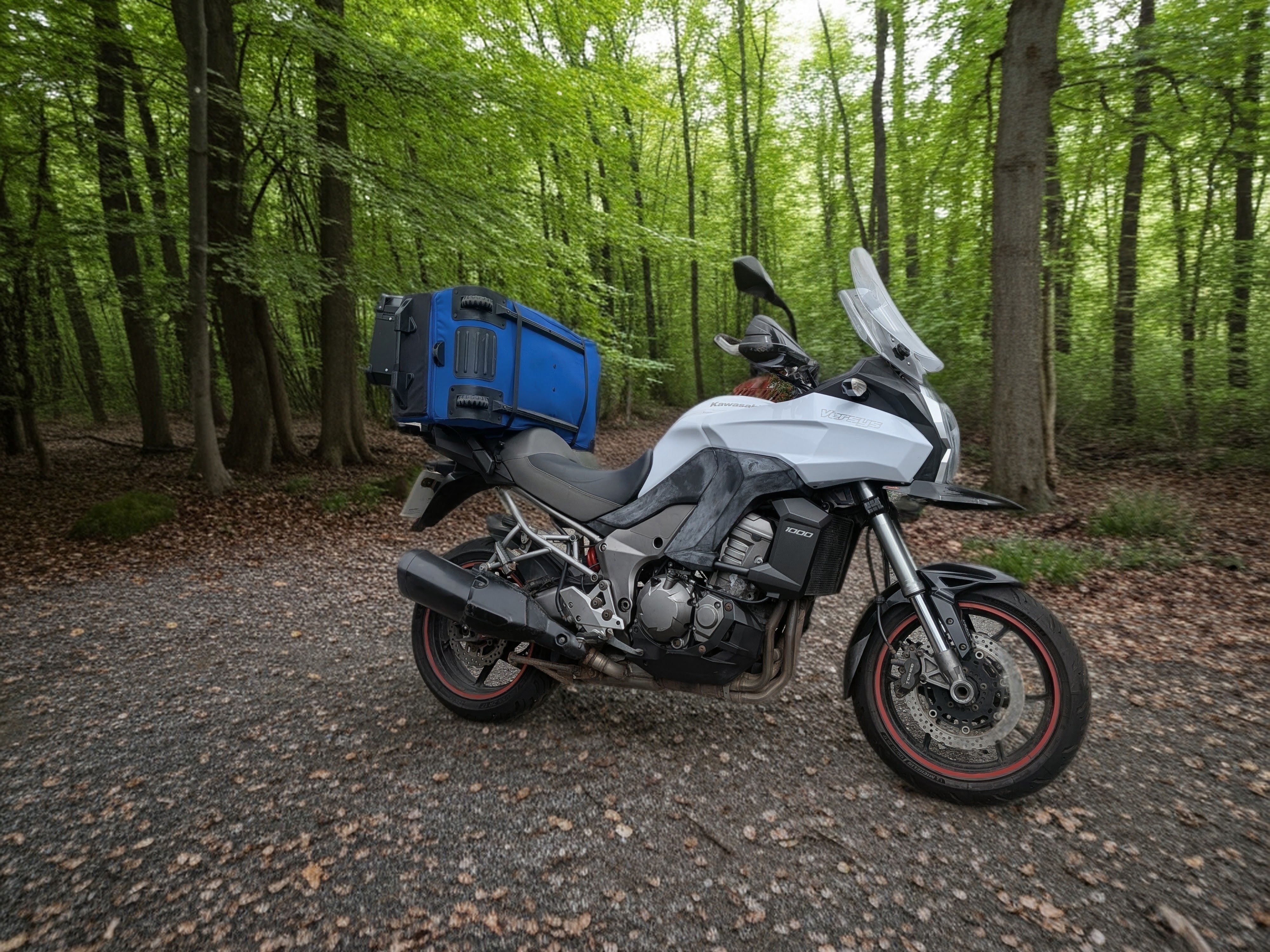
Is the 2026 Ducati DesertX better than my current motorcycle, a 2012 Kawasaki Versys 1000?
Well, yes, obviously. Though, perhaps tellingly, I suspect I’d be conflicted about exchanging one for the other. If Ducati came to me and said, “You can have this bike in exchange for your Versys,” I’m pretty sure I’d say yes, but not completely sure. There’s a lot to be said for a bike that starts every time, doesn’t stall, and has an oil filter that is easy to find and replace.
Gear worn in photos
Helmet: HJC RPHA 60
Jacket: Spada Vanguard
Gloves: Aerostich Elkskin Competition Ropers
Pants: Spada Vanguard
Boots: Sidi Taurus GTX

2026 Ducati DesertX V2 specs
| PRICE | £14,995 |
| ENGINE | 890cc liquid-cooled V-twin |
| TRANSMISSION | 6-speed, with quickshifter |
| POWER | 110 bhp at 9000 rpm |
| TORQUE | 68 lb-ft at 7000 rpm |
| TOP SPEED | n/a |
| SEAT HEIGHT | 880 mm |
| GROUND CLEARANCE | 250 mm |
| WEIGHT | 209 kg (without fuel) |
| FUEL CAPACITY | 18 liters |
| FRONT TIRE | Pirelli Scorpion Rally STR 90/90 – 21 |
| REAR TIRE | Pirelli Scorpion Rally STR 150/70 R18 |
| FRONT BRAKES | Two 305mm semi-floating discs, radially mounted Brembo monobloc 4-piston 2-pad calipers |
| REAR BRAKE | Single 265 mm disc, Brembo 2-piston floating calliper |
| FRONT SUSPENSION | KYB 46 mm upside-down fork, fully adjustable |
| REAR SUSPENSION | KYB shock absorber, fully adjustable, remote preload adjustment, full floater progressive link |



Leave a Reply