
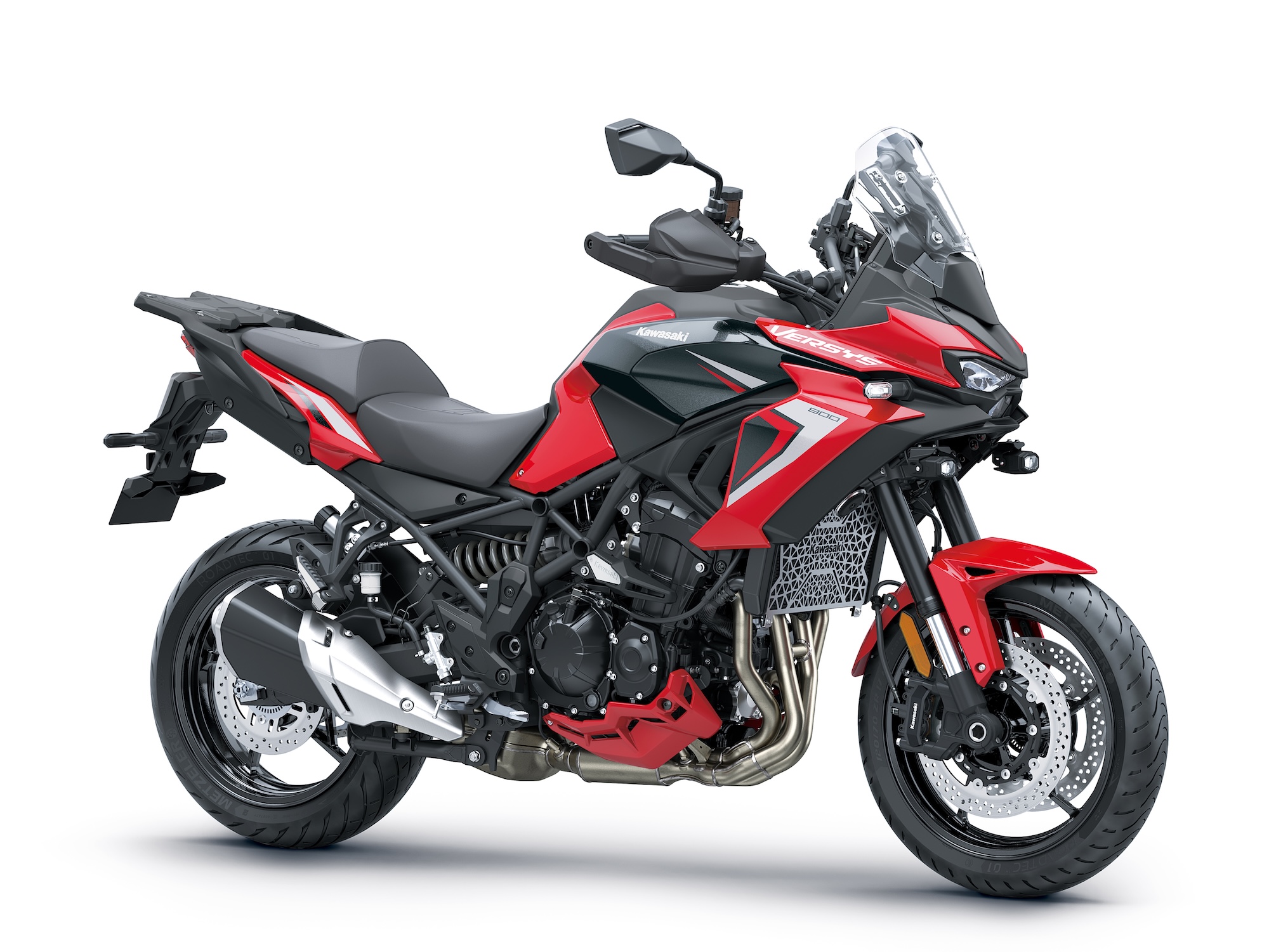
I am all-in on this, which probably means it won’t be a big seller. Indeed, I may be one of a very small handful of people who think the new Versys 900 is a good idea. Announced just last week, all talk of the bike has already disappeared from moto websites. And despite the fact that there are approximately 82 million moto-influencers out there I’ve not seen even one of them talking about this thing.
I wonder if Kawasaki even has faith in it. Pre-reveal hype consisted of just two Instagram posts, then the bike was revealed via a short, detail-thin media release that was issued at 4 pm on a Tuesday.
What we do know is this: powered by the same 948cc inline four that has driven the Z900 since 2017, the new Versys 900 promises peak outputs of 120 bhp at 9500 rpm and 71.7 lb-ft of torque at 8000 rpm. Ostensibly, the 900 creates a mid-point between the Versys 650 and Versys 1100. But I feel that it creates a big question mark – one that Kawasaki may or may not use as an opportunity to deliver something bold.
Probably not, if we’re being honest. But we’ll get to that in a bit.

What we know about the 2027 Versys 900
“Combining strong, controllable response from low and medium rpm with a free-revving character that pulls smoothly towards the upper end of the rev range, [the Versys 900’s] exciting engine delivers the distinctive exhilaration that only an In-Line Four can offer across a wide range of riding situations, whether riding in town, in the hills, or across the country,” declares Kawasaki’s press release.
The Versys 900 will be built around an “all-new” trellis frame and be packed with technowhizzbangery, including cornering traction control, cornering ABS, LED lighting, adaptive cruise control, forward collision warning, blind spot detection and Emergency Stop Signal (ESS). A 5-inch TFT screen will connect to smartphones via Kawasaki’s in-house app, which is inarguably the most stupidly named app in motorcycling. I am not making this up, it’s called: “RIDEOLOGY THE APP MOTORCYCLE.”
RELATED: Five adventure tourers for less than £5,000
I would guess that the target audience here is folks who might otherwise be considering a Honda CB1000GT, Suzuki GSX-S1000GX, Yamaha Tracer 9, or the like – a modern sport tourer that hustles but doesn’t necessarily break the bank. The base model Versys 900 will start at £10,899 when it hits UK dealerships in April 2027; a higher-spec Versys 900 SE will start at £11,799.
“The main frame is engineered with an emphasis on achieving an ideal rigidity balance and a high level of front-end feel, while the rear frame offers the rigidity to accommodate a passenger and/or panniers plus a top case,” explains Kawasaki’s media release. “A near 50:50 front-to-rear weight distribution delivers excellent light, agile handling.”
The screen (which looks too small, in my opinion) is adjustable to seven different settings. Seat height can be adjusted between 825mm and 845mm, and the fuel tank holds 20 liters of dino-juice.

What this means
The very first question that needs to be asked about the Versys 900 is: “Why?”
The “versatile system” concept stretches back almost two decades, to when the Versys 650 was first introduced in 2007. Five years later, a big Versys was introduced in the form of the Versys 1000 (I own a first-gen Versys 1000), which was then upgraded to an 1100 in 2025.
It’s interesting to me that the new mid-point 900 has slightly higher peak figures than the original Versys 1000. My 2012 Versys 1000 claims 116 bhp and 75 lb-ft from its liquid-cooled 1043cc inline four.
The current 1100 (driven by a 1099cc version of the 1043cc powerplant used by the 1000) claims 132 bhp and 82.6 lb-ft of torque. And here’s where the question marks start popping up. When looking at just peak figures, the difference between the 900 and 1100 feels too small. Add in the fact that the 1100 – at present, at least – doesn’t have some of the 900’s fancier tech (eg, so-called adaptive cruise control light) but costs roughly £3,000 more.

So, I guess I need to rephrase that first question. It’s not “Why the 900?” but “Why the 1100?” What happens now with Kawasaki’s hitherto flagship adventure-styled touring bike?
One possible answer for Kawasaki is to go bigger, creating an even larger and more discernible gap between the 900 and 1100. Although the peak numbers are close-ish for the two models, where those numbers show up in the rev range tell a different story. The 900 is revvier, sportier, and sits on a thinner and probably lighter (full specs are not yet available) chassis. Whereas the 1100 offers healthy amounts of torque from pretty low in the range and has a more formidable, all-day-steady stance.
So, Kawasaki could increase capacity just a little bit more to create a 1200, and equip it with the best tech the company has to create a full-on upright luxury touring machine – in the spirit of, say, the Ducati Multistrada V4 S Grand Tour. Or, Big Green could go even further by resurrecting/updating the 1352cc inline four that drove the GTR1400 and ZX-14. In the GTR1400, that powerplant offered 160 bhp and 100 lb-ft of torque.

RELATED: 2016 Kawasaki GTR1400 Ride Review
Certainly it’s the case that such a move would fit the modus operandi of the Versys platform, which is: “Get as much as you can out of stuff we’ve already got.”
The current Versys 1100 uses an engine with a lineage that can be traced back 30+ years to the 1994 Ninja ZX-9R. The “new” Versys 900 relies on an engine with core architecture that’s been around since at least 2013 (in the Z800).
So, blowing the dust off the transverse-mounted 16-valve inline-four of the GTR1400/ZX-14 (first introduced in 2006) wouldn’t be out of character for Kawasaki. The challenge would probably come in stuffing that engine into the existing Versys 1100 frame. The GTR1400 and ZX-14 were very wide, long, heavy bikes.

Not knowing how big of a challenge that would be, I worry that Kawasaki will just take the lazy route and continue offering the existing 1100 to diminishing returns, sort of following the same route that Suzuki has in allowing its V-Strom 1050 to be almost usurped by the V-Strom 800. Which would be a shame because, as I’ve mentioned before, I’m a fan of kinda-big touring bikes and I feel the Versys 1000/1100 not only falls into that category but is also an overlooked gem.

Leave a Reply