
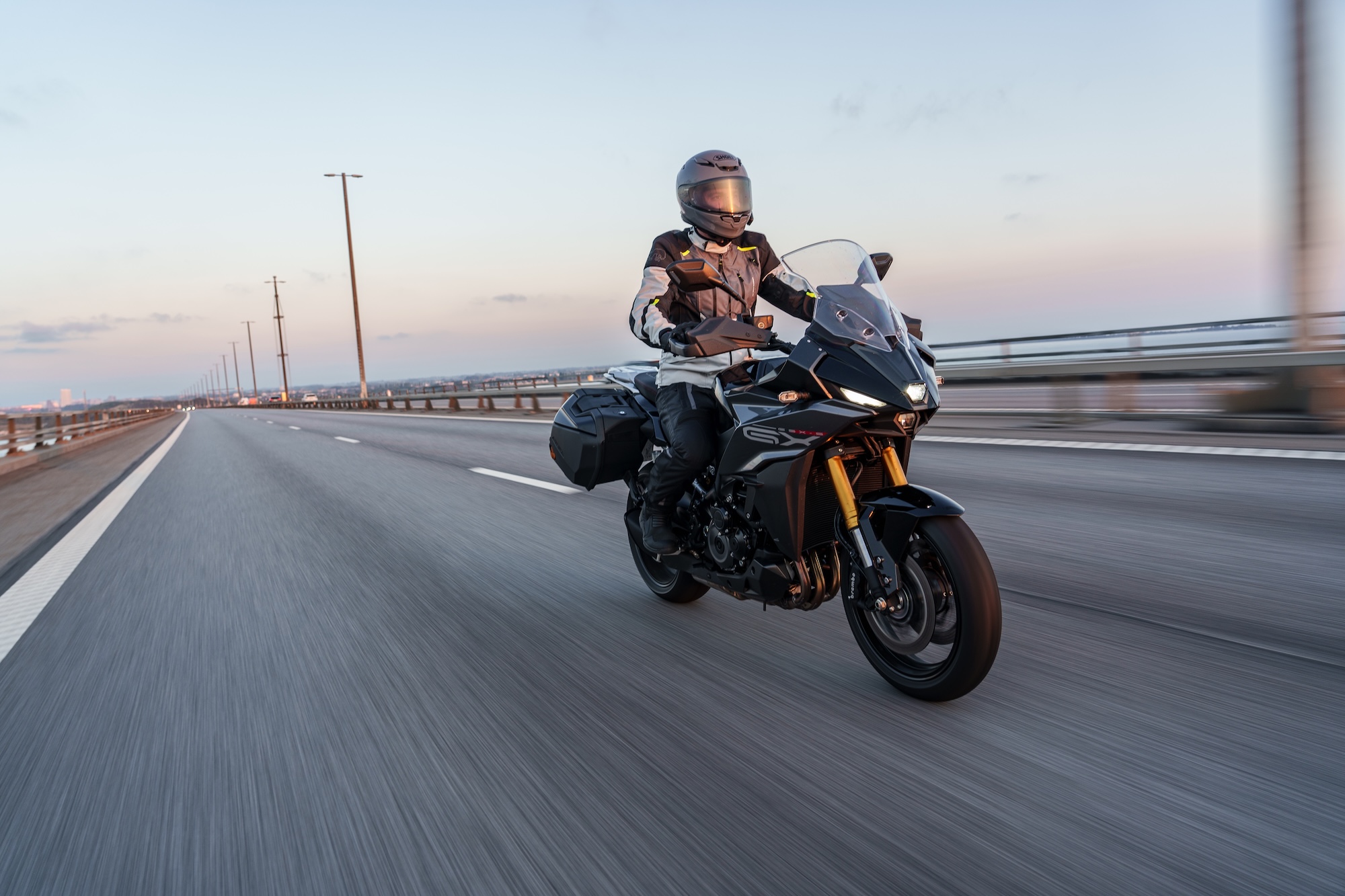
What does it say about the Suzuki GSX-S1000GX+ that I spent two months with the upright sport tourer and only bothered to take one picture of it? Perhaps that’s the TLDR review: excellent machine, surprisingly forgettable.
The one picture I took was on the day I picked it up from Suzuki GB. Photographed outside a Starbucks on the A1 for the sake of showing my wife.
“Is it a sexy bike?” my wife had texted.
“Looks like this,” I replied, sending the photo.
“Ooh, looks like your other one.”
“What other one?”
“Your bike. When we lived in Penarth.”
“The V-Strom??”
“Maybe. It was also red.”
How you can confuse a 99.2bhp V-twin adventure-touring bike from 10 years ago with a 150bhp four-cylinder modern sport tourer, I do not know. It’s like saying that Madness and The Wailers sound the same. But perhaps that is the TLDR assessment of Suzuki these days: excellent machines, surprisingly forgettable.

Which is a shame because – as best I can remember, at least – the GSX-S1000GX+ is a mostly excellent machine. It exudes Suzuki quality and reliability and serves as viable competition for the markedly more expensive BMW S 1000 XR. Though, there may be others in the segment that can top it.
The GSX-S1000GX+ is a sport tourer. There are two kinds of sport-touring motorcycle, of course: the old-school ‘sportbike made comfortable’ type that had their hey-day in the 2000s, and the modern type with adventure bike ergonomics. Suzuki is one of the few manufacturers that offers both.
The excellent GSX-S1000GT takes care of the old-school side of things, whereas the GSX-S1000GX+ makes use of the same engine and same frame as the GT to offer more upright thrills. First introduced in 2024, it is part of a growing segment that includes the aforementioned BMW, as well as marginally less powerful machines like the Yamaha Tracer 9 and Triumph Tiger Sport 800.
When I first heard of the GSX-S1000GX, I thought: “Aha! That is the bike for me!” Having now spent two months with it, would I say the same thing? Read on.

The best bits
As mentioned, the GSX-S1000GX+ shares an engine with the GSX-S1000GT: a 999cc liquid-cooled inline four-cylinder engine claiming 150 bhp at 11000 rpm and 78 lb-ft of torque at 9250 rpm. The engine is a direct descendent of the legendary K5 engine. As I explained in my review of the GT, the K5 was originally designed as a superbike engine – for the 2005 GSX-R1000. It was quickly found to be so functional and tractable, however, that Suzuki put it to work in numerous applications. At present, it drives four different Suzuki models.
As in the GT, the engine is the star of the show: tractable, delightful, and capable of going so, so, so fast. Heaps of delicious torque are available from relatively low in the rev range. For reasons that I’m not clever enough to guess, however, the powerplant is buzzier in the GX than the GT. This happens predominantly at ‘enthusiastic’ motorway speeds and above, and isn’t insufferable, but definitely noticeable.
The transmission is as slick as with the GT – so much so that you don’t really need the quickshifter, though that is a nice thing to have. Especially because it’s one of the few quickshifters I’ve encountered that actually work as they should.
Despite high-speed buzziness, the GSX-S1000GX+ is a relatively comfortable machine, with a relaxed, upright seating position that feels instantly natural. The seat is, for the most part, suitable for long days in the saddle – aided by the fact that the bike’s fuel economy isn’t great. So, you’ll be stopping more frequently.

In terms of handling, it’s everything I could ask for. Brakes, too, are good. For me, at least. I’m aware that other reviewers have taken issue with the Suzuki’s stopping power and I suppose I can see where they’re coming from. I suspect that different brake pads might offer more bite.
The unique selling point: Suzuki Advanced Electronic Suspension
Broadly speaking, the GX is a GT for taller riders/folks who don’t like to bend. The biggest area in which the GX diverges from this formula is in its suspension. Whereas the GT has an old-school fully adjustable suspension, the GX is equipped with an electronic suspension that adjusts according to speed, conditions, etc.
“This state-of-the-art electronically controlled suspension not only absorbs road surface irregularities to improve manoeuvrability and comfort, but also achieves both good handling performance at low speeds and reassuring stability at high speeds,” says Suzuki.
Uhm, maybe. For me, the whole show felt a bit overly firm, even at the softest settings. Outside of that, I wouldn’t say that the set-up was noticeably different from the very good standard set-up of the GT. In other words, the SAES is probably a nice thing to have but it’s probably not so observably good that it’s going to win you over financially.

‘A mostly excellent machine’ (The not-so-great bits)
Not only can you feel the engine’s buzziness at higher speeds, you can observe it in the mirrors. Objects aren’t terribly clear at 70 mph and above. I want to stress again that all this is not awful, it’s just not up to the quality standard I’ve come to expect from Suzuki.
My general feeling about Suzuki is that, yes, its machines aren’t at the very cutting edge – if a Suzuki has a bit of technowhizzbangery, that will have existed elsewhere for quite some time – but they are solid and reliable and ‘right.’ So, the mirrors are markedly better than I’ve experienced on any Chinese- or Indian-made motorcycle, but they don’t meet the expectations I have for this brand.
The pro tip on this, of course, is to simply pull your clutch in for a second if you need to identify whether the thing behind you is a police car. It’s a pain, but, hey-ho.
Speaking of technowhizzbangery, as with the GT, the Suzuki MySpin app does not actually work. It simply won’t connect. Or, at least, it won’t connect to a Pixel phone. I’ll admit that doesn’t upset me because I think that connectivity apps are nonsense that will just make the bike old before its time (it is highly unlikely that Suzuki has future-proofed its software to the extent that it will have any chance of interacting with phones 10 years from now)

The everyday bits
On the whole, whatever criticisms I have of the GSX-S1000GX+ are minor. It’s a bike that starts every time, a bike that is happy to take whatever I throw at it: motorways, filtering through traffic, winding country roads, etc. Many people refer to the GSX-S1000GX+ as a “tall-rounder” and I’d say that’s a pretty accurate description. This is very much a motorcycle for people like me, who can only afford to have one motorcycle. Go to work every day, go to Hungary in the summer; it’ll do both – again and again.
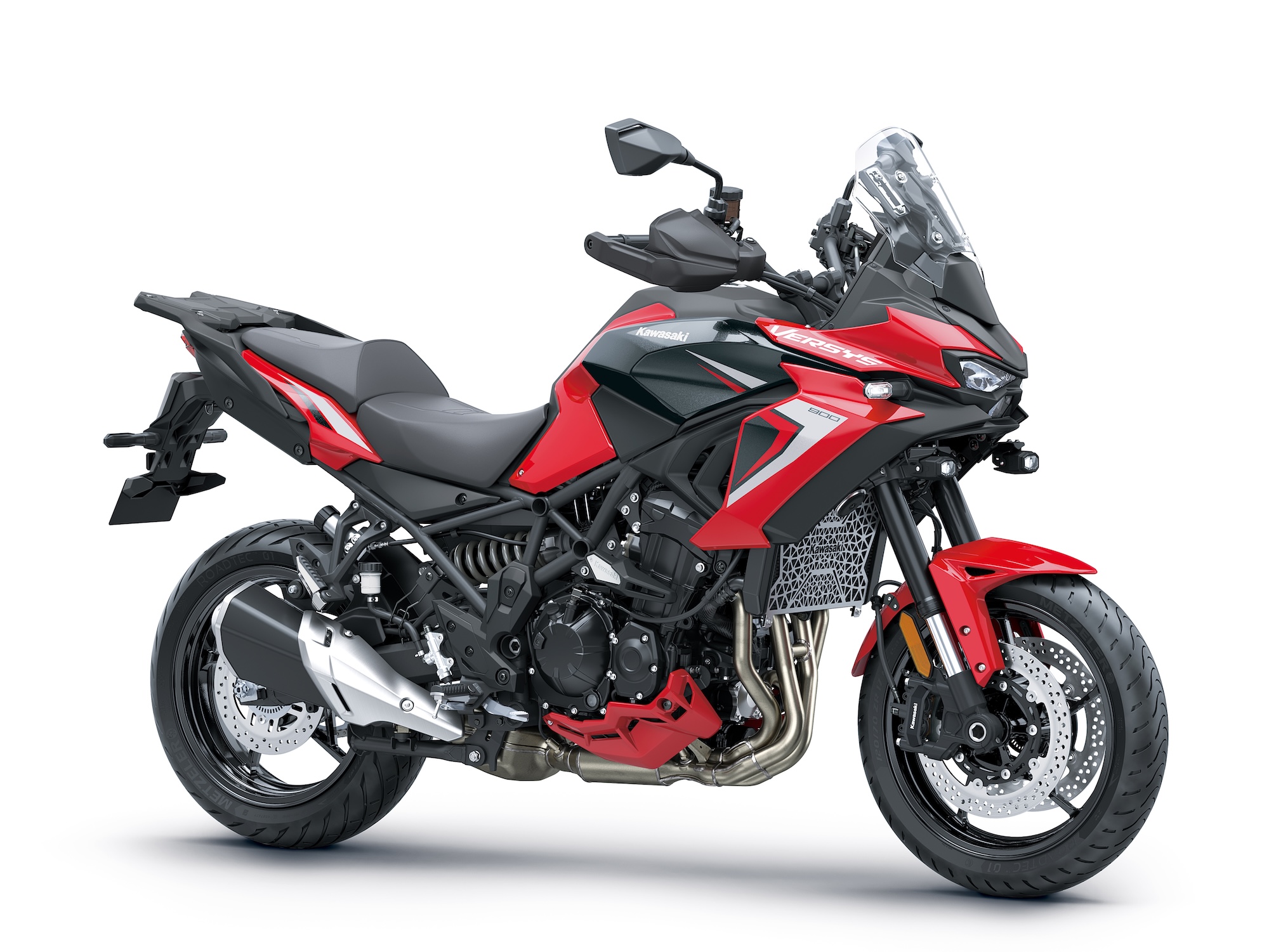
That said, although the rider and passenger seats here are larger than on the GT, I’d suggest using a Kawasaki Versys 1100 or the like for two-up touring. There’s enough room on the GX for a human-sized pillion to be content on a Sunday ride, but I wouldn’t want to be clinging to the back of this thing across the Pyrenees.
One can debate the necessity of SAES but it and all the other rider aids – and there are many – work as they should (the Suzuki MySpin app being the exception). The screen is easy to read in any light, and switchgear is relatively intuitive. Overall fit and finish is also good.
Aesthetically, it’s not a bike that wins me over. It’s not ugly, it’s just – as I say – not memorable. During the writing of this review I have several times switched tabs to look at images of the bike, to try to jog my memory about certain elements, then returned to my article and forgotten completely what the bike looks like.

You will notice, meanwhile, that throughout this article I have referred to the GSX-S1000GX+. That ‘plus’ means a GSX-S1000GX with panniers, heated grips, and a few other bits. The standard GX is no longer sold in the UK. The heated grips work as they should; the panniers, however, are too small. I was not able to fit a laptop or helmet into them.
Lastly, as mentioned above, fuel economy on the GSX-S1000GX+ isn’t great. You’ll only get about 150 miles from the 19-liter tank before its fuel indicator is in the red.
Verdict
On the whole, the GSX-S1000GX+ is a bike that feels like it needs a second generation. It is very good – especially considering this is Suzuki’s first attempt at the proper upright sport tourer segment – but not as good as I expect it to be. I find myself longing for another version with all its little quirks and quibbles ironed out.
Unfortunately, I’m not sure that will happen. Sales of the GSX-S1000GX have not been great. This is why Suzuki’s sought to improve its appeal by offering only the GX+ version.

At £14,999, it’s a better deal than the £17,650 BMW S 1000 XR that it’s clearly copying. Not to mention that heated grips and panniers are not standard on the BMW (but, the Bavarian motorcycle is more powerful: 167.2 bhp). And because of Suzuki’s ability to make really reliable bikes, I’d probably choose the GSX-S1000GX over a comparably priced used S 1000 XR.
The question is whether I’d remember that it was in my garage. This is a very good motorcycle that’s capable of being both very useful and very fun, but there’s something about it that causes it to disappear from your mind almost as soon as you step off it.
Meanwhile, I have yet to ride Honda’s 147.5bhp CB1000GT, but it seems to be offering everything the Suzuki’s got – powerful inline four, electronic suspension, panniers – for £3,000 less.
My advice, however, is to go out and buy a secondhand GSX-S1000GX. They are exactly the same as a brand-new GX, with used prices starting as low as £7,400. Buy some Grip Puppy covers to help with the engine buzzing and invest in some Kriega bags to facilitate legitimate long-distance touring.
Or, you know, go with an old-school bike and check out my choice of the five best used sport tourers for under £5,000.

2026 Suzuki GSX-S1000GX+ specs
| PRICE | £14,999 |
| ENGINE | 999cc liquid-cooled inline four-cylinder DOHC |
| TRANSMISSION | Six speed |
| POWER | 150 bhp at 11000 rpm |
| TORQUE | 78 lb-ft at 9250 rpm |
| SEAT HEIGHT | 845 mm |
| GROUND CLEARANCE | 155 mm |
| WEIGHT | 232 kg |
| FUEL CAPACITY | 19 liters |
| FRONT TIRE | 120/70ZR17 |
| REAR TIRE | 190/50ZR17M |
| FRONT BRAKES | Twin disc |
| REAR BRAKE | Single disc |
| FRONT SUSPENSION | Inverted telescopic, coil spring, oil damped |
| REAR SUSPENSION | Link type, coil spring, oil damped |


Leave a Reply