
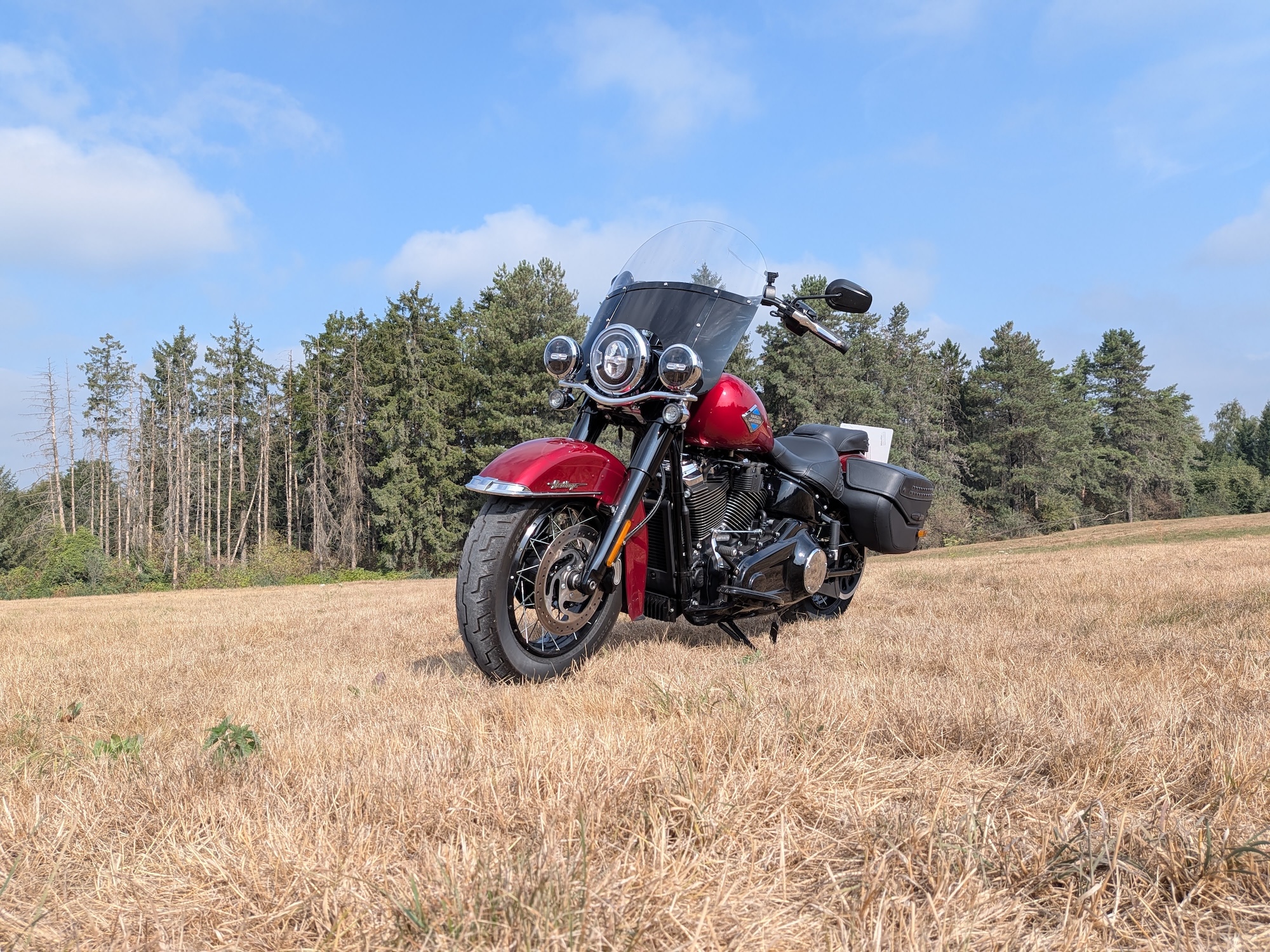
I’m going to be controversial here. You might stop reading this site as a result of what I have to say. You might find yourself writing to a representative demanding that I be investigated for my controversial and outrageous opinions on the 2026 Harley-Davidson Heritage Classic.
OK, not really. I follow a guy on YouTube who talks about how to improve engagement, and he seems to think that being controversial is a winning strategy. So, feel free to tell me in the comments how outraged you are.

In truth, however, there’s nothing particularly controversial about this bike. Nor is my opinion of it going to shock anyone. If you are a long-time reader of Dancing the Polka, you’ll know that I tend to be pretty kind to Harley. Sure, its bikes are heavy and expensive and impractical, but they’re so much fun!
And I’m pretty open about the fact that the Harley-Davidson Street Bob is one of my favorite bikes of all time.
RELATED: 2025 Harley-Davidson Street Bob – Ride review
As it happens, the Heritage Classic is very similar to the Street Bob. It may not look it, but in terms of the engine, frame, chassis, handling, and the core experience, many aspects are identical. In light of that, wanna take a wild guess as to whether I think the Heritage Classic is a good bike?
All that said, it’s not perfect. Ironically, the bits that differentiate it most from the Street Bob are its weakest points. Related to that, in terms of being controversial, the best I’ve got for you is this: I think the Heritage Classic is woefully overpriced.
Let’s get into it.

Look, Fit, and Feel
There’s certainly nothing controversial about the look of this motorcycle. By design, the Heritage Classic is exactly what we think of when we think of a Harley-Davidson: that late 1940s/mid-‘50s styling. The paint is deep and rich, and sparkles when the sunlight hits it – accented by very subtle pinstriping.
The Heritage Classic was first introduced way back in 1986. In other iterations, it would have been flashier. Thankfully, modern styling trends veer away from excessive chrome. But you still get flashes of ridiculousness, the metal studs on the seat and panniers being chief offenders. The studs are blacked out, so only folks who are standing up close can tell that your bike has been bedazzled like something in a Strictly dance number, but still. Metal studs. Why?
This is something that I have always hated. If you can deliver a reasonable argument in favor of metal studs on a motorcycle seat I’d be happy to hear it.
Overall, however, everything on the Heritage Classic is done tastefully. I love the classic badge and sweeping fenders. There is so much to just stare at and enjoy about the bike’s aesthetic. It is definitely one of those bikes that you can get lost in admiring. Schedule an extra 30 minutes into each ride for the sake of just looking at your bike.

Schedule an additional 30 minutes for all the conversations you’ll have with others about it. When you are on this bike, you will be looked at.
Part of the bike’s beauty is in its robustness. Everything looks and feels built to last. If my experience of dropping the bike is anything to go by, that robustness is legit.
The Heritage Classic weighs 329 kg wet. When you are on the move, the low center of gravity means it isn’t a problem, but pushing it around the garage is unwieldy. If you suffer a momentary loss of concentration and the bike starts to head groundward there’s nowt you can do but watch it happen.
But when I picked it back up and inspected the grips, levers, tank, and floorboards, there wasn’t a single scratch. There was zero evidence of my idiocy. If I owned this motorcycle, I would fully expect it to outlast me. I’d put it in my will.

Despite that classic look, you do get modern touches. For example, the spoked wheels look authentic, but they wear tubeless tires. You also get full LED lighting, which throws a massive, confidence-inspiring beam at night.
In terms of rider comfort, the riding position is classic: upright, relaxed, and comfortable for all-day riding. The rider seat is massive, and surprisingly, the passenger seat is a legitimate, reasonably sized seat – not the usual afterthought that one sees on other Softail models. Add a sissy bar with a back pad and you’ve got a machine that can carry you and a passenger on big road trips.
But, as I say: it’s not perfect. The bike’s speedometer/dash, for example. I like its barebones aesthetic, but I’m not a fan of its being located on the tank. I realize that’s a historically accurate location, but it’s also a ball ache. You have to actively look down and take your eyes off the road to check your speed, or gear selection, or the time, or if your indicators are on, etc.
The tank is too wide. Your legs end up splayed out. At highway speeds, the wind catches your knees and pushes your legs apart, which gets uncomfortable on the hips after a few hours.

Engine and Transmission
The beating heart of the Heritage Classic is its 117 cubic-inch (1923 cc) Milwaukee-Eight V-twin engine.
You get 91 bhp at 5020 rpm and 115 lb-ft of torque at 2750 rpm (If you are reading this outside of Europe, your performance figures may be a little different).
Massive low-end torque is the selling point of (almost) any Harley. It gives you joy. Accelerating out of a corner or just moving slowly through town makes you so happy.
If you go back and read pretty much any article I’ve written about Harley-Davidson over the last 10 years or so, you’ll find endless praise for the Milwaukee-Eight engine platform, so I won’t repeat myself here. But suffice it to say it is a raison d’être. Not just a justification of the bike’s existence but your own. You ride around on a Milwaukee-Eight-powered bike thinking: “The fact that I am here in this moment is evidence that I have made at least some good choices in life.”

What makes me a little less happy is the Heritage Classic’s six-speed transmission. I don’t know if it’s just my luck lately, but in the last year, the transmission of every Harley I’ve tested has felt clunkier than I remember. (You may recall that I used to do PR for Harley-Davidson, so I am very familiar with its bikes).
But the issues on this particular bike were acute enough that I’m willing to accept it as a one-off issue – not indicative of the average consumer’s experience. I found it nigh impossible to get it into neutral while the engine was running. As I say, I assume this is an anomaly with this specific bike. If I owned it, I’d take it straight to the dealer under warranty.
Chassis, Handling, and Brakes
Obviously, this is not a sportbike. Within the context of what it is and what it is intended for, however, the Heritage Classic handles beautifully – in straights and corners. The bike’s 329 kg effectively disappears above 7 mph. Well, no, that’s a lie. You always feel the weight; it’s always there. But above walking pace it becomes a kind of asset, helping you to feel planted and secure. This is true even when maneuvering through cities and filtering through traffic.
At highway speeds, the suspension smoothes things out so that all-day rides are not only possible but desired. Or, well. They would be were it not for one issue which I’ll get to in a moment.

The brakes, meanwhile, are excellent. It’s only a single disc up front, but it is reliable, nuanced, and I never had a single issue scrubbing speed or trail-braking through corners.
Now, though, we need to talk about the Heritage Classic’s barn-door windscreen. I understand why it’s there – for the authentic 1950s look – but there is a reason we don’t put these on modern motorcycles. They aren’t very effective. In fact, rather than enhancing the riding experience – ostensibly through weather protection – they make it worse.
At anything above 65 mph, and especially heading into a strong wind, the massive screen catches the air and lightens the front end ever so slightly, negatively affecting steering. The otherwise planted, 329kg Harley becomes skittish at motorway speed.
If you hit a lane divider bump at 80 mph, you get a wobble. It is not confidence-inspiring, and it ruins what is otherwise an excellent handling bike.
The obvious solution here is to simply remove the windscreen. Or buy one that’s more effective. The Street Bob that I rode to Prague a few years ago had a quick-release windscreen that worked pretty well. Would recommend.

Tech, Rider Aids, and Luggage
This bike keeps its analog spirit while hiding the digital necessities. You get ABS and traction control, riding modes (Sport, Road, Rain), and the unique engine mapping that I talked about in my recent reviews of the Street Bob, and Low Rider ST.
RELATED: 2025 Harley-Davidson FXLRST Low Rider ST – Ride review
I very much appreciate that cruise control comes standard on the Heritage Classic, and that it’s exactly as good as you’d expect from a brand whose bread and butter is touring. But I am genuinely annoyed that heated grips are still an accessory. Come on, Harley. How much does it really cost to put heated grips on this bike as standard?
While I’m complaining about things, my second biggest gripe about this bike – behind its windscreen – is the luggage. If I owned this motorcycle, I’d take the panniers off immediately. They look simultaneously cheap and camp (metal studs); they distract from the beauty of the motorcycle. They feel flimsy, and even worse, they aren’t very good at holding things.
Usually, a Harley pannier will easily swallow a Kriega US-20 drybag. But on the Heritage Classic, the locking mechanism juts aggressively into the interior, forcing you to pack even more lightly and leaving a bunch of wasted space.

Verdict: The Street Bob Dilemma
Here is where we return to the Street Bob similarities. Both bikes share the same frame and engine. The chassis is very similar but the Heritage Classic runs 16-inch wheels front and rear, whereas the Street Bob runs a 19-inch front. The Heritage also gives you a bit more rear suspension travel (56mm vs. 43mm). The Street Bob has mid-set pegs; the Heritage Classic has slightly forward running boards. But, truthfully, outside of aesthetics they are quite close to each other.
I’d rate the Harley-Davidson Softail Heritage Classic an 8 out of 10. It is an iconic, head-turning machine. But it suffers from what I call the “Street Bob Dilemma.”
The Heritage Classic and the Street Bob become even more similar if you remove the two main things I dislike about the Heritage Classic: the windscreen and panniers.

Now, consider this:
In the His Majesty’s Kingdom of Great Britain and Northern Ireland, the starting price of a Heritage Classic is £24,245. The starting price of a Street Bob is £13,995.
That is a price difference of £10,250.
To put that into perspective, that is £10,250 more than the Dancing the Polka YouTube channel has earned in the last year. More succinctly, it is £10,250 more than I have ever earned on YouTube.

Sure, there are differences. The Heritage Classic, for example, is better suited to touring right off the showroom floor. But the Harley aftermarket is practically infinite. Even if you limited yourself solely to official Harley-Davidson parts, I find it impossible to believe that making a Street Bob as comfortable/practical as a Heritage Classic would somehow cost you ten grand.
Here’s the great controversial statement: The only reason the Heritage Classic costs so much is simply because that is what some people are willing to pay for it.
That’s why I say it’s overpriced.
But, then again… The Heritage Classic has been in Harley’s line-up for four decades. Who am I to argue with 40 years of success?
Certainly it’s true that if you have the money, honey, you are never going to regret buying this bike. You are never going to open your garage, look at this machine, and think: “I’m not sure that was a good idea.”
You will spend a ridiculous amount of time polishing it, you will spend even more time staring at it, and you will take real joy every single time somebody gives you a thumbs-up as you ride by.

2026 Harley-Davidson FLSTC Softail Heritage Classic specs
| ENGINE | 1923cc Milwaukee-Eight 117 Classic V-twin |
| POWER | 91 bhp at 5020 rpm |
| TORQUE | 115 lb-ft of torque at 2750 rpm |
| TRANSMISSION | Six-speed |
| SEAT HEIGHT | 690 mm |
| GROUND CLEARANCE | 120 mm |
| WEIGHT | 329 kg |
| FUEL CAPACITY | 18.8 liters |
| FRONT TIRE | 130/90B16,73H,BW |
| REAR TIRE | 150/80B16,77H,BW |
| FRONT BRAKE | Single disc, 4-piston fixed |
| REAR BRAKE | Single disc, 2-piston floating |
| FRONT SUSPENSION | Dual-bending valve 49 mm telescopic with aluminum fork triple clamps; dual rate spring; “beer can” covers |
| REAR SUSPENSION | Hidden, free piston, coil-over monoshock; 56mm stroke; hydraulic preload adjustment |

Leave a Reply