
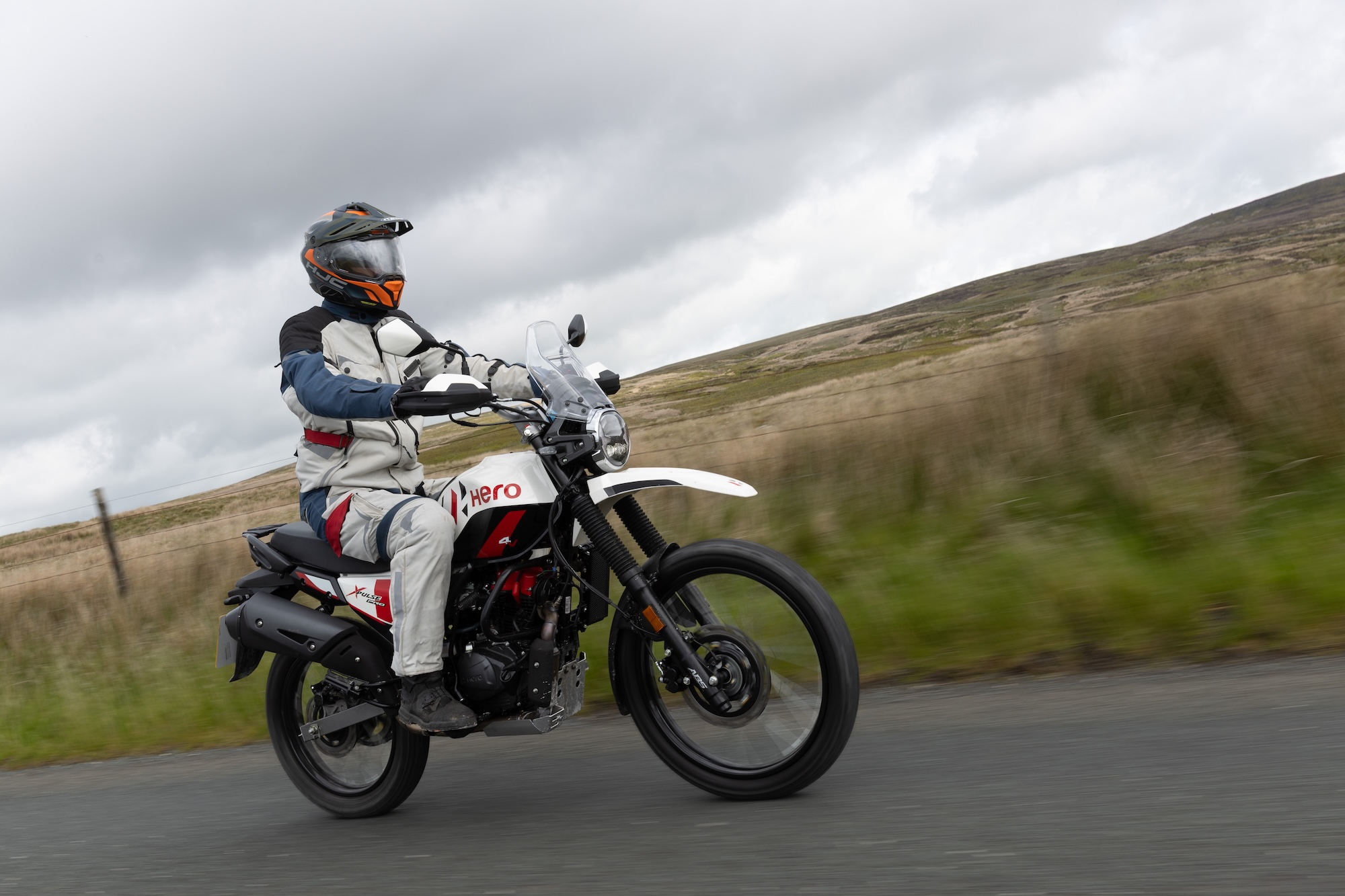
Hilariously, this is one of the machines I’ve been most excited about this year. Forget your mega-powered super-wahoozit-equipped bikes that cost more than I make in a year. The Hero XPulse 200 Pro, which I first spotted in a MotoGB warehouse back in January is the cheap and cheerful moto that has regularly been on my mind.
Priced at just £2,700, this India-made motorcycle undercuts pretty much everything in the market – even Chinese bikes. Hell, it’s so cheap that you almost can’t afford not to buy one.
Could this old-school-styled, old-school-engined, and astonishingly cheap dual-sport be any good? Recently, I travelled to the Forest of Bowland to spend a day riding (and crashing) the 199cc thumper in some of the most beautiful scenery Northern England has to offer. Here’s what I learned.

How we got here
Hero, often mis-identified as Hero-Honda, is one of India’s largest motorcycle manufacturers. It is huge. In the 2024-2025 fiscal year, it churned out an astonishing 19.6 million two-wheelers (motorcycles, scooters, and mopeds). Its most popular model, the Splendor, sells roughly 1 million units a year.
The company was founded in 1984 as a joint venture between Honda and bicycle-focused Hero Cycles – hence the confusion about the name. It used to be known as Hero-Honda, but that partnership ended 16 years ago. Since then, Hero’s been expanding: in India and globally. It currently operates in 48 countries around the world, with the UK having been added to the list late last summer.
Although Hero manufactures the X440 for Harley-Davidson in the Indian market (and is heavily rumored to be the company that will be producing the affordable Sprint model that H-D has been promising), it is much more a ‘cheap and cheerful’ brand than Indian counterpart Royal-Enfield.
The XPulse 200 Pro, and its lower-spec companion, the XPulse 200 4V, is an excellent example of that. It doesn’t get much cheaper, nor much more cheerful (at least not at this price).
The XPulse 200 and XPulse 200 Pro are Hero’s second and third bikes to be brought to the UK market, following the roll-out of the Hero Hunk 440 (terrible name, same spec as the Harley-Davidson X440) late last year. Hero MotorCorp CEO Harshavardhan Chitale says the company has introduced the XPulse 200 platform because it spotted a gap in the market. Respectfully, I call shenanigans on that claim.
The bike was first introduced in India back in 2019. In its home country, the platform has recently been upgraded considerably, now carrying a 210cc liquid-cooled single. We get the previous version here in the UK, driven by an air-/oil-cooled engine that is so old school it has a kickstarter.

The cynical side of me wonders if it’s not simply the case that Hero accidentally over-produced the XPulse 200. One can imagine a scenario in which the company had revealed the new XPulse 210 and some bean counter said: “Hold on. We’ve got warehouses full of the old engines. What the hell are we supposed to do with all of them?”
Looking at some reviews of the Hero XPulse 200 Pro, I’ve noticed a tendency by some mo-jos to draw comparisons to the Royal Enfield Himalayan 450. This comparison is unfair to both brands. It completely undersells the quality of Royal Enfield’s dual-sport and places expectations too high for the XPulse 200 Pro.
That’s not to say that Hero’s bike isn’t good, simply that there’s a reason for the £3,000 price difference (starting price on a Himalayan 450 is £5,750)
Design and build quality
The XPulse 200 Pro has a styling that is refreshingly unpretentious. Other manufacturers would struggle to resist the urge to give it some unnecessary fairing or bits that don’t make sense. This is a bike that seems to reflect the use case in its country of origin. It is built to tackle both the densely populated towns and cities of India, as well as its always bad roads.
The XPulse 200 Pro doesn’t look fancy, it looks functional. And it’s all the better for it.
Going forward in this review, I think it’s fair to point out that almost any criticism or moan I may have about the bike can be countered with the following statement: “Yeah, but it costs £2,700.”

Overall fit and finish, and build quality, aren’t bad, but they aren’t great. Nothing looks or feels overly cheap or flimsy, but it certainly doesn’t feel premium (“Yeah, but it costs £2,700”).
Perhaps the only thing that particularly stands out as problematic when just looking at the bike is the oil cooler. Hero has chosen to stick it out to the left of the engine (I‘d assume to ensure unrestricted air flow?), where it seemingly serves as protection for a crash bar. It flexes on its mounting when you touch it.
Seat height is a lofty 890 mm, made more manageable by a narrow seat and chassis. I’m 6-foot-1 and had no trouble getting both feet on the ground. If that seems too tall for you, check out the XPulse 200 4V. It is effectively the exact same bike, but with a less off-road-capable suspension. It has an 825mm seat height, and a £2,500 price tag.
The seat on either is firm but not insufferably so. Hero claims the XPulse 200 Pro is “designed for long distance comfort.” Again I call shenanigans, but the low-power nature of this motorcycle means it’s an unlikely choice for long hauls. The overwhelming majority of riders won’t be in the saddle for hours on end.
For a bike this tall, the rider triangle feels a teensy bit cramped; the handlebar a little too close. Although, that becomes a plus when you ride in a standing position. It feels comfortable and natural when adopting an ADV riding stance.
Hero claims a wet weight of 161 kg. The bike feels particularly light and manageable. YouTuber Mike Pye, who is a demonstrably better rider than me, was able to lift the front wheel from a stand still – using just suspension compression and muscle.

Engine and transmission
The XPulse 200 Pro is powered by a 199cc air-/oil-cooled single cylinder engine that Hero claims it designed and built from the ground up. Shenanigans?
This bike came out in 2019. That suggests that at some point in the 2010s somebody at Hero declared: “Hey, let’s make an engine that has roughly the look, power, and characteristics of the GS125 engine that Suzuki made in 1982, but have it be a four-valve.”
OK, sure.
The original XPulse 200’s engine had a carburetor! The current bike has a kickstarter. Hero designed an all-new engine in the 2010s that had a carburetor and a kickstarter?!
The XPulse 200 Pro also has an electric starter, which works just fine. Indeed, it works better than the kickstarter. It may be that inexperience played a part here (this was, in fact, only the second motorcycle I have ever ridden that had a kickstarter, the other being a Honda CG125 that I rode in 1994), but I found that the kickstart really only worked immediately after the engine had been shut off. Placement of the passenger peg doesn’t help; my heel kept catching the peg when attempting to kick down.
Anyhoo, claimed peak performance from this quirky powerplant is 19 bhp at 8500 rpm and 12.8 lb-ft of torque at 6500 rpm. That latter number means you’ll be cracking the throttle to the stop to get ahead of traffic at lights but it’s genuinely enough. And off-road, it means a less aggressive power delivery.

That’s not to say it won’t perform under the direction of a skilled hand. Mike Pye was hoisting the front wheel up for textbook wheelies at every opportunity. And Inch Perfect Trials instructor Sarah Bell was climbing literal walls with the thing.
On the road, there is mostly enough power for us mere mortals. Mostly. As long as you never venture onto a dual carriageway. Or an A road in the Fens (where many roads are flat and straight in a way that is conducive to speeding).
The fastest speed I was able to attain on the XPulse 200 Pro was 66 mph. That was downhill.
I will note, however, that it was composed at that speed – a fair bit of noise but no chaos. And anything below ~53 mph is pretty easily attainable. As you would expect, gear selection is important for steady progress but the bike has more push and shove than I was anticipating from something of this displacement.
So, it’s a very good choice for urban environments – and relatively viable if you live in someplace like West Sussex, where I live. The roads in my part of England are so crowded, poorly maintained, and surveilled by speed cameras, noise cameras, and AI cameras looking for a host of infractions that you don’t get much opportunity to exceed 60 mph. Often you’re lucky to manage 40 mph. The XPulse 200 Pro would do just fine.
The sound of the engine is a bit… regulations compliant. I’d like it to sound more dirt-bikey, less civilized. I am fully confident that the aftermarket has options, though.

The transmission is OK – what I would expect from a motorcycle costing £2,700. It’s smooth but has the feel of something that may need to be replaced sooner than you’d expect on a bigger, more expensive machine.
There is no slipper clutch here, obviously. It is a bike that will require you to remember all the stuff you used to know, like rev matching. I am so used to riding bikes with slipper clutches that I’ve gotten lazy. Coming into a turn on the XPulse 200 Pro, I chose to bang down a gear and had the rear end hop up on me: a frightening reminder of the need to ride well.
Chassis and brakes
Front suspension is fully adjustable on the XPulse 200 Pro. That’s unheard of on a motorcycle this affordable. The suspension is tall (250 mm travel on the front forks, 220 mm of travel on the rear shock) and capable of suffering a good amount of abuse. See above mention of Sarah Bell’s antics.
The bike works well in the hands of an idiot, too. Hero’s UK distributor MotoGB organized a route that included some trickier-than-I-would-have-chosen off-road terrain. Mud and rocks, and rocks and mud. So much mud. And so many rocks. Big rocks, just lying about the place in such a way that there was no obvious line. There were also deep ruts, little drop offs, and streams swollen by two days of heavy rain.
The bike’s suspension handled it all. I was impressed.
I think I would have been even more impressed with better tires. The XPulse 200 Pro is equipped with Metzeler Enduro 3 Sahara tires, which I would have expected to be quite good. It’s Metzeler, after all; I’ve ridden a number of other (larger) bikes with (different) Metzeler tires and never had complaints. Here, though, the tires seemed to lack grip in all situations.

There was little to no feel on the road. I never felt I could trust them to go hard through corners. And, indeed, they were pretty slippy on wet tarmac. They were even slippier on wet rocks and in mud. If I owned an XPulse 200 Pro, I think one of the first things I’d do is invest the time/money into finding better shoes.
Lack of confidence in the tires contributed to and was exacerbated by my lack of confidence in the brakes. The brakes are not good (“Yeah, but it costs £2,700”). Not awful. Not dangerously ineffective. Just not good.
Part of the reason for this is the fact that the rear wheel does not have ABS; only the front is equipped with antilock braking technology (which in itself is pretty basic). Hero claims that the rear has the tech, but there were no ABS rings on any of the rear wheels of the bikes we rode.
All of this means that it is entirely possible to lock up the rear. Especially when you’re using Metzeler Enduro 3 Sahara tires on a wet surface. Readers with a keen memory will recall, as well, that I have a bad habit of braking late (which I am working to correct). You can probably guess that I uttered a fair few profanities while getting used to this bike’s way of doing things.
Off road, of course, absence of ABS isn’t an issue. Related to this, the ABS system has three settings: Road, Off Road, and Rally. Off Road, and Rally. According to Hero, Road offers full ABS, Off Road turns off ABS entirely, and Rally turns off ABS in the rear only. The physical reality of the bike negates these claims.
In fact, you have two choices: a bike with ABS at the front, or a bike with no ABS at all. The system defaults to Road every time you restart the bike.
Side note: I find it surprising/interesting that this braking set-up is legal. I’ve done some digging into the EU/UK rules, and under Euro 4/Euro 5 regulations, motorcycles with a capacity greater than 125cc must have ABS, but the law only explicitly requires a single-channel (front wheel) system to pass homologation. Most manufacturers just do both because the tech is already there, but Hero went with the bare legal minimum, ostensibly to save money?

Off-roading the XPulse 200 Pro: The mud, the waterfall, and the crash test dummy (me)
An excellent suspension, gentle power delivery, and relative lightness all mean that the XPulse 200 Pro is well suited to someone like me, who lacks confidence off road. I really do feel that this is a bike that I could learn and grow on.
Even so, it would probably be a while before I intentionally took on the kind of off-roading that I experienced when testing Hero’s dual-sport.
The media ride was based out of Inch Perfect Trials (IPT), near Whitewell. Its organizers partially relied on the local knowledge of IPT’s instructors to map out an “easy” route for us media and YouTube types. But what’s easy for a trials instructor can be the sort of thing that instigates an attack of atrial fibrillation for laptop jockeys like me.
Perhaps the route had been easy when it was first plotted out in dry weather. After several days of rain, though, it was slippery and squishy: the rocks slick and the mud thick.
At one point, we were riding along a section of narrow, muddy track that had been deeply rutted on each side by tractor tires. Everyone ahead of me was riding in these tire-track ruts, so I naturally did the same until suddenly I remembered something that three-time World Enduro champion David Knight had told me the week before at the launch of the 2026 Ducati DesertX: often there is more grip in the space that other riders have not been.
However, David told me this when we were riding in dry, dusty, sandy terrain. I’m guessing he would have offered different advice for this situation. But I’m seemingly not clever enough to apply riding advice conditionally. So, I was feeling really pleased with myself – “This is what David Knight would do,” I thought – when I suddenly chose to move to the space between the two ruts.

This was not what David Knight would do. Anyone who has ever walked, cycled, ridden, or driven across a wet British farm field will be able to guess what happened. Because it hadn’t been squashed down by a tractor, the patch of muddy earth between tire ruts had the consistency of blancmange.
The bike’s not-so-grippy tires were able to grip even less than usual and the back end kicked wildly. Once again, my brain offered up some more ill-applied wisdom, this time from Motorcycle.com editor Ryan Adams: “When in trouble, just look where you want to go and give it gas.”
Upon reflection, that was also advice offered in the context of dry conditions. I didn’t consider that. I just looked steadfastly toward the horizon and opened the throttle. David Knight would not have done this, either. What had been thoroughly unpleasant now became unmanageable. The bike squirreled, there was a tiny moment in which I thought I had saved it, then I hit the ground.
Being thrown into the mud is like being tackled in rugby. The initial impact isn’t actually all that bad – I suppose because the force of the hit is more widely dispersed – but it is something you feel for days afterward.
Mike Pye caught the whole thing on his camera. If he’s willing to share the video with me I’ll upload it to the (very, very rarely used) Dancing the Polka YouTube channel.
He also helped me pick up my bike. When we looked at it, the most obvious issue was that the gear shifter had bent out of place. Fortunately, it is made of butter and we were able to shove it back into place with our boots.

The left hand guard, too, had been mangled. I was able to bend that back by hand. Whether the crash bar bent here or as a result of my second crash, I don’t know. Everyone was keen to get moving, so we didn’t spend a lot of time staring at the bike.
The second crash was predictable. To the extent that I think MotoGB’s team was actually surprised that I was the only one to bin their bike in this section. We had been warned about “the one tricky bit” of the off-road ride several times during the day. Warranty Manager Rod Geskell told me that he had nearly broken his leg attempting it. By the time we came to it, four members of the group had opted out.
It started with a water crossing – through a rushing stream deep enough to all but cover the XPulse 200 Pro’s 18-inch rear wheel. Then quickly up a steep and narrow, grassy/muddy path before turning onto an even steeper section of miniature boulders.
“When you hit this, don’t stop, just keep going,” Rod had told me. “You’ll never get up if you stop midway.”
When the boulders came into view I noted that rainwater was flowing down the hill. Effectively, I was attempting to ride up a waterfall. In my mind, Rod’s “just keep going” conflated with Ryan’s “give it gas” advice and I again twisted the throttle to the stop.
The bike bounced and bucked and snarled and kicked. I wasn’t steering or riding the bike so much as I was “holding on and intrigued to see how all this would turn out.” At one point, I veered off the rocky path into a hedge. Then back out of the hedge. Over rocks. Through a stream. I was looking where I wanted to go and could see that I wasn’t far from where the path evened out.
“Holy sh-it,” I thought. “I’m going to pull this off!”

I was wrong. Once again, this was not what David Knight would do. I slammed the bike head-on into a boulder. The bike came to a halt and again I tumbled to the ground. Again there was a need to kick the gear shifter lever into place but I got the bike started up. Someone (I can’t remember who) stepped forward to help lift the front wheel, taking the view that the best way to get past this enormous rock was to go over it.
Behind me, I could hear MotoGB’s PR man, Luke Brackenbury, shouting unintelligible instructions.
“Wait. What’s he saying?” I asked aloud. “Something-something is my friend?”
“He’s talking to someone else,” shouted the person trying to lift my front wheel. “Focus on this. Head up. Give it throttle!”
I lurched forward. Almost fell. Saved it. Almost fell. Saved it. And on and on. With no small amount of effort, I fought my way up the rest of the hill. Lucia Aucott caught some of my struggle in her Instagram post from the event.
“You are bright red, mate,” Mike laughed when I finally stopped – exhausted and wheezing. “Your face is like a tomato.”

It was only later that I observed the bent crash bar. MCN’s Justin Hazeldyn pointed out that the oddly placed oil cooler, seemingly so flimsy and at risk of damage, was fine.
“Perhaps that flexibility helps in crashes,” he joked.
Fancy bits and maintenance
It shouldn’t surprise you that tech isn’t really the XPulse 200 Pro’s ‘thing.’ There’s the questionable ABS settings, full LED lighting, a well-placed USB charger, and the baffling option of Bluetooth connectivity. That’s about it.
I say baffling, because the dash is LCD digital; it looks like a dash from 15 years ago. Nonetheless, it is apparently possible to connect your phone and gain turn-by-turn navigation in a little corner of the screen. I didn’t test this; I will admit to being skeptical.
When it comes to maintenance, however, there’s a lot more reason to be upbeat. This is the kind of bike you might buy just for the sake of teaching yourself how to wrench on things. A motorcycle doesn’t get much simpler than this.
Which is fortunate because it’s the nature of a bike like this that you’ll be servicing it more often. Hero suggests changing the oil, oil filter, and air filter every 3,000 miles. It suggests replacing the spark plug and checking valve clearance every 6,000 miles.
The bike comes with a tool kit. I did not check to make sure that every necessary tool is there for regular servicing, but, as I say, it should all be pretty straightforward. Everything is easy to access and understand. I can’t find any maintenance manuals specifically for the XPulse 200 Pro, but I’m pretty sure that a Haynes Maintenance TechBook would be all you’d really need.
Verdict
Look, if you’ve got more money to spend on a dual-sport motorcycle, you should probably spend more money. Especially if you’re looking for a dedicated dual-sport. The XPulse 200 Pro is far from perfect. Some of the components appear to have been made of old beer cans and will not stand up to a crash.
A secondhand Honda CRF300 Rally will give you twice as much in terms of durability, longevity, braking quality, and engine power. But, of course, a good-condition secondhander will cost you at least twice as much as the XPulse 200 Pro. And that’s the thing: maybe you don’t want to spend that much. Maybe you’re not that invested.
Throwing down in excess of £5,000 on a bike like this implies a seriousness and dedication to green laning and trail riding that you might not have. Maybe you’re a novice, or a fair-weather enthusiast. Maybe you live in the United Kingdom and are realistic about the limited number of places and times of the year where off-roading is possible (British weather means that riding conditions are often inherently exclusionary. It takes a higher level of skill/stupidity to ride in the slurry-like mud that is so prevalent on this sceptred isle).
Or perhaps the sort of road rider who looks at the incessant number of off-roading articles that fill motorcycle media these days and thinks: “Maybe I’d like that. I don’t know.”
The XPulse 200 Pro is a way to find out. In your own patch. At your own pace. According to your own schedule. And after all, not all of us want to be a Dakar hero. Some folks just want to be able to ride somewhere pleasant so we can stop, take in the scenery, and think: “Well, isn’t this nice? Isn’t it a lovely thing to be alive?”
In that context, the XPulse 200 Pro is perfect. The suspension is capable of everything a new/novice/learning rider is going to reasonably throw at it. Give it better tires (perhaps Pirelli MT21s?) and carry a spare gear shift lever on rides, and this thing will offer up all kinds of silly fun.
OK, sure: maybe one day you’ll outgrow it. Maybe you won’t. The price tag means it doesn’t matter.
Honestly: if I were gainfully employed (ie, not freelance and therefore unsure of when/where my next paycheck will come from), I would have already bought one of these. It’s hilarious, non-threatening, and ridiculously cheap. What’s not to like?

The three questions
Does the 2026 Hero XPulse 200 Pro fit my current lifestyle?
As a toy/hobby, yes. I don’t know how many legal byways and trails there are in West Sussex (whereas you could get away with fudging the law on a Zero XE, a screaming single-cylinder engine is going to make you pretty conspicuous) but the bike is so cheap that it’s hard to resist.
For all of the other riding I do it’s insufficient: underpowered and with a suspension, brakes, and tires that aren’t particularly well-suited to enthusiastic or long-distance on-road work. It’s definitely a second bike – not an only bike.
Did the 2026 Hero XPulse 200 Pro put a smile on my face?
Definitely. I crashed on the bike twice. I spent the next several days keeping paracetamol close at hand. Yet here I am saying that I would like to have one in my garage. This thing is all kinds of fun.
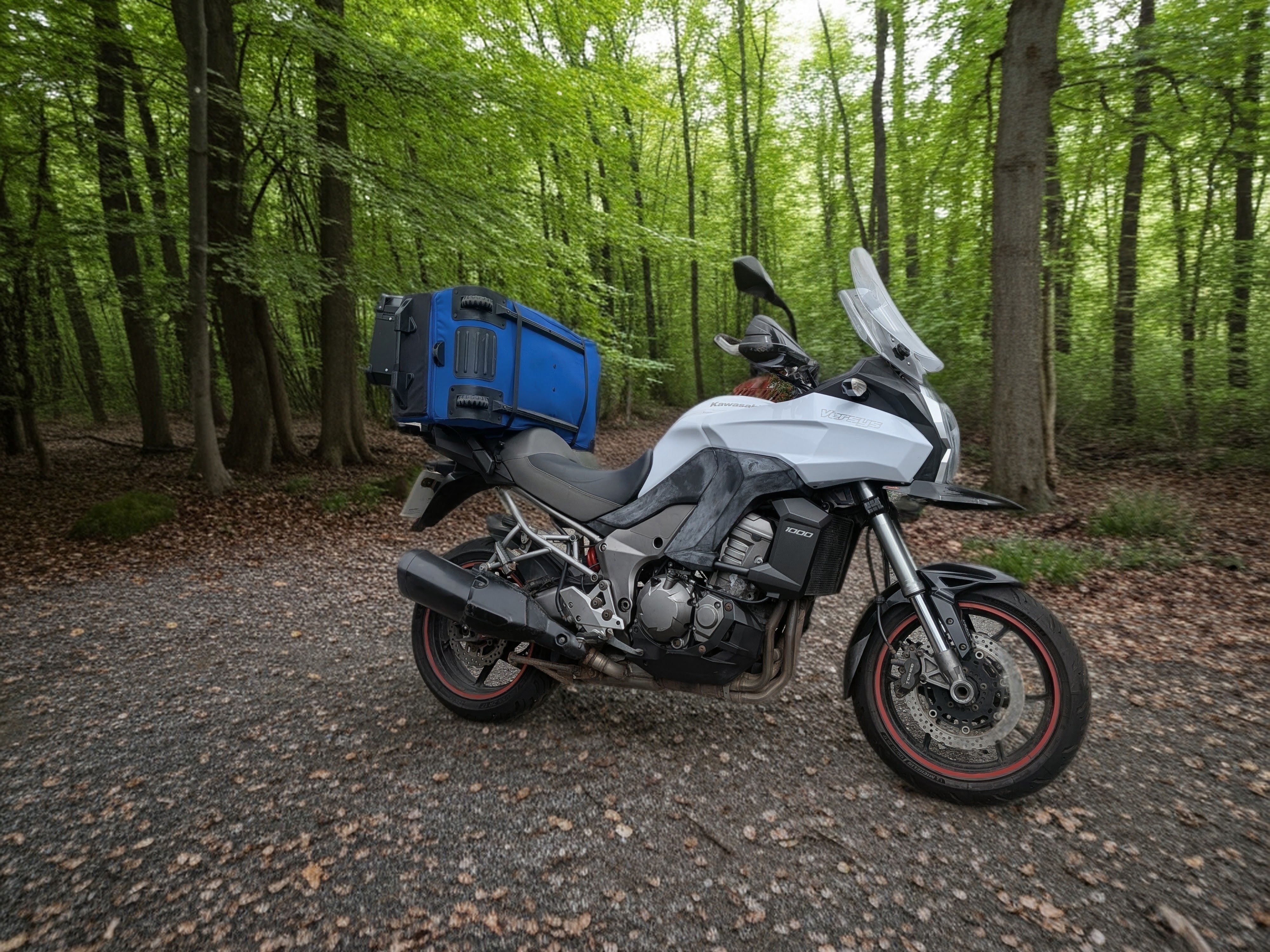
Is the 2026 Hero XPulse 200 Pro better than my current motorcycle, a 2012 Kawasaki Versys 1000?
Off road, yes. On road, no. Not at all.
Gear worn in photos
Helmet: HJC RPHA 60
Jacket: Spada Vanguard
Gloves: Richa Atlantic GTX
Pants: Spada Vanguard
Boots: Sidi Taurus GTX
Backpack: Oxford Aqua H2
2026 Hero XPulse 200 Pro specs
| PRICE | £2,700 |
| ENGINE | Oil-/air-cooled single cylinder |
| TRANSMISSION | Five speed |
| POWER | 19 bhp at 8500 rpm |
| TORQUE | 12.8 lb-ft at 6500 rpm |
| TOP SPEED | 71 mph (claimed) |
| SEAT HEIGHT | 891 mm |
| GROUND CLEARANCE | 270 mm |
| WEIGHT | 161 kg |
| FUEL CAPACITY | 13 liters |
| FRONT TIRE | 90/90-21 |
| REAR TIRE | 120/80-18 |
| FRONT BRAKE | 276mm petal disc with ABS |
| REAR BRAKE | 220mm petal disc |
| FRONT SUSPENSION | RWU adjustable telescopic 37mm diameter forks |
| REAR SUSPENSION | Adjustable mono-shock |



Leave a Reply