
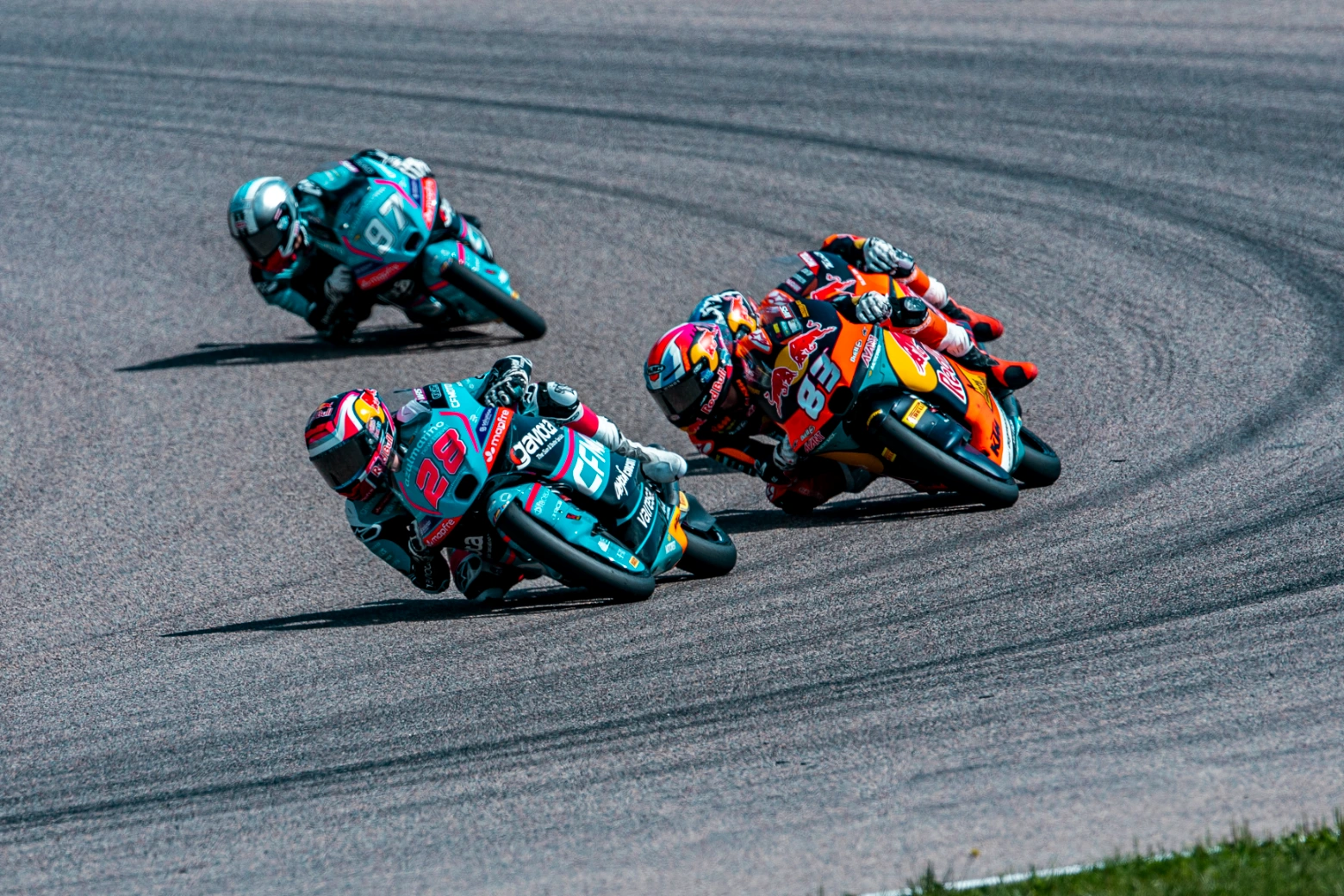
As of this writing, I have ridden five different motorcycles from three different Chinese brands: Voge, QJMotor (as well as its subsidiary, Morbidelli), and CFMoto. Some of these bikes have been good (Voge DS800X Rally), some have been excellent (CFMoto 1000MT-X) and they’ve all been at least “OK.”
But all of them have had the same problem. And beyond my immediate personal experience, based on reviews I’ve read and conversations I’ve had, it’s a problem that extends to most other Chinese (or Chinese-owned and -manufactured) brands: bad engine mapping.
Look at my reviews of the Chinese bikes I’ve ridden and the phrase “snatchy throttle” shows up in almost all of them. The bikes have a tendency to shudder and jump at low revs, sometimes seeming to be on the verge of stalling out. The severity of this condition varies, of course. On the DS800X Rally, for example, the issue was so bad that it knocked my opinion of the bike from, “Hey, this is something that you should actually consider buying,” down to, “Well, you could certainly do worse.”
Most people speculate/agree that emission standards are behind this. Europe has stringent environmental regulations that have presented and continue to present challenges for all manufacturers. There’s a reason Kawasaki doesn’t sell the KLR650 in Europe, for example, and it’s not because riders here don’t want one.

To quote Elton John, all the science I don’t understand – but for whatever reason, the act of getting a bike through red tape involves mangling its low-rev performance.
So, OK. That explains the challenge that Chinese manufacturers face. But it doesn’t explain why they haven’t overcome it. Remember: all manufacturers have to deal with these regulations. But you don’t see the same criticisms being levied against Japanese, American, or European motorcycles. It seems to be a predominantly Chinese issue. Why?
I mean, surely they have ears. Surely they’ve heard customers’ criticisms. Surely they’ve seen reviews like mine and dozens of others flagging throttle issues as the Achilles heel to bikes that are otherwise well-built, well-equipped, and attractively priced.
If almost everyone else has figured out how to get around the problem, why haven’t the Chinese? Especially considering Chinese manufacturers’ reputation for being “inspired” by the engineering of other brands.

I have no doubt that all of my personal information exists in a CCP database somewhere, so I don’t want to accuse anyone of stealing intellectual property, but it’s well known that many Chinese engine designs are eerily similar to those of established brands. The 645cc liquid-cooled V-twin that powers the QJMotor SVT 650, for example, is a dead ringer for the 645cc V-twin that was/is used in the Suzuki V-Strom 650 and SV-7GX.
So, why haven’t the Chinese been “inspired” to use the mapping set-ups that their Japanese/European/American competitors are using?
“It doesn’t work like that,” explained moto-journalist Adam ‘Chad’ Child recently. “The issue is software, not hardware.”
Chad and I were at the recent press ride for the 2026 Norton Atlas. We found ourselves discussing this topic of engine mapping with several other moto-journalists at dinner because the Atlas, too, has some mapping issues.

Or, at least it had them. As I explained in my review of the Atlas, the bikes we rode were pre-production models. Norton says, however, that it is fully aware of the issues and the customers’ bikes won’t be so afflicted. Only time will reveal the veracity of that claim but I’m inclined to believe Norton.
YOU MIGHT ALSO BE INTERESTED IN:
2026 Norton Atlas first ride review: A leap of faith?
Noting that Norton does seem to genuinely want to get things right, I asserted my feeling that Chinese manufacturers are aware of Western criticisms but that they simply don’t care. Chad hit back at this.
“They do care. They definitely do,” he said. “I can’t really go into why I know this, but, trust me: I’ve got some experience in this area. An engineer can look at hardware, take it apart, and replicate it. They can build an engine that looks exactly like another one, but it will perform differently because you can’t do that with software.
“Let’s say you and I want to put on a magic show,” he continued. “We’ve got the saw; we’ve got the wooden box; we’ve got the pretty lady. But we can’t replicate the trick just because we’ve seen it. There’s a real potential for error here.”

Not fully understanding his analogy, I tried to push back – pointing out that Chinese companies have demonstrated themselves to be extremely clever and motivated. In addition, Chinese manufacturers receive considerably more support from their government than manufacturers elsewhere.
“I’m pretty sure they’re capable of stealing code,” I said.
“Of course they are,” Chad replied. “But the algorithm for one bike is only ever going to work on that bike. The software is so specialized; it’s not cut and paste.”
An ECU algorithm relies on a complex Volumetric Efficiency (VE) table. Even if a Chinese brand reverse-engineers an engine, things like the intake airbox volume, the exhaust backpressure, the exact fuel injector spray pattern, and the sensor latency will be slightly different.

“So, you can take the algorithm of, say, the Ducati Panigale V4 and try to program it into the V4 that CFMoto’s developing, but it won’t work,” Chad explained. “Because CFMoto’s bike isn’t exactly like Ducati’s in every way. Even the tires make a difference.”
I’ll admit that I had never really thought of things that way; you can’t steal the software off one bike and have it work on another. So, it would seem that the reason Chinese manufacturers’ bikes are lacking in refinement is down to the fact that you can’t imitate refinement.
SOMEWHAT RELATED:
Value vs trust: Should you buy a Chinese motorcycle?
For “traditional” manufacturers like, say, BMW or Honda, that refinement is born of tens of thousands of hours of research and testing – knowledge accumulated over decades. Chinese manufacturers simply haven’t been competing at the same level for as long.
The bad news for those traditional manufacturers is that many Chinese brands – CFMoto being a prime example – are rapidly catching up. As Chad says, they definitely do care, and you can see that in the aggressive racing efforts of brands like CFMoto and ZXMoto.

The things they learn in competitive arenas will filter down to consumer bikes, and soon the only competitive advantage that traditional manufacturers will have will be name recognition and dealership experience.
Right now, the magic trick still belongs to the legacy manufacturers, even if their competitors have figured out how to build a cheaper wooden box. But how long until that changes? One year? Two? Three? The gap is undeniably closing, and when Chinese engineers finally master the software side of things, traditional brands will be fighting for their lives.
Make a one-time donation
Make a monthly donation
Make a yearly donation
Choose an amount
Or enter a custom amount
Your contribution is appreciated.
Your contribution is appreciated.
Your contribution is appreciated.




Leave a Reply