
I mentioned recently that the V-Strom 650 is no longer available in the UK market. If you want Suzuki’s iconic 645cc V-twin engine (first introduced in the SV650 some 27 years ago) your only current option for a new bike comes in the form of the very competitively priced SV-7GX.
The SV-7GX isn’t really an adventure bike, however. It falls more squarely into the ‘adventure-styled tall sport tourer’ class – mimicking its 1000cc sibling, the GSX-S1000GX. So, what if you want something more adventurey? You know: 19-inch front wheel, crash bars, boxy aluminum luggage…
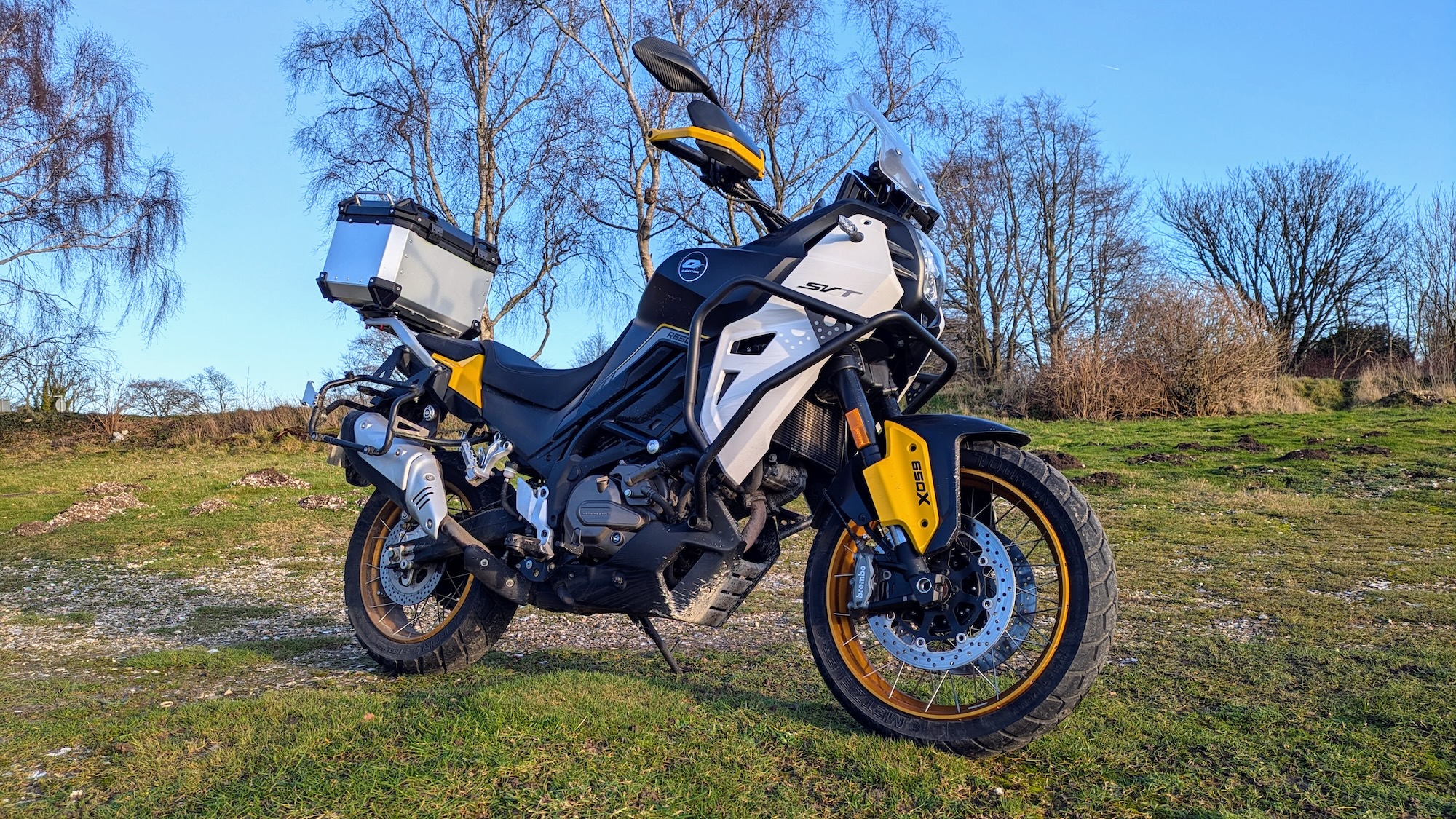
China’s QJMotor has the answer: the SVT 650 X.
The engine driving the SVT 650 X is clearly an homage to Suzuki’s powerplant. And by “homage” I mean QJ basically “designed” its engine by placing tracing paper on top of a schematic diagram of Suzuki’s engine.
But, hey, imitation is the sincerest form of flattery, right?
The starting price on a new SVT 650 X is £5,999. That’s £1,300 more than the QJMotor SRT 600 S, a bike that is nominally in the same class and which has a few more trinkets (eg, auxiliary lights).
Related: 2026 QJMotor SRT 600 S – Ride review
Having ridden the SRT 600 S, I was eager to find out what £1,300 buys you within the QJMotor context. Quite a lot, it turns out. The SVT 650 X is demonstrably better than its super-affordable cousin. But does that mean it’s actually a good motorcycle? Read on.

How we got here
QJMotor is one of the many brands owned by Chinese manufacturer Qianjiang Motorcycle Group. Headquartered in Winling, Zhejiang Province, it’s been in operation since 1985. Part of the massive Geely group (which owns Volvo, among others), it is one of China’s largest motorcycle manufacturers.
In addition to QJMotor, Qianjiang is also the force behind Keeway, Benelli, and Morbidelli. Having operated in Europe for a few years, QJMotor arrived in the UK market last year with a host of bikes with prices dramatically undercutting those of Japanese and European rivals.
Related: Value vs. trust: Should you buy a Chinese motorcycle?
The SVT 650 X was part of QJMotor’s initial line-up in the UK. I’m not able to find any data on sales, but in terms of anecdotal evidence, the SVT 650 X is certainly the QJMotor model that I’ve seen most often on UK roads.
That’s understandable. On the surface, it is an attractive proposition. And half of the bike, at least, is attractively styled. For £300 less, you can buy the alloy-wheeled (but otherwise identical) SVT 650, but if you pay the full £6k you get fancy spoked wheels that accommodate tubeless tires and full hard luggage in the form of panniers and top box.

Look, fit, and feel
At first glance, the SVT 650 X looks kinda cool. On second glance, however, it’s a bit awkward. It’s yet another Chinese motorcycle that appears to have been designed by AI.
The front half draws inspiration from the Husqvarna Norden 901. The back half has the generic commuter styling of the sort of moto you’d see locked up and abandoned in a London bike parking space. It is the motorcycling equivalent of a mullet.
Outside of that, it is a full-size machine. It looks the part. And, on the whole, the most important bits – the frame, the engine – seem well built. It’s not hard to imagine those things lasting a reasonably long time. Other aspects give me less confidence; if I were the owner of an SVT 650 X, I would definitely invest in buying big bottles of ACF-50 or XCP Rust Blocker.
The cheapness of the switchgear stands out in particular. The buttons look like they have been sourced from Fisher-Price; they have the quality of things found on children’s toys. You half expect the starter switch to make a “moo” sound when you press it.
This isn’t to say the switchgear is particularly flimsy, however. For the most part, it just looks cheap.

Meanwhile, the bash plate looks and feels durable, and the tubeless spoked wheels give the bike a sense of quality. Heated grips, heated seat, crash bars, and a center stand are also standard. In terms of brand-name stuff, you get Metzeler tires, Brembo brakes, and a fully adjustable Marzocchi suspension.
Throw a leg over, and the 835mm seat height creates a riding experience where you feel you’re sitting in the bike, rather than on it. Apologies to Alan Dowds, who hates when moto-journalists use that cliche, but I can’t think of a better way to explain it. The seat is low but the rest of the bike is of usual ADV proportion. So, it feels as if QJ built the thing then, at the last minute, thought: “Wait a minute, if the seat was lower it would appeal to more riders.”
It means that the pegs feel a bit too close, and the handlebar feels a bit too high. It’s not uncomfortable for a 6-foot-1 rider – I managed a 300-mile day without physical complaint – but it wouldn’t be my first choice in terms of rider triangle.
Looking straight ahead, you’ve got a 7-inch TFT screen, hidden behind a too-small windscreen. The TFT screen is hard to read in bright sunlight. The windscreen is one of the least effective I’ve experienced.

Engine and transmission
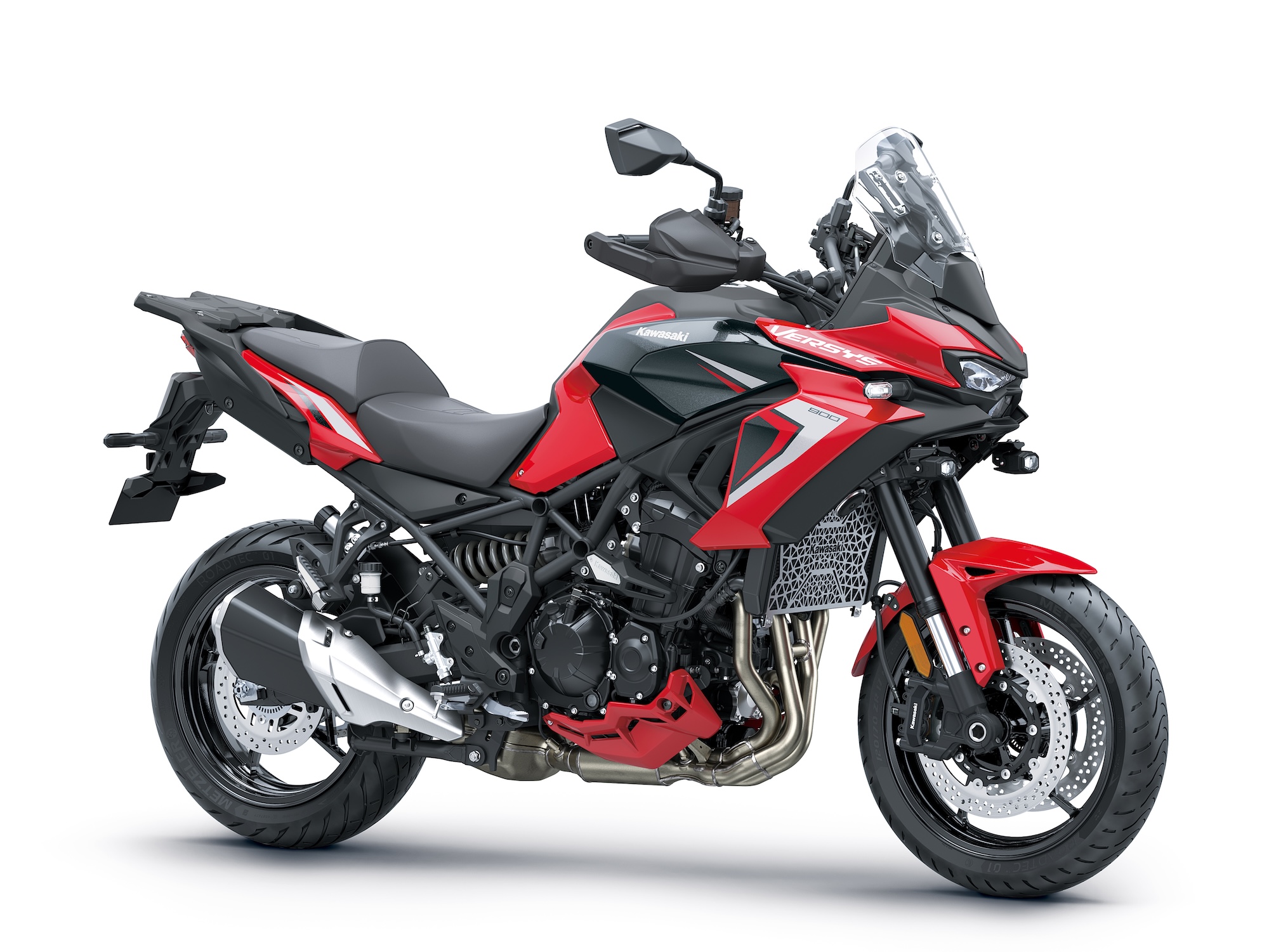
As mentioned, the SVT 650 X’s engine is heavily inspired by Suzuki’s much-loved 645cc V-twin. That means it produces a good amount of power and torque, all things considered. QJMotor’s 645cc liquid-cooled V-twin claims 75 bhp at 9000 rpm and 48 lb-ft of torque at 8000 rpm. Compare that to the 71 bhp and 45 lb-ft of a Suzuki V-Strom 650 or the 66 bhp and 45 lb-ft of a Kawasaki Versys 650 (starting price £8,049).
Getting up to and maintaining motorway speeds is effortless. Cruising at around 80 mph is not a problem. At lower speed, there’s enough torque to have fun. However, this is hampered by the surging issue that seems to afflict all Chinese motorcycles – or, at least, every one that I have ridden so far.
This is most notable when attempting to maintain a steady 30 mph through town. It’s not as bad as what I experienced on the Voge DS800X Rally, but it’s still annoying enough that it might put me off buying an SVT 650 X if I did a lot of in-town riding.
The six-speed transmission is laudably slick, with an easy clutch pull. There was a slight clicking noise upon gear selection that caused me to raise an inquisitive-suspicious eyebrow, but I’m not sure it was indicative of anything problematic.

Chassis, suspension, and brakes
The SVT 650 X’s fully adjustable suspension is certainly one of its strengths. This bike rides and handles better than I would have expected for a £6,000 motorcycle.
It’s a relatively nimble machine in tight spaces, making it a viable choice for filtering and tight city work (if you’re able to live with the engine surging). It’s also fun on country roads and lanes. When the pace picks up, it’s planted and reliable; I felt confident pushing hard into corners.
It’s a heavy ol’ thing, though; wet weight is 236 kg. Compare that to the V-Strom 650’s 216 kg, or the Versys 650’s 217 kg. You notice this primarily when pushing the bike around.
The Brembo calipers (note that they are mated to a non-Brembo master cylinder) perform well in the dry. Stopping power was reduced notably in the wet, which makes me think it’s a brake pad issue. Get rid of the OEM brake pads and replace them with something that works and I’m willing to bet that all will be well.

Features and flaws: Heated grips, bad windscreens, and dim headlights
The SVT 650 X has very good mirrors. That seems like one of those ‘damning with faint praise’ sort of things, but a lot of manufacturers have a bad habit of overlooking the importance of being able to see what’s behind you.
The quality of the bike’s aluminum luggage is also worthy of praise. I especially like the soft lining, with little pockets in the lid. However, the pannier rails stick out pretty far, making them look very much like an afterthought.
I mentioned that the TFT screen is hard to read in bright sunlight. That means it’s perfectly acceptable for 10 months of the year in the United Kingdom. Unfortunately, it is quite difficult to navigate. It’s the same nonsensical system used by the SRT 600 S, which means you’ll be left wondering: “Does this bike not have such-and-such feature (eg, an external temperature reading), or is it simply the case that I can’t find it?”
I also mentioned that much of the switchgear looks cheap. For the sake of balance, it’s worth noting that many of those toy-like buttons control features that would cost extra on a V-Strom 650 or Versys 650 – things like heated grips and a heated seat.
But, unfortunately, those fancy add-ons aren’t as fancy as you’d expect/hope. In both cases, there is only a choice of ‘on’ or ‘off.’ There are no settings. The heated grips are too weak to be felt through gloves. Only with bare hands could I tell that, yes, the grips were warm, but still not hot. The heated seat was equally unspectacular.

Meanwhile, the windscreen and the headlight rival each other for being the biggest disappointments on the SVT 650 X.
The headlight has a very narrow beam. In my voice notes on the bike (I record notes over the course of my time with a bike) I have described the headlight as “pretty not-good.”
It is not enjoyable to ride at night with this headlight. The beam is too focused, meaning that large parts of the world around you are hidden in darkness. If you’re planning to ride the SVT 650 X in the evening, you will definitely want to invest in some Oxford auxiliary lights.
While you’re adding aftermarket items, I’d suggest also hunting down a better windscreen. There are a few offered on Amazon from companies I’ve never heard of, so buyer beware, but it’s hard to imagine anything being a whole lot worse than the stock screen.
Actually, in fairness, the biggest problem with the screen is that it’s just in the wrong place. It’s too far away. Imagine a standard image of an aerodynamic vortex, where the shape of the aerodynamic forces look a bit like a comet. With the SVT 650 X’s windscreen, you are outside of the aerodynamic pocket.
If you lean way forward, chest almost to the handlebar, there is an OK-ish pocket of air behind the screen. Not big, not great, but OK-ish. If you sit naturally, however, the screen is so far away that the vortex ‘tail’ hits you in the chest, concentrating all of the elements – wind, rain, whatever else – right at your core. It’s a great way to make a cold, wet ride even more miserable.
The screen is adjustable, by the way, but not on the move. And moving it up and down has no effect on its being too far away.

Maintenance and reliability: Wrenching on the SVT 650 X
QJMotor suggests changing the oil, oil filter, air filter, and spark plugs every 7,500 miles. Valve clearance inspections are recommended for every 26,000 miles. The oil filter and sump bolt are where they should be but you will need to remove the bash plate to get at them. You will have to remove the fuel tank (as well as the seat and a few bits of fairing) to get access to the air filter.
It’s pretty standard stuff, made annoying by the fact that you will need both a Torx ratchet set and a metric set to do this.
The SVT 650 X is still a relatively new model, so there’s not a great deal of collective knowledge about the bike yet, but, I’ve dug around on the internet and found that, reassuringly, there don’t appear to be too many red flags. Most owners highlight frustrations with poor fuel mapping (hence the surging) and the subpar windscreen. Outside of that, I don’t yet see many reasons to be concerned about reliability/longevity.

Verdict
The SVT 650 X is definitely one of those “look at the price tag” bikes. It’s not perfect, but look at the price tag. That said, with a better windscreen and some auxiliary lights it would be quite an enjoyable machine to own. If QJMotor would do something about the fuel mapping – something that it could theoretically offer to existing owners if it were so inclined – it would be even better.
Sure, you’d need to be persnickety about keeping it clean, but there are plenty of European and Japanese bikes that don’t appear to have been made for outdoor use. Elbow grease increases your affection for a motorcycle. And, indeed, there are things here to like.
The bike handles well, its engine offers a good amount of shove, and it looks good. Or, well, the front end does.
The thing is, though, I’m not sure there’s a particularly compelling argument for buying this over a good-condition secondhand V-Strom 650 XT. I mean, £6,000 will buy you a pretty good Strom. And the thing is: the reason the V-Strom is so beloved, the reason it has a cult following, is not really because of its engine character.
Sure, its V-twin is charming and tractable (and in Suzuki’s hands it doesn’t surge), but its real selling point comes in its durability and reliability. The V-Strom 650 is a bulletproof workhorse. People ride those things around the world without issue.
The QJMotor SVT 650 X hasn’t really been around long enough to prove itself one way or another in that context. But certain elements (eg, cheap-o switchgear) make me wonder.
At the same time, in His Majesty’s United Kingdom, at least, there are no new V-Strom 650s anymore. Which means you won’t find one with the SVT 650 X’s two-year warranty. You won’t find one with a fancy TFT screen, either. Nor a fully adjustable suspension.
So, you pays yer money and you takes yer choice, as they say. To that end, when I’ve seen an SVT 650 X out in the wild, there’s been a part of me that’s thought: “Solid choice.” After all, it may very well turn out to be as reliable as the bike it’s copying. Only time will tell.

The three questions
Does the 2026 QJMotor SVT 650 X suit my current lifestyle?
With a better windscreen (and auxiliary lights), yes. It can go wherever I want to go and do whatever I want to do. Although, the rider triangle is a bit squished for a 6-foot-1 rider.
Did the 2026 QJMotor SVT 650 X put a smile on my face?
Yes. Initially. That smile disappeared somewhat when I had to ride in the rain and when I had to ride at night. It returned when I had a sunny day on country roads.
Is the 2026 QJMotor SVT 650 X better than my current motorcycle, a 2012 Kawasaki Versys 1000?
Uhm, no. I mean, yeah, it’s newer, but outside of its TFT screen and LED lighting it doesn’t have any tech that my bike is missing. In fact, it has less. My bike has traction control (in fairness, the SVT 650 X doesn’t really need it). My bike is also more powerful, more comfortable, more practical, better handling, has a better engine, is known to be reliable, and weighs only 3kg more. There is also a Haynes Manual for the Versys 1000, which means I’m able to work on it without having to guess.
2026 QJMotor SVT 650 X specs
| PRICE | £5,999 |
| ENGINE | 645cc liquid-cooled V-twin |
| TRANSMISSION | Six speed |
| POWER | 75 bhp at 9000 rpm |
| TORQUE | 48 lb-ft at 8000 rpm |
| TOP SPEED | n/a |
| SEAT HEIGHT | 835 mm |
| GROUND CLEARANCE | 170 mm |
| WEIGHT | 236 kg |
| FUEL CAPACITY | 20 liters |
| FRONT TIRE | 110/80 R19 Metzeler Tourance |
| REAR TIRE | 150/70 R17 Metzeler Tourance |
| FRONT BRAKES | Sunstar twin 320mm disc with four-piston radial Brembo calipers with Bosch dual channel ABS |
| REAR BRAKE | Sunstar single disc 240mm with Brembo single piston caliper and Bosch dual channel ABS |
| FRONT SUSPENSION | Marzocchi 43mm adjustable USD forks |
| REAR SUSPENSION | Marzocchi adjustable mono-shock |


Leave a Reply