

A lot can happen in a decade. So, earlier this year, when I got a chance to spend a day riding an Africa Twin as part of the RAPID Training experience, it should not have surprised me to discover how different the bike is from the last time I’d ridden an Africa Twin – a decade ago.
RELATED:
2016 Honda CRF1000L Africa Twin – First Ride Review
And yet, some part of me was surprised. Back in 2016, I’d ridden an Africa Twin into some mud, crashed, snapped off a mysterious and seemingly irrelevant piece of fairing, and logged the bike in my brain as: “Good, but not the Wundermotorrad that everyone’s hyped it to be.”
Compared to the Suzuki V-Strom 1000 I owned at the time, it felt underpowered and not as well-balanced.
But the Africa Twin of 2026 is so different from the Africa Twin of 2016 that it almost feels misleading to apply the same moniker to both. For one thing, there are now multiple flavors of Africa Twin. The specific model I rode was a 2026 CRF1100L Africa Twin Adventure Sports ES with manual transmission. I will refer to it simply as “Africa Twin” going forward because writing the full name is tedious.

Although, it’s worth noting that on certain parts of its UK website, Honda refers to it simply as “Adventure Sports,” with the old Africa Twin name going more consistently to the off-road-focused CRF1100L Africa Twin.
Confused? Wait until you wade into all the variations of each sub-model. By my count, there are five different current motorcycles that could (and do) carry the Africa Twin name. Equipped with a 19-inch front wheel and most of the comfort accoutrements you’d expect from a touring-focused machine, the Africa Twin Adventure Sports ES is a more road-focused motorcycle.
As of this writing, its starting price is £16,499. Or £17,799 if you want the one that’s equipped with DCT. The question to ask about the Africa Twin is not whether it’s any good – it most certainly is – but whether it’s fully deserving of its price tag. After all, a Chinese bike like the CFMoto 1000MT-X offers you a lot of the same specs and features for roughly half the price.
YOU MIGHT ALSO BE INTERESTED IN:
Five Used Adventure-Touring Motorcycles For Less Than £5,000
Some background
The origin of the Africa Twin stretches back more than four decades, to 1982, when Honda achieved its first victory in the Paris-Dakar Rally. The feat was achieved on a heavily modified XR500R.
The win inspired Honda to sink more effort and money into rally bikes and in 1986 it came up with the NXR750R, which ultimately paved the way for a production version: the 1988 XRV650 Africa Twin.

That bike was powered by a 647cc liquid-cooled V-twin promising 57 bhp and 41 lb-ft of torque. In 1990, capacity was boosted to 742cc and the Africa twin became the XRV750. In 1993, the platform was dramatically overhauled: capacity became 750cc, the frame and chassis fully revamped, and the styling reworked. Less dramatic updates came in 1996 and 2000. Then, around 2003, it was dropped from the Honda line-up.
It is not uncommon to still still see those old Africa Twins being ridden and abused around the world. Which is why Honda’s axing of the platform, seemingly attempting to replace it with the XL700V Transalp (2008-2012) and XL1000V Varadero (2001-2010), didn’t really work. Almost as soon as the Africa Twin disappeared riders were calling for its return.

They didn’t have to wait long. In 2014, Honda began teasing an all-new take on the platform with its “True Adventure” series of emotive, inspirational videos – complete with swelling music, two-second flashes of adventurous people doing adventurous things, and postcard vistas.
The bike was finally revealed in 2015, powered not by a V-twin but a 998cc parallel twin. It arrived in dealerships early the next year. It was an instant hit, praised to the hilt by seemingly everyone. I cannot remember reading any negative reviews of the bike; mine was the only one I’m aware of that was even lukewarm.
Yet, for whatever reason, the platform was dramatically overhauled in 2019. Engine capacity was boosted to 1084 cc, giving the Africa Twin moderately more horsepower and torque, minor build quality issues (eg, rusty spokes) were addressed, and a kapow-whizbang electronics package was introduced. Most importantly, the problem that Honda had previously seemed to want to solve with its Transalp/Varadero split was now resolved by offering the more off-road-focused Africa Twin and more road-focused Africa Twin Adventure Sports.
Additional refreshes of the platform came in 2021 and 2024. A decade on, this iteration looks better, feels better, and rides better. Ten years of development have genuinely benefitted the platform.

Look, Fit, and Feel
The Africa Twin Adventure Sports is a formidably sized machine. Possibly intentionally.
There is a tendency for people to slot it into competition against bikes like the BMW R 1300 GS, Triumph Tiger 1200, or Harley-Davidson Pan America 1250. Those bikes are considerably more powerful than the Africa Twin, which has a spec sheet that competes more directly against bikes like the Suzuki V-Strom 1050.
The Africa Twin’s price tag, however, is more in line with those larger-capacity machines. So, I suspect that Honda has made it physically bigger on purpose. It is not overwhelming, however, and there is something very charming about the fact you can see design cues from the original Africa Twin.
Build quality, as you would expect from Honda, is excellent. Everything looks and feels sturdy; it’s not hard to imagine that we’ll be seeing these bikes still being used and abused in the 2050s – and beyond. I often argue that Chinese motorcycles are right on the cusp of drawing level with traditional manufacturers, but when you look at and ride a Honda that day seems a little further away.

Throw a leg over the saddle (adjustable to two heights – 850mm and 870 mm – with the option of an 825mm low seat), and you are once again confronted by the Africa Twin’s Hondaness: a bike that immediately feels right.
Digressing here a bit: it’s wild that Honda is able to build so many different motorcycles that are so instantly rideable, while some manufacturers aren’t even able to make one.
Anyhoo, ergonomics are perfect. The riding position is natural and comfortable and everything makes sense. Well, almost everything. It wouldn’t hurt Honda to replace the Africa Twin’s switchgear with that of the XL750 Transalp. That bike’s handlebars are not overly cluttered by buttons, whereas on the Africa Twin it looks as if someone has superglued a graphing calculator to the left grip.
I reckon it takes several days and possibly a special course to get comfortable with the Africa Twin’s myriad buttons and switches. The good news is that the bits that matter are straightforward, so you can get on and go without fuss.
Looking straight ahead, you’ve got a 6.5-inch TFT touchscreen that offers both Apple CarPlay and Android Auto. Beyond that, a five-level adjustable windscreen does a reasonably good job of keeping weather off, though taller riders will still experience buffeting.

Engine and Transmission
The Africa Twin’s 1084cc liquid-cooled parallel twin engine claims peak outputs of 100 bhp at 7500 rpm and 82 lb-ft of torque at 5500 rpm. As mentioned above, that horsepower figure won’t win any blue ribbons against the competition, but the bike’s meaty torque figures make the spec sheet a little more palatable.
But if you caught my appearance on the Moto Adventurer Unscripted podcast recently, you’ll know that I don’t put a huge amount of stock in spec sheets. What matters is feel and character. The feel here is one of unflappability. Words like “snarling” or “wild” don’t apply. The spirit is not one of Widowmaker, Pecos Bill’s untameable horse, but of a highly proficient machine that is fully capable of entertaining all your idiot notions of derring-do.
And it’s worth pointing out that the bike absolutely makes the most of what it’s got. As part of the RAPID Training event, I spent some time riding this bike on a track, where I discovered that it pulls easily to 87 mph in third gear.

On top of that, firing order, as you would expect of a modern adventure bike, is 270 degrees. That means the engine’s character is a little more in line with that of the V-twin that the Africa Twin used to be.
Power delivery is smooth, with torque poured on with syrupy, unbroken consistency. There are multiple ride modes, of course – six in total – but they all perform well. Or, at least, all those that I tested. I didn’t take the bike off road, nor spend any time trying to create a bespoke setting with the two User modes.
The Africa Twin platform has long been a showcase for Honda’s Dual Clutch Transmission (DCT) set-up. The model I was riding, however, had a manual transmission that was so slick and perfect that it makes you question the need for DCT, or even E-Clutch, which is rumored to be coming to the Africa Twin very soon.
Gear shifts are smooth, reliable, and exactly what you’d expect from Honda.

Chassis and Brakes
Ten years ago, one of the things riders crowed about in reviews was the fact that the Africa Twin was so well-balanced. I didn’t really find that to be true. That is to say, it was well-balanced but not more so than a more affordable V-Strom 1000.
The Africa Twin of today, however, easily lives up to the hype of a decade ago. It is instantly manageable, inspiring confidence and helping to quiet that wobbling little voice in your head that is always looking at what you’re doing and saying: “This could really go wrong.”
Meanwhile, the “ES” in “CRF1100L Africa Twin Adventure Sports ES” stands for “electronic suspension.” Specifically, the bike is equipped with a Showa Electronically Equipped Ride Adjustment (Showa-EERA) that Honda says delivers “optimum damping, all the time.”
The system has five settings – Soft, Mid, Hard, Off-Road, and User – and allows you to swap between modes, as well as adjust rear spring preload, while riding. In application, the system works brilliantly. It adjusted with ease to the notoriously bumpy and potholed roads of Northern England, allowing me to hustle confidently through corners.

The Africa Twin is not a sportbike, but within the context of its being an adventure machine it is agile. What’s interesting to me is that the Africa Twin is so nimble, in fact, that it makes the Honda NT1100 – a bike that shares many components with the Africa Twin but which is explicitly designed for road use – feel cumbersome by comparison.
Brakes are similarly excellent. If you read about my experience at RAPID Training you will know that one of the things I learned about my riding was that I had a bad habit of braking late. My instructor was able to identify this in part by the fact that I was triggering the ABS.
When she pointed this out I had a moment of thinking: “Wait. I was triggering the ABS??”
I hadn’t fully picked up on that because the system on the Africa Twin is so controlled and effective. Honda: making your bad riding better.

Rider Aids and Other Fancy Bits
I’ve already moaned about how cluttered the switchgear is. That’s largely my only criticism of the fancy stuff on this bike, and there is loads of it:
Rider modes, electronic suspension, seven different levels of cornering traction control, cornering ABS, three-level wheelie control, three levels of engine braking, four levels of power delivery, Emergency Stop Signal (the hazard lights flash under hard braking to warn motorists behind you, USB ports, cornering lights, self-canceling indicators, heated grips, handguards, and, of course, the aforementioned 6.5-inch TFT screen with Bluetooth connectivity and the ability to run either Apple CarPlay or Android Auto.
As I mentioned in my video review of the Ducati DesertX, I’m rarely impressed by technowhizzbangery. Especially if, as in this case, it results in grips that are littered with confusing buttonry. But I’ll concede that most of the stuff on the Africa Twin is at least useful. If you’re the sort of person who makes motorcycle purchasing decisions based on how effectively the bike will integrate with your phone, Honda’s got you covered here.
But, yeah, I still think there are too many buttons – to the extent that they strike me as hazardous. All those buttons, and the brain space/focus needed to navigate them while moving, create a distraction that can lead to some very unhappy moments if you’re trying to fuss with them in the dark or traffic.

Service and Maintenance
Honda suggests replacing the oil every 8,000 miles, the oil filter every 16,000 miles, and the spark plugs every 32,000 miles. Valve clearances should be checked every 16,000 miles.
The air filter is labelled as an “air cleaner” and Honda says it should be dealt with every 16,000 miles. It also says you shouldn’t touch it. The Africa Twin owners manual states: “Do not perform the maintenance. Should be serviced by your dealer.”
I call shenanigans.
Because Honda doesn’t want you touching it, I don’t really know where the air cleaner is. I’m sure there are plenty of home mechanics on YouTube who can help you find it and figure out how to clean it without having to pay a dealer.
Outside of that, servicing is pretty straightforward. You’ll have to remove the bash plate to access the sump plug and oil filter but it’s otherwise an oil change as you know it.
The Africa Twin also comes with a tool kit that contains all the bits you need for basic servicing. It’s located in a tool box that sits just above the engine (no need to remove the seat).

Verdict
The Africa Twin ain’t cheap. Truth is, Hondas are rarely the most affordable option in a segment. But I think it’s fair to say that they are priced according to what they’re actually worth.
When you ride a bike like the Africa Twin, you find yourself regularly being reminded of its Hondaness – a quality that makes you think: “Ah, yes. That’s where the money goes.”
So, yeah, this motorcycle is markedly more expensive than a Chinese equivalent, most of which will be more powerful or have even more electronic wizardry. But in ways that really only reveal themselves as you ride – over hours, days, weeks, months, years, and, since we’re talking about an Africa Twin here, decades – it is also markedly better.
For my personal needs and tastes, I’d wonder if I wouldn’t be just as happy or happier with an XL750 Transalp, but there’s no denying the fact that this is an excellent motorcycle.
I find that it’s often the case that people will read my reviews after they’ve bought a bike, basically combing the internet in search of affirmation rather than advice. Since the CRF1100L Africa Twin Adventure Sports ES hasn’t really changed in two years, it’s entirely possible that’s why you’re here. If that’s the case, congratulations: You made a very good purchase.
Keep up with maintenance and a reasonable amount of cleaning, and you’ll probably still be riding it around 20 years from now. I will be jealous of you then, just as I am jealous of you now.

The Three Questions
Does the 2026 Honda CRF1100L Africa Twin Adventure Sports ES fit my current lifestyle?
Without doubt. It’s everything that I need and want. Plus a little more. The only reason I’m not riding around on one right now is the fact that moto-journalism is a terribly paid profession.
Did the 2026 Honda CRF1100L Africa Twin Adventure Sports ES put a smile on my face?
Easily. Admittedly, I was having a lot of fun taking part in the RAPID Training event, so it wasn’t just the bike giving me feels. But there’s no question that the Africa Twin made my day better.
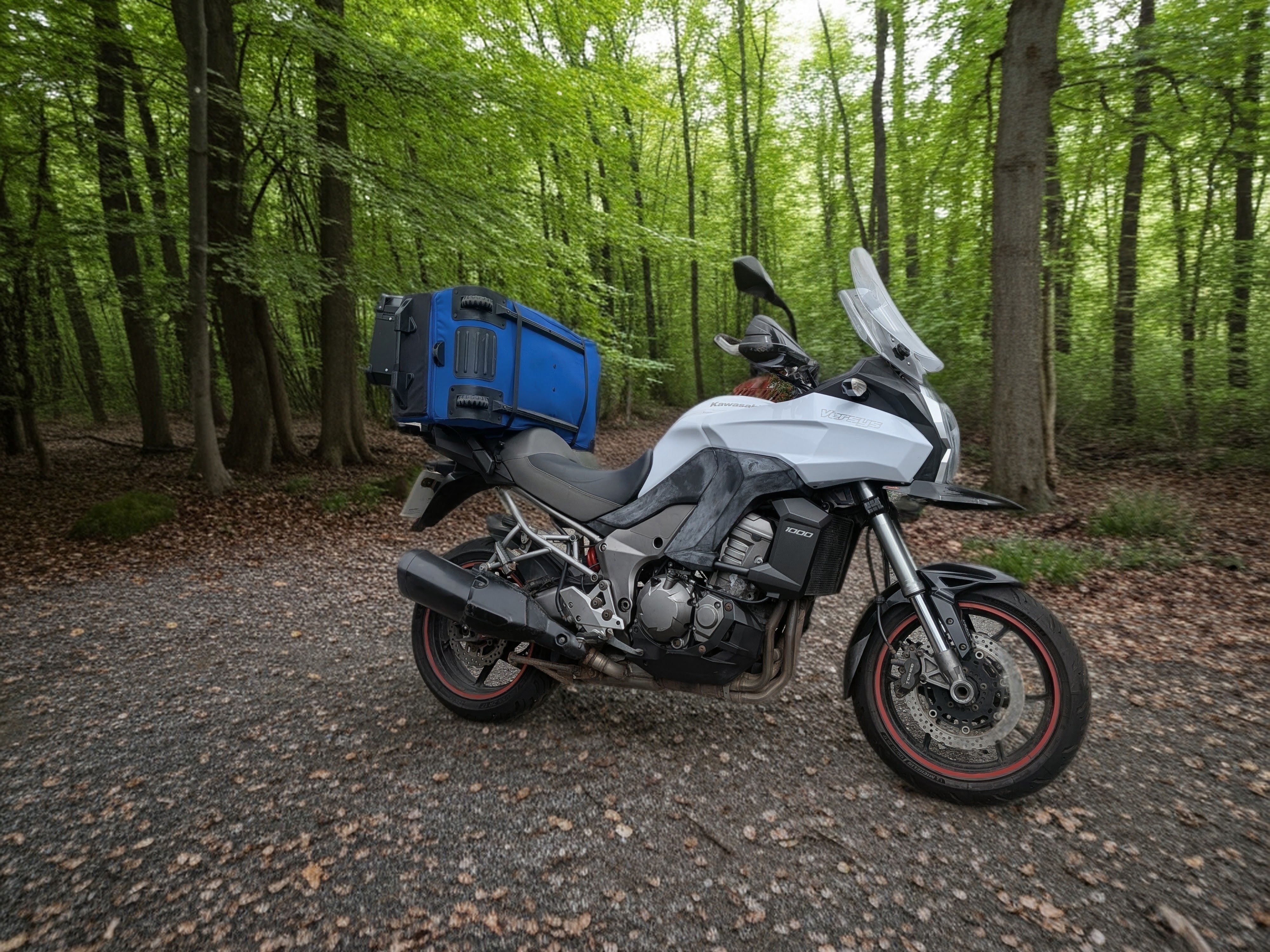
Is the 2026 Honda CRF1100L Africa Twin Adventure Sports ES better than my current motorcycle, a 2012 Kawasaki Versys 1000?
Yup. In pretty much every way. The Givi AirFlow screen I’ve put on my bike is better than the OEM screen on an Africa Twin, but it’s an aftermarket product. I’m sure the same sort of thing could be found for the Honda.

Gear Seen in Photos
Helmet: Shoei Neotec 3
Riding Suit: LS2 X-Master
Gloves: Richa Atlantic GTX
Boots: Richa Oberon
2026 Honda CRF1100L Africa Twin Adventure Sports ES Specs
| Engine: | 1084cc liquid-cooled parallel twin (270° crank) |
| Power: | 100 bhp (75 kW) @ 7,500 rpm |
| Torque: | 82 lb-ft (112 Nm) @ 5,500 rpm |
| Transmission: | Six-speed w/ optional quickshifter |
| Seat height: | 850/870 mm (Low seat option of 825 mm) |
| Ground clearance: | 250 mm |
| Weight: | 233 kg |
| Fuel capacity: | 18.8 liters |
| Front tire: | 110/80-R19M/C 54H (tubeless type) |
| Rear tire: | 150/70R18M/C 70H (tubeless type) |
| Front brakes: | 310mm dual wave floating hydraulic disc with aluminium hub and radial fit 4-piston calipers and sintered metal pads |
| Rear brakes: | 256mm wave hydraulic disc with single piston caliper and sintered metal pads |
| Front suspension: | SHOWA Telescopic inverted fork with an inner tube diameter of 45mm, and electronic control unit (SHOWA EERA) with compression and rebound damping adjustments, 230mm stroke |
| Rear suspension: | Monoblock aluminium swing arm with Pro-Link with SHOWA gas-charged damper, hydraulic remote control preload adjuster and electric control unit (SHOWA EERA) with compression and rebound damping adjustments, 220 mm rear wheel travel. |
Make a one-time donation
Make a monthly donation
Make a yearly donation
Choose an amount
Or enter a custom amount
Your contribution is appreciated.
Your contribution is appreciated.
Your contribution is appreciated.
Leave a Reply