
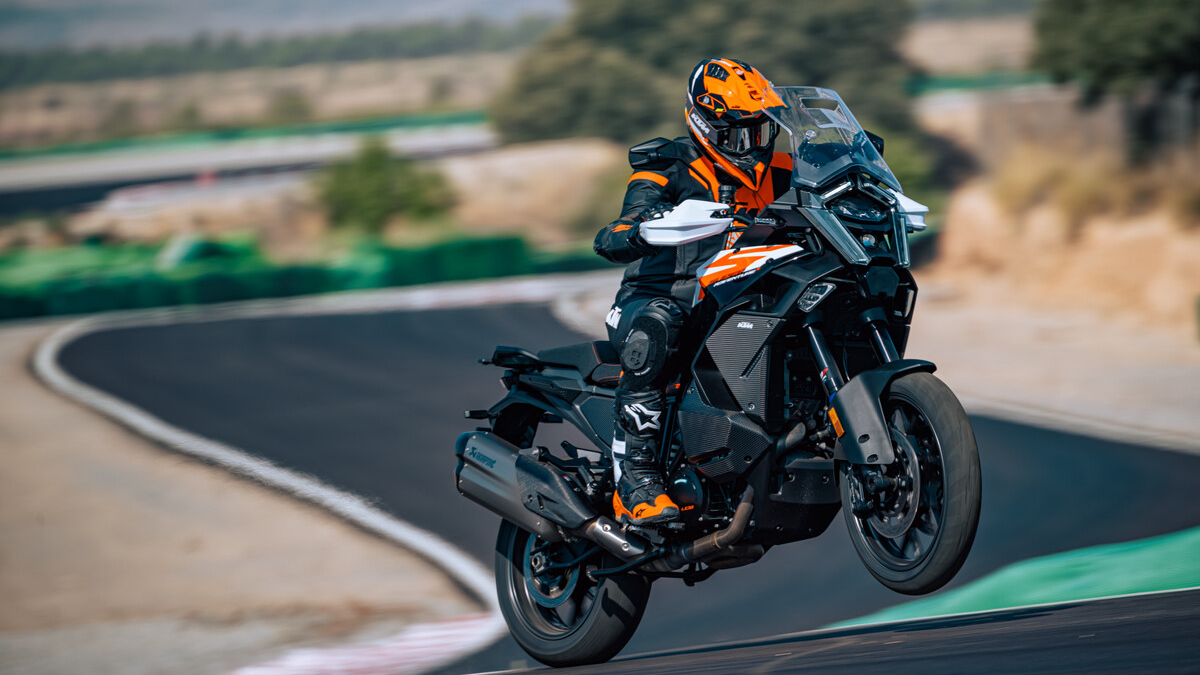
I’m beginning to wonder whether KTM’s problems are so extensive that the brand is doomed. Which is a prospect that, in a weird and sadistic way, I find kind of exciting.
Don’t confuse my meaning there. I’m not eager to see a bunch of people lose their jobs, nor for thousands of motorcyclists to suddenly find themselves riding around on bikes with no support network. It’s more of the excitement of watching a house burn down. That sense of: “Oh, this isn’t good… but since it’s happening, I’m here to watch.”
Back in October, I made a few observations about the currently unsteady nature of the motorcycling industry (largely in Western countries) and wrote: “I doubt that KTM is doomed. People love to predict the downfall of a brand when it hits rough patches, but they’re usually wrong.“
However, some news that came out last week has me reconsidering that statement.
The phrase that rings alarm bells…
On Friday, MCN reported that “KTM AG will require an investment of at least €100 million” and that the Austrian motorcycle manufacturer is “negotiating a bridge loan in the ‘three-digit million” range.’”
The two words to zero in on and start panicking about here are: “bridge loan.”

In general, bridge loans are a very bad idea, saddling the debtor with high interest rates that compound frequently ─ sometimes even daily. Hitherto, I’ve only ever heard of them being used in a real estate context. A scenario for using a bridge (or “bridging”) loan might go like this:
You’ve decided to buy a new house and will use the sale of your current house to pay for it. You find your new house, and have all your ducks in a row, ready to move, when the mortgage falls through for the person who is set up to buy your current home. That could mean that everything blows up and you start again from square one. Or, because you are practically in the door of your new place and sooo eager to move and sooooo certain that your current house will sell in a relatively short amount of time, you could get a bridge loan. It bridges the gap between now and when (you think) you’ll definitely have money.
Bridge loans are inherently risky. They assume a lot of things will go right, which is interesting and counterintuitive because you more often than not turn to a bridge loan when things are going wrong. And there are a lot of things going wrong at KTM right now.
The wheels have come off…
According to MCN, net debt for KTM parent company Pierer Mobility AG (which also owns Husqvarna and GasGas, and has 50.1% ownership of perennial motorcycling albatross MV Agusta) has risen to around €1.5 billion. That’s billion with a ‘B.’ That’s roughly the annual GDP of Grenada.
KTM has fired just shy of 600 people this year, and there are rumblings of another 300 positions being scrapped in the next few months. Those who are keeping their jobs will be working less, with KTM reducing production at its Austrian plant to a single shift ─ affecting some 1,000 workers. That will come after a two-month work freeze in January and February, designed to help the company reduce inventory.

You will remember from high school the basic concepts of supply and demand: theoretically, you can charge more when you have less. At present, KTM has way too much relative to the market demand for its products. It seems not that many people want overpriced motorcycles that are famous for electrical faults and camshaft issues. Funny how that works.
Here in the United Kingdom, KTM’s desperate attempts to get rid of stock are downright stunning. At Blade KTM in Swindon, for example, you can presently get a £10,000 KTM 790 Adventure for £7,700. That’s still a little more than a CF Moto 800MT Sport ─ which has the same engine ─ but an impressive price drop, nonetheless.
Speaking of CF Moto (with which KTM has a strategic partnership), KTM says it plans to move considerably more of its production to China and India. And, according to MCN, “overhead costs are also expected to be scaled back significantly.” Which means what, I wonder. Not having enough spare parts? Only making bikes during daylight hours so you don’t have to turn on the lights?
A bridge too far?
So, amid all of this chaos of firings and work freezes and offshoring and desperately trying to shift inventory, KTM is seeking a colossal bridge loan. Intrinsic in seeking such a loan, KTM is promising that it will definitely get its act together in 2025. But do we buy that?
If KTM is telling the truth that the reason for its being in this mess is a global (read: in Western countries) downturn in motorcycle sales ─ especially in North America ─ do we believe that everything will be better in the next 12 months?

When you look at most economists’ predictions for the next year it’s something along the lines of: “Well, maybe better, but probably not in a way that everyday people will really notice.”
Let’s imagine, though, a wild scenario in which President Trump’s economic policies turn out to be as amazing as he claims they are. Even then, do we think that in the space of just one year ─ the absolute longest amount of time for which you’d want to take out a bridge loan ─ things will get so much better and we’ll be so flush with cash that we’ll be buying (China-made) KTMs with reckless abandon?
If it’s actually the case that KTM is in this situation because of the ineptitude of its management, do we believe that it will really be able to execute a huge culture shift in less time than it takes for an elephant to gestate? Right now, two African elephants are doing the humpty dance (in a Burger King bathroom) and by the time they’ve got a 200-pound bundle of joy everyone will be doing wheelies on KTMs to celebrate; do we really think that’s going to happen?
I don’t know. I don’t run an international corporation. Heck, when I ran my own one-person business I drove it into the ground. So, I’m entirely willing to accept that I don’t know what I’m talking about here, but from where I’m sitting it definitely looks like a sh*t show.
Watching it burn…
Which brings me back to what I said at the start: isn’t this exciting? It’s been a while since a big motorcycle company ran aground. Sure, electric motorcycle companies come and go at the moment with the frequency of sunsets. And the early 2000s brought the quiet deaths of a few too-big-to-be-niche brands like Laverda and Cagiva (who were also tied up with MV Agusta at one point). But I can’t think of a major player, on par with KTM, that’s gone under during my lifetime.
Over the years, when I’ve read the histories of big brands that have tanked ─ in the words of Ernest Hemingway ─ gradually, then suddenly, there’s always been this thought of: “How did this actually happen, though? What was all this like in the moment?”

Now, it seems, I’m getting to watch the process. It’s fascinating and educational and possibly historic. If you are a KTM owner, now’s a good time to stock up on parts and start crafting your stories of how KTMs had a certain something that modern machines just can’t match ─ like the way old boys talk about Nortons.
I could be wrong, and I won’t be sad if I am, but right now it seems KTM might be on the way out.


Leave a Reply