
You’re probably aware of the so-called Matthew Effect, the idea that if you already have stuff, your chances of being able to get more stuff are dramatically increased over those starting out without as much stuff.
It gets its name from Matthew 25:29: “For whoever has will be given more, and they will have an abundance.”
It’s interesting that the Matthew Effect gets its name from that Bible passage, because the verse isn’t speaking to the unfair nature of privilege. Instead, it’s part of a lesson about putting your talents to good use. But, I’m getting off track; the point I was getting to is simply that having stuff always plays to your advantage. And if that stuff happens to be money, now is a great time to be a motorcyclist.
HELP ME PUT MY TALENTS TO GOOD USE:
Please consider supporting this site
For a variety of reasons, the motorcycling industry is struggling ─ globally, and especially in the United Kingdom. As a result, multiple brands are offering some of their best deals in years.
Suzuki, for example, is offering 0-percent financing on a number of its models in the United Kingdom ─ including the GSX-S1000GX, GSX-S1000GT, GSX-S1000, Katana, Hayabusa, and V-Strom 1050DE. Slightly less impressive is Kawasaki‘s 0-percent financing deal, being offered on the Z125, Ninja 125, Z500, Ninja 500, Eliminator 500, Z650, Z650RS, Ninja 650, Vulcan S, or Versys 650.

I don’t really want any of those Kawasakis. But, hey, 0 percent is 0 percent. After having learned the hard way about the evils of PCP financing, 0-percent deals are the only ones I’d ever consider. (Even, then, though, it’s a questionable decision because you’re locking yourself into regular payments for a long time. That’s risky; God hates plans, and the payment that’s affordable now may be an outright pain three years from now.)
Norton, too, is offering 0-percent deals. Which is probably a really bad sign for the brand. Norton pitches itself as a premium/luxury product, and it doesn’t have nearly the volume of a manufacturer like Kawasaki or Suzuki. If it’s having to scramble to generate sales, that doesn’t bode well for the long-term future of the brand.
KTM‘s another brand that has people questioning its future. Last month, the Austrian marque announced it was cutting 200 jobs. Those lay-offs come in addition to the elimination of 373 positions earlier in the year. On top of that, it says it’s reducing production by 25 percent and shifting the bulk of its manufacturing to India and China (which is a plan that could definitely backfire).
It’s doing this in part because sales are down 27 percent in the first half of 2024 and clearly it doesn’t foresee a dramatic turnaround anytime soon. In recent financial reports, KTM acknowledged that its sales are declining in North America, Australia, and China. There are probably a number of reasons as to why, including the fact that, increasingly, its bikes are just CF Moto bikes with a different name.
In an effort to salvage that name, the brand is running a promotion in the UK that knocks a colossal 20 percent off the price of any of its models. The promotion claims to be eliminating VAT (If you’re playing along outside the UK, Value Added Tax is a 20-percent sales tax added to most goods). The truth is: you’ll still pay VAT, but on a motorcycle that costs 20 percent less. Being snarky here, the promotion reduces the price of a 790 Adventure to £7,695, but that’s still almost £900 more than a CF Moto 800 MT, which has the same engine.
All this said, I doubt that KTM is doomed. People love to predict the downfall of a brand when it hits rough patches, but they’re usually wrong. For example, they’ve been doing that with another orange-and-black brand since the Great Recession, yet Harley-Davidson is still chugging along.

Admittedly, things aren’t exactly smooth sailing. Four years after its previous CEO was abruptly booted from his position, his replacement, Jochen Zeitz, hasn’t really stopped the bleeding. In 2019 ─ Matt Levatich’s final full year on the job ─ Harley sold 218,273 bikes worldwide. Last year, it sold 162,771 bikes. That’s a more than 25 percent decrease.
Meanwhile, in His Majesty’s United Kingdom, five Harley-Davidson dealerships have shut their doors for good in 2024, adding to the three that closed down last year. Back in 2018, I attempted to ride a Street Bob to all of the UK’s Harley dealerships; that trip would be a lot easier now.
To its credit, though, H-D isn’t showing the kind of panic as KTM. No deep discounts and the best “deal” you’ll get is 4.9-percent financing on a bike that nobody wants.
Elsewhere in the UK you can find similar tales of woe: BMW has dropped a dealership or two in the last year; Completely Motorbikes, which operates 10 dealerships across the country (including Thunder Road, my least favorite dealership in the UK), has gone into administration, ie, bankruptcy. Seemingly wherever you look, bikes just aren’t moving out of dealerships at the moment.
I referenced the global cost of living crisis as being some of the reason that companies are struggling. I think the sting of that is being felt particularly strongly in the UK. The cost of everything has shot up here, while most people are either dealing with stagnant wages or job cuts. I was laid off back in July, for example, and have not been able to find steady work despite applying for positions every day.
(Thank the sweet baby Jesus for Motorcycle.com, Bike-urious, and New Atlas, who are giving me little gigs and helping me stay afloat. Or, at least, sink less rapidly.)
Weather, too, plays a big part in motorcycle sales. This past summer was particularly miserable in the United Kingdom. Overall, it was the coldest summer since 2015, and in certain parts of Scotland it was the wettest summer on record. It is wet and cold as I write this, the Long Dark bedding in for its seven-month residency. Most people now will be wanting to spend their time beside a pub’s fireplace ─ gently nursing a £8 pint ─ rather than on a bike.

Which all leads back to what I said at the start: now’s a great time to be rich. The dwindling number of people out there who actually have enough cash to buy a new motorcycle are spoiled for choice. The power is in your hands, rich people. Manufacturers and dealerships are desperate for your custom. If you’ve got the money, honey, they’ve got the time and inclination to do what it takes to make a sale.
If you don’t ride out of a new bike purchase with a pannier full of branded swag, you’re just not trying.
That is even more true at this time of year. November to February is famously difficult for dealerships. Show up toward the end of December ─ ie, at the end of the quarter ─ and they’ll probably throw a little party in celebration of your purchase.
RELATED:
How to buy a used motorcycle
Obviously this situation is untenable for motorcycling brands. The industry won’t survive if it has to rely solely on people who are so comfortably well off that they are unaffected by the current financial climate.
I’m not as doom and gloom about the state of things as some people. In a recent video, Nathan Millward suggested that the death of motorcycling is upon us. That’s extreme and just plain incorrect. Death and change are different things. And I do think that motorcycling ─ in the UK, at least ─ is in, or on the very cusp of being in, a period of paradigm shift.
Last year, six of the 10 best-selling motorcycles in the UK were models with a capacity of 500 cc or less ─ the Royal Enfield HNTR 350 being the stand-out hit among those that can’t be ridden with L plates. (If you are playing along outside the UK, bikes of 125 cc capacity or less can be ridden with just a CBT, rather than a full license, as long as the bike is labeled with an L plate, meaning “Learner.” As a result, sub-125 cc bikes are always among the best sellers because they are cheaper and easier to access.)

Sales of the HNTR 350 remain strong this year, and Triumph has had solid success with its Speed 400 and Scrambler 400X models. Related to that, as of September, year to date sales of bikes in the 125cc-500cc category are up 20.4 percent over 2023. Whereas sales of bikes in larger capacity categories are down as much as 10.6 percent.
I don’t think that British riders have suddenly fallen in love with the thrills of 39-horsepower machines. What they like about these sub-500cc motorcycles is their sub-500cc price tags.
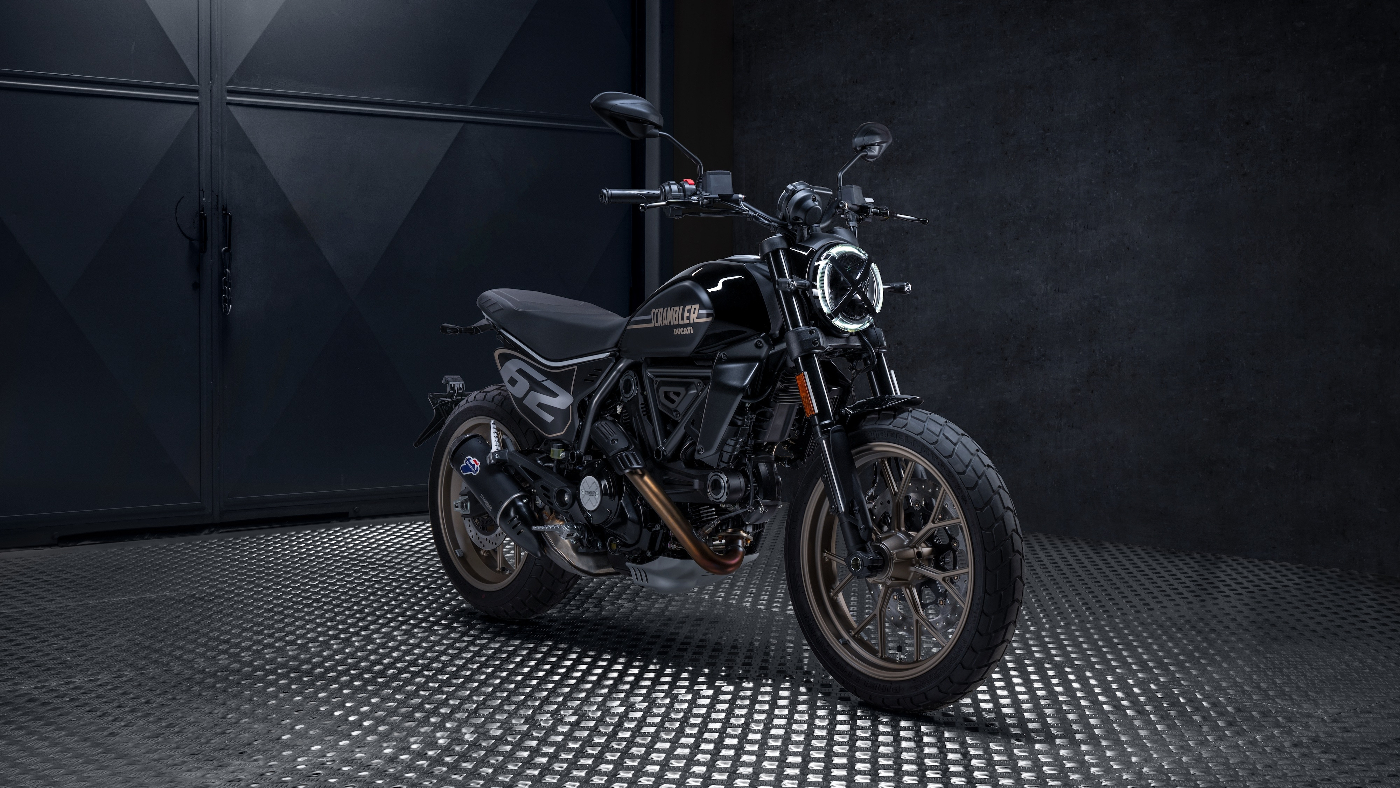
What annoys me is that other manufacturers seem to know this but don’t really do anything about it. Case in point: Ducati last week pulled the cover off two cosmetically refreshed Scrambler models, and as part of its coverage MCN shared a quote from Fabrizio Cazzoli, head of Ducati UK.
“The market is changing,” he said. “The products are changing in line with the market demand and I think Ducati are following that trend very well… the cost of motorcycles is becoming increasingly significant for people.”

As proof that it is “following that trend,” Ducati is pricing its “new” Full Throttle scrambler at £11,195, and its “new” Icon Dark at £9,495. These are bikes sharing the same platform, which has changed very little over the past nine years and is based on a platform that was introduced in 2010. So, Ducati knows riders are struggling financially and its answer is to offer up a 14-year-old engine with fresh paint that costs roughly a third of the UK median annual wage. Grazzie, guys.
I guess I’ll just stick to daydreaming about old cop bikes. If you’ve got money, though, it’s a fantastic time to be you.

Leave a Reply