

All of the Indian Motorcycle articles I’ve been publishing lately have not only reignited my fondness for the Minnesota-based company but sparked a wistfulness toward the brand that laid its foundations: Victory Motorcycles.
I’m pretty sure my buddy Cam is the only reader that’s been with Dancing the Polka from the very beginning, but others may be aware that I’ve long held a fondness for Victory. In my second-ever post, more than 13 years ago, I used a Victory Vegas as the lead image for a short missive on how my obsession with motorcycles felt borderline unhealthy.
So, imagine my glee and shaky-hand excitement recently when I spotted a Victory model that I could actually afford to buy. Sure, it’s 23 years old, the company that built it went out of business almost a decade ago, and the company that owned that company (Polaris) completely disavowed itself of motorcycles earlier this month, but it’s a Victory, man. A genuine, designed-in-Minnesota, built-in-Iowa piece of American motorcycling history.
My birthday is in less than a month, and I’ll be turning 50. It’s a ‘big’ birthday. Surely the perfect gift to myself would be a motorcycle from the brand that fuelled my return to motorcycling more than a decade ago…

What the ad says
“Here is a super clean, low mileage VICTORY 1500 cruiser, now priced for mid-Winter clearance prior to business closure in 2026. Just 21,000 recorded miles. Quality custom tourer in showroom condition for its age. It must have enjoyed only dry Summer use. Runs and rides just as it should. Panniers for touring. Heavily discounted to clear as it stands, warranty does not apply. Price is firm. A deposit of £100 can secure this stunning machine.”
What is it?
I remember exactly where I was on 4 July 1998: attempting to woo my future ex-wife at an Independence Day party in Incline Village, Nevada. Roughly 1,600 miles away, in Spirit Lake, Iowa, the first V92C motorcycles were rolling off the production line.
Victory Motorcycles had been launched just a year before, at the tail end of the great Harley Clone era – when Harley-Davidson was struggling to meet consumer demand. Its dealers had waiting lists that were months or even years long. Companies like Big Dog and American Iron Horse jumped in to fill the void; quality was poor but sales were good enough that new companies popped up every month or so.
Minnesota-based snowmobile, watercraft, and ATV maker Polaris decided it wanted in on the action. But rather than slap yet another S&S engine into yet another crappy chassis, it decided it wanted to build a motorcycle that people might actually want. A motorcycle that people might even choose over a Harley. So, it launched Victory Motorcycles and the V92C.
The V92C was produced from 1998 to 2003. There were a few variations on the theme, with the stripped-down cruiser and this, the touring-focused Deluxe, being the most popular. Initially powered by a five-speed 1507cc V-twin engine that produced roughly 57 hp at the wheel, the first V92C models boasted the largest production engines available at the time.

“Victory’s debut motorcycle holds many surprises for experienced riders,” wrote Motorcycle Cruiser magazine in 1998. “But perhaps the most pleasing is its ergonomic excellence.”
The motorcycle was also lauded for its powerplant – considered better than the Evolution engines Harley was using for big twins at the time – and its brakes. Victory’s stoppers came from Brembo.
In 2001, the V92C’s powerplant was replaced by the first generation of the Freedom V-twin, with capacity boosted to 1510 cc, the engine produced peak outputs of 65 bhp and 112.2 lb-ft of torque. See full stats for the 2003 Victory V92C at the bottom of this article.
The model was phased out in 2003, with its engine ultimately becoming the 1737cc Freedom 106 V-twin that powered almost all Victory models (other than the ill-fated Octane) until the company’s demise in 2017.
Why you would want it
When the V92C was first launched, it was a cut above pretty much anything else being offered by Harley (or its clones) at the time: faster, better handling, better stopping. Better looking? Beauty is in the eye of the beholder.
The bike earned a lot of praise from American moto-journalists at the time, and most people credit the V92C and Victory with forcing Harley to up its game in consecutive years.

Overall, build quality was good, and the advanced nature of its handling and braking means that it still manages to perform about as well as some modern-day cruisers. Though, obviously without modern-day features like ABS.
Despite being a generally good motorcycle, the V92C suffered from the same problem that afflicted all Victory Motorcycles’ offerings: for whatever reason, it didn’t tug at riders’ heartstrings the way a Harley or Triumph might. As a result, secondhand examples can be found for considerably less than Harley equivalents. Whereas a 2003 Harley-Davidson Heritage Softail will set you back roughly £8,500, you can have this V92C Deluxe for the same price as a clapped-out, 20-year-old Yamaha Fazer 600.
| Spec | 2003 Victory V92C Deluxe | 2003 Harley-Davidson Heritage Softail |
|---|---|---|
| Engine | 1507cc (92 cu in) Freedom V-Twin | 1450cc (88 cu in) Twin Cam 88B |
| Cooling | Air/Oil-Cooled | Air-Cooled |
| Fuel Delivery | Electronic Fuel Injection (Standard) | Carburetor (EFI was an optional extra) |
| Brakes (Front) | Dual 300mm discs with Brembo calipers | Single 292mm disc |
| Wet Weight | 311 kg (685 lbs) | 340 kg (749 lbs) |
| Current Used Price (approx) | £2,500 – £3,500 | £6,500 – £8,500+ |
Why you wouldn’t want it
Note that I said build quality was good “overall.” The V92C wasn’t perfect, especially the very first examples.
Fuel pumps are a known issue – specifically the fuel-injection sensors. On a slightly similar note, the bikes suffered from a few electrical gremlins. Stators and voltage regulators had a reputation for leaving the party early.

And the gearbox was clunky. Things improved with the Freedom engine, somewhat, but my experience was that crunchy transmissions were simply a feature of Victory bikes. In my first-ride review of the 2015 Victory Gunner, for example, I described the transmission as a “wrench-in-a-bucket gearbox” that “offers a viscerally pleasing clunk with each gear change.”
The biggest argument against the V92C, however, isn’t mechanical but existential. As noted above, Polaris killed Victory in 2017. At the time, it promised 10 years of parts support. Theoretically, there’s another year to go in that window but I would be ‘knock me down with a feather’ surprised if Polaris could offer up any new Victory parts in 2026.
Update: the fine print on Polaris’ parts promise is that it was 10 years of support from the date of production. So, the window on the V92C was closed from the very beginning.
All this means that getting hold of proprietary replacement parts (like the fuel injection sensor) will most likely be a colossal ball ache. That being said, I’ve just checked Amazon, and you can, at least, buy a stator and regulator rectifier for the V92C, among other parts. So perhaps not all hope is lost.
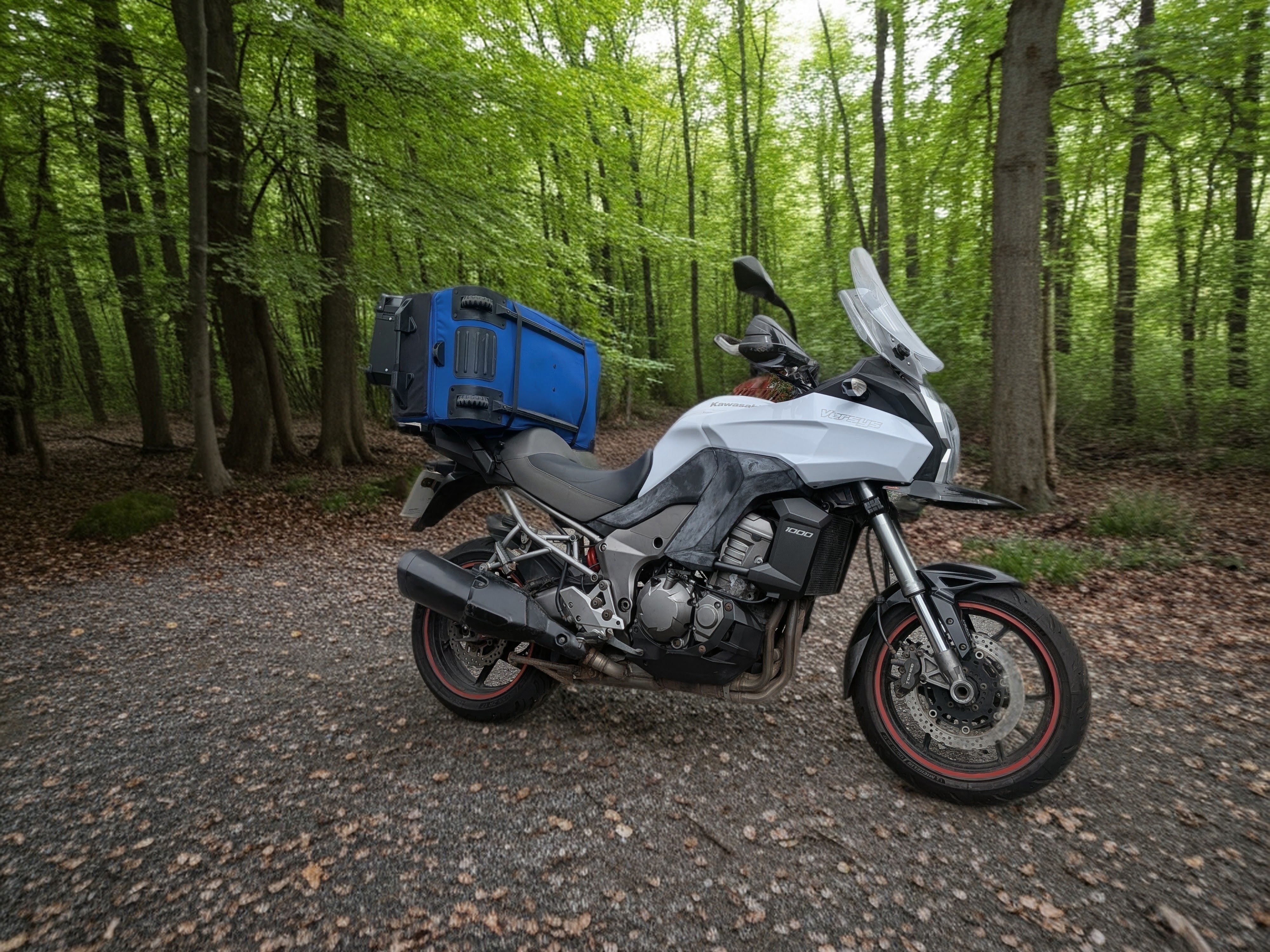
Is it better than my current motorcycle, a 2012 Kawasaki Versys 1000?
I should probably stop asking this question in these articles. Often, the comparison is just too ‘apples to oranges.’ Such is the case now. In terms of performance, handling, technology, utility, and parts availability, my bike wins. Obviously.
But the story of my Versys 1000 is not nearly as emotive as that of the V92C. No one ever stops to talk to me about my Versys 1000. I’m willing to bet that would happen every time I ventured out on a V92C.

Should I buy this one?
This is a 2003 model, meaning it benefits from the Freedom V-twin engine. And many of the quirks of earlier models will have been ironed out by the time this one came along. Searching this particular bike’s DVLA history, I’m able to see that it has not had any issues other than “excessively worn” brake pads since 2017.
The bike has less than 22,000 miles on the clock and looks good in the (admittedly low-quality) photos, so the seller is probably correct that it has been pampered (by someone who favors use of the rear brake). If, indeed, it “runs and rides as it should,” as the ad says, there’s no reason to think it won’t continue to do so for the immediate future.
And, you know, there’s the whole romantic appeal of finally owning a Victory on my 50th birthday. But, really, this is something that I should be walking swiftly away from.
First, there’s the fact the bike is being sold as-is – no warranty – from a company that’s going out of business. But outside of the fact that the seller wouldn’t help me with any potential issues is the fact that no one would help me.
“Is buying [a V92C] in 2026 a good idea? Honestly: no. It’s a terrible idea,” observed a friend of mine. “Buying a 23-year-old motorcycle from a brand that no longer exists is an exercise in financial masochism.”

For some, there might be a kind of joy in overcoming all the challenges that come from owning a bike that has zero dealer/manufacturer support and almost no aftermarket support, but I should not pretend that I am one of those people. Nor that I will ever be one of those people. Nor that I would even want to be one of those people.
The Victory V92C was a good motorcycle in its time. But for me, that time has long since passed.
2003 Victory V92C stats
| ENGINE | 1510 cc air/oil-cooled Freedom V-twin |
| TRANSMISSION | Five-speed |
| POWER | 65 bhp at 5500 rpm |
| TORQUE | 112.2 lb-ft |
| TOP SPEED | n/a |
| SEAT HEIGHT | 711 mm |
| GROUND CLEARANCE | 121 mm |
| WEIGHT | 310 kg |
| FUEL CAPACITY | 19 liters |
| FRONT TIRE | 130/90-16 |
| REAR TIRE | 160/80-16 |
| FRONT BRAKES | Dual 300mm discs, four-piston Brembo calipers |
| REAR BRAKE | Single 300mm disc, two-piston Brembo caliper |
| FRONT SUSPENSION | 45mm fork, 130 mm travel |
| REAR SUSPENSION | Mono shock, preload adjustable, 102 mm travel |



Leave a Reply