
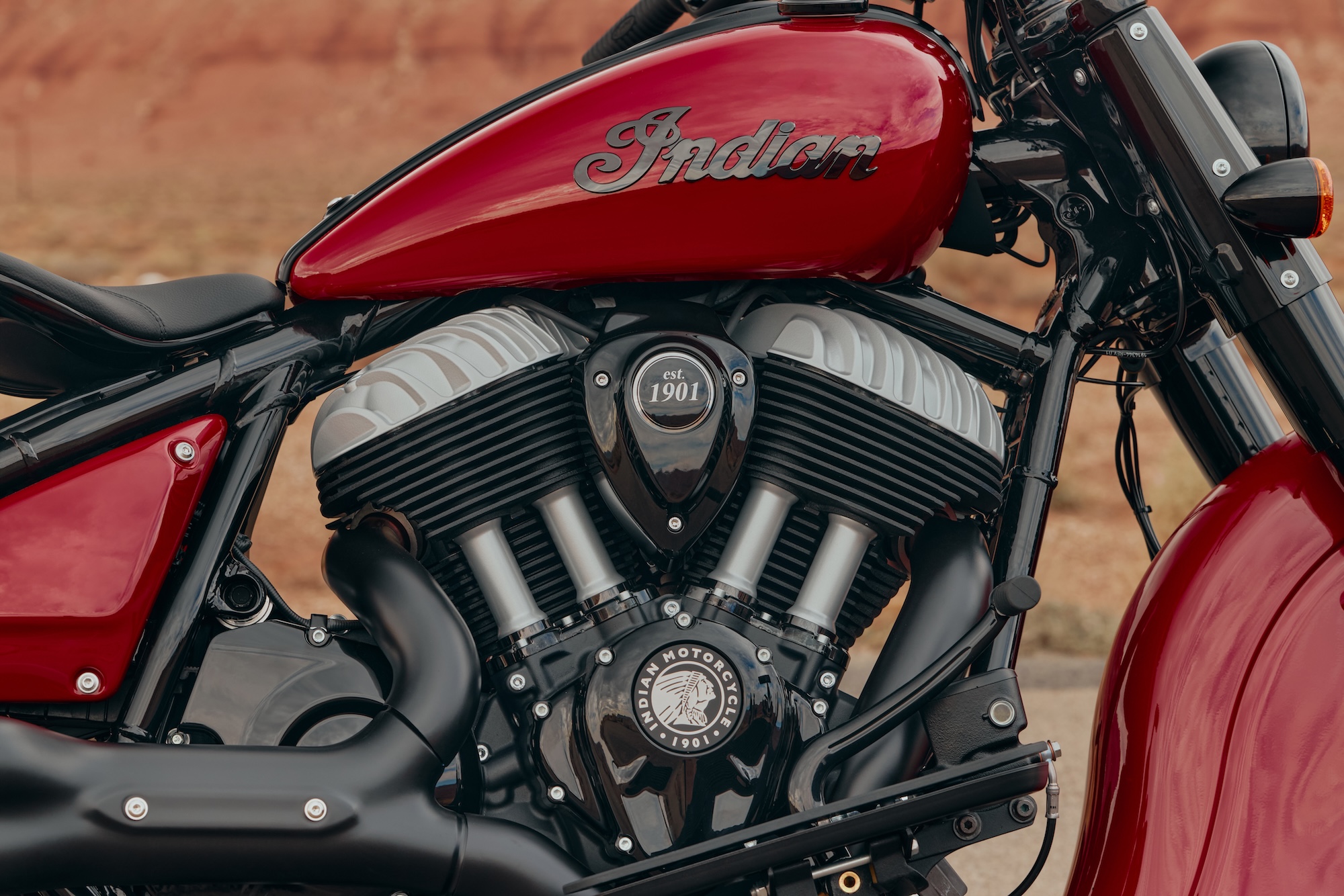
Draw your own conclusions about the fact that it happened on Groundhog Day, but as of 2 February 2026, Indian Motorcycle is officially no longer part of Polaris.
I’ve been covering Indian Motorcycle for more than a decade now. As I explained recently, when Indian announced a new slogan, Minnesota-based powersports company Polaris resurrected the brand back in 2013, sinking in real money, expertise, and leadership, but was showing signs of questioning its investment less than a five years later.
In October 2025, Polaris announced that it was selling a controlling stake of Indian shares to California-based private equity company Carolwood LP. This week, Indian Motorcycle issued the media release below, confirming that the deal had finally been done.
So, let’s do a hot take of the media release, trying to read between the lines and guess what the future has in store for the 125-year-old brand. Passages from Indian’s media release are in bold:

“Indian Motorcycle, America’s First Motorcycle Company, announced today that Carolwood LP has officially closed its agreement with Polaris to acquire the historic American motorcycle business. The deal’s closure marks the beginning of a dynamic new era for the iconic American brand as a fully independent business focused solely on motorcycles.”
For as long as I’ve been doing this, Indian has started every single media release with the phrase, “Indian Motorcycle, America’s First Motorcycle Company…” This is the first time that it seems authentic. Or, well, the “company” part, at least.
Under Polaris, Indian felt like a division of the larger corporation – and often a not very important one. At times it reminded me of the video rental sections in supermarkets when I was a kid: not the core business, and not particularly relevant to the core business, but a service that the business provides.
Back in 2018, I got a chance to go to Polaris headquarters in Medina, Minnesota, and was slightly knocked back by how “Also this” the Indian brand felt in terms of specialness or spotlighting.
One suspects that this outward lack of passion for the brand was a reflection of internal feeling. I don’t find it hard to imagine that any number of Indian projects were halted, delayed, half-done, or never started because the larger corporation wanted to withhold or divert resources elsewhere in the business.

The Indian fan boy in me wants to believe that Indian as “a fully independent business focused solely on motorcycles” might be able to capture some of the authenticity and passion that Polaris-era Indian didn’t quite nail (despite the excellent work of its US marketing agency, The Brand Amp).
“Under the leadership of new CEO and motorcycle-industry veteran, Mike Kennedy, Indian Motorcycle embarks on its next chapter as a stand-alone company, intent on building upon the brand’s significant momentum and elevating it to an even higher level of global relevance and success. 2026 marks the 125th Anniversary of Indian Motorcycle, a milestone that only increases the timeliness and significance of this historic transition.”
“‘It’s an incredible honor to take the helm of Indian Motorcycle as it celebrates its 125th Anniversary, empowered by a sense of gratitude and opportunity, and the support and ambition of a well-resourced, highly motivated ownership team,’ said Kennedy, CEO for the Indian Motorcycle Company. ‘2026 will be a special year to honor our history, but more importantly, to drive the brand into the future with a renewed level of commitment, focus and clarity that can only be found as a stand-alone company.’”
Three paragraphs into this media release, and Indian has described itself as “fully independent” or “stand-alone” in every single one of them. Want to guess one of the key marketing messages going forward?
Who is Mike Kennedy?

Meanwhile, Kennedy is indeed an industry veteran. He was the CEO of RumbleOn, a US online motorcycle marketplace that has since merged with RideNow. Some 90 percent of sellers on RumbleOn were established dealers, so ostensibly Kennedy has experience in understanding and responding to dealerships – which will be VITAL for any future success.
Kennedy has also served as CEO and president of Vance and Hines, meaning he’ll come to this role with a strong awareness of how important parts and accessories are. And he spent 26 years in the Church of Harley Latter-day Davidson, serving “in various leadership roles,” according to a media release sent last year.
Bringing in someone with so much relevant experience seems like a smart move, but who knows? Harley’s new guy, Artie Starrs, comes from the golf world and there are questions about whether he had ever ridden a motorcycle before taking the job. Before him, Jochen Zeitz had come from the shoe world.
Harley seems to think that outsiders are necessary for growth. Whereas Kennedy has a wealth of experience in a segment that is shrinking. Who’s right here?

“Kennedy and Carolwood are committed to a long-term strategy centered on delivering an even better ownership experience for riders and stronger, more focused support for the dealer network. This means concentrating investment in the motorcycles, technologies, and experiences riders value most. Sharpening performance, elevating craftsmanship, and deepening the connection to the unmistakable character that defines Indian Motorcycle. The result is a brand that shows up with greater clarity, higher quality, and a stronger connection to the riding community. Today and for the road ahead.”
“We will achieve our vision through a deeper level of differentiation, leaning in on what makes our brand unique, and with products that possess a style, craftsmanship and performance quality that is uniquely justified by our historic legacy and spirit of innovation,” said Kennedy.”
What does that actually mean?
I wonder what they mean by “performance.” You might remember that when the Indian Chief Vintage was revealed last month, I worked out that peak power output (a figure that Indian has not shared) from its 1890cc air-cooled Thunderstroke 116 V-twin is something around 71 bhp – on par with a Suzuki V-Strom 650.
So, what is “performance?” Does Indian plan to bring back/rework the FTR 1200 platform? Is it going to start giving its bikes more than 28 degrees of lean angle? Is it going to find a way to make its PowerPlus models lighter?

And elevating craftsmanship sounds like a good idea – everybody wants a nice bike – but Indian has long delivered bikes of a very high standard. That’s one of the reasons they tend to cost more than Harleys. I question whether it’s going to help Indian to have its prices go up even more.
Meanwhile, I agree with Kennedy that more effort needs to be put into differentiation. Too often in recent years, the selling point of Indian has seemed to be: “Kinda like Harley, but slightly better in ways most people won’t notice, and more expensive.”
The FTR 1200 platform was a great way to stand out but it was abandoned almost as quickly as it was introduced. With Harley having goofed its overhaul of the Sportster platform, the Scout is currently the best way for Indian to stand out.
Wouldn’t it be nice if Indian were to deliver a genuine touring bike built around the Scout platform? I don’t mean a Scout with a ‘we found it in a parts bin’ snap-on screen and some visually incongruent bags, I mean a dedicated 1200cc touring bike that could perhaps stand toe to toe against a BMW R 1300 RT. Harley has nothing like that – never has. Indian could definitely claim “innovation” with such a bike. And perhaps aim it at the European market if you don’t think enough American buyers will get on board.

“Indian Motorcycle’s future will be built alongside its global dealer network. The company is committed to delivering the number one dealer experience in the industry – partnerships built on trust through transparency.”
“Dealers are our most important partners, and we will judge our business based on the success of our dealers,” said Kennedy. “We intend to be extremely collaborative with our dealers, actively listening to their feedback and incorporating it into our planning and decision-making, not only in terms of dealer operations, but also product development and marketing.”
I don’t know how things are in the United States, but in the UK the dealership network has probably been Indian’s biggest weakness. There aren’t enough of them and all the ones that I’ve visited – with the possible exception of Krazy Horse – have not been very good.
I’ve written in the past about going to UK Indian dealerships and feeling surprised, annoyed, and disheartened at the fact that my enthusiasm for the brand massively exceeded the enthusiasm of anyone selling its bikes.

This was at the heart of why – before I came to my senses and stopped buying bikes on finance – I never bought an Indian. If you’re going to pay more than a Harley for a bike that is kinda like a Harley, you want it to feel Pretty F’ing Special (PFS). None of the dealers I encountered came anywhere near accomplishing that.
With dealers/dealerships being mentioned eight times in this media release, one would hope that Indian really is focused on turning things around. My advice is to drag current and future dealers to someplace like Sykes Harley-Davidson, in Lewes, England. When you walk in, you get an overwhelming sense that people there think that Harley is PFS, the people who ride them are PFS, and you are PFS for wanting to buy one.
(For what it’s worth, the dealerships that I am thinking of are no longer Indian dealerships. One of them went bankrupt back in 2024.)
“The finalized acquisition agreement includes approximately 900 employees that now transition to become part of the new Indian Motorcycle Company. Indian Motorcycle will base all manufacturing out of the company’s existing facilities in Spirit Lake, Iowa, and Monticello, Minn., while continuing its industrial design and technology and product development out of its existing research and development centers in Burgdorf, Switzerland and Wyoming, MN. Sales, service and support for Indian Motorcycle dealers and customers will continue seamlessly under new ownership and leadership.”

Is Indian Motorcycle still an American company?
So, how do we describe Indian Motorcycle? I checked with their UK representative and he says it’s still correct to describe Indian as a Minnesota-based company. I’m happy to hear it, obviously (I came of age in Minnesota).
And it makes good sense. If you’re striking out as a “fully independent business” you want your customers to know that you’re tough, resilient, and in it for the long haul. What better place to have as your home than Minnesota – currently America’s strongest defense against tyranny.
“America’s first motorcycle company will put America first,” said Kennedy. “Our brand and business will be grounded in our American identity and more importantly, American manufacturing. ‘Built in America’ is not a slogan. It’s a competitive advantage, and we intend to use it.”
Uhm, work on your phrasing there, Kennedy. The phrase “America First” has very specific connotations these days. Yeah, you might want those guys’ money, but I’m not sure it’s a clever business strategy to alienate everyone else.
Especially in a media release that was sent to EMEA journalists.

Let’s give Indian the benefit of the doubt, and assume that what it means is that it wants to embody all the good things that the United States and “Built in America” represent. Certainly that’s something that appeals to me. And there’s nothing wrong with embracing your brand’s national identity. Ducati, Moto Guzzi, and Royal Enfield all do it to great effect.
But, as I say, Indian needs to work on how it phrases that sentiment. The fact is, with bikes like the Indian Chief Vintage, it is offering motorcycles that cost more than a Harley equivalent, have less power than a Harley equivalent, and have considerably less robust dealership/aftersales support than a Harley equivalent. If it’s going to declare that Indian Motorcycle is an American company building American bikes in America for Americans, the question I’d have as a European motorcyclist is: “Why are you here, and why would I buy one of your bikes?”
Also, I guess this pretty much kills my idea of a Scout-based touring bike for the European market.

Leave a Reply