

Some part of me feels this must be a trick. How could a bike this pretty, seemingly in this good condition, be within my budget?
Maybe I’m just telling myself it’s a trick so I won’t end up buying it. I mean, I haven’t been fully employed since July. I technically have the money, but there may be an unhappy point in the not-too-distant future when I’ll need to use my motorcycle savings to pay rent.
In that scenario, I suspect my incredible fondness for this Moto Guzzi would be tarnished somewhat. Though, not totally. After all, one of my favorite pieces of advice to have ever received was: “When you’re down to your last $5, use it to buy a milkshake.”
By that logic, it makes total sense to buy a 16-year-old Italian motorcycle. Right?
What the ad says
“Excellent bodywork, Tyre condition Excellent…Free delivery within 50 miles. £2,699“
The shortness of the ad rings some alarm bells for me. But, I find that professional sellers are often fond of brevity. It’s a strange trait if you think about it: one would think that a business dedicated to selling motorcycles would put more effort into, you know, selling their motorcycles.

The fact that it’s a professional seller also raises some minor concern. With any professional seller, it’s safe to assume that the bike’s actual value is £200-£500 less than what they’re asking (unless you’re dealing with a used BMW, Harley-Davidson, or Triumph being sold by a BMW, Harley-Davidson, or Triumph dealer, in which case the mark-up can be upward of £1,000). So, this bike is already priced low enough to make me ask questions, and the nature of the seller means it’s arguably worth even less than that.
Why is it so affordable? What’s wrong with this bike that its five-word description is leaving out?
Anyhoo, this V7 Classic has 9,554 miles on the clock, which works out to less than 600 miles a year since it was first registered in January 2009. A check of the bike’s MOT history shows that it has passed every MOT test since 2013, when it was only rejected for a misaligned headlight.
(Side note: Businesses that will fail a bike because of a misaligned headlight can go to hell, as far as I’m concerned. It’s better to just readjust the damned thing, save your customer the cost of a new MOT, and earn customer loyalty in the process.)

There are some rusted bolts and a little corrosion here and there, but, on the whole, the pictures suggest the seller is telling the truth about the bodywork. And it probably sounds lovely with that aftermarket Zard exhaust.
What is it?
The V7 is one of Moto Guzzi’s most iconic platforms, with a history stretching back to 1964, when it was initially created to serve as a motorcycle for Italy’s Polizia Stradale (highway patrol). Two years later, in 1966, Moto Guzzi started producing models for foreign markets. Interestingly, it didn’t produce V7s for Italian riders until 1967.
Back then, the V7 was driven by a 703cc air-cooled 90° V-twin designed by Giulio Cesare Carcano. Originally intended to serve as a car engine, the V-twin ─ transversely mounted to put cylinders in the wind and assist cooling ─ delivered an impressive-for-the-time 50 horsepower.
By the time this particular bike rolled off the assembly line in 2008, Moto Guzzi had fallen under the purview of its current owner, Piaggio. The V7 Classic model was produced from 2008-2013, and powered by a fuel-injected, but still air-cooled 744cc V-twin engine that claimed an unimpressive-for-the-time 48 horsepower and 36 lb-ft of torque.
Described by MCN as “stylish, useful, charismatic and simply a nice motorcycle to ride,” the V7 Classic faced criticism from some riders for being underpowered. But, hey, 16 years later, Royal Enfield is churning out bikes with very similar figures and I’m an unapologetic fan. And you’ll find plenty of Guzzistas who strongly agree that numbers on paper don’t tell the full story.

Indeed, one of the great selling points of a Moto Guzzi is that it is a bike that owners end up having deep affection for..
“There is something extremely appealing about the basic nature of the Moto Guzzi V7,” observed Jon Urry for MoreBikes’ buyer’s guide. “And although it is far from the slickest… or the fastest retro out there, it has that special bit of soul that pulls on your heartstrings.”
Is it better than my current motorcycle?
Obviously yes, and kinda no.
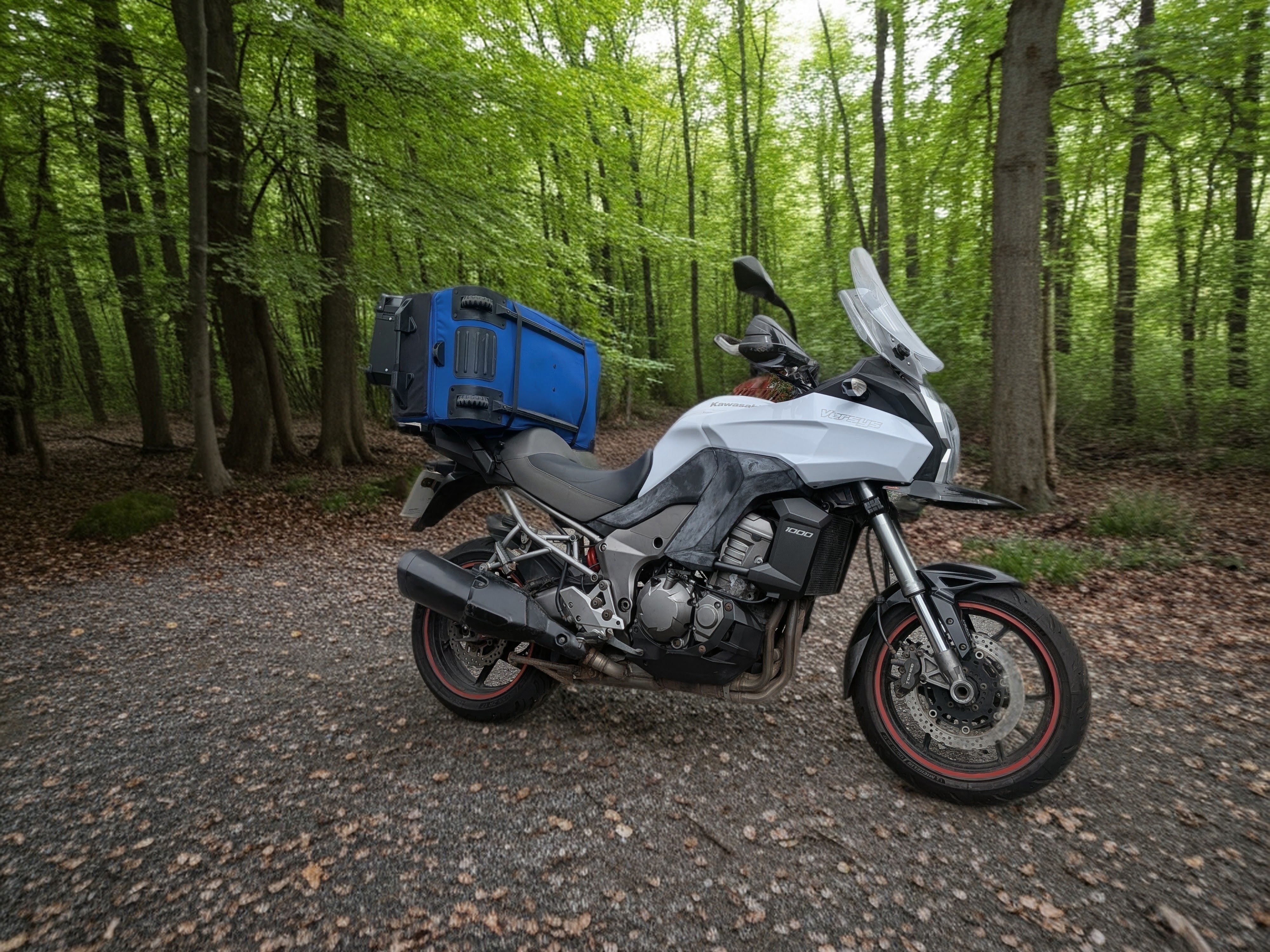
In the yes category, the V7 Classic is more attractive and has infinitely more character than a 2012 Kawasaki Versys 1000. I like my bike; I think it’s a pretty good machine. But there’s no way it could ever deliver the warm fuzzies of a Moto Guzzi on a sunny day.
The V7 Classic is the kind of motorcycle one might choose to love and nurture for years and years, eventually passing it on to their children. Whereas, if I were to preserve my Versys 1000, I doubt very much that my daughter would be all that grateful.
Also, the V7 Classic has shaft drive.

Despite that, when it comes to everyday use, the Kawasaki is the winner. It has ABS, traction control, riding modes, better brakes, a better suspension, a (marginally) better gearbox, better wind protection, better long-haul capacity, better passenger accommodation, and, oh, yeah, markedly more horsepower and torque. It also has longer service intervals.
Should I buy this one?
If my current financial situation were different, I might have already bought this thing by now. I’ll admit that even with things as they are, I am fighting the urge to ride out to Southampton (where this bike is being sold) to, you know, just have a look…
But doing that would be dangerous. Southampton’s less than 50 miles away. It would be so easy to take advantage of the free delivery. Especially since, hey, the either/or scenario that I set up in asking whether the V7 is “better” than my Kawasaki is an unnecessary question. At this price, I could afford to have both.
But would I want both? Would I want the maintenance demands of both? Especially in light of the fact that service intervals are every 4,500 miles on the V7 Classic and valve clearances need to be checked at every service. Has that been done with this bike? The ad doesn’t say. Even if it did, I have learned over the years that one man’s “regularly serviced” is another man’s “largely neglected.”

The mileage on this bike is such that it should have been serviced twice by now. I’ll bet that that second one’s been overlooked. I’ll bet, too, that valve clearances were skipped on the first. And I’ll bet that the age of the bike means bearings or seals may have worn in the bike’s shaft drive.
In other words, the low price tag belies the actual cost of this thing. I’d be putting a lot of work or money or both into it from the get-go.




Leave a Reply