

A number of motorcycle media outlets are reporting that Kawasaki’s underrated adventure tourer, the Versys 1000, is slated to get a capacity boost for the 2025 model year. And if that’s true, I’m happy to hear it.
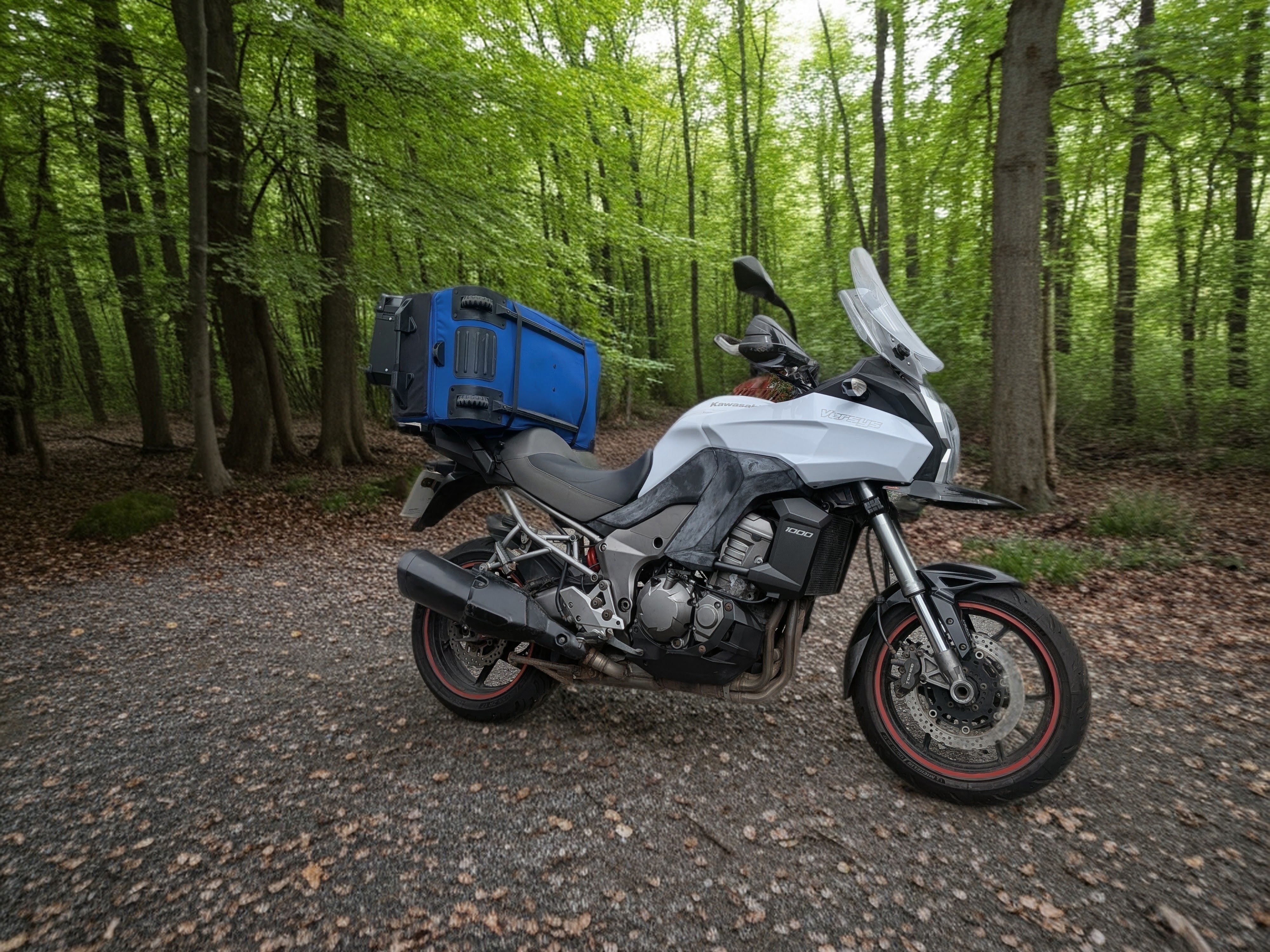
I own a first-generation (2012-2015) Versys 1000, and I have also ridden the current-gen bike (2021 – present). So, I can say that in whatever guise you choose it’s an excellent platform. True, it’s afflicted with a slightly agricultural gearbox, and can be infuriating in the fact you have to pull the fuel tank to change the air filter, but it’s excellent all the same.
If Kawasaki is giving it a capacity boost, that means it is continuing to invest in the platform, which, as I say, is a good thing. Against competition from the likes of BMW’s S 1000 XR, Suzuki’s GSX-S1000GX, Honda’s NT1100, and others, the Kawasaki Versys 1000 often gets forgotten by the chattering classes.
Perhaps understandably. I only stumbled into my love for the model because I found one for the same price as the Benelli TRK 502X that I had gone to a shop last year to look at. Sure, the 2012 Versys 1000 they had on display was older and had higher mileage than the Benelli, but it was more powerful, had better name recognition/reputation, and wasn’t made in China.

I had turned an affectionate eye toward the Versys 1000 in the past, but never really considered owning one until that point. Turns out I lucked into a good thing. The Versys 1000 is massive, well-balanced, insanely comfortable, powerful, and it delivers Harley levels of smooth, wonderful torque. I don’t really think it needs a capacity boost, but who am I to complain?
About that, though. Visordown reports that Australian approval documents show “the existence of a model named the KLZ1100B, while the current Versys 1000 is known as the KLZ1000B.” The website suggests this means a bigger Versys is on the way, probably as a means of meeting increasingly stringent environmental regulations (I don’t fully understand the science, but manufacturers have found it’s easier for big engines to test clean).
That’s a good theory, but Cycle World points out that it might be wrong. The current Versys 1000 is powered by a 1043cc inline four. You may remember from school that 1,043 is more than 1,000. In the inexact world of motorcycle naming convention, a 1043cc bike could easily be called an 1100. The aforementioned NT1100, for example, is powered by a 1084cc parallel twin.
So, the forthcoming Versys 1100 S that’s mentioned in these Australian documents may actually be the same bike we already know, but with a new name. Like when the Suzuki V-Strom 1000 became the V-Strom 1050. To support this theory, Cycle World points out that: “Normally, these documents include some fairly detailed specifications including power, dimensions, tire information, and even photographs of the bike that the approval covers but, in this instance, there are simply blank spaces in all of those areas.”

So, maybe Kawasaki’s just going to give its bike a new name because bigger sounds better. If that’s the case, I would hope there would still be some changes elsewhere. I’d really like to see Kawasaki try again with the aesthetic, for example. The front end of the Versys 1000 has always looked like it was the last thing the design team worked on and that they were against deadline; it has a certain “good enough” quality.
I find the bike’s 118 horsepower to be more than enough to fire past slow-moving traffic with ease, but, again, I don’t suppose I’d complain about having more ponies. If Kawasaki wanted to give it more torque, I’d complain even less.
Whatever the case, I do feel the manufacturer wants to think of something new relatively soon. Outside of the addition of some rider aids (eg, cruise control), the Versys 1000 platform has remained largely untouched for nine years. I worry that, like the discontinued GTR1400, it’s a great bike that will quietly fade away because Kawasaki hasn’t given riders enough reason to pay attention.


Leave a Reply