

There is a part of me that is very, very tempted by this latest find: a 1994 BMW R 1100 RS with less than 32,500 miles on the clock. Equally, there is a part of me that suspects that if I let this one go I’ll be sparing myself from immeasurable frustration and financial misery.
If you’re new here, What I Can Afford is a sporadically regular feature in which I trawl classifieds for a motorcycle that I could actually buy with my current savings. It’s something I do in an attempt to avoid looking at PCP deals.
My motorcycle savings is in a constant state of flux because I also use it to pay for the maintenance and upkeep of my current bike – and this month I bought new tires for the thing. As such, my savings haven’t progressed a great deal since the last time I wrote one of these articles, which means the best motorcycle I can find (or, at least, the most interesting one) is a bike that rolled off the assembly line when Green Day was still relatively unknown.

But then, this isn’t just any 30-year-old bike, it’s a boxer-twin BMW that appears to be quite aesthetically sound. Perhaps this is an opportunity to own a classic?
WHAT THE AD SAYS
“BMW 1100RS – Non ABS – Lots of work done see pictures – selling due to new bike. No offers and no time wasters please. Red, 4 owners, £1,100“
Along with being worryingly short, the ad description contains one of my red-flag phrases – that is, a phrase that makes me pretty sure I don’t want to deal with the seller. The phrase in question is: “no time wasters.”

Who is that for? No one approaches a seller thinking: “I’m going to deliberately waste this person’s time.”
Or, if there are such people, they’re certainly not going to be put off by a “no time wasters” request. I mean, imagine the person clicking through ads who thinks: “Ooh, this is an interesting bike. I don’t want to buy it, though; I just want to sit on it and flip all the switches. Oh, wait. What’s this? ‘No time wasters’? Darn, that’s me! Well, I guess I won’t bother him.”
To me, “no time wasters” is code for “I’m going to be a pain in the ass to deal with and will probably get angry when you put in the effort to properly inspect the bike.”

Another red flag can be found in the photos, where the seller has covered his registration plate with a towel. This is a weird thing that paranoid people do. Unless an individual works for the police or DVLA (Driver and Vehicle Licensing Agency), a vehicle owner’s details (eg, where they live) cannot be found using their vehicle registration number. Meanwhile, members of the police/DVLA wouldn’t be looking up owner information for fun, because to do so without official cause is a criminal offense.
The only thing that obscuring your registration plate does in the UK is make it difficult for a potential buyer to do an MOT check. To me, hiding the registration plate is an attempt to hide problems.
(For those of you playing along outside of the United Kingdom, every vehicle that’s less than 40 years old is subject to an MOT check, which tests the road-worthiness of the vehicle. It’s a pretty extensive process. The results of every vehicle’s checks are available online for free. For example, if you wanted to know how the Triumph Tiger 800 XRT that I rode to Scotland in 2018 is doing these days, you could see that it has a leaky front fork and a missing indicator lens.)

WHAT IS IT?
The BMW R 1100 RS was a sport-touring motorcycle produced from 1993 to 2001. Driven by a 1085cc air- and oil-cooled boxer twin that offered 90 horsepower and 70 lb-ft of torque, it was reportedly capable of a top speed of 131 mph.
The bike served as a kind of comeback for the boxer-twin platform. Before this, BMW had introduced its three- and four-cylinder K bikes and had abandoned the fully air-cooled two-valve boxer twin in the early 1980s. Many figured the boxer would never return. But instead, BMW chose to update the boxer to be a four-valve (per cylinder) set-up, with air/oil cooling and fuel injection – things that were somewhat cutting edge at the time (for motorcycles). To compliment this modern engine, BMW equipped the R 1100 RS with ABS brakes – a feature that many other manufacturers wouldn’t offer for another 20 years.
All this new-fangled whizzbangery wasn’t cheap. In 1994, the bike sold for US $14,000, according to Motorcycle.com. Adjusted for inflation that would be $29,505 in today’s dollars – or £23,567. For comparison, a 2024 BMW R 1250 RS starts at £13,140. Unlike the modern RS, though, this bike was built in BMW’s reliability heyday. Whereas, these days the manufacturer seems to be simply living off an old reputation for reliability.

Sharing a chassis with the R 1100 R, the RS was a shaft-driven motorcycle sporting a Telelever front suspension. That suspension wasn’t adjustable (although there was rear preload), and Motorcycle.com’s Andy Saunders reported at the time that the “settings are a little on the squishy side for a serious sportbike.”
“Instead of a sportbike, the RS is a bike to take off for a weekend, or a month,” he continued. “Where the intent isn’t to blitz the corners but to enjoy them in the smoothest way possible.”
Sport-touring bikes weren’t necessarily a ‘thing’ in those days and one might argue that BMW effectively created the segment with this bike. Good ergonomics meant it was all-day comfortable, a rider with a judicious throttle hand could get 200 miles from the tank, and standard hard luggage swallowed a good amount of gear. Limited lean angle, created by the engine’s headers sticking out and possibly dragging, also discouraged pure sporting use.

Because sport tourers weren’t really a thing when the RS was introduced, the handful of reviews that I can find from the time are wishy-washy about the bike’s performance and the overall riding experience. It’s sort of like a decade ago, when reviewers would be presented with an adventure tourer and get lost in complaints about its lack of off-road ability.
Filter through the “it’s not a sportbike” lamentations and it appears that the RS was a very solid and likable platform. It was never cool, though. Pictures from the time show riders decked out in Aerostich Roadcrafters.
IS IT BETTER THAN MY CURRENT MOTORCYCLE?
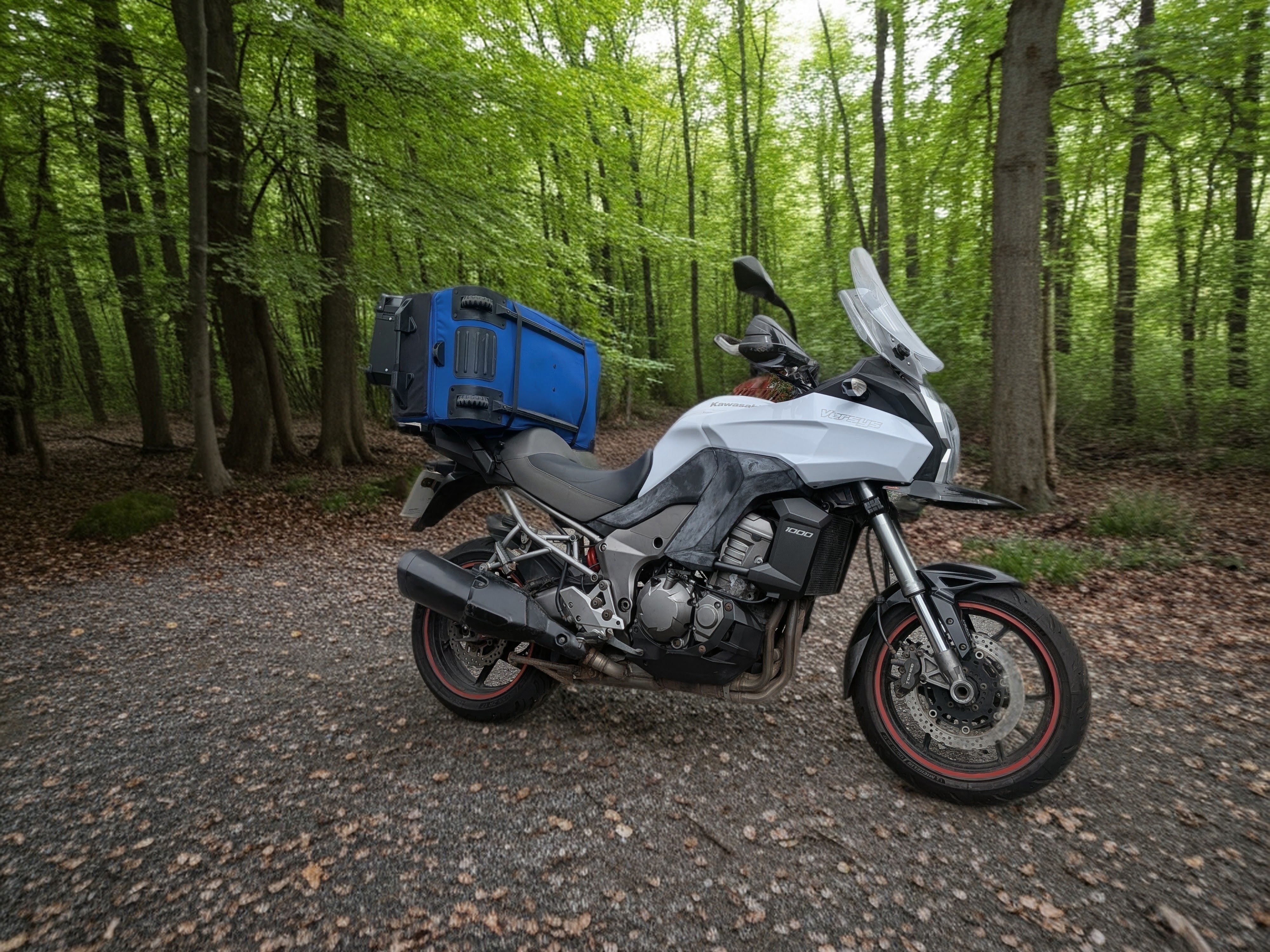
Probably not. My current bike is a 2012 Kawasaki Versys 1000. It is massive, with acres of space for a passenger or Kriega bags – or both, thanks to the sizeable luggage rack. Its 1043cc four-cylinder liquid-cooled engine delivers roughly 116 hp and 75 lb-ft of torque. It also comes equipped with ABS, as well as two riding modes and three traction-control settings. Continuing the similarities with the RS, my Versys 1000 has a tank range of about 200 miles, weighs 239 kg wet, and has an aesthetic that isn’t to everyone’s taste (I genuinely like the look of both bikes in this case).

Without having ever ridden an RS, I can’t claim that the Versys 1000 is a more exciting/pleasurable/characterful motorcycle, but will state that every time I ride my bike I am surprised by how much I enjoy it. Also, it is undoubtedly one of the most comfortable bikes I’ve ever ridden.
But, admittedly, it doesn’t offer the boxer-twin experience. The boxer engine is a unique, wonderful, and lovely thing…
SHOULD I BUY THIS ONE?
Probably not. There’s something of a cult around boxer twins, so finding parts and a knowledge base to help me work on the bike probably wouldn’t be that hard. But it also wouldn’t be cheap. And despite the pictures showing bodywork that’s in good shape, it is a 30-year-old bike; plastics only last so long before they crack.

Although the seller didn’t write much in his ad, he did take lots of pictures, including of three invoices showing recent work that has been done. Hilariously, although he went to the trouble to hide the registration plate in pictures of the bike, he didn’t block out the registration number on the invoices – or his name (Hi, Rob). So, I’m able to see the bike’s MOT history all the way back to 2006. Ironically, the history shows a bike that has passed most of its MOT tests, only failing in 2015 because the rear tire was excessively worn.
However, the invoices tell a slightly different story. Within just the last year, Rob has spent £1,695 on the bike, replacing the ignition coil, inlet rubbers, sensor triggers, starter motor, front brake lines, and a belt. In addition, the bike’s been given a full service, the throttle bodies have been reset twice, and the ABS has been disconnected to remedy a problem in which the rear brake was seizing.
Maybe all the problems have been sorted out by that work. Maybe this bike is a money trap. I will admit that the possibility/hope of the first statement being true has me very much wanting to buy this thing. And the more I look at the photos, the more I find I really like the look of the R 1100 RS.

It could be a sunny-weather moto, with my Kawasaki remaining as my stalwart, go-to bike. I can see myself putt-putting through the West Sussex countryside on the RS, drawing the admiration of old dudes at cafes.
I can also see myself broken down by the roadside, and eventually seeking to off-load the RS to someone else – insisting, of course, that prospective buyers not be time wasters. I think that if I were more mechanically inclined, and more willing to take on a challenge of unknown difficulty, I would actually put my money down for this one.
But, I suppose the wiser thing to do is save my money for another day – let someone else find out whether this bike is a joy or a pain, and resign myself to simply wondering about what might have been.



Leave a Reply