
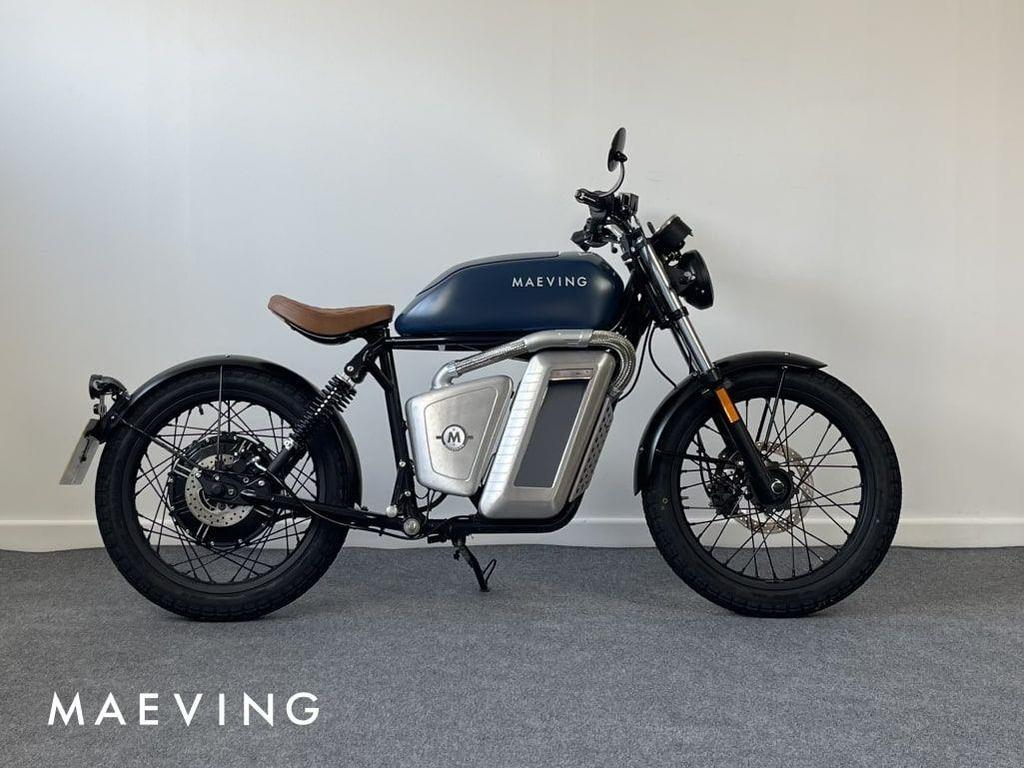
Aha! Oho! What bike is this? How fast does it go? At only 3 years old, it’s certainly the newest bike I’ve ever covered in my sporadic ‘What I can afford’ feature. It’s also the first-ever electric motorcycle.
So, what is it? A UK-made Maeving RM1. How fast does it go? Probably not very. But that doesn’t mean this isn’t an interesting choice.
Based in Coventry – only a few miles from Meriden and Birmingham, where so many iconic British motorcycling names began – Maeving was established in 2017 by Seb Inglis-Jones and Will Stirrup. The duo recruited about a dozen former Triumph employees and have been slowly moving forward ever since. Their story (a bunch of former Triumph folk making a British bike) earns them favorable coverage from the UK moto press, but it does seem that the bikes are of good quality and enjoyable within their given context.

The RM1, first introduced in 2022, was the company’s first effort. Maeving has since added the more powerful and more refined RM1S to its line-up.
What the ad says
“Engineered by a team responsible for some of Britain’s greatest motorcycles, the Maeving RM1 is an ideal urban commuter. We are thrilled to offer this 72-plate, dual-battery, blue RM1 for sale. This bike has only covered 266 miles. As with all of our bikes, this has undergone a full factory restoration and will be fully serviced prior to delivery.“
The bike is still too new to have required an MOT (though, one is due at the end of next month). I’m not sure what such a thing would tell you anyway. I suppose an MOT on an electric bike would check alignment and function of various lights, and ensure the brakes work, but I’m not sure it would actually tell you much about a bike.

The fact this is being sold by Maeving strikes me as a positive. If Harley-Davidson or Ducati or Suzuki or whoever were selling a ‘full factory restoration’ bike, I would have no concerns about its quality or reliability. If anything, it might be in better condition than any other RM1 because factory engineers – who will be aware of all the various gremlins that have presented themselves since the bike’s launch – will have looked after this machine.
What is it?
The RM1 was designed as an inner-city commuting vehicle for people who commute in the inner city – people who never see speed limits in excess of 30 mph. To that end, it reminds me of the Vespa Elettrica that I rode a few years ago. That scooter was fun, but underwhelming and very limited in its use case scenario. It was speed limited to just under 30 mph.
The RM1, at least, claims a top speed of 45 mph. Though you’d really be wringing its neck to do so.

“The motor is rated at 3.0 kW continuous (4 bhp) and 4.4 kW peak (5.9 bhp),” explains Simon Hargreaves in his review on BikeSocial. “The Maeving boys and girls are explicit in designing and labelling the RM1 as an urban machine – short inner-city hops, short-range commutes, nipping out for a coffee at lunch time… it’s not designed to excel on open roads.”
What makes me think the bike might deliver a similar experience to the Elettrica is Hargreaves’ observation that it is “surprisingly sluggish off the line.” Not really what you want in an urban setting. A lifetime ago, when I was a courier cyclist, I prided myself on being able to beat most cars off the line – able to get ahead and hold my lead all the way across an intersection. If I’m riding a motorized vehicle in the city, I fully expect it to be able to beat my legs.
Uniquely, the RM1’s motor is housed in the rear wheel hub. So, you don’t have to fuss with a chain or belt or the like. All that space where you’d normally put an engine is where the batteries are housed. The RM1 counters one of the biggest challenges that electric motorcycles face by having those batteries be removable.

In His Majesty’s United Kingdom of Great Britain and Northern Ireland, just under 60 percent of households have access to private parking – eg, driveway, garage, allocated parking space. The overwhelming majority of those households are not in dense urban areas and there are no statistics about how many of those parking spaces have access to electricity. So – digressing away from the RM1 here – although Brits have been very good about adopting electric vehicles (I see loads of them everyday), I often suspect we’re not too far from hitting a plateau. To their credit, however, a lot of councils are taking steps to remedy this by installing curbside charging stations; there are four such spots in my little town.
Anywho, the RM1 overcomes this issue by allowing you to transport the batteries to a power source. There are two batteries, each weighing about 12 kg (26.45 lbs) and promising roughly 40 miles of range (so the bike offers ~80 miles of range in total). They can be charged via standard household socket and take about four hours to go from zero to hero.
That strikes me as entirely practical for a commuter. You can lug the batteries into your office to charge them up while you’re at work. Plus the absence of power ostensibly discourages theft of the actual motorcycle (chain it up, anyway, though).

The bike is “superbly built,” according to Jon Urry’s review on MCN, and handles well in urban situations – nimbly allowing you to capitalize on every gap in traffic. Hargreaves says the suspension is a little rudimentary, but owner reviews on MCN (there are four of them) give the bike 5 out of 5 stars.
Is it better than my current motorcycle?
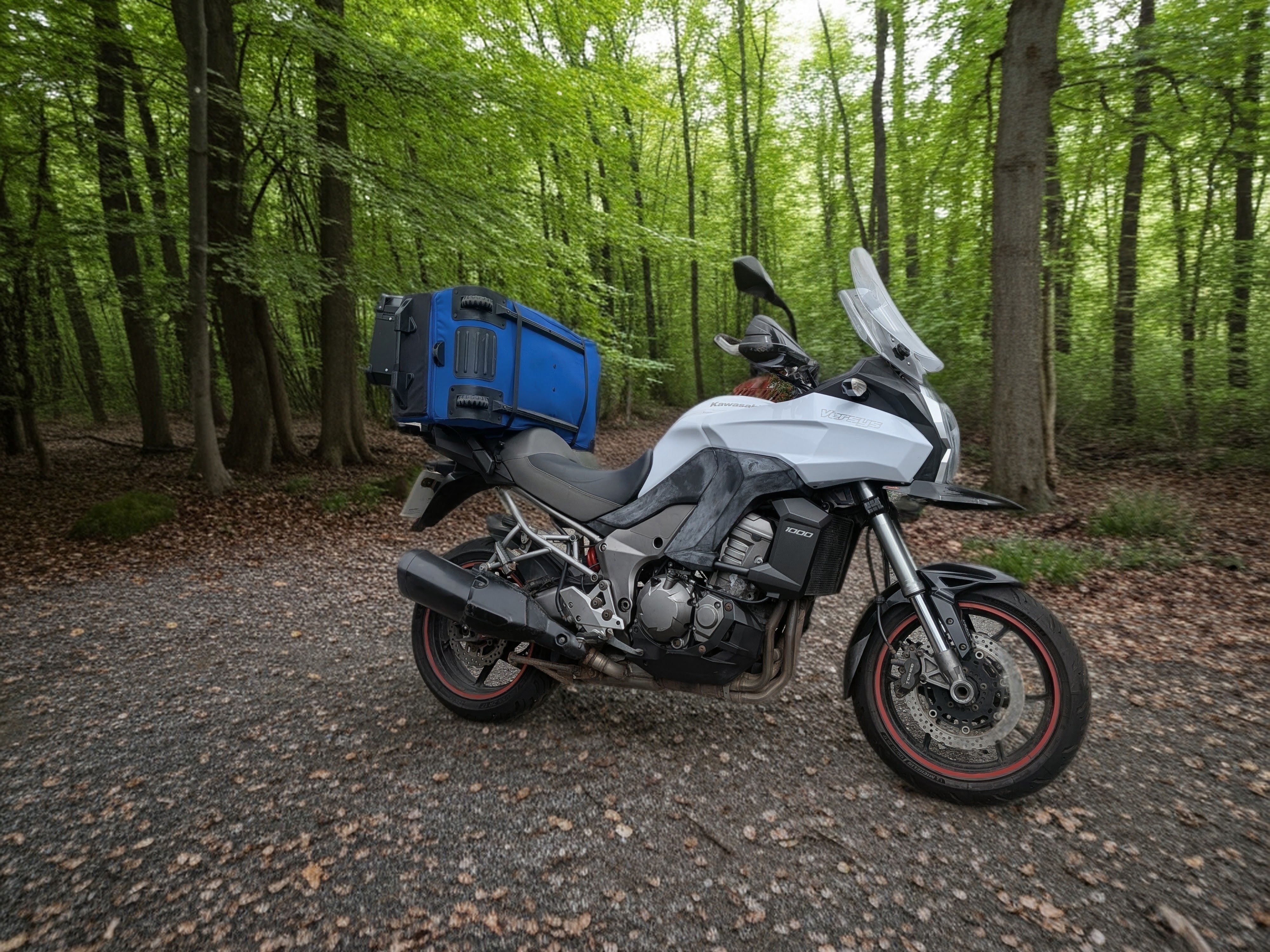
It has less rust and is certainly more stylish than a 2012 Kawasaki Versys 1000. And it’s markedly better for the environment (remember that in the UK, the majority of energy comes from renewable wind, solar, bioenergy and hydroelectric sources; I realize that is not the case in some other countries).

But, no, a charming but slightly uncomfortable electric motorcycle that struggles to achieve 45 mph and has (probably quite a bit less than) 80 miles of range is not better than the bike I already have. Especially within the context of my lifestyle.
Should I buy this one?
The RM1 can be ridden on one or two batteries. Bought new, this two-battery bike would have set you back £5,995. That’s pretty reasonable for an electric bike in and of itself, but this particular example is being offered for £3,495. It has just 266 miles on the clock, it’s been lovingly restored by the people who know it best, and it comes with a 6-month warranty.
If I didn’t live in a rural town some 60 miles from London I’d be all in. It looks pretty cool and I have long been a fan of electric motorcycles. The future has been frustratingly slow to arrive, but I still believe electric bikes are the future. Or, at the very least, a very big part of it.
Electric bikes are all kinds of fun. And I’m willing to bet this bike is, too. If it had enough oomph to handle motorway riding (and I mean real motorway riding – sustained speeds of 75-80 mph) and perhaps 20 more miles of legitimate range, I’d be very interested. Maybe one day. In the meantime I’ll keep looking.


Leave a Reply