
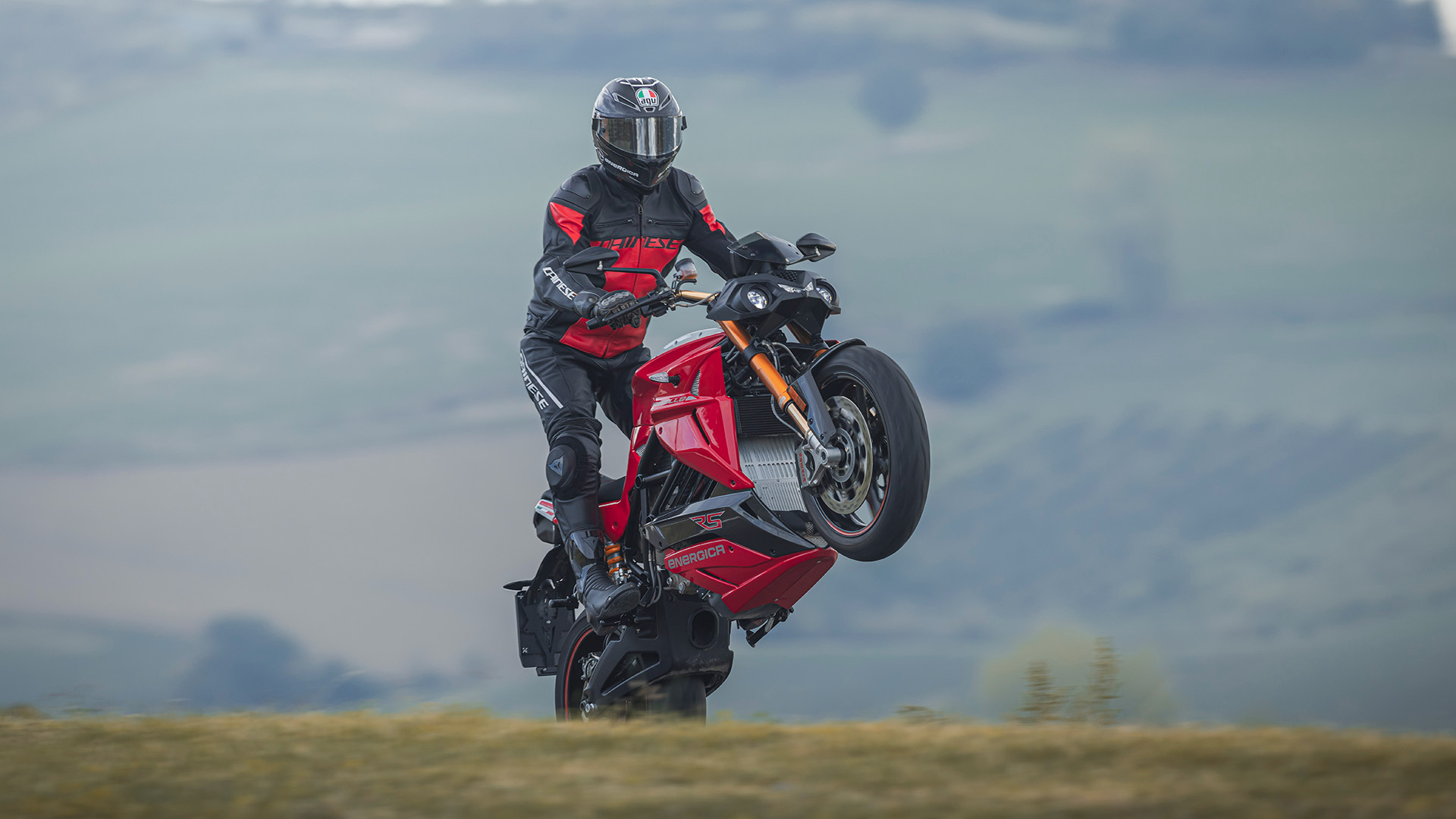
You may have seen the news this past week that Italian manufacturer Energica has run into financial difficulties. If you’re a critic of electric motorcycles, this news may have been met with a certain sense of Schadenfreude.
“See?!” you may have thought. “Yet more proof that the concept of electric bikes is a doomed-to-fail dead end.”
But, of course, you are wrong.
BECOME A PATRON
Support this site for just £1
Before I explain why, though, let’s back up a bit. Last week’s news is a little messy. Last Monday, Common Tread reported that “Energica Motors is on the verge of shutting down after already laying off employees and narrowly avoiding eviction.”

According to EV-focused website Elektrek, Energica had laid off 70 percent of its workforce recently. It wasn’t enough. The day after Common Tread reported concerns about the manufacturer, MCN reported that Energica “has filed for liquidation, marking the end of their decade-long run as a leader in high-performance electric motorcycles.”
This was seemingly confirmed by Energica itself that same afternoon, when its founders issued a statement declaring that the company’s Board of Directors had “resolved to enter into a bankruptcy judicial liquidation pursuant to art. 121 et seq. of the insolvency law.”
The statement blamed a “crisis in the electric market” for its demise, as well as “challenges from the downturn in the automotive market and supply chain.” More subtly, it blamed its majority shareholder.
Speaking of Energica in the past tense, the statement hints at some bad blood between Energica’s founders and US-based Ideanomics, which owns 75 percent of Energica.
Ideanomics is ostensibly an electric vehicle company, but one with a meandering and somewhat confusing past. It has traded under no less than nine different names in its 20-year history. And one of its founders is Shane McMahon (Yes, that Shane McMahon).

Earlier this year, the United States Securities and Exchange Commission charged three senior Ideanomics executives with fraud (McMahon was not one of them). At roughly the same time, it was delisted from the Nasdaq for failure to meet the minimum bid price and market value of publicly held shares. It is also presently the subject of a patent infringement lawsuit.
The statement released last week from Energica goes out of its way ─ with bold headline font ─ to point out that news of the company’s insolvency comes only from “the founding members of Energica.” Tersely, the statement adds: “It is noted that Ideanomics has chosen not to comment.”
Adding to the criticism, in addressing the aforementioned “crisis in the electric market,” the statement claims that “the decline in sector investments impacted Ideanomics, and consequently, compromised Energica’s investment capabilities.”
I don’t know about you, but I’m reading that as saying: ‘Ideanomics took its eye off the ball as far as Energica was concerned.’
Whatever the particulars, it’s clear that Energica’s story ─ begun in 2014 ─ has come to an end. Which is sad. I never got a chance to ride an Energica but from everything I’ve heard, they were good bikes. Certainly the styling was above others in the electric motorcycle market. I was particularly intrigued by the adventure-touring Experia, which had a claimed highway range of 134 miles (261 miles in the city). It was too expensive for me, but priced competitively against bikes like Ducati’s Multistrada V4 S.

I’ll admit, however, that Energica also always gave off an aura of a company that was not long for the motorcycling world. I can’t really put my finger on what made me feel that way. I suppose it’s because it was doing things that Zero Motorcycles wasn’t.
Zero is a stalwart of the electric moto biz. For 18 years, it has been plodding along with reliable but mildly uninspiring models, while competitor after competitor after competitor has shown up, made an impact, and burned out. Because of Zero’s ability to carry on, I have come to feel that if it’s not doing something, there must be a good reason. Zero may not (yet) be making bikes that people salivate over but it is making bikes, and it’s selling those bikes, and it’s keeping the lights on.
Which gets us back to my point that Energica’s collapse is not a statement on the viability of electric motorcycles. It seems pretty clear that Energica made some less-than-clever decisions in getting wrapped up with Ideanomics. In his Common Tread article, Lance Oliver seems to suggest it was a decision made out of desperation.
“I have to think that if a manufacturer such as Energica truly had bright prospects, it would not willingly agree to be taken over by a company that can’t decide if it wants to sell video on demand or trade oil futures,” he wrote.
I disagree. I think it’s a classic example of hope over experience/better judgment. Which is a story that has been told over and over and over and over in the motorcycling world. Motorcycling has always attracted dreamers and charlatans, with the latter feeding off the former. And if it’s not charlatans, it’s people who don’t understand how to make money. Whether you’re talking about manufacturers, gear makers, or motorcycle media, motorcycling history is littered with good ideas that flamed out because of poor application.
Or, sometimes, just bad luck.

Consider the fact that just in the United Kingdom, there has been a motorcycle company for every letter of the alphabet ─ often more than one. Yet how many British motorcycle companies are left standing? One? Three, if you count Ariel and CCM, I suppose. A similar story plays out in American motorcycling history. And Italy, and Germany, and so on. There have been, in fact, hundreds of companies that produced good ol’ reliable, sellable, internal combustion engined bikes, and yet didn’t last even as long as Energica.
The point is: motorcycles are a volatile and not exceedingly profitable business. Not just electric motorcycles, all motorcycles. Hell, that’s true of all ventures, really. No doubt you’ve heard that statistic that 90 percent of new businesses fail. Statistically speaking, Energica did well just to make it through its first three years (roughly 60 percent of businesses don’t).
I still think electric will be the future of motorcycling. It won’t happen as quickly as we were predicting 10 years ago, but I think it will happen. If not simply because there aren’t any particularly viable alternatives. Along the way, there will be many more electric manufacturers to come and go (looking at you, DAB), but their failures will not be failures of concept.

Leave a Reply