
I’ll admit I’m not a huge fan of flat track racing. I’d like to be. Or, I think I’d like to be.
Flat track feels like the sort of thing I should be interested in. Or, it feels like the sort of thing that should or would be interesting to the kind of guy I sometimes wish that I were. Know what I mean? Sometimes in life it can be difficult to know whether you are actually interested in something or simply pursuing the interests of the person that you think you want to be ─ like you’re method acting your way through life.
So, there’s an imaginary version of me that doesn’t have delicate writer fingers, that doesn’t need time to destress in a safe space every time he tackles a maintenance job more complicated than an oil change, and who genuinely thinks that hurtling sideways toward a wall at 100 mph is fun.
I’m not that guy, and I’m not entirely sure I’d want to be that guy, but I think I admire that guy and I imagine that he would be into flat track. Meanwhile, the version of me that does exist maintains a somewhat baseless fondness for Indian Motorcycle.

Why am I telling you all this? Two reasons: Firstly, because search engines tend to give lower ranking to short articles. Secondly, to explain why I’m kinda sad that changes to the structure of American Flat Track racing and the retirement of an iconic competitor will almost certainly mean the end of Indian’s dominance of AFT.
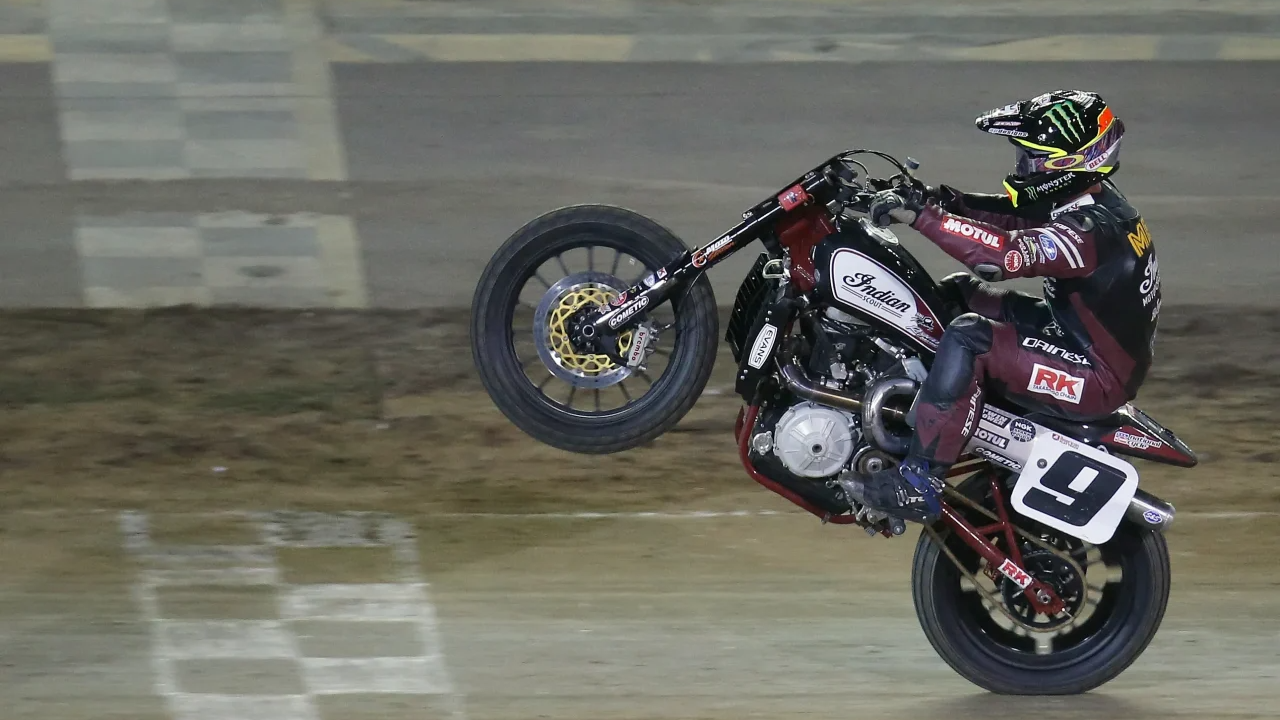
Eight years ago, Indian rolled out the FTR750, a racing weapon that was designed to win the brand total dominance of the flat track world and, by extension, bragging rights over Harley-Davidson. It worked. The FTR750 has won every premier class title since 2017 and has put its riders on the podium in 96% of the races in which it played a part.
That all ends next year. New rules in AFT’s SuperTwins Championship “will render the [FTR750 platform] ineligible,” according to an Indian press release. It seems the competition has decided it will only allow bikes with engines derived from production street bikes, meaning Indian’s racing-only FTR750 is out.
According to Sideburn (which is a magazine that that other version of me would definitely read more often), starting in 2025, engines also “must not exceed a displacement of 800cc for water-cooled engines or 900cc for air-cooled engines when used in competition.”

So, the only Indian engine now eligible for competition is a modified version of the Scout Sixty‘s powerplant. I’m pretty sure that with hard work and intelligent engineering that thing will still be able to hustle, but it won’t be the light, purposeful engine that’s made the FTR750 so unbeatable. It’s hard to imagine that Indian Motorcycle will be the same force that it has been.
Again, I’m not a huge fan of flat track. I have only attended one race (which Harley-Davidson flew me all the way to Florida to watch), and I have never once bothered to pay attention to the competition outside of press releases. So, my opinion probably isn’t relevant here. But this feels unfair. From my totally uninformed point of view, it feels as if AFT is deliberately changing its rules to stop Indian from winning.
But maybe that’s exactly what AFT is doing, and maybe its fans see the move as entirely fair. I mean, if it’s just one team winning over and over and over for more than half a decade, maybe that’s boring.
Meanwhile, another thing that feels sad to me for no particularly solid reason is the fact that Indian’s winningest rider, Jared Mees, is choosing this moment to end his career. Earlier this week, he secured the 10th Grand National Championship of his career and announced that it would be his last.

“I’ve been fortunate enough to be on this journey with Indian Motorcycle since day one,” he said. “We’ve had an incredible journey with this bike, and to go out on top, knowing it’s the last time, makes this win even more special.”
Indian has not said whether it plans to keep investing as much energy and money into its flat track team going forward.
Meanwhile, Honda’s NC750X engine is reportedly eligible to compete in AFT. Can you imagine?



Leave a Reply