

I first moved to the United Kingdom on 12 July 2006, arriving at Gatwick Airport jet-lagged and dry-mouthed with my now-ex-wife and two duffel bags full of clothes. A hell of a lot has happened since then.
Though, I do still have those duffel bags.
A person born on the day I arrived is now legally old enough to drink in the British Isles. Eighteen years is a long ‘ol space of time, and it’s given me plenty of opportunity to acclimate and become familiar with British culture. There is some part of me that always resists calling it “home,” but certainly I feel comfortable on this soggy archipelago. I feel I ‘get’ the place and its people.
I’ll admit, though, that there are some things I still struggle to understand…
1) Finding dental floss should not be this difficult
The stereotype of British people with bad teeth is decades out of date. Do a like-for-like comparison of people at different socioeconomic levels and you will find no difference with Americans. So, clearly people are able to access the tools of dental hygiene, but, man, it requires effort.

You will almost never find floss at a corner store, for example. It is usually stocked at large grocery stores, but not always. Your best bet is to either order it online or go to a chemist (aka pharmacy), where they will have only one brand and it will be stocked in some odd place, like next to the adult diapers.
2) They love dark rooms
Admittedly, electricity costs a lot in the United Kingdom, but I’ve never heard someone use that as an excuse for their refusal to turn the lights on. In the daytime, even when it’s cloudy, Britons will rely solely on daylight. At night, they’ll combine the orange glow of an outside streetlight with a lamp tucked into a corner and running a 3-watt bulb.
It’s like they all got the wrong message about Miss Havisham.
3) They don’t understand how to heat a home
I have never been in a UK home with forced-air heating, of the sort that is ubiquitous in most US homes. It’s not even common in office buildings/hotels. Instead, houses are kept “warm” via thin, ineffective radiators that emit so little heat they couldn’t melt a crayon. Insulation, meanwhile, is subpar. As a result, I spend October to May wearing a blanket.
4) They don’t understand how to cool a home
True, some parts of the UK don’t really have summer. Scotland, for example. Summer there is a concept. But down in the Sarf we do get whole weeks of non-sweater weather. Enough that people might want to do something about it. Bafflingly, most do not.
I know of just one person who has built-in air conditioning and she is a literal millionaire. I have a large R2-D2-sized portable unit that is capable of (sort of) cooling one room, but I am in the minority. According to the internet, less than 5% of UK homes have some form of air conditioning. I am willing to bet that the overwhelming majority of those are homes occupied by foreign-born individuals such as myself and the aforementioned millionaire.

True Britons, it seems, would rather be miserable. Proof of this comes in the fact they also don’t tend to use electric fans. I can’t find any statistics about fan use, but my own unscientific research (ie, thinking about all the homes I’ve been in over the past 18 years), suggests that only 1 in 8 UK homes own/use electric fans.
5) The technology one might use to keep bugs out of the home is beyond their comprehension
British homes may not have fans or air conditioning but they do, at least, have windows. One might not be inclined to open them, however, because Britain also has bees and wasps and hornets and flies and flying ants and moths and midges and, in the southern part of the country, mosquitoes.
If only there were some way to enjoy the benefits of an open window without having to welcome in all those little creatures. Some kind of… screen, perhaps.
Sadly, no one on Earth has ever come up with a solution.
6) They don’t know how to wash their dishes properly
Many Brits have a dishwasher. Those that don’t, however, wash their dishes like this:
1) Fill a plastic “washing up” tub with warm, soapy water.
2) Take an old rag or sponge purchased in the early 1990s, dip it into said soapy water and rub all the food bits off a given dish into the tub.
3) Place the dish – unrinsed, with soap bubbles still dripping down it – in a dish-drying rack bought at IKEA.
4) Repeat steps 1-3 for all dishes, using the same increasingly disgusting dishwater.
5) When all the dishes have been “cleaned,” overturn the washing up tub and allow all the food bits to go down the sink, which does not have a garbage disposal. Then, at some later date, be confused and angry that your sink is backed up.
7) They’re weird about coat hooks
If you were going to live in a country that is famous for being wet and cold most of the time, what’s the one article of clothing you might want? A coat, yes?
And in a country where wearing some kind of coat is something you do in every season, where would you put said article of clothing when inside a restaurant or pub or toilet stall? In Britain, the answer is: “In your fucking lap, son.”
Plenty of homes have coat racks, usually located just behind the front door and so overloaded with clothing that the door won’t open fully. But they are almost non-existent in public spaces.
8) They do sleeping wrong
Americans and other right-thinking people: picture a bed. Specifically, picture how it is made. Not constructed, but “made” in the sense of being adorned with sheets and pillows.
Probably, you’re thinking of a bed with a (fitted) sheet to cover the mattress, a top sheet that goes over you, and a comforter/duvet over that. If you’re picturing a bed at your grandmother’s house, you’ll add a dusty wool blanket from the First World War in between the top sheet and duvet/comforter.
But in Britain, where – as we’ve established – the houses are drafty and cold in the winter, and stifling in the summer, a bed consists of just the (not always fitted) mattress sheet and a duvet, the latter of which is ALWAYS undersized. In the winter it is not enough; in the summer it is too much.
9) They do camping wrong
I’ve complained a lot about the British view of camping over the years. The quintessential British campsite is a treeless, rutted field where crowds of people erect cheap tents with no sense of order or respect for others’ space. At one end of the field there will be a block of mucky toilets where the floors are always wet. It’s “camping” in the way that being in a refugee camp is camping; there is no joy to it.

In fairness, this has been changing just a teensy bit since the Covid pandemic prompted a greater interest in outdoor spaces. Unfortunately, spots at campsites with trees and a greater sense of outdoor isolation can cost as much or more than a night at a hotel.
10) It is impossible to get breakfast before 8:30 am
Blame it on the booze, I suppose, but British people are not early risers. There is no equivalent to Dennys, Perkins, or Waffle House in the United Kingdom; if you want breakfast before 8:30 am you’re going to have to make it yourself.
11) They do breakfast wrong
When you do get breakfast, prepare to be disappointed. This is especially true in England, where sugary baked beans from a can are a staple of the breakfast experience. Along with this you will get sausage that is largely flavorless and white bread that has been cooked in a deep fat fryer. English breakfasts are so bad that the Scottish improve things by scrapping the beans and giving you slices of sausage that are made with actual blood.
12) Prawn cocktail flavored crisps
Stop. For the love of God, please just stop.
13) They are strangely dedicated to poorly designed and/or insufficient roads
Britain is an ancient country. I live near the South Downs Way national trail, which is comprised largely of a trading route that was being used 3,000 years ago. If you were to overlay a map of Roman roads in the UK with a modern road map you would see that the overwhelming majority on the country’s motorways and major roadways follow routes established by the ancient Romans. In other words, a whole lot of this country’s infrastructure was established before anyone ever thought about cars. Fair, then, that things aren’t perfect.
What’s baffling to me, though, is the fact they haven’t really made any effort to update things since the invention of the car. Even when they’ve had the opportunity. They build new roads to the same claustrophobic dimensions as the ones designed by people traveling by foot or horse, making them just as winding and nonsensical.
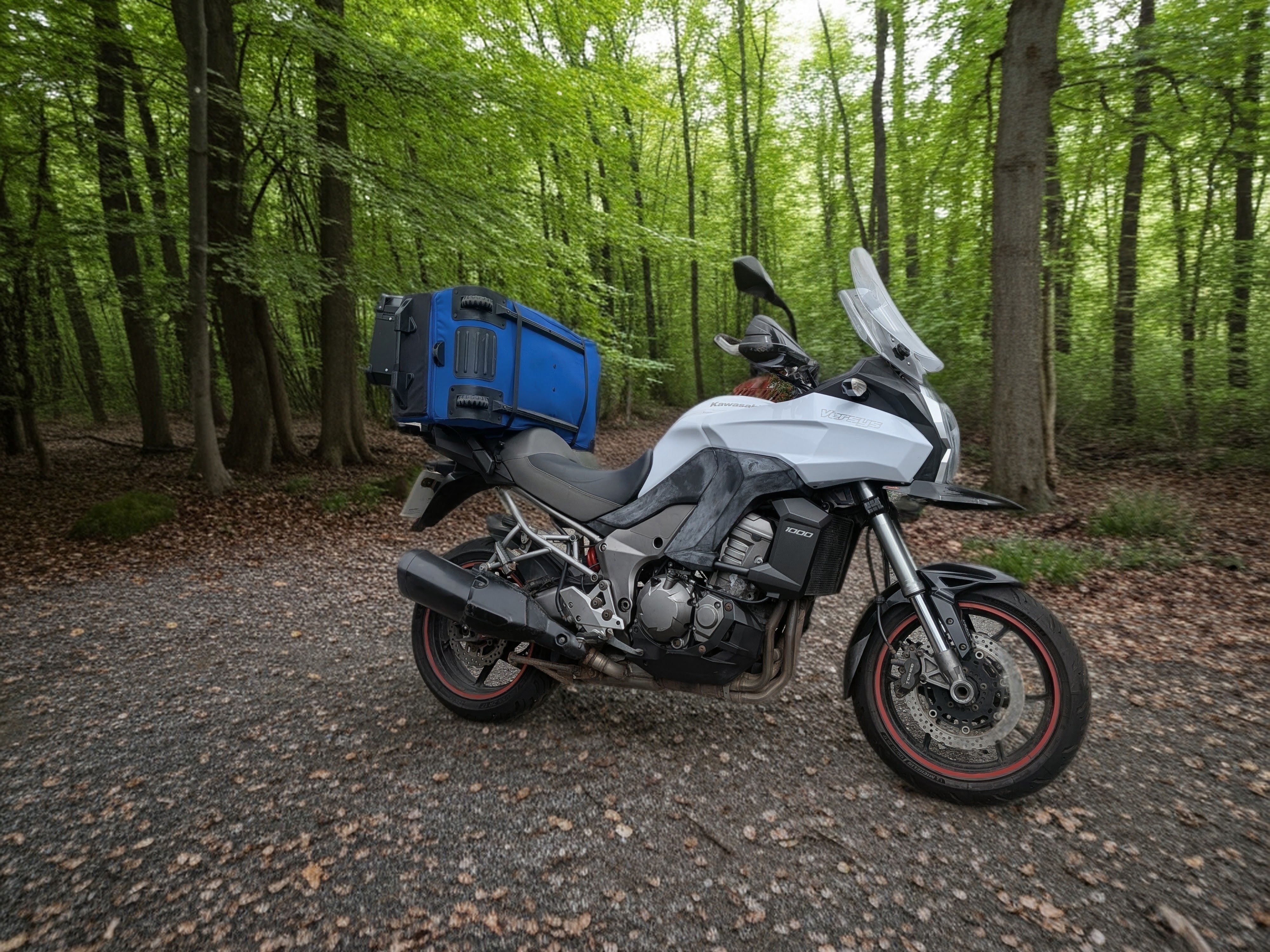
Then, once the roads are built they NEVER maintain them. I’m pretty sure one of the reasons adventure bikes are so popular in Britain is the fact our roads offer a de facto trail-riding experience.
14) They do Christmas music wrong
Christmas is a time of togetherness, kindness, and reflection, right? Those are the themes you hear in American Christmas music. Think “White Christmas,” “I’ll Be Home for Christmas,” “Winter Wonderland,” etc. Yes, there are a handful of novelty songs with simplistic, janky rhythms, à la “Grandma Got Run Over by a Reindeer,” but those are outliers.
Turn on the radio at Christmastime in Britain (which starts in October here because there is no Thanksgiving to keep the Yuletide at bay) and you will be inundated by awful songs that are mildly amusing if heard only once, but borderline crimes against humanity if listened to over and over and over and over. Just the thought of hearing Noddy Holder scream “It’s Chriiiiistmas!” gives me PTSD symptoms.
15) Dedication to bucket hats
Every era had its questionable fashion decisions; the 1990s had more than most. In Britain in the 1990s, inspired by American rappers of the 1980s (think LL Cool J), the bucket hat became a very big thing – especially among men. Look at pictures of British bands from the era, like Oasis, Blur, or Supergrass, and you will see an almost fanatical dedication to bucket hats.

The ’90s are long gone, but bucket hats are not. They are still going strong. And they still look as dumb as they did 30+ years ago.
16) They can’t agree on how to say a phone number aloud
Let’s say you wanted to phone the Chilean embassy in London. Why? I don’t know. Let’s just say that you do. Their phone number is 02072222361. How would you read that out to somebody?
If you are American, you might break it into a somewhat familiar “three-four-four” pattern (ie, 020 7222 2361), which makes some sense because, like an area code, the first three numbers in this case identify that it is a London number. If you were German, you might set out the first four numbers (ie, 0207 2222361), and so on and so on and so on. It doesn’t really matter how you do it, just that there’s some sort of consistency in how people communicate numbers to each other.
But the British don’t have this; there is no collective agreement on how to say a number. As a result, when you are on a call with, say, your car insurance provider or water company or whatever, when they say, “Just to confirm, the best number to contact you is…” and read your number to you, you’ll go through this slow, painful process of trying to reorder all the numbers to get them to make sense.
This is not a ‘stranger in a strange land’ phenomenon, British people have told me they have exactly the same experience.
17) They can’t agree on how to measure things
Distance and speed are measured in miles (eg, 60 mph, or 118 miles between London and Birmingham). Length, however, is measured in metric (eg, a 2-meter gap). Human height is measured in feet and inches (eg, I am 6-foot-1), unless you are in a medical situation – then it’s metric.
Human weight is measured in metric or the baffling method of stones/pounds. Babies are an exception, which are measured in pounds/ounces. Weight of other things is generally measured in metric, unless it’s fruit or vegetables bought in a market, in which case it will usually be pounds/ounces.
Temperatures are given in Centigrade, unless you are in Devon or Cornwall, where the TV weather often translates to Fahrenheit.
18) Traffic reports that cover the entire country.
In terms of land area, the United Kingdom (~94,000 sq mi) is slightly bigger than Minnesota (~87,000 sq mi), slightly smaller than Michigan (~96,000 sq mi), so not particularly huge. But equally not so small that what’s conditionally relevant at one end is conditionally relevant on the other – things like weather or traffic. And yet both are reported on national radio.
Weather, I can understand. Depending on the winds, what’s happening now in Belfast may be happening where I am in the next 24 hours or so. But traffic? Why does a person anywhere other than Belfast need to know that there’s congestion on the Sandyknowes roundabout? Why does anyone outside of Aberdeen need to know there’s been an accident on the A956?
And yet, every hour during the day, there is a person on the radio telling you what traffic is like in all the places you’re not.





Leave a Reply