

This month’s What I Can Afford bike actually runs £14 over my budget. I feel that it would be worth the stretch, but the thing is: I’d inevitably be spending a hell of a lot more than £14 to get it on the road…
The bike is a 1986 Honda GL1200 Gold Wing Aspencade. An ’80s Gold Wing is nonpareil. Built in the United States (From 1980-2010, all of Honda’s Gold Wings were assembled at a plant in Ohio) and dripping with the finest tech the 1980s had to offer, this is a glorious piece of two-wheeled of history – possibly one of the most iconic versions of one of the most iconic motorcycles of all time.
It was a Gold Wing, after all, that Buddy (“Bud for short”) was riding in the early 1980s when he somehow charmed Elspeth Beard into sleeping with him at a cheap motel in Las Cruces, New Mexico (though his bike likely would have been a GL1100). She recounts the tale in her book, Lone Rider, expressing regret at having fallen for a man whose apparent sole purpose in life was to “cruise.”
“Even in the midst of it, I felt really cheap,” she wrote. “I didn’t even particularly like Buddy… What was I thinking?”
It’s OK, Elspeth; don’t be hard on yourself. It wasn’t Buddy. It was the Gold Wing. Ultimately, no one can resist the charms of a ‘Wing.
WHAT THE AD SAYS
“** Project Bike**, part exchange to clear. This bike runs well and has an MOT until July 2024. We are selling this bike with no warranty and sold as seen. Please note this bike has not been checked over in any way, nor has it been cleaned. This bike would make an ideal home ‘restoration’ job. We have not tried all the features to see what works and what dosen’t. Supplied with 1 key and minimal paperwork.“

The first two words in the ad are a famous red flag. Nothing says “walk way” like the phrase “project bike.” In fairness to the seller, they don’t seem to be trying to pull the wool over anyone’s eyes. Effectively, the ad says: “This bike runs, it has an MOT, we know nothing else and we deny any and all responsibility.”
To that end, I feel pretty confident that I could talk them down to pricing the bike within my budget. Would I want to, though?
WHAT IS IT?
If you don’t know what a Gold Wing is, if you can’t hear the sweet sound of Bob Seger blaring in your mind’s stereo simply upon thinking of a Gold Wing, I can’t help you, man. You’re dead inside.
Looking at this bike sends me to a very happy place, to road trips with my family – the four of us piled into a first-generation Plymouth Voyager minivan en route to Colorado or South Dakota. Staring out of the windows at the endless blur of the American landscape, I always took notice of the Gold Wings. We were joined on the interstates by plenty of Harleys, sure, but the full-dresser Gold Wings are what stick in my memory.
They were magnificent things, more often than not bedecked in USA and POW/MIA flags, strip lighting, and equipped with a towering CB antenna. They were always – always – helmed by a dude with a three-quarter helmet (with sun visor!) and a mustache.

“Think of it as an American motorcycle,” Cycle World wrote in its 1984 review of the GL1200 Gold Wing Aspencade. “Deep, down inside, that’s what the Gold Wing is. This is deeper than the engine and deeper than the parts in the engine. Inside all that, there was an idea. And that idea is American.”
I learned to ride from a man who rode a Gold Wing. In the summer of 1994, I earned my license by attending a course in a YMCA parking lot. The class was taught by a dude who showed up on his Gold Wing wearing a wine-colored two-piece leather riding suit, under which he wore no shirt. It was summer, so he usually had the jacket opened to his belly button. We never left the confines of the parking lot and I passed my riding test primarily because the instructor was too hot to stand around and have me repeat a section that I had messed up. GOD BLESS AMERICA!
I feel I should get this bike just so I can sit and stare at it, being overwhelmed by all the good, nostalgic feelings it gives me.
Anyway, the Gold Wing, you will know, is one of Honda’s longest running models. This year, in fact, marks its 50th birthday. It was conceived as a monster-engined sportbike but quickly transitioned to being a long-haul tourer while still in development. So far, there have been six generations of Gold Wing; the GL1200 was the third.
The original GL1000 Gold Wing was a naked bike, absent iconic fairing, and driven by a 999cc flat-four engine. Fairing showed up on the 1085cc second-generation GL1100 Gold Wing, and aesthetically things didn’t change much for the third-generation GL1200, which had an 1182cc engine. The third generation was the last to be driven by a flat-four. After that and to the present, the bike has housed a delightful flat-six.

The GL1200 Gold Wing Aspencade was reportedly capable of 94 horsepower and 105 Nm of torque. The bike had a dry weight of 330 kilograms, so it’s probably closer to 350 kg fully fuelled. Chunky, but consider the fact that an equally all-bells-and-whistles Indian Roadmaster weighs in at 412 kg fully fuelled.
The aforementioned Cycle World review was mostly a love letter to the GL1200, highlighting significant improvements over its predecessors – including a larger engine with increased power and torque, reduced maintenance requirements (oil changes are 8,000 miles apart, for example), enhanced smoothness, and better handling. Shaft-driven and dripping with features that many cars of the time didn’t even have (or, at least, not my dad’s AMC Pacer), the bike was touring Valhalla.
In a retrospective review of the GL1200, written in 2021 on Common Tread, Lemmy wrote: “Honda’s designers, engineers, and factory did a wonderful job on the 1200… The machine absolutely works. It is beyond relevant today. It offers amenities we still don’t see on machines positioned as touring mounts.”
IS IT BETTER THAN MY CURRENT MOTORCYCLE?
I have two answers to that question: “Yes,” and, “Obviously!”
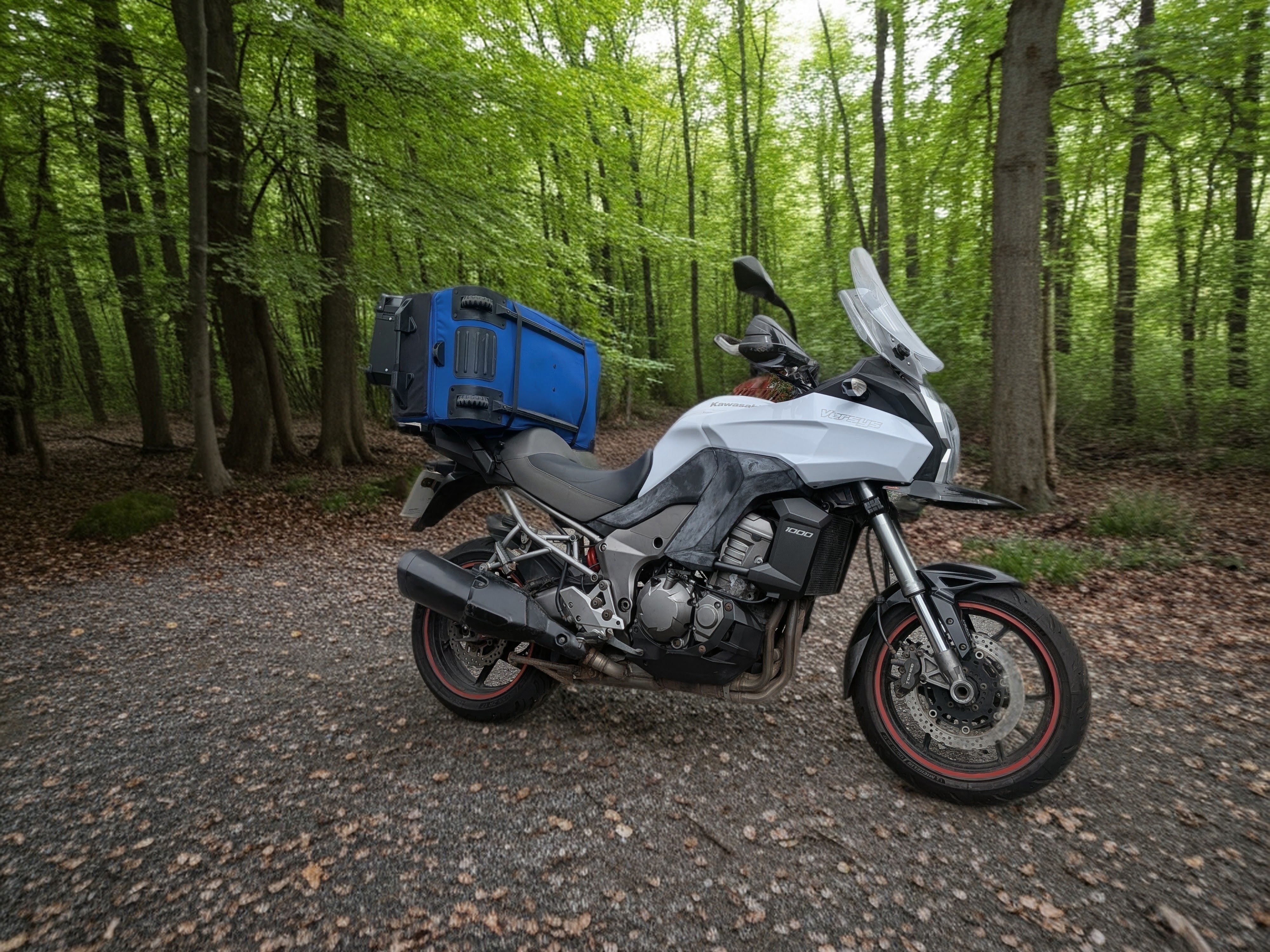
OK, yeah: although it has a linked braking system, a 1986 GL1200 Gold Wing Aspencade does not have the antilock brakes of my 2012 Kawasaki Versys 1000. It does not have two riding modes, three levels of traction control, nor a fancy little symbol on the dashboard that tells me when I’m riding in a fuel-efficient manner. It doesn’t have 118 horsepower…

But it does have more torque than a Versys 1000, and in pretty much every way that matters, a properly functioning 40-year-old Gold Wing is objectively better than a 12-year-old Versys 1000. Hell, it’s better than a brand new Versys 1000. It has more character, more style, more class…
I mean, I really like my Kawasaki, but I cannot think of a single situation in which I would rather be seen on a Versys 1000 instead of an old-school Gold Wing. Young women on round-the-world adventures don’t abandon their better judgment to get naked with Versys 1000 owners; but they do get it on with Gold Wing guys.
SHOULD I BUY THIS ONE?
You might have picked out a very important distinction in my claim that a ‘Wing is better than a Versys. I said that a properly functioning GL1200 is a better bike. That’s really important.
This particular bike apparently runs well, and a look at its MOT history shows that it has passed every test on record without advisories, save one time, many years ago, when the owner tried to skate by with bad tires. Those two facts inspire some level of optimism, but man… All the bells and whistles of the Gold Wing Aspencade mean there is A LOT of stuff that could break or may already be broken.
Stators are known issues for the GL1200, as are related electrical gubbins. Meanwhile, it’s generally safe to assume that any 40-year-old part is going to need replacing, repairing, or refurbishing sooner than later. You can find some GL1200 parts on sites like David Silver Spares (an excellent place to find stuff for old Hondas) and the Gold Wing has spawned a very active and engaged online community full of dudes (with mustaches) who are eager to help answer any questions. But I’ve got to think that some challenges will be still considerably bigger and more expensive than others. I mean, I dread to think of finding new parts for the bike’s air suspension.

This bike is a steal for someone who is mechanically sound and wants to spend a solid amount of time, effort, and money. And it is such an iconic machine that it makes me want to try to be one of those guys.
“This could be my thing,” I’ve told myself in looking at this bike. “I could work on this bike over a long period of time – months, years – and make it beautiful again. Imagine showing up at classic bike meets on this beast!”
But there’s all kinds of problems with that line of thinking.
Firstly, there is very little past evidence to support the idea that I could become mechanically adept enough to manage all of the work that would be necessary to return a 40-year-old Gold Wing to its former glory. I can change various fluids and replace spark plugs, that sort of thing, but the biggest job I’ve ever done was replacing a radiator. This bike would demand much, much more. And my garage doesn’t have an electrical outlet.
Secondly, if buying a £2,000 bike puts me over budget, I’m not likely to have the kind of wallet necessary to restore this machine.

And most importantly, I already have too many things. I’m a dad; that’s a whole big thing in and of itself. I like riding more than I like wrenching. I play trombone in three different groups. I daydream about hiking the Appalachian Trail. And lately I’ve gotten really into trying to change my life. I haven’t got time for another thing, especially not a thing as involved as this.
I love the Gold Wing and I hope that I will own one some day. But, I’m afraid it won’t be this one.
— IIII —
UPDATE: The bike sold while I was writing this article. Whoever bought it made the right choice.



Leave a Reply