
Somewhat unrelated: how is Morgan Gales managing to age in reverse? Morgan is a moto-journalist who served as host for this week’s video from Indian Motorcycle, launching the 2025 Scout platform (which you can buy in 2024). I’ve had the incredible good fortune to hang out with Morgan a number of times; he is the sort of person that everyone loves. Even so, I can’t help but be jealous/annoyed of his ability to look younger as time moves forward.
I mean, look at the photo below of Morgan and me from almost seven years ago, when we were attending the launch of the BMW K 1600 B. Then look at him in this week’s launch video. He looks older in the photo from 2017 than he does now. What the hell, man? What moisturizer does he use?

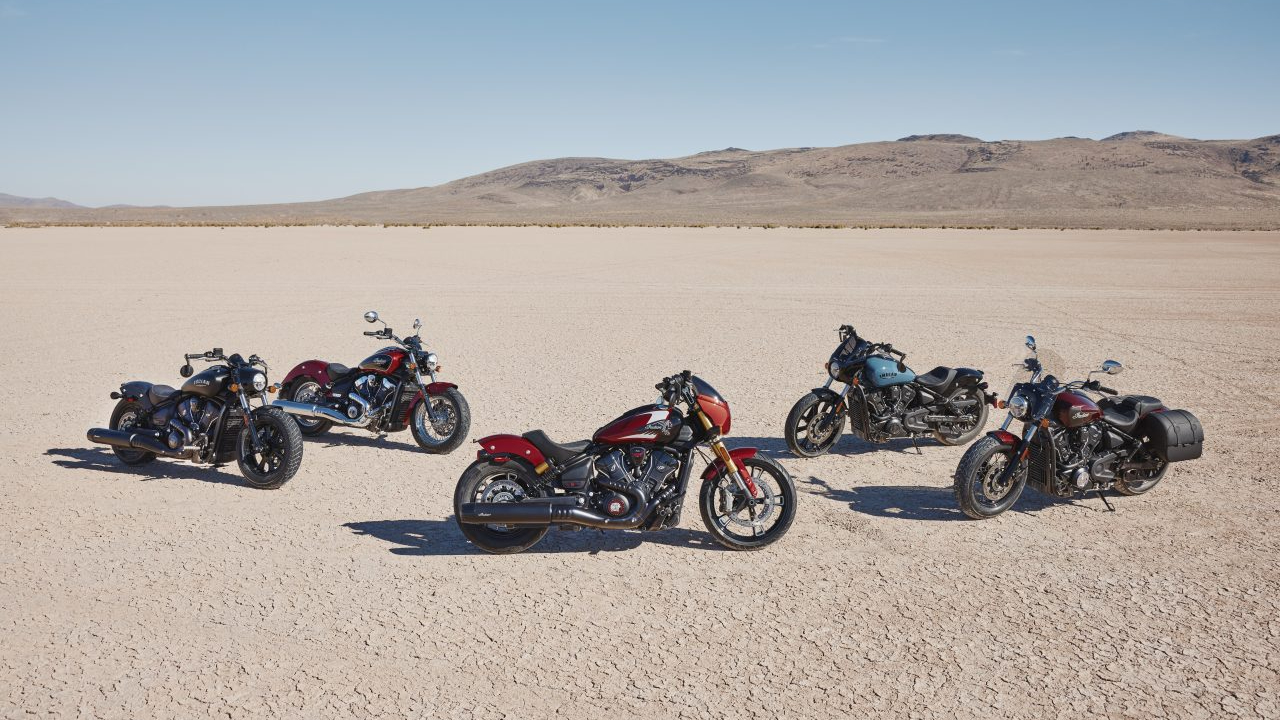
Meanwhile, along with demonstrating that Morgan is still a handsome, handsome son of a gun, Indian this week revealed a family of five ‘new’ Scout models. Or, perhaps, two new Scout models, or none, or 450 of them – depending on what your definition of ‘new’ is.
Regardless, It’s a move that makes perfect sense. The Scout platform has not been properly updated since it was launched a decade ago (Obviously, the Indian Scout name has been around more than a century; I’m talking about Indian under Polaris ownership). We’ll get into the particulars of the five different flavors of Scout in a second, but the main takeaways are that the new Scouts have:
- A bigger, better engine
- More tech
UPDATED LOOK
As a long-time Polaris fanboy I’ll admit that these new bikes have me salivating, but they always have. To that end, Indian have been clever here in not throwing out the things that were good about the previous generation of Scout. Which is a mistake that I think Harley-Davidson made when it overhauled the Sportster platform a few years ago. In that case, Harley did too much too soon, dramatically changing both the Sportster’s powerplant and look (Sorry, I can’t get over the fact that the Sportster S and Nightster look like generic Chinese toys).
“We knew that [redesigning the Scout] was going to be an exercise in the fine art of evolution, not revolution,” explains Indian Motorcycle Director of Industrial Design Ola Stenegard. “We had to honor the original Scout; it’s one of the cornerstones in our history. We also had to find ways to improve the current (2014-2024) Scout; that’s one of the most successful motorcycles in our lineup today.”
Aesthetically, Indian has (gently) softened the hard lines of the previous-generation Scout, aiming to give the models more “soul” and a less “industrial” feel. That sounds like nonsense, but, in fairness, if you look at side-by-side images of the ‘old’ 1133cc Scout and the new 1250cc Scout Classic (below), you can clearly see a difference – especially in the tank and the engine. The new bike looks more “drawn”, if that makes sense, rather than machine-made.


Other things that have drawn my attention are the radiator, and the new two-into-one exhaust. That exhaust looks MASSIVE, a concession to ever stricter environmental regulations, but I think I still prefer it over the previous generation’s dual exhaust. The radiator, meanwhile is much improved. It’s less chunky, fitting between the frame’s downtubes, and gels better with the overall look, feel, and spirit of the bike.
NEW ENGINE
Looks are a matter of opinion, though, so the thing that most people will be interested in will be the Scout’s new SpeedPlus engine. It’s a 1250cc liquid-cooled V-twin, so nothing earth-shattering compared with the outgoing Scout. But capacity is more than 100 cubic centimeters more (the outgoing bike was 1133cc), and Indian claims 105 horsepower on all but the 101 Scout model, along with 82 lb-ft of torque. Compare that to the previous generation’s 95 hp and 72 lb-ft of torque.

The new 101 Scout, meanwhile, has been tweaked to produce 111 hp, with torque remaining the same.
“That’s an 11-percent increase in power and a 14-percent increase in torque,” says Indian Product Director Ben Lindaman. “What’s awesome about that torque increase is, it’s a really flat torque curve… which makes the acceleration extremely predictable and smooth.”
Again, subtle changes have been made to the appearance of the engine, as well. Wisely, Indian hasn’t added unnecessary cooling fins – this is a modern bike with a modern engine and there’s nothing wrong with that – but the whole thing is a little easier on the eye.
“We reskinned the whole motor,” says Stenegard. “We made it a little bit less industrial-looking; it’s a little bit more cruiser-like, so to speak, and it takes a lot of cues from the Challenger.”

Outside of the way it looks and Indian’s claims of how it performs, we’ll have to wait a little bit to see what the consensus opinion is on the new powerplant. I’m too out of the moto-journalism loop to know when Indian will be hosting press rides, but I’ve got to think it will be soon; according to Indian’s website, the new Scouts are already available to purchase.
NEW TECH
One of my criticisms of the outgoing Scout platform had always been that it was pretty no-frills compared with, say, a Triumph Bonneville Bobber/Speedmaster 1200, Honda CMX1100 Rebel, or current-generation Harley-Davidson Sportster. No traction control, no ride modes, no dashboard that connects with the International Space Station.
“Since launching the current Scout 10 years ago, the midsized cruiser segment has evolved,” says Lindiman. “After conducting tons of research, rider insights drove our developments that prioritized styling, performance, and new rider-centric technology.”
Arguably, the no-frills approach is part of the appeal of a cruiser, so Indian is providing that choice to riders in its so-called Standard trim – available as an option on three of the five new models. Everywhere else, though, the platform gets traction control, riding modes, and cruise control. If you’re willing to throw down a good bit of dough, you can also get a 4-inch touchscreen in place of the gauge, which uses Indian’s impressive Ride Command operating system.

The bike’s ride modes are as you’d expect: Rain, Standard and Sport. Until we start getting reports back from the aforementioned press rides, there’s no real way to know how dramatically each mode changes the experience, but according to Lindaman: “Standard mode is very similar to [the outgoing 1133cc] Scout. And Sport is fun for everybody.”
450 FLAVOR COMBINATIONS
According to Indian, some 30 different ergonomic combinations can be achieved on the new Scout platform, thanks to the magic of paying for accessories (different bars, seats, and pegs, specifically. On top of that, each of the new Scout models is being offered in three different “trims,” which is a cruisery way of saying “options package.” Multiply all that across the five new models and you’ve potentially got 450 different versions of Scout.
Actually, you could go even further than that. Indian says that “more than 100 factory accessories are available” for the new Scout platform. And since the brand has been gentle with its updates, I’m willing to bet that a lot of existing aftermarket accessories will continue to work. This has always been the charm of cruisers; they’re pretty easy to personalize.
Paring it down, though… a breakdown of the unique features of each new Scout model is below. But with three of those models – the Scout Classic, Scout Bobber and Scout Rogue Sport Scout – you get three different “trim” options: Standard, Limited, and Limited+Tech.

Standard is the no-frills version of the bike mentioned above. It has a trusty analogue gauge and a good ol’ fashioned ignition that requires a physical key. The only real rider aid whizzbangery to be found here is standard ABS.
Limited adds to the Standard with those three riding modes, traction control, cruise control, a USB port, and a silly little badge that says “Limited” (which looks like it was stolen from a Triumph parts bin).
Limited+Tech is where the 4-inch touchscreen with Ride Command comes into play (that’s in addition to all the features in the Standard/Limited trims). “You’ll wonder how you ever rode without it,” declares Indian’s website. You also get keyless start, which is helpful in protecting you against carpal tunnel syndrome.
In the United Kingdom, the Limited trim adds £800 to a Standard bike’s pricetag; the Limited+Tech trim adds an eye-watering £2,000.
FIVE NEW MODELS
The five new models announced this week are: the Scout Classic, Scout Bobber, Sport Scout, Super Scout, and 101 Scout.

The Scout Classic is basically the updated version of the Scout that was introduced 10 years ago, its styling harkening to the same 1950s feel that Indian’s other bikes had when the brand relaunched under Polaris leadership in 2013. The Springfield and Roadmaster are still hanging on but for the most part, Indian has purged that styling from its lineup, so I wouldn’t be surprised to see the Scout Classic disappear in the not-too-distant future. Maybe not, though; there’s something deeply likable about the Scout Classic’s look.

The Scout Bobber also hasn’t changed much, still looking quite a lot like the Scout Bobber I rode back in 2017. Still gorgeous, but still suffering from the same ergonomics problem: The bike is uncomfortable with its standard handlebar set-up. Add mini ape-hangers, however, and it’s a joy.

The Sport Scout, meanwhile is just a Scout Rogue with a better name and handlebars on 6-inch risers in place of mini ape-hangers. It is seemingly targeted at the sort of person who still wears spotlessly clean flat-brimmed baseball caps. If there’s any justice in the world, it will be dropped from the lineup next year.

The Super Scout is a Scout Classic that’s been hit very hard with the accessories stick. In addition to the Limited+Tech trim, the bike comes with a quick-release windscreen, passenger seat, and panniers. Fuel tank capacity is still just 13 liters, though.

The 101 Scout is the sexy one. Producing more horsepower than the other models in the Scout lineup, it’s arguably one of the best-looking bikes that Indian has ever produced. Beauty is in the eye of the beholder, though, and it may be that what appeals to me here is the fact that this bike seems to achieve the style/spirit that Victory Motorcycles often struggled to get right. The guiding principle of Polaris’ previous motorcycle brand was to create the motorcycle version of American muscle cars (think Ford Mustang, Dodge Challenger, etc.). Some bikes (Gunner, Judge) managed that; others (Magnum, Octane) did not. The 101 Scout absolutely nails it. I love the piggyback shocks, I love the seat, and especially love the fact that it has dual front brake discs. They help the bike look so much more aggressive. And it costs less than a Harley-Davidson Low Rider S (with which it shares a lot of visual similarities).
“Scout is the most iconic American cruiser of all time and is synonymous with the Indian Motorcycle brand,” says President for Indian Motorcycle Mike Dougherty. “As our top-selling platform, Scout has long been a staple in our lineup. And while riders around the world love the current Scout offering, we’re excited to take it to the next level and continue its evolution with a robust offering of models to meet the diverse needs of our global riding community.”
If you want more detail about the specific differences between the five models, check out the chart at the bottom of Motorcycle.com’s article.
Oh, and this isn’t the end of things. Apparently Indian has hinted that an overhauled Scout Sixty (lower capacity Scout) is on the way, too.



Leave a Reply to Terry RCancel reply