
I have zero criticisms for the 2026 Honda XL750 Transalp with E-Clutch. None. I’m not sure that’s ever happened before.
There are plenty of bikes that I’ve loved – most in fact. But usually I’m able to identify at least one little gripe. With the Transalp 750 I’m finding that very hard. Honda may have made the perfect bike.
That’s a feat made all the more impressive by the fact that the Transalp 750 shares much of its platform with another bike (in other words, it is not unique), and it makes use of a technology that doesn’t feel particularly necessary.
Read my review of the 2026 Honda CB750 Hornet E-Clutch
Yet, somehow, despite sharing an engine, frame (but not subframe), and E-Clutch tech with the Hornet 750 that I reviewed recently, the Transalp 750 does it better. Everything makes more sense in this context. It’s more fun and more functional.

How we got here
Like the Hornet 750, the Transalp 750 borrows a much-loved name from Honda’s not-too-distant past. The original XL600V Transalp was launched in 1986, powered by a 583cc V-twin engine that promised peak outputs of 55 bhp and 38.8 lb-ft of torque. In 2000, capacity was boosted to 647 cc (XL650V), then up to 680cc (XL700V) in 2008.
The model was ultimately dropped in 2012, with Honda making the questionable decision of replacing it with the NC700X, which then became the NC750X that is so favored by European commuters.
The NC750X is a middleweight, and it does have adventure styling, but it is definitely not a middleweight adventure motorcycle. After roughly a decade of leaving competitors free to eat up market share with great bikes like the Yamaha Tenere 700, Honda resurrected the Transalp name in the form of a 755cc parallel twin.

The XL750 Transalp was launched in 2023 and despite some lukewarm reviews has gone on to sell in excess of 30,000 units.
A year after the Transalp 750 was introduced, Honda rolled out its E-Clutch system – a technology that effectively eliminates the need for a clutch lever while maintaining the overall motorcycling experience. Initially, E-Clutch was only available on the CBR650R and the CB650R.
Last year, Honda made a few improvements to the Transalp 750, including minor aerodynamic tweaks. Now, in 2026, all the pieces have come together. Honda has brought E-Clutch tech to its 750 platform and created a bike that has me constantly thinking: “How can I get my hands on £10,000?” (The Transalp 750 E-Clutch asking price is £9,999)

Look, fit, and feel
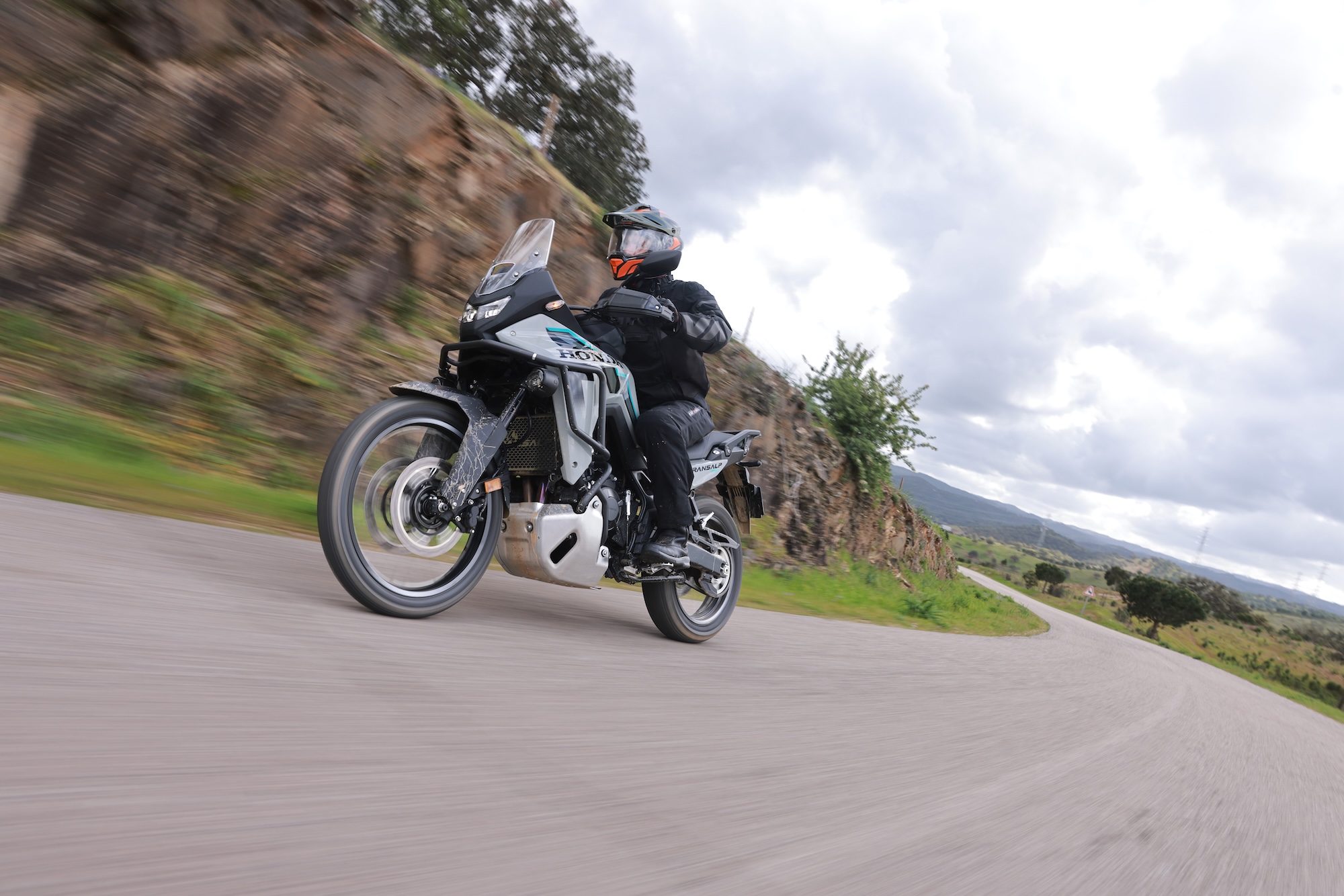
The Transalp 750 E-Clutch is a good-sized motorcycle but not intimidating. Too often, manufacturers try to make their adventure bikes look like some kind of a war machine. The Transalp 750 looks more like a bike that’s made to be used.
Its styling ties it somewhat to the CRF1100L Africa Twin, but there are also clear nods – especially in the cowling and windscreen shaping – to the original Transalp. I like that; I appreciate when designers seek to maintain consistency with the past.
The 2026 model comes in three paint schemes: Ross White Tricolour, Mat Ballistic Black Metallic, and Pearl Deep Mud Gray. The last of those is the one you see me riding in the photos – bedecked in Comfort Pack accessory trim. It has turquoise pinstriping that, from a distance, makes it look as if the bike is wearing CFMoto colors. I can’t imagine that was intentional.

The bike comes standard with a rear carrier and an aluminum bash plate that’s now 2.5mm thick and designed to make sure the E-Clutch system is also protected. A USB socket is tucked under the seat.
Build quality, as you would expect from Honda, is excellent. It’s not opulent luxury or anything, just well built and right. It has the look of a motorcycle that will still be up for daily use 20 years from now.
I mentioned in my review of the Hornet 750 that I’ve been riding a lot of Chinese motorcycles lately – most of them adventure bikes, such as the QJMotor SRT600S, QJMotor SVT650X, Voge DS800X Rally, and Morbidelli T1002V. They’re decent machines. But then you encounter something like the Transalp 750 and you think: “Ah, yes, the Chinese still have a ways to go.”
Hoist a leg over the bike’s 850mm seat (a lower 820mm option is available) and you’ll encounter a saddle that is all-day comfortable. There’s plenty of room for a passenger on the one-piece seat, but I’m not sure an adult would want to be perched there for a multi-day jaunt to the Carpathian Mountains.

Honda says the ergonomics have been designed to offer “natural leverage” when both sitting and standing. I’m not sure I understand what that means, but certainly it’s true that everything falls naturally in place: hands to bars, feet to pegs. The riding position is upright and comfortable.
Turning attention first to the handlebars, the switchgear is uncluttered. Outside of the standard buttons (horn, indicator, starter, etc) there is a simple, backlit, four-way switchcube on the left grip to help you navigate the bike’s menu and choose settings.
Looking straight ahead, a 5-inch TFT display sits in the lower periphery of your view. A non-adjustable windscreen sits beyond that. I would complain about the lack of adjustability were the screen not as good as it is.
Honda says that one of its aerodynamic tweaks is a “central duct”in the upper fairing “to direct airflow around the helmet and reduce backpressure/buffeting.” I’m 6-foot-1 and I found that this, in conjunction with the screen, works brilliantly – even at very illegal speeds.

Engine
The Transalp 750 uses the same 755cc liquid-cooled parallel twin engine as the Hornet 750, producing the same peak figures of 90.5 bhp (67.5kW) at 9,500 rpm and 55 lb-ft (75Nm) of torque at 7,250 rpm. Yet, somehow, it’s so much better in this application.
It sounds better. It feels better. Honda says the Transalp 750 has a mapping ‘flavor’ that’s in keeping with long-distance touring work, but I think the engine also feels punchier here, more willing to have fun. Albeit in the same, non-threatening, mature way as with the Hornet 750’s set-up.
Power delivery is strong when you want it to be, smooth always, and torquier than you’d expect from a machine offering 55 lb-ft of torque. The soundtrack of the engine is fantastic. Honda has given it a slightly dirt-bike snarl. Not so loud/obnoxious that you’ll be getting the stink eye from neighbors, but enough that you’ll be cracking the throttle constantly.
There are five different ride modes in total, each affecting power delivery, as well as the intensity of engine braking, traction control (or what Honda more accurately calls torque control), and ABS. The modes are Sport, Standard, Rain, and Gravel, as well as two user modes that allow bespoke settings.
As far as fuel consumption is concerned, Honda says a range of 240 miles is possible from the bike’s 16.9-liter tank.

The fancy new thing (E-Clutch)
The E-Clutch system works exactly the same on the Transalp 750 as it does on the Hornet 750, so I’ll encourage you to go read that article rather than fully rehashing things here.
In short, Honda has invested tremendous amounts of time, effort, and money to make your left hand redundant. E-Clutch is not an automatic transmission; it’s still up to you to choose which gear you want and when you want it, and you’re still selecting said gear with your foot. The main difference between E-Clutch and what you already know is that you no longer need to squeeze the clutch lever.
You can if you want to – doing so will override the E-Clutch system – you just don’t have to. And if you’re particularly averse to the idea, you can just shut it off entirely. This latter aspect makes it easy to imagine a future in which Honda equips all of its bikes with E-Clutch. Don’t want it, don’t use it; but it’s there if you change your mind (or sell the bike to someone who does want it).

That said, Honda has hinted strongly that this tech will be coming to additional models, but there’s no talk – at the moment – of it being introduced across the board.
The system makes use of a Rube Goldberg-like mechanism consisting of two small motors and about half a dozen equally small sprockets, which sit beside and partially in the right-side engine cover. The mechanism responds to the input of your foot and works with the bike’s throttle-by-wire and torque control systems to deliver smooth, judder-free gear changes.
In some ways, E-Clutch is a really, really fancy quickshifter. In other ways, it’s better than that. You can change gear at any RPM and the system will adjust surprisingly well – blipping the throttle as needed. Idiot downshifts are made clever. This is handy when riding on twisty roads, as well as off road.

The system detects the ‘hop’ that comes from rapid downshifting and deploys a kind of “half-clutch” to stabilize things. If you suspect in that sentence that I don’t fully understand the technology, you are correct. I simply know it works. Equally, on off-road upshifts the system monitors front/rear wheel speed discrepancy and – again – ensures a smooth gear change.
One aspect of E-Clutch that I found particularly useful is the fact that you can be at a stop with first gear engaged. As soon as you want to move – when a traffic light turns green, for example – you just twist the throttle and go. Say goodbye to the experience of filtering to the front of a long traffic queue then accidentally stalling with a white van breathing down your neck.
Of course, say goodbye to clutch-up wheelies, too. Unless you override the system with the clutch lever.
Related to the question of how often one goes for the clutch lever: on the whole, the system works really well. Ninety to 95 percent of the time it’s as slick as a human would be. Honda took us on a dirt road to demonstrate its usefulness off road, but I would not describe that particular road as challenging. I suspect there are still situations in which I’d trust my left hand more than Honda’s tech.

Chassis and brakes
Another big change for 2026 comes in the Transalp 750’s suspension set-up. When the bike was first launched, some reviewers felt the suspension was too soft – especially for pillion work. For 2026, Honda has taken those criticisms on board, tweaking the bike’s Showa front fork and Pro-Link rear shock, as well as ensuring that both are adjustable for compression and rebound damping adjustment.
All of this works in conjunction with a steel frame that is shared with the Hornet, and a more rugged subframe aimed at better supporting passengers and luggage.
The whole show weighs 216 kg, yet manages to feel light and manageable. Off road, it is as stable and confidence-inspiring as the Royal Enfield Himalayan 450 Mana Black I rode a few months ago – a bike so manageable that it reinvigorated my interest in exploring beyond the pavement. On road, meanwhile, such a comparison becomes deeply unfair to the Royal Enfield; the Transalp 750 is markedly more planted, steady, and smooth. It really is a ‘best of both worlds’ bike.

Technowhizzbangery
Like the Hornet 750, the Transalp 750 features a 5-inch TFT display that is easy to read, with a menu that is easy to understand. Phone connectivity is possible – according to Honda – via the company’s RideSync app.
I didn’t test the system, and regular readers will know that I am deeply sceptical of riding apps, but Honda says RoadSync can be used for turn-by-turn navigation, calls, and music via a Bluetooth headset.
Indicators are self-cancelling and are based on speed difference rather than time. And in addition to all the safety features we’ve come to know and expect (eg, ABS and traction control) you also get Emergency Stop Signal, which temporarily activates your hazard lights under hard/emergency braking – to give vehicles behind you a heads up that you are stopping fast.

Basic maintenance
The Transalp 750 comes with a tool kit under the seat. God bless Honda for continuing to trust riders to do stuff on their own. There is not yet a Haynes manual for the Transalp 750, but I’m willing to bet there will be soon.
Recommended oil changes come every 8,000 miles. Oil filter changes are suggested every 16,000 miles but oil filters don’t cost that much – might as well replace them at the same time as the oil. Honda suggests inspecting the air filter every 8,000 miles. Spark plugs should be replaced every 32,000 miles.
Getting at the sump plug and oil filter isn’t too difficult, although you will have to turn a few more screws in the process of removing the bash plate. Based on home mechanics’ experiences with the 2023-2025 Transalp 750, getting to the air filter is straightforward but tedious. It involves removing the tank and a few other bits and bobs.

Competition
The Transalp 750 exists in a very, very crowded field. Pretty much everyone wants to play in the middleweight adventure space. The field is so crowded that I’ve left out competition on the high and low ends, limiting my table to bikes within a 100cc capacity range – ie, 650cc to 850cc.
Even so, there are so many options in this segment that I’ll admit I haven’t ridden them all. Of those that I have ridden, the Honda is the best.
Additionally, fellow journalist James Oxley of Adventure Bike Rider (who was on the launch in Portugal with me) said that he would place the 2026 Transalp 750 with E-Clutch in the “top three” of the middleweight adventure machines he’s ridden. Admittedly, he said this in the presence of Honda’s PR man – the same PR man who had just paid for his beer – so it may be that he was being polite.
Obviously, which is best will depend a lot on how you intend to use the bike. Some competitors are far more off-road focused (eg, the Aprilia); some offer an ostensibly better on-road experience (eg, the Moto Guzzi).

| ENGINE | OUTPUT | PRICE | |
| Honda XL750 Transalp E-Clutch | 755cc parallel twin | 90.5 bhp 55 lb-ft | £9,999 |
| Aprilia Tuareg 660 | 659cc parallel twin | 79 bhp51.6 lb-ft | £10,945 |
| Benelli TRK 702X* | 698cc parallel twin | 68.3 bhp51.6 lb-ft | £6,799 |
| CFMoto 800MT-X* | 797cc parallel twin | 93.8 bhp64 lb-ft | £6,999 |
| Kove 800X Rally* | 799cc parallel twin | 94 bhp59 lb-ft | £9,499 |
| KTM 790 Adventure | 797cc parallel twin | 93.8 bhp64 lb-ft | £9,999 |
| Moto Guzzi V85TT | 853cc V-twin | 80 bhp61.2 lb-ft | £12,195 |
| Moto Morini X-Cape 700* | 693cc parallel twin | 70 bhp50 lb-ft | £6,799 |
| QJMotor SVT650X* | 645cc parallel twin | 75 bhp50 lb-ft | £5,999 |
| Suzuki V-Strom 800DE | 776cc parallel twin | 84.3 bhp57.5 lb-ft | £9,999 |
| Voge DS800X Rally* | 798cc parallel twin | 94 bhp60 lb-ft | £6,999 |
| Yamaha Tenere 700 | 689cc parallel twin | 72.4 bhp50 lb-ft | £10,104 |
*Denotes Chinese brand
Verdict
I said at the beginning of this review that the Transalp 750 is a bike for which I have no criticism. I will admit, though, that there are two things that make me raise an eyebrow.
The first is the fact that Honda chooses to equip the bike with tubed tires. This wouldn’t be my first choice – and I suspect I’d become a lot more critical if I had to deal with a flat on the M25 – but, sure, whatever.
The second issue is even less dramatic. The off-road focused Gravel mode does not shut off rear ABS entirely. So, you can’t do those cool hooligan dirt slides that you always see in magazines. The solution to this, though, is easy: use one of the bespoke User modes to build your own off-roading set-up.
Outside of that, the bike is damn-near perfect.

As I said of the Hornet 750, the Transalp 750 is a bike that is instantly rideable and confidence-inspiring – not in a boring or tame way, but in a way that makes you more willing and eager to ride closer to your limits. The Transalp 750 stands ahead of its naked sibling, however, in better delivering on the promise of the 750 platform.
I want one. Honestly: if I had £10,000, I would have already bought one. I anticipate that I will spend the next three years setting aside money, sitting on my hands, and hoping that I eventually have enough cash to buy a Transalp 750 that’s fresh out of a PCP deal. They will be a difficult three years.
The three questions
Does the 2026 Honda XL750 Transalp E-Clutch fit my current lifestyle?
Yes. The Transalp 750 can go everywhere I want to go and do everything I want to do.
Does the 2026 Honda XL750 Transalp E-Clutch put a smile on my face?
Yes. I love this bike. It is friendly, fun, and easy to ride – Honda at its very best.
Is the 2026 Honda XL750 Transalp E-Clutch better than my current motorcycle, a 2012 Kawasaki Versys 1000?
Yes. Is sleeping in a bed better than sleeping on the floor? Is a bottle of wine better than a fistful of old grapes? My Kawasaki boasts more horsepower and a bigger passenger seat, but in every other way – measurable and emotional – the Transalp 750 is the superior machine.

Gear worn in photos
Helmet: HJC RPHA 60
Jacket: LS2 X-Master
Pants: LS2 X-Master
Gloves: Richa Atlantic GTX
Boots: Richa Oberon WP
2026 Honda XL750 Transalp E-Clutch specs
| PRICE | £9,999 |
| ENGINE | 755cc liquid-cooled parallel twin with 270-degree crank |
| TRANSMISSION | Six-speed w/ E-Clutch |
| POWER | 90.5 bhp at 9500 rpm |
| TORQUE | 55.3 lb-ft at 7250 rpm |
| TOP SPEED | 121 mph |
| SEAT HEIGHT | 750 mm |
| GROUND CLEARANCE | 210 mm |
| WEIGHT | 216 kg |
| FUEL CAPACITY | 16.9 liters |
| FRONT TIRE | 21-inch, 90/90 |
| REAR TIRE | 18-inch, 150/70 |
| FRONT BRAKES | Dual 310mm discs, two-piston brake caliper |
| REAR BRAKE | 256mm disc, single-piston caliper |
| FRONT SUSPENSION | Showa 43mm SFF-CA USD, 200 mm travel |
| REAR SUSPENSION | Monoshock damper, Prolink swingarm, 190 mm travel |


Leave a Reply