
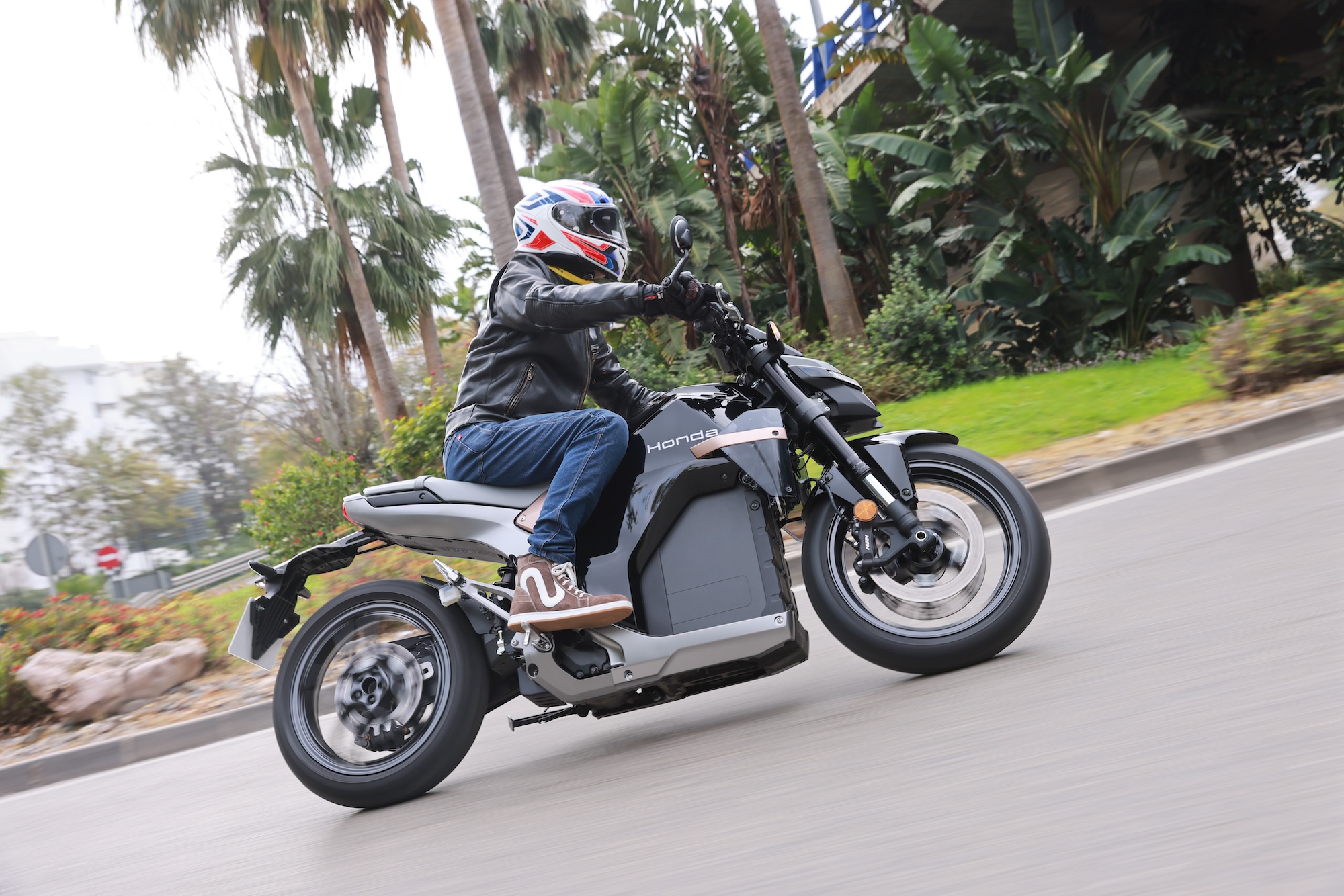
“I don’t know,” says Gem, who sub-edits some of my stuff for Visordown. “£13k for a bike that can be overtaken by a Ford Transit is a bitter pill to swallow.”
I think she may be missing the point. Certainly it’s true that the WN7 is the most expensive naked motorcycle that Honda sells, outpacing the 155bhp CB1000 Hornet SP by almost £3,000. But that’s a strawman argument – an apples-to-oranges comparison built to undermine the WN7 with the same old price/range criticism that people have been using for more than a decade.
I’m not saying those concerns are completely unfounded, but they fail to address what the WN7 is, what it delivers, and how incredibly good it is at delivering it. The TLDR of this review is that I think Honda’s electric bike is one of the purest motorcycles you can buy.
What do I mean by that? And should you buy it? Read on.

How we got here
More than 120 years ago, 38 percent of the cars in the United States were powered by electricity, according to the Washington Post. Hilariously, 40 percent were powered by steam.
Many people blame 20th century’s world wars for side-lining electric vehicle technology. On the battlefield, far from any kind of infrastructure, petrol-powered vehicles made the most sense. As such, factories were geared toward making them, and manufacturers didn’t want to spend the money on retooling after the fighting was done.
So, foundationally, there is nothing new in what Honda is doing here. That’s one of the quirks of the WN7: there’s no real USP, nothing at which to point a neon sign. It’s the first full-size production electric motorcycle to come from Honda, but not its first production electric motorcycle, nor its first full-sized electric motorcycle (via Mugen, it raced at the Isle of Man TT for a number of years).
And it’s definitely not the first full-size production electric motorcycle ever. Nor is it even the first full-size production electric motorcycle to come from a major manufacturer – that prize goes to the Harley-Davidson LiveWire. Even so, the WN7 is special.
You may also want to read: 2019 Harley-Davidson LiveWire – First ride
I was in the same press group as the great Michael Neeves when I test rode the WN7. He made the observation that electric motorcycles have come far enough that we really should be assessing them simply as motorcycles. I agree. And the fact that we now have one from Honda makes that all the more practicable.

So, perhaps what’s most ‘new’ or ‘special’ about the Honda WN7 is its Honda-ness. We’ve still not arrived at the glorious electric future that I was predicting a decade ago, but the WN7 offers electric bikes the sense of normalcy that can only come from a heavyweight manufacturer like Honda.
Hitherto, an inherent part of owning an electric motorcycle has been that you’ve needed to be an ‘early adopter’ type – someone who’s willing to try new things and risk having them fizzle out on you. The maker of your electric motorcycle might go bankrupt or get cold feet.
An electric motorcycle from Honda, though, feels like a safe bet. It’s a Honda, for the love of Pete. You know it’s going to work, you know Honda’s not going anywhere, and you know that the company has a history of seeing a future that no one else can.
Dual Clutch Transmission is an example of this. Honda’s been equipping bikes with DCT for 16 years. Back when the first DCT VFR1200F first came out, all the old boys looked at it and said: “Nobody wants this.”
Less than two decades later, Big Red is selling hundreds of thousands of DCT-equipped bikes. The WN7 as a specific model may not be around 20 years from now, but I’d bet large sums of money that the platform idea and spirit of it will be.
The ‘W’ in the name stands for ‘Wind.’ Honda’s tagline for the bike is “Be the wind,” which sounds stupid until you ride it. The ‘N’ stands for “Naked” – the kind of bike that it is. And the 7 is a reference to the 0-9 power scale that Honda uses to rate its vehicles.

Look, fit, and feel
There’s not much to write home about when it comes to the WN7’s aesthetics. When I first saw it in person – in the awkward lighting of a Fiera Milano hall at EICMA 2025 – I was kind of underwhelmed.
Now that I’ve had a chance to see, touch, and ride the bike in the real world, my opinion has changed. I now appreciate its simplicity. This is an electric bike that doesn’t try to be something that it’s not.
Just as the engine is the center of attention on a cruiser, the battery is the focal point here. There isn’t even a frame; the WN7 is just a bunch of bits bolted to the battery. The small amount of bodywork either exists in service of that battery (panels that push air onto it to keep it cool) or they are there to hide wiring and give everything a sleeker look.
It’s simplistic. Straightforward. No-nonsense. It’s not something that you’re going to sit and stare at post-ride (like an Indian Chief Vintage) but I like it.

The story behind the WN7’s unusually small rear tire
My one real qualm with the WN7’s look is the size of its rear tire. The 150/60R17 hoop at the back seems small for a full-size motorcycle. I asked WN7 Project Leader Masatsugu Tanaka about this. He assured me that it has no negative effect on performance – which I believe after having ridden the bike – and explained that it is, in part, the byproduct of the design philosophies that guided the WN7 project.
Honda put A LOT of effort into ensuring that this bike is as quiet as possible. Since an electric motor eliminates engine noise, the bike’s designers decided to accentuate this feature. Gears were cut in special ways, the fairings crafted to be as aerodynamic as possible, and belt drive was chosen over the clatter of a chain, or the weight of a shaft drive.
As part of the sleekness and simplicity of the bike’s look, it is a particularly narrow machine: just 826 mm wide with the bar-end mirrors attached. Slim enough to ride through a household doorframe.
Belt drives, however, have space-consuming set-ups. If the tire was wider the belt drive housing would either have to stick out like a sore thumb, or the structure of the bike would have to be altered/widened for aesthetics.
The whole thing is an interesting lesson in the multi-level ways that a designer must think, and gives you an even greater respect for how good Honda’s people are at their jobs.

A true cafe racer
The original cafe racers were so named because riders would race from one cafe to another, covering relatively short distances. Honda doesn’t refer to the WN7 as a cafe racer, but that’s what it is.
With a claimed range of less than 100 miles, the WN7 is not a long-distance machine and is designed accordingly. Throw a leg over the 800mm-tall seat and you’ll find a saddle that most of the riders I was with thought was too firm. It didn’t bother me. I wouldn’t want to do an Iron Butt on it, but in the context of the bike’s range it’s fine.
The riding position is borderline sporty, with a slight lean to the ‘bars and pegs that’s just a little further back than I’d have liked. Note that in some of the photos my heel is resting on the peg (I should be placing the ball of my foot there).
Things are not so sporty that you’re forced into an odd position, though. This is first and foremost a city motorcycle and the riding stance is conducive to being able to weave through traffic while keeping your head up and alert to everything around you.
Build quality is what you’d expect from the best of Hondas. Even the bar-end mirrors, which is usually something I hate, are surprisingly good at showing what’s behind.
Looking ahead, a 5-inch TFT screen sits below your natural sight line: easy to glance at when you need info, easy to ignore when you don’t. Such is the benefit of a naked bike. You’re able to make the motorcycle disappear from your peripheral vision. This is an aspect that adds to the ethereal feeling of riding an electric motorcycle.

Power delivery
Normally at this point in a review I’d talk about the engine and transmission. The WN7 has neither of those. Instead, it has an 18kW motor tucked in more or less right at the swingarm pivot. Honda claims peak power output of 50 kW; in old money that’s about 67 bhp. Peak torque is 100 Nm, or 73.7 lb-ft.
I did some digging and those are basically the same numbers as a 2004-2020 Harley-Davidson Sportster 1200. But delivered pretty much instantly. No winding up the engine to get the right revs. No clicking through gears. Just instant, wonderful go.
One of the things that occurred to me when riding the WN7 is the fact that the motorcycling vocabulary doesn’t really fit the electric experience. You don’t thunder or scream or howl or rocket, you… ghost.
Have you ever seen an episode of Doctor Who that features the Weeping Angels? They’re demon-like creatures that move when you’re not looking. A character will spot one across the room, blink, then discover the angel is just inches away. This is what it’s like to ride the WN7: twist the throttle and, poof, you’re in a different part of town.
It is joyful, delightful, and addictive.

There are four riding modes: Sport, Standard, Rain, and Econ. Throttle delivery is super smooth in all modes. So much so that I’d normally argue that there’s no need for Rain mode. But the motor is capable of delivering so much instant torque to the rear wheel that it perhaps makes sense.
Related to this. At a photo stop I was sitting on the bike and pondering aloud: “I’ll bet you could do some pretty cool smokey burnouts on this thing.”
Before my right hand had even fully closed the brake to test this theory, I heard the voice of one of Honda’s UK PR team right behind me: “NO! Don’t try it, Chris!”
I nodded in obedience. As soon as the PR man turned his head, however, Honda engineer Tanaka-san magically appeared at my side.
“It’s easy to do,” he said. “Just turn off traction control. I will show you how. Wheelies you can do, too.”

Honda WN7 range and charging time
Honda says the bike has a range of 140 km, which works out to be just a smidge under 87 miles. That figure is based on WMTC2-2 testing, which tests in the most ideal of ideal conditions. Even as Honda’s team was sharing these numbers with me, its representatives were rolling their eyes.
In the real world, range is closer to 60 miles. Honda took me on a route that was about 70 km in total – add in a few extra kilometers for the back and forth of photo stops and I’d push that to 80… or just under 50 miles.
Our route largely allowed speeds in excess of 60 mph. I kept the bike in sport mode the whole time and was constantly snapping the throttle for the sake of experiencing All That Torque. At the same time, I was leaning into the benefits of regenerative braking (see below), keeping it at setting 2 most of the time. When we got back to the hotel my bike’s battery was just above 20 percent.
So, if I owned a WN7, I’d probably be planning out rides with charging stops every 50 miles or so, just to ensure I didn’t experience range anxiety.
In a city/urban context, that range is fine. Especially since you’ll be riding at slower speeds and using the regenerative braking even more. The electric scooters that are increasingly popular with urban riders don’t offer anything close to the range of the WN7.

Out and about, admittedly, ~60 miles range is a little disappointing. The good news is that the WN7 comes equipped with a quick charger.
There are two ways to juice the WN7: via a Type 2, or CCS2.
Type 2 is the most common type of charger you’ll see in the UK. Getting the battery from 0 to 100 percent via this method will take roughly 2 hours and 30 minutes, Honda says. That’s not awful, but it’s certainly not great. I’m a notoriously slow eater, but even I don’t take 2-and-a-half-hour lunchbreaks.
However, if you’re stopped somewhere that has a CCS2 charger, you can boost the battery from 20 to 80 percent in just 30 minutes. That’s far more agreeable. It’s not hard to imagine an enjoyable Sunday afternoon spent zipping from one cafe to another, recharging oneself with tea and cake while the bike tops up. The only drawback there is that it’s a riding style that may see you gaining weight.
Meanwhile, you can also charge at home even if you don’t have a home-charging set-up. The WN7 comes with a cord that plugs into a standard household outlet (connecting to the bike via the Type 2 port). By this method, charge time is in excess of six hours – definitely an overnight job.

Chassis and brakes
As with the build quality, the chassis and suspension of the WN7 are of the quality you would want and expect from Honda. The bike weighs 217.5 kg, but you genuinely do not feel it. The weight is kept low and centralized. As a result, the whole show feels light, flickable, and easy to manuever.
Accentuated by its slim stance, the WN7 would be a dream through London traffic, cutting through the tiniest of gaps. And on faster, more free-flowing roads it is easy and intuitive. It is often said of Hondas that they are ‘get on and ride’ bikes – motorcycles to which a rider adapts instantly. The WN7 is one of the best examples of that statement that I can think of.
The brakes, meanwhile, are excellent – helped by the bike’s regenerative braking, which is adjustable on the fly. On the left grip, there are two buttons that allow you to change how intense the regenerative braking is.
If you’re new to electric vehicles, regenerative braking occurs when you close the throttle, feeding kinetic energy back into the battery. Think of it as engine braking.
There are three possible settings for regenerative braking: press ‘up’ to decrease the intensity, ‘down’ to increase it (getting that order right confused me initially). At its most intense setting, the regenerative braking is so strong that you almost never need to touch the actual brake lever/pedal. In case you’re wondering, yes, the brake light activates when you use regenerative braking – alerting vehicles behind you that you are slowing down.

Fancy bits
The whole bike is technowhizzbangery, so obviously the WN7 offers a number of fancy bits, including keyless start, full LED lighting, a USB-C charging port, a speed limiter, an Emergency Stop Signal feature, and phone connectivity via Honda’s RoadSync app.
Breaking some of that down, one of my favorite aspects of booting up the WN7 is the fact that the start button is on the side, mildly reminiscent of the way bikes used to be started: turning a key above the engine rather than in the steering headstock.
The Emergency Stop Signal feature simply activates the hazard lights under hard braking – alerting vehicles behind to the fact that you are coming to a stop very quickly. An increasing number of bikes and cars have this feature, and I am all in.
A quirk of the phone connectivity is the fact that the WN7 does not have its own WN7-focused app. The RoadSync app is like the various other manufacturer apps that I’m always complaining about: offering maps and such, but running the whole thing through your phone.
The RoadSync app does not offer you any diagnostic information about the WN7. It doesn’t, for example, tell you the bike’s charge level – meaning you can’t monitor recharging remotely.
The WN7 also has a feature called Walking Speed Mode that allows you to move the bike forward or backward at a walking pace of no more than 5 km. I don’t see the need for the forward aspect; as I say, the throttle in any mode is very smooth and easy to nuance.

Basic maintenance
There’s no engine. So there’s no regular servicing, outside of replacing items like tires and brake pads as and when they get worn. Honda didn’t say how often you should replace the belt, but based on other belt-drive motorcycles and Honda’s belt-driven scooters, I’d assume you can rack up a good 30,000 miles. Honda likely recommends inspecting the belt every 10,000-12,000 miles.
Riding the WN7
Each of us comes to motorcycling for different reasons. For me, at least, it has nothing to do with noise. I enjoy a throaty exhaust, but that is not why I ride. A good exhaust note is like discovering that your girlfriend is proficient at juggling. Even if that’s the thing that initially drew your attention to her, it’s not the reason you’re with her.
Instead, the raison d’être of motorcycling is connection – in particular, connection with the broader world.
When I ride, I feel the movement and force of movement – its impacts on my body – more viscerally than in a car. I experience the minor temperature changes of microclimates. I feel the cold, the wet, the heat. I take in all the aromas – the flowers, the petrichor, the manure… It’s not always perfect, but even in imperfection there is the joy of connection: I am a living, breathing part of a living, breathing world.
Connection is hugely important. Every single day we read and hear stories about the terrible, corrosive effects that disconnection has on the human mind and soul, and on society.

If you remove the noise of a motorcycle you remove the last barrier between you and full connection with the world around you. Now you can ride with all five of your senses alive.
The WN7 gives you this. Get on the bike, adjust your vision so that the structure of the machine is out of your peripheral view, and suddenly Honda’s “Ride the wind” tagline makes total sense. Riding an electric motorcycle is not about being some smug eco-warrior, it’s about full connection. It’s about the purest form of motorcycling.
Honda’s effort to eliminate extraneous noise (chain clatter or rattling bits) and the delightfully smooth and natural throttle genuinely result in the experience of flying – through cities, on twisting roads, even on the motorway.
And the joy that comes from this is almost uncontainable. I have ridden hundreds of motorcycles over the years and I’ve found joy in all of them, but it has been a long time since I spent the whole of my ride just giggling – as I did on the WN7.

Criticisms
The only exception to the WN7’s excellent build quality is to be found in the panel that covers the charging ports. It’s flimsy and has a tendency to pop open under really hard acceleration. And if you’re the sort of person who is used to resting your elbows on the tank at stops you’ll have to break yourself of the habit quickly. Or get used to accidentally opening the panel at every stop.
The panel latch seems like a rare oversight on Honda’s part. I’m willing to bet that it gets fixed in the next wave of production. Also seemingly an oversight but less likely to be ‘fixed’ any time soon is the absence of a parking brake.
The bike has no gears, of course, so you can’t really park it in such a way that it won’t move. You have to park it on a level surface. Which means you cannot park your bike at the Holiday Inn Express Exeter East. Or any number of other places in the world. Or, at least, you cannot park it on any kind of downward slope – lest it roll off the sidestand.
This aspect of the bike negates the benefit of the WN7’s reverse Walking Speed Mode. You’re not able to park in a tricky parking spot to begin with, so you don’t really need a special feature to help you get out of tricky parking spots.
If you park on an upward slope, meanwhile, Honda’s engineers say the bike will be sturdy and secure at any angle up to 40 degrees.

Personally, I’d still like to have a parking brake. When I pressed on this issue, Honda’s people explained that to fit a parking brake that meets proper safety regulations, would mean adding upward of 5 kg to the bike’s weight and a not inconsiderable amount to its cost. So, although they tacitly acknowledge that a parking brake would be beneficial, they’re unlikely to add one.
The solution, it seems, is to go out and buy an Oxford Brake Lock, or something similar, that holds the front brake closed.
Lastly, I wouldn’t say that I am critical of the WN7’s range, but I’ll admit feeling something akin to disappointment. This is the same sort of range that the Harley-Davidson LiveWire had. For some reason, I’d have thought things would be further along by now.
I don’t suppose that’s really a critique of Honda, though. More a lament about the nature of reality. Progress doesn’t happen as quickly as I’d like sometimes.

Competition
As mentioned, the WN7 is the most expensive naked bike that Honda sells. But in the world of full-size electric motorcycles, it is downright cheap.
Consider first the exotica of Verge, which is selling bikes for £23k and up (And the solid state battery that Verge is promising, by the way, seems to be a lot further away than was implied at this year’s CES). And Verge, like most other electric manufacturers, is a company that feels like a gamble.
Motorcycling is littered with the gravestones of electric motorcycle manufacturers that rose and fell with the same spectacular beginning and predictable end as a person being fired out of a cannon into a space with no net. Energica, Lightning, CAKE, Alta, and on and on.
All of these failures add a feeling of uncertainty to the brands that are still afloat. Even LiveWire, which is owned by Harley-Davidson, seems unsteady. According to the Milwaukee Business Journal, Harley-Davidson is planning lay-offs in response to poor 2025 results. With LiveWire still losing money and selling just 653 units globally last year, I’d reckon it’s on the chopping block.
Honda, on the other hand, sells 20 million motorcycles a year, and all 55 of its UK dealerships will support the WN7. That’s a backing that no other electric motorcycle can match. And, as I said above, because this is an electric motorcycle from Honda, there’s every reason to believe the platform will still be with us two decades on.
In addition to there being a glut of dead electric motorcycle companies, there is an equal abundance of electric motorcycle companies promising and accepting money for bikes that are not actually in production (eg, Verge). The table below contains competitors that are selling actual bikes that actually exist.

| PERFORMANCE | CLAIMED RANGE | PRICE | |
|---|---|---|---|
| Honda WN7 | 67 bhp 73.7 lb-ft | 87 mi | £12,999 |
| LiveWire S2 Del Mar | 82 bhp 194 lb-ft | 69 mi | £10,690 |
| Zero S w/ Power Tank | 59 bhp 97 lb-ft | 102 mi | £18,880 |
| Can-Am Pulse | 47 bhp 53 lb-ft | 71 mi | £11,899 |
*In the table above, only the WN7 is equipped with a fast-charger.
Verdict
The Honda WN7 is one of the most purely enjoyable motorcycles I have ever ridden, offering an experience that simply cannot be matched. Certainly not one that can be matched by a petrol-powered motorcycle.
In some way, perhaps, riding an electric motorcycle is like walking on the moon. For the handful of individuals who have ever trodden the lunar surface it was probably a perspective-altering experience – changing their understanding of all kinds of things, including their definition of walking. Does that mean, however, that any of those guys wanted to live on the moon? Dunno.
I’ve mentioned my concerns about range. Tied to that is the fact that you need to teach yourself a new infrastructure. I spent 15 minutes messing about on ZapMap, trying to determine how many CCS2 chargers there are near me before giving up. There is an entirely new lexicon to learn and understand before you can answer the simple question of: “Can I charge this bike here?”
It’s learnable, I’m sure, but that’s another aspect of electric motorcycles that hurts the segment. If you have to spend a lot of time learning something new for the sake of being able to do something simple (ie, recharging the battery) a lot of people won’t even bother.
In other words, the WN7 has a lot of mountains to climb. But, it is better equipped to do that than any other electric motorcycle I’ve encountered. It has the gravitas, knowledge, experience, and wealth of Honda behind it. And there’s the fact that, stand-alone, it is a very, very good motorcycle: well-built, well-thought-out, nimble, fast, addictively torquey and delightful to ride.

The three questions
Does the 2026 Honda WN7 fit my current lifestyle?
No. It is not uncommon for me to have to ride 300 miles to Chorley to pick up a bike, or 180 miles to Peterborough to chat with a magazine editor, or any number of other somewhat faraway places. Getting to these places and back on an electric motorcycle – even a fast-charging one – would be too time-intensive.
Additionally, I store my bike in a garage that does not have a power source. There is no way to charge a vehicle overnight. So, that adds an additional layer of faff to the whole ownership experience.
Does the 2026 Honda WN7 put a smile on my face?
Yes. The bike is a giggle-inducing joy machine. I highly recommend that you test ride one. Even if you have no interest in electric motorcycles, or – like me – don’t currently live in circumstances that could support an electric motorcycle, I strongly encourage you to test ride the WN7. It will improve your life.
Is the 2026 Honda WN7 better than my current motorcycle, a Kawasaki Versys 1000?
Uhm. Well, yes and no. It’s more fun. It offers a greater sense of motorcycling connection. And it’s lighter and more nimble. But in all practical ways, no. Plus my bike is faster, more comfortable, and is able to carry more stuff.
Gear seen in photos
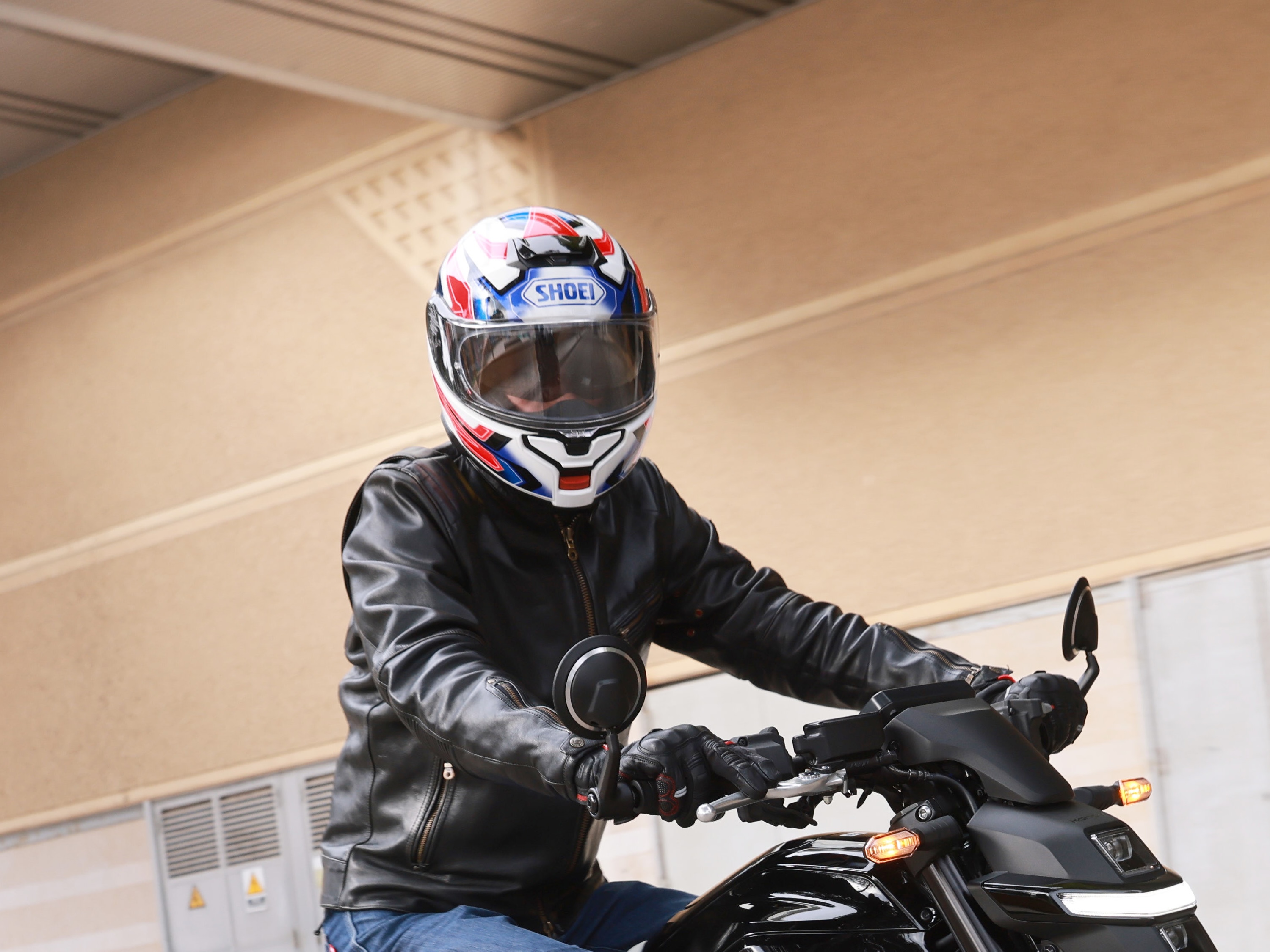
Helmet: Shoei Neotec 3
Jacket: 55 Collection Hard Jacket
Gloves: Richa Atlantic GTX
Jeans: Pando Moto Boss 105
Boots: Spada Strider S
Backpack: Richa Saigon
2026 Honda WN7 specs
| MOTOR | 18 kW |
| POWER | 67 bhp |
| TORQUE | 73.8 lb-ft |
| TOP SPEED (Speed limited) | 80 mph |
| RANGE | 87 miles (140 km) |
| WEIGHT | 217.5 kg |
| SEAT HEIGHT | 800 mm |
| FRONT TYRE | 120/70 R17 |
| REAR TYRE | 150/60 R17 |
| FRONT SUSPENSION | Telescopic 43mm USD forks, 120mm travel, non-adjustable |
| REAR SUSPENSION | 41mm monoshock, 120mm travel, preload adjustable |
| FRONT BRAKES | Dual 296mm disc, two-piston calipers |
| REAR BRAKE | Single 256mm disc, single-piston caliper |

Leave a Reply