
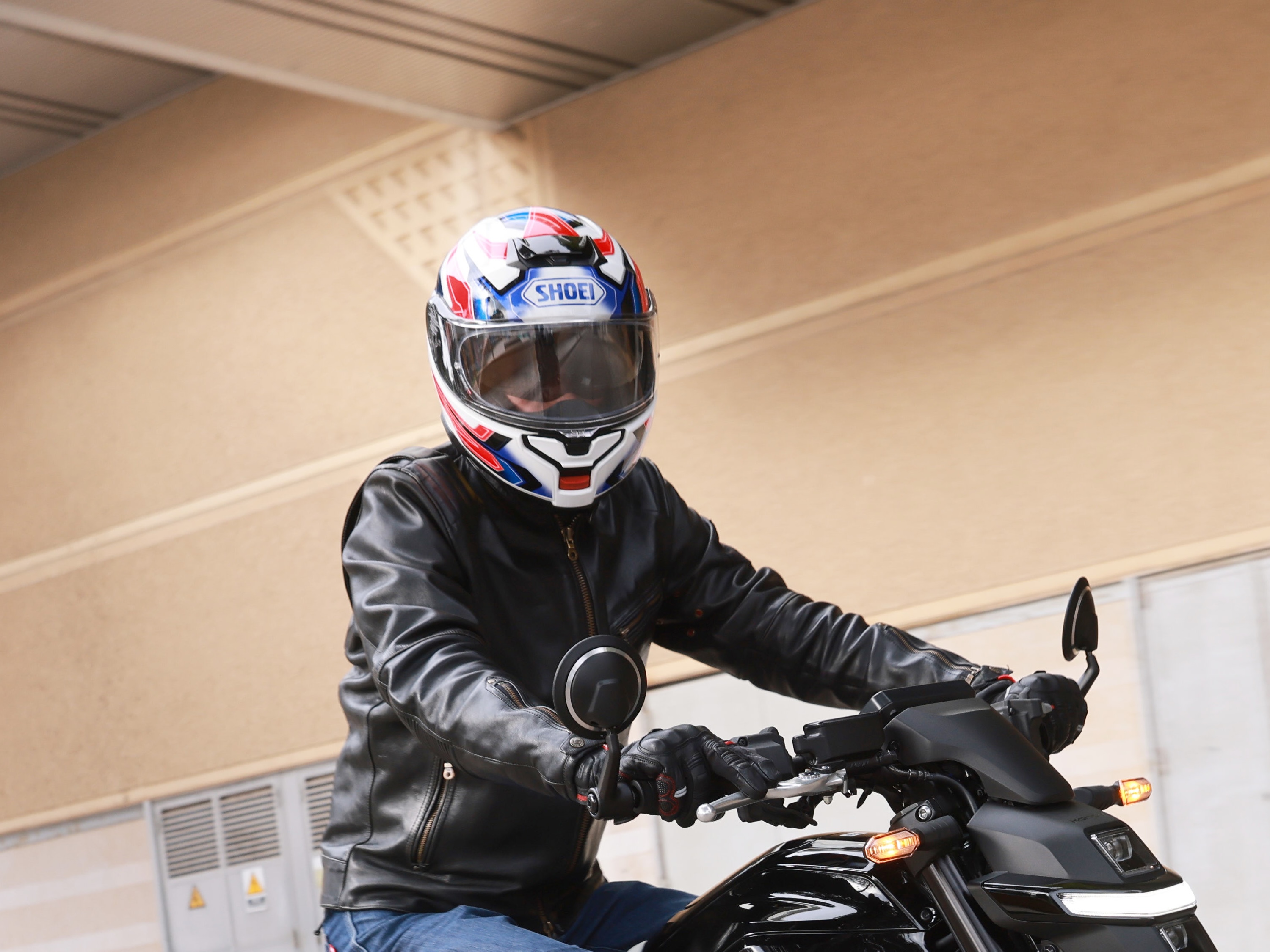
“You pay for what you get,” sang Dave Matthews. That’s a cultural reference that applies to the Shoei Neotec 3 in two ways.
Firstly, because it’s an expensive lid, with an asking price that starts around £600 (or $950 in the United States), it is good but definitely not cheap. Secondly, because the typical Neotec 3 owner is the sort of person who would understand a 30-year-old musical reference.
Might I also interest you in a review of the Aerostich R3 Roadcrafter while we’re at it?
Stereotypes aside, I’ve been wearing the Neotec 3 for about eight months now, having upgraded from the Neotec 2 that had been my go-to helmet for a number of years. Because I loved my Neotec 2, and the changes made for this model aren’t that dramatic, you can probably guess how this review is going to go (Note that I’ve awarded it the Recommended tag).
Read my review of the Shoei Neotec 2
If you’re even considering a Neotec 3, you’re probably already comfortable with its hefty asking price, as well as its reputation for being the choice of gentlemen of a certain age. I’m guessing the big question you have is along the lines of: is the Neotec 3 better than the Neotec 2?
Well, let’s dig into that.

Shoei Neotec 3 specs
| STARTING PRICE | £599.99 |
| MADE IN | Japan (No. 16 on the Democracy Index) |
| SAFETY RATING | ECE 22.06 and P/J Homologation (You can legally ride with the chinbar up) |
| SIZING | XS-XXL (three shell sizes) |
| WEIGHT | 1715 grams (for a size M) |
Key features of the helmet include:
- Flip-front opening
- Easy-to-remove visor
- Integrated drop-down sun visor
- Micro-ratchet chin strap
- Pinlock antifog insert included
- SENA SRL3 compatible
Neotec history
Shoei, you probably know, is a Japanese company, based in Tokyo. Producing helmets since St. Patrick’s Day 1959, it has grown to encompass 785 employees, according to its website, and prides itself on delivering ‘handmade’ high-quality products.
The helmets are still made in Japan, via a process that Shoei says involves 50 people in the making of each helmet. That strikes me as impressive. I would struggle to think of 50 people to invite to a party, yet 50 strangers have put time and effort into protecting my head when I ride a motorcycle.
The Neotec 3 helmet was officially launched in 2023, arriving in shops in early 2024. Comfortably residing in the Top Two choices of preferred helmet for long-distance riders (the other, arguably, being the Schuberth C5), it is – as the name suggests – the third generation of a line that began in 2011.

Fit and comfort
Manufacturers tend to build helmets for one type of head, hoping that it will fit enough customers to deliver profit. Shoei has a Personal Fitting System, which is available at a number of UK shops and involves having someone meticulously measuring various bits of your skull and face, then tweaking cheekpads and headliner to deliver a bespoke fit.
Doing this will generally add about £50 to the cost but it gives you a better chance of riding away with a helmet that actually fits your cabeza. Even so, you’ll probably still need to have a Shoei-shaped head.
I’m fortunate that I do. Although there is a very weird quirk to the Neotec 3’s fitting, which I’ll get to in a moment.
Offered in three shell sizes (XS-M, L, XL-XXL), the Neotec 3 fits heads from 53 cm to 64 cm in circumference, with the fully removable and washable EPS liner pads helping to tailor fit.
A size Medium Neotec 3 weighs 1,715 grams without the SRL3 system installed – about as much as a 16-week-old kitten. With the communication installed, it weighs 1,750 grams. There are lighter lids out there, like… wait for it… the Neotec 2. That helmet weighed 1,665 grams. Nonetheless, it’s a weight that you get used to. I’ve worn my Neotec 3 on 350-mile days without complaint.

And that weight contributes to an overall feeling of robustness. The Neotec 3 FEELS safe, and that counts for something.
One of the great benefits of a flip-front helmet is that – with the chinbar up – it’s easier to pull onto your head than a full face – it’s basically a three-quarters lid at that point. This is especially beneficial if you are like me and like to ride with a neck buff pulled up over your face (to help filter out pollen and road dust). And here’s where we get to the odd quirk of the Neotec 3’s fit.
The difference between good and bad fit is a piece of cloth
When I first got the helmet, the weather was still warm and I didn’t pull my neck buff over my face on the first few rides. In those first few rides, I found that after about 45 minutes the helmet would start to hurt – pressing hard into my right temple. After an hour, the pain was excruciating. After an hour and a half, it was downright debilitating. I had to buy emergency paracetamol at a services and lie in the grass until the pain went away.
If I’d not had so much residual love for the Neotec 2, I would have thrown this Neotec 3 in the river at that point, but I persisted – hoping it was just a painful break-in process.
Then, one morning it was cold. I pulled the buff up over my nose and – poof – the problem was gone. There was not even a hint of pain. I wore the helmet for three hours without any problems whatsoever. I find this impossible to believe, but, clearly, it was the neck buff what fixed it.

That makes no sense to me. The neck buffs that I wear are just tubes of cotton cloth no thicker than a T-shirt. How could that tiny extra bit of material over my cheeks and face change the helmet’s fit so dramatically?
But it did. It does. If I pull the neck buff down the helmet starts to hurt again.
The flip-front mechanism
To swing the front of the helmet up, you press down on a robust switch located right at the center of the chinbar. It is exactly the same set-up as existed on the Neotec 2. It is a very secure system, so you need to press firmly. Which means you need to put your neck muscles into the job, holding your head steady.
The switch can be just a teeny bit tricky when wearing thick gloves, but not overly so. You get used to it.
Like the Neotec 2, the Neotec 3 is P/J homologated, which means that you can legally ride with the chinbar up, effectively using the helmet as an open-face. This is a fantastic feature if you want to ride around looking like an Italian motorcycle officer. Ostensibly it’s also beneficial when riding in warm environments.

The problem is that it shifts a bunch of weight to the top of your head, thereby encouraging head wobble. Additionally, the chinbar then acts as a sail at pretty much any speed above 20 mph.
It’s a nifty feature, but not one I’m keen to use.
Visor, vision, and ventilation
The biggest differences between the Neotec 2 and the Neotec 3 come in the way Shoei has cluttered the chinbar with fiddly elements. The first of those is the visor lock and latch.
On the Neotec 2, the visor latch – ie, the little tab that you catch with your finger to be able to lift the visor – was located on the left side. This was clever, since your left hand is the one you’re most likely to be able to free when riding, and it meant you weren’t sticking your hand directly in your field of vision. Useful stuff when filtering on the M25.
The Neotec 3 moves the latch to the center and places it above the visor lock, chin vent, and chinbar release button. You can’t see any of these bits when you’re wearing the helmet, of course, so you usually end up just sort of slapping at the helmet for a bit when trying to find the latch.

The challenge is exacerbated by the visor lock. This is a new feature; the Neotec 2 didn’t have one. I’d argue it’s not necessary on a touring helmet. I’d also argue that it’s annoying when riding in traffic. You need to press the lock button while simultaneously lifting up on the visor. This requires a dexterity that is a bit challenging one-handed while wearing gloves. A challenge made worse by the other unseeable buttons/switches on the chinbar. Not the sort of challenge you want when filtering on the M25.
As far as the visor itself is concerned, it’s excellent. The field of vision is great, and the Pinlock insert works exactly as you’d expect and hope – keeping things fog-free all day, even in rainy/cold conditions.
That’s fortunate because the Neotec 3 can get quite steamy. The Neotec 3 is pitched as quieter than its predecessor and it seems that one of the ways Shoei has achieved this is by tweaking the fit of the chin curtain (that bit of cloth at the bottom of the chinbar). But decreasing noise ingress also decreases ventilation. Ultimately, I decided to just remove the chin curtain.
Speaking of ventilation, air flow primarily comes via two large vents: one at the top of the head, and one at the chin. Both vents offer three settings: closed, partially open, and fully open. Good luck finessing this with a gloved hand while moving.
The top vent is easy enough to open and close, but the chin vent is the source of my biggest gripe with the Neotec 3. Firstly, because the switch for it adds to the clutter on the chinbar. Secondly, because the switch is incredibly difficult to operate with a gloved hand.

On the Neotec 2, the chin vent was opened and closed via a proper switch – like a big light switch. One that could be easily flicked up or down with a hand that’s jumping off the clutch mid-filtering.
On the Neotec 3, the switch is a slider, like the top vent. It is impossible to feel with a gloved hand and constructed of a slick plastic that means your glove more often than not slips up and off the switch. Ninety percent of the time it’s annoying. The other 10 percent of the time you wonder why they changed things.
Is the Neotec 3 quiet?
Shoei’s claims to have developed a quieter helmet are both accurate and misleading.
Shoei says the helmet is “windtunnel engineered” and certainly that’s something you can feel. Or not feel, as the case may be. There is no buffeting or shuddering. At motorway speeds, I’m able to look left and right without resistance. It’s excellent.
That aerodynamic improvement certainly plays a part in noise reduction, but as I mentioned earlier, a lot of the noise reduction seems to have come via reduced ventilation. After all, if air can’t get in, neither can noise. With all the vents closed and the chin curtain in place, it is indeed a very quiet lid.

But if you’ve read up to this point, you know why those particular conditions aren’t likely. So the helmet is quieter, but not if you want to breathe.
The good news is that even with the chin curtain removed and the vents open, it’s still a very quiet lid. Certainly as quiet or quieter than the Neotec 2. Although, take that with the caveat that I almost never ride without ear plugs (I use Honeywell Howard Leight Max Protection ear plugs, which I highly recommend).
SENA SRL3 System
For the low, low price of £339, you can buy the SENA SRL3 communication system, which integrates seamlessly with the Neotec 3. Which is to say the helmet was designed with the system in mind. The SRL3 slots in easily and in such a way that there are no visible wires or unsightly buttons.
The system is very much like the SENA system that integrated with the Neotec 2. Annoyingly, it is not exactly the same system, so if you have an old Neotec 2 you can’t slot that SRL in here.
The SRL3 offers voice command, so, if you ride around with your phone mounted to your handlebars you could theoretically speak a request to Google Maps to direct you somewhere. I have not tried this but I suspect it would not actually work.

One of the key selling points, however, is its Mesh 3.0, which offers two modes: open mesh and group mesh. In open mesh you can interact with “a near-limitless number of users within a range of up to 5 miles,” according to SENA. The company compares it to an old-school CB network. I can’t decide whether I think this would be fun or a rolling version of hell. I guess it depends on whether people would allow me to call them Rubber Duck.
Group mesh “supports a single, private group for up to 24 participants… for a more intimate group conversation,” says SENA. I do not have enough friends to capitalize on this feature. Even if I did, I can’t imagine that I’d want them all in my head as I was riding.
Related to that, sound quality for music is good. I’m not really one for riding and listening to music; I feel it’s too distracting. I don’t want to get in a crash for the sake of listening to Raye (Baby, where the hell is your husband? He’s embedded in a tree because he was listening to music in his helmet). But, in my limited exploration of this aspect of the SRL3, I found it to be pretty good. Not as good as the Sony noise-cancelling headphones I wear around the house all the time, but, you know, good.
Neotec 2 vs Neotec 3: What are the differences?
In addition to the cluttered chinbar, too-effective chin curtain, not-as-useful chin vent, and additional weight, the Neotec 3 differs very subtly from its predecessor in design and size.
Place the two helmets side by side and the Neotec 2 is noticeably thinner. This is because ECE 22.06 regulations have made all helmets a little bigger. By extension, it has made them a little heavier. On the go, however, this weight and size difference is negligible.

Overall the Neotec 3 looks a little less Old Man. That’s not to say that wearing this helmet is going to earn me the front cover of any magazine I write for. It’s just less Old Man.
The Neotec 3’s sun visor is 5 mm longer, which doesn’t sound like much but makes a surprising difference. In application, it’s as effective as riding with a fully tinted visor. With the benefit of being able to flick it up when you hit dark/shaded sections of road.
Verdict
On the most recent episode of the Front End Chatter podcast, Simon Hargreaves and Martin Fitz-Gibbons spent a few minutes discussing helmets, observing that all helmets – even those worn by MotoGP riders – are made of the same stuff, and that ECE 22.06 regulations mean that you can get a very safe lid for very little money.
The LS2 Strobe II, for example, is also a flip-front helmet with a drop-down sun visor and P/J homologation. It will set you back just £99.99.
But “the difference between a cheap helmet and an expensive helmet [is that] the price graduation dictates… the rate at which that helmet deteriorates,” says Hargreaves. “It’s how soon it starts to feel baggy, how soon the visor mechanism starts to click and slop, how soon the vents feel… a bit clicky and a bit gritty.”

Therein lies the argument for shelling out so much money for a Neotec 3. All the buttons and vents feel built to last. Experience tells me they will. My Neotec 2 is still in great condition after 8 years of service. It’s in such good shape that I refuse to throw it away. There’s no reason to think this latest generation will age any differently.
The Neotec 3 will last longer than Shoei thinks you should keep it
Shoei says you should replace your helmet “after about five years of normal use, care and storage.”
I say that’s nonsense. Remember when we were kids and McDonalds got rid of polystyrene packaging because everyone was concerned about polystyrene just sitting in landfills and taking 500 years to break down? Wanna guess what the inner part of a helmet is made of – the bit you rely on to protect your skull? Yes, polystyrene!
A few years ago, Consumer Reports tested hundreds of bicycle helmets and found that “age did not significantly affect the performance of the protective foam in helmets up to 26 years old.” It was talking about bicycle helmets, but, again: polystyrene!
So, let’s be conservative and say you can wear a Shoei Neotec 3 for eight years, as I did with my Neotec 2. Add in the cost of a SENA SRL3 and you’re looking at an initial outlay of roughly £1,000. That’s spicy, but divide it by eight. Then it’s £125 a year, or £2.40 a week. Bargain.

And eight years from now, you can be pretty sure that the helmet will be just about as good as it is today, with the added benefit of your having grown accustomed to its foibles. Indeed, I can already predict my review of the Neotec 4, whenever that comes along: “Why’d they change the chinbar vent? The one on the Neotec 3 is so easy to use…”
You can find plenty of cheaper helmets, but you won’t really find many better ones.
Better than ever?
Is it better than the Neotec 2? On paper, yes. It certainly has a higher safety rating. But if you’ve got a good-condition Neotec 2 right now (or can find one of the handful still being sold on the internet) I’d say there’s not enough improvement here that you need to drop everything and upgrade.
When you are ready for a new lid, though, the Neotec 3 is highly recommended.



Leave a Reply