
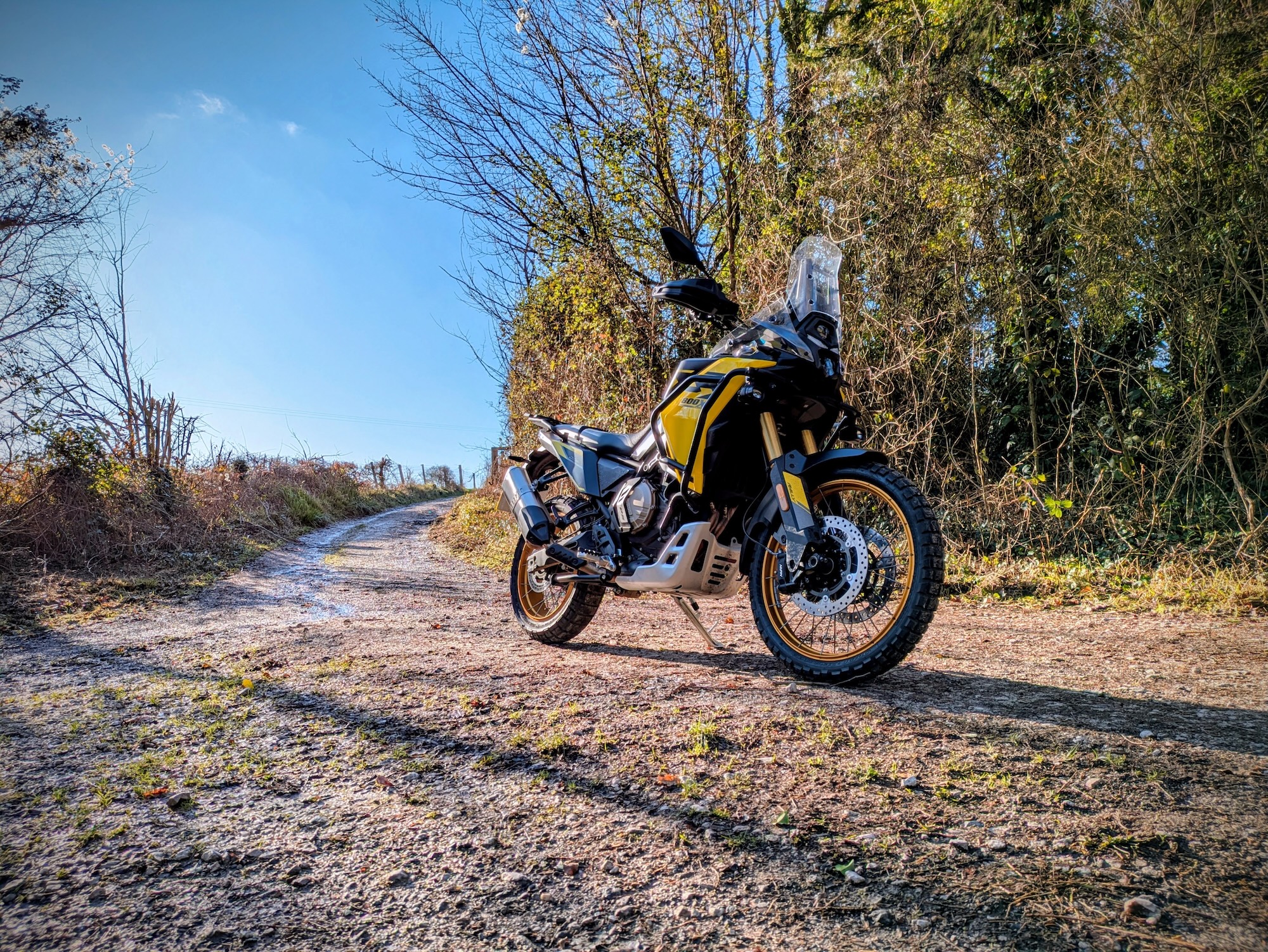
There is an alternative to buying used: buy Chinese.
The implicit argument of my recurring Five Under £5K articles is that you have to make certain compromises if you want an affordable motorcycle, ie, buying a secondhand bike with older tech and a few thousand miles on the clock.
But what if you could have a brand-new 94bhp adventure bike with a fully adjustable KYB suspension, Pirelli tires, Nissin brakes (the same manufacturer relied on by Honda), Bosch EFI, and a list of technowhizzbang goodies for exactly what you’d pay for a 10-year-old BMW R 1200 GS with 30,000 miles on the clock?
That is the promise of the £6,999 2026 Voge DS800X Rally – a bike that I was surprised and impressed by. So much so that I would genuinely consider owning one. But there is a difference between considering doing something and actually doing something. What would push me one way or the other? Let’s get into that.

How we got here
Odds are, you’ve heard about Voge by now. Thanks in no small part to the popularity of its lauded DS900X, Voge is one of the UK’s 10 best-selling brands – ahead of more ‘traditional’ names like Harley-Davidson and Ducati.
You may also want to read my review round-up of the 2024 Voge DS900X
That said, the brand is not so well-known that Google Docs’ spell-checker doesn’t keep trying to change its name to Vogue. So, it’s perhaps worth noting that Voge (no one can agree on a pronunciation) is the premium export brand of Chinese manufacturing giant Loncin Holdings, based in Chongqing, China.
Along with a plethora of other products, Loncin produces upward of 2 million motorcycles a year, as well as 3 million motorcycle engines. Perhaps of most interest to Western riders – and the main reason that the DS900X has sold so well – is the fact that Loncin has been producing engines for BMW for almost two decades. At present, it makes the powerplants for all of BMW’s F-series bikes, save the F 450 GS, which is built by India’s TVS. Loncin also builds BMW’s C 400 GT and C 400 X scooters.
The Voge brand was launched in 2018 and arrived in the UK market three years later. It wasn’t until the DS900X came along in 2024, however, that people really started to notice. That bike’s key selling point is that it is – engine-wise, at least – exactly the same as a BMW F 900 GS, but with more tech and a considerably lower price tag.

At present, Voge offers a line-up of 13 different models, with the DS800X Rally sitting toward the top of the range. Unlike the DS900X, the DS800X Rally doesn’t have a direct competitor in the market but stands as an alternative to a number of models. We’ll get into that a bit later.
Look, fit, and feel
The DS800X Rally is a formidable machine. Not intimidating. Not oversized. But formidable. It looks capable. Legitimate. All of the bits that you can see and feel have a robustness to them.
Yes, there’s a little more plastic here than I’d like. And if you look really closely, you’ll find some things to nitpick about – the bolts on the rear suspension linkage, for example, look like they’ve come straight from Trade Point – but there’s nothing here that looks particularly cheap or flimsy.
Throw a leg over the 850mm-high seat and you’ll find that the saddle is narrow, not overly firm, and comfortable. All-day comfortable for me, but keep in mind that I have a tendency to like saddles that other people hate, eg, those of the Royal Enfield Himalayan 450 Mana Black and the Honda WN7 (review on that one coming soon). Hands fall naturally to the ‘bars, feet to the pegs.

The switchgear is of decent quality, but it’s here where you’ll find my first big gripe about the bike. Heated grips and heated seat come standard; the heated seat is too warm, and the heated grips not warm enough. But the big issue comes in the buttons to control them. From the rider’s perspective they are on the back of the switchgear housing, completely out of view. So, you are left to feel around for them, which is borderline impossible if you are wearing thicker gloves – as you probably would be in weather where heated grips are called for.
Secondly, the switch for the high beam sits awkwardly close to your left index finger, so you end up flashing the brights pretty much every time you switch gear or cancel the indicator.
Looking forward, the 7-inch TFT screen is oriented in portrait style, making it look like a tablet. It’s easy to read and offers a good amount of information, though not all the info that I’d like. Or, at least, I don’t think it does. We’ll get into this in a moment, but navigating the bike’s menu is the exact opposite of intuitive.
Beyond the TFT dash, sits a tall, narrow windscreen that is surprisingly good at keeping the weather off. The screen is moderately adjustable, but not on the go. You need to unscrew four bolts to move it.

Engine and transmission
The DS800X Rally is powered by a 798cc parallel twin engine with a 270-degree firing order, which means it has a V-twin feel. This so-called KEL engine is not a direct clone of someone else’s work but borrows heavily from competitors’ influences. The most obvious comparisons are with BMW’s parallel twins, and Yamaha’s CP2 parallel twin – which drives the MT-07, Tracer 7, and Tenere 700.
Claimed peak outputs are 94 bhp at 9000 rpm, and 60 lb-ft of torque at 6500 rpm.
Press the starter and the bike has a fantastic growling at idle that suggests it’s up for a good time. The soundtrack continues on the move; acceleration is rewarded by a bellowing that is just on the right side of noise regulations.
Power delivery is a little snatchy. Some might say “punchy.” It makes for a fun, torquey experience on acceleration but means that it’s never smooth. This is especially true at lower speeds.

Jerky throttle (and a possible solution)
If you’ve read reviews of the DS900X, the stand-out complaint people have about that bike is its seeming inability to be ridden smoothly at urban speeds. The DS800X Rally suffers from exactly the same problem. The bike effectively fights your attempts to hold a slow, steady pace. You will not win any ‘go-slow’ races with this machine.
This problem exists regardless of which riding mode you choose. Obviously, it is a mapping issue – the sort of thing that Japanese ride-by-wire bikes were dealing with more than a decade ago. Ostensibly, it’s an issue that can be fixed relatively easily. My question is: will Voge bother to offer that fix?
In the meantime, the best answer I came up with was constantly feathering the clutch at low speeds. This was annoying. According to the internet, another possible solution involves turning the ignition on but not hitting the starter, then twisting the throttle to its stop and holding for 20 seconds. This apparently resets the ECU. I was unaware of this trick when I had the bike on loan, so I have no idea whether it works.
Back in the arena of things I like, the DS800X Rally’s six-speed transmission is smooth, accurate, and offers no cause for concern. Clutch pull is very light.

Chassis and brakes
Fully adjustable KYB suspension and an adjustable rotary steering damper are evidence that Voge isn’t messing around when it comes to performance. This bike can be tweaked to ride exactly as you like. Although, as far as I was concerned, it didn’t need any fettling.
The DS800X Rally isn’t the best-balanced bike I’ve ever ridden (that prize goes to the Suzuki V-Strom 1000), but I certainly didn’t have any complaints. Voge only offers a dry weight figure: 213 kg. If we assume an additional 30 kg to account for fuel and various engine fluids, it’s not the lightest of bikes, but its center of gravity is low, so I felt comfortable taking it down dirt roads.
On the tarmac, the standard suspension set-up is good for distance travel. It is equally well suited to being enthusiastic in corners, though I don’t know how much faith I’d put in the stock Pirelli Scorpion Rally STR tires. Pirelli makes very good tires; I’m just not sure I’d be keen on trying to get a knee down on a tire that is roughly 65-percent on road, 35-percent off-road.
Moving on to the Nissin brakes, I found them to be very good at bringing all that mass to a safe and controlled stop. The pull of the adjustable brake lever stood out to me as particularly rider friendly.

Fancy bits
One of the KSPs of any Chinese motorcycle at the moment is the promise of incredible technowhizzbangery on a no-frills budget. In addition to the top-shelf suspension, brakes, and tires, you also get:
- Center stand
- Crash bars
- Hand guards
- Aluminum bash plate
- Heated grips
- Heated seat
- Two riding modes (Sport and Road)
- Switchable traction control
- Switchable ABS
- 1080p dashcam
- Dual charging port (USB and USB-C)
- Tire pressure monitoring
- Full LED lighting.
On the point of that lighting: auxiliary lights come standard. If you don’t have them on, they serve as cornering lights. If you do have them on, they contribute to a good spread of light that makes night riding markedly less stressful. The only drawback is that they appear to be quite bright; I got a handful of oncoming vehicles flashing their brights at me on evening rides.
As stated above, the 7-inch TFT screen is incredibly easy to read but not easy to use. Navigating the menu is infuriating. I was never able to figure out, for example, how to reset the trip meters. I did learn, though, that they will reset themselves at the seemingly random mark of 621 miles. I eventually realized that 621 miles is 1000 kilometers.

The DS800X Rally offers phone connectivity, but because I am an old man, I don’t tend to want or pay attention to these sorts of features. Because I am a paranoid old man, I especially refuse to connect my phone to a Chinese motorcycle.
From what I understand, however, I’m not missing out on much. According to internet scuttlebutt, Voge’s app is glitchy and problematic. Most of the complaints I’ve seen are centered on retrieving footage from the bike’s 1080p forward-facing dashcam. Apparently, the app crashes a lot. So, there goes your side hustle of posting rage-bait videos on YouTube.
Basic maintenance
Voge recommends an oil and oil filter change every 6,000 miles, which is a bit frequent if you compare it to a Triumph Tiger 900 Rally Pro, but generous if you compare it against a Harley-Davidson Pan America 1250 Limited.
Air filter changes are recommended every 12,000 miles, spark plugs, too. Unnervingly, Voge’s service manual suggests replacing the chain every 12,000 miles, too. That’s definitely too often. Probably it’s something you can remedy, however, by buying something other than OEM chain and sprockets when the time comes.

You’ll need to buy a torx bit set to work on the DS800X Rally – all those years of building BMWs have clearly rubbed off on Voge. Getting at the sump plug and oil filter are easy enough; you simply have to remove the bash plate.
The DS800X Rally has a very clever air filter set-up that should be as easy as removing two torx screws at the head of the tank and sliding the filter up. Unfortunately, it’s clear that the bike’s steering damper was an afterthought because its panel blocks the air filter from sliding free. So, you have to remove the steering damper panel, which has very tiny, fiddly screws. Cue obvious affiliate link to magnetic screwdrivers.
Speaking of build quirks: the coolant reservoir sits pretty low on the bike and strikes me as particularly exposed to debris coming from the front tire. I don’t find it hard to imagine a scenario in which the reservoir might end up punctured.
The bike does not come with any tools, save a single torx-headed L-wrench under the passenger seat, which you can use to gain access to the battery beneath the rider’s seat. Additionally, there are obviously no Haynes Manuals available yet for the DS800X Rally, so if you do work yourself you will need a higher level of mechanical knowledge.

Riding impressions
It’s always a sign that I actually like a bike when I’m really nitpicky about it. This means that I am looking at the bike from a consumer perspective, thinking to myself: “Would I spend my money on this?”
As mentioned above, the DS800X Rally is a motorcycle that I would genuinely consider owning. It is relatively well built, looks good, and is enjoyable to ride. Throttle mapping issues aside, it has an assertive and adventurous spirit that makes you want to get out and ride.
In the city
The bike is the sort that – throttle mapping issue aside – I often refer to as a “thinking bike.” Which means that it’s a bike that is well balanced and intuitively maneuverable. It does not demand your attention. So, you could be lost in a major urban area – London, for example – your head on a swivel for cars and buses and people and signage and roads and landmarks and so on, and the bike isn’t pulling your attention away from that. It’s not contributing to the chaos; it’s allowing you to think.
Not all bikes work that way. The Harley-Davidson Street Glide Ultra that I rode last year is an example of something that is very much NOT a thinking bike. It is a joy to ride in the right conditions, but its weight and girth demand your attention and focus always. You have to plan where you’re going. You cannot get 70 percent through a junction and suddenly decide to turn left on that bike. On the DS800X Rally you can.

On the highway
The ease in handling is a part of the bike’s spirit of adventure. But there is, too, its ability to tackle long slogs. Voge’s UK distributor, Moto GB, is located almost exactly 300 miles from my house. Which means that in the two weeks I had this bike, I clocked up at least 600 miles just sitting on the motorway at ~75 mph.
Or I think that’s how fast I was going. As is the case with all the Chinese bikes I’ve ridden, the DS800X Rally’s speedometer is off by a good amount – dramatically overstating your speed. So, although the speedometer was reading 80 mph, the number of cars passing me made it clear that I was going slower.
I did not have an independent sat-nav with me to tell me just how much slower. I was just guessing. So far no speeding fines have arrived in the post, so I’m assuming I did OK. There’s an accessory mounting bar above the TFT screen – a perfect place to mount a Quadlock mount so you can use your phone and Google Maps if you want to be sure you’re staying on the right side of the law.
As Simon Hargreaves recently pointed out on the Front End Chatter podcast: “Google Maps’ speed figures are accurate, according to Google.”
Alternatively, I suppose you could go old-school and get a TomTom Rider 550.

On the dirt
Because the throttle mapping issue makes the bike very difficult to ride in a nuanced way, I wouldn’t want to spend a great deal of time riding the DS800X Rally off road, though it’s certainly well-balanced enough that I was content taking it down a nearby lane. And its price tag makes off-road work seem like less of an idiot proposition than with, say, a £15,000 Triumph.
Best use case
Without fixing the throttle mapping issue, I’d see the bike as an excellent touring option. Light enough to not feel overwhelming. Powerful and well built enough to handle pretty much anything you throw at it. And packed with comfort features. Voge will sell you a full set of luggage for £700, which is less than you’d pay for the equivalent from Givi or SW Motech.
Lastly, can you tell that the throttle mapping issue really annoyed me?
Competition
The DS800X Rally exists in a very, very crowded field, with options available from almost all the “traditional” manufacturers, as well as Chinese brands.

Many of the other reviews of the DS800X Rally I’ve seen have pitched it as an alternative to the Yamaha Tenere 700. This is largely based on styling and engine similarities. But you’d have to step up to the £11,920 Tenere 700 World Rally to find the same sort of bells and whistles that you get with the £6,999 DS800X Rally. And that would still see you giving up quite a bit in terms of power. The Yamaha boasts 72.4 bhp – more than 20 fewer than the Voge.
And that’s pretty much the story across the board when it comes to the “traditional” brands. The Voge outguns them all in price and spec, and beats all but the markedly more expensive Ducati and Triumph in the horsepower game.
To find a brand that stands toe to toe, you have to look at other Chinese offerings, with CFMoto being the standout example. Its 800MT-X matches the DS800X Rally in price and power output, while offering a smidge more torque. It more or less matches the Voge in spec, too.
China also offers the only comparable bike that actually costs less: Moto Morini recently re-entered the UK market and its (less powerful) X-Cape 700 beats the DS800X Rally’s asking price by £200.

How the Voge DS800X Rally stacks up against the competition
| ENGINE | OUTPUT | PRICE | |
| Voge DS800X Rally* | 798cc parallel twin | 94 bhp 60 lb-ft | £6,999 |
| Aprilia Tuareg Rally 660 | 659cc parallel twin | 79 bhp 51.6 lb-ft | £12,445 |
| CFMoto 800MT-X* | 799cc parallel twin | 94 bhp 64 lb-ft | £6,999 |
| Ducati Desert X | 890cc V-twin | 108bhp 68 lb-ft | £14,995 |
| Honda Transalp 750 | 755cc parallel twin | 90 bhp 100 lb-ft | £9,899 |
| Kove 800X Rally* | 799cc parallel twin | 94 bhp 59 lb-ft | £9,499 |
| KTM 790 Adventure | 799cc parallel twin | 94 bhp 64 lb-ft | £9,999 |
| Moto Morini X-Cape 700* | 693cc parallel twin | 70 bhp 50 lb-ft | £6,799 |
| QJMotor SRT 900 SX* | 904cc parallel twin | 94 bhp 66 lb-ft | £7,699 |
| Suzuki V-Strom 800 DE | 776cc parallel twin | 84 bhp 57.7 lb-ft | £9,999 |
| Triumph Tiger 900 Rally Pro | 888 inline triple | 106.5 bhp 66.3 lb-ft | £14,695 |
| Yamaha Tenere 700 World Rally | 689cc parallel twin | 72.4 bhp 50 lb-ft | £11,920 |
* Denotes Chinese brand
Verdict
The throttle mapping issue is a major fly in the ointment for the DS800X Rally. It doesn’t fully negate the bike’s appeal, but it does speak to something that seems to be consistent in all the Chinese motorcycles I’ve ridden so far (Voge, QJMotor, and Morbidelli). These are bikes that lack refinement.
It seems Chinese manufacturers are very good at offering respectable alternatives to “traditional” brands, but they still haven’t managed to figure out that final 5-10 percent of a bike that takes it from good to great.
They are great value, but not great bikes. No Chinese motorcycle I’ve ridden so far (the Chinese have demonstrated an uncanny ability to adapt very quickly, so this may change in the next three to five years) has actually been better than a “traditional” competitor.
Additionally – as perhaps I would with any other brand that hasn’t been in the market very long – I worry about long term aftersales support.

Based on my experience with the DS800X Rally, I’d say there’s every reason to believe that – with regular maintenance and a reasonable amount of care – a bike bought today will still be running and 10 years from now. But will parts be available for the bike then? Loncin will still be around, I’d assume, but it produces so many millions of bikes for markets that are less complex and regulatory than Europe/UK. What happens if it gets bored and walks away?
Sure, that could happen with anyone, I suppose, but it seems less likely with a brand like, say, Suzuki, which has been in the UK market since 1964. Looking on the internets, I’m presently able to find 19 different secondhand Suzuki V-Strom 800 models for £7,000 or less.
Would I really choose a secondhand Suzuki that has mileage and wear from another owner, 10 bhp less peak power than a DS800X Rally, and considerably fewer bells and whistles? Well, yes, I would. Although, I’ll admit that certain ideological hang-ups also play a part in that thinking.
And at the same time, I’d agree that anyone buying a DS800X Rally is making a good choice. The asking price is low enough that you can learn to live with certain foibles. And there aren’t even that many foibles.
Throttle mapping issues aside, the 2026 Voge DS800X Rally is a surprisingly good motorcycle. It sounds fantastic, it looks good (albeit derivative), has an enjoyable engine (above 30 mph), rides really well, and has solid build quality. All available brand new, with a two-year warranty, for the same amount that you’d pay for an older model from a “traditional” brand.

The three questions
Does the 2026 Voge DS800X Rally suit my current lifestyle?
Yes. The DS800X Rally offers more legitimate off-road ability than I really need/want from a motorcycle that weighs close to 250 kg, but it has all the necessary trappings of a quality adventure tourer, which is right up my Straße.
Did the 2026 Voge DS800X Rally put a smile on my face?
Easily. I really enjoyed my time on the bike. When Moto GB called me to set-up a date to return the bike I pleaded (without success) to be allowed to hold onto it for longer. I just wanted to play on it more.
Is the 2026 Voge DS800X Rally better than my current motorcycle, a Kawasaki Versys 1000?
In all the ways that are measurable, yes. The Versys 1000 has a little more power, handles a little more confidently in corners and is more comfortable on long hauls (especially with an accessory Givi AirFlow windscreen), but those advantages aren’t really enough to overcome all the pluses that a brand-new DS800X Rally can offer.
Sure, I have anxieties about future aspects of the bike, but those are intangibles and things that may never come true.
2026 Voge DS800X Rally specs
| PRICE | £6,999 |
| ENGINE | 798cc parallel twin |
| TRANSMISSION | Six-speed |
| POWER | 94 bhp at 9000 rpm |
| TORQUE | 60 lb-ft of torque at 6500 rpm |
| TOP SPEED | n/a |
| SEAT HEIGHT | 850 mm |
| GROUND CLEARANCE | 220 mm |
| WEIGHT | 213 kg DRY ( >243 kg estimated) |
| FUEL CAPACITY | 24 liters |
| FRONT TIRE | 90/90R21 (Tubeless) |
| REAR TIRE | 150/70R18 (Tubeless) |
| FRONT BRAKES | Double 298 mm disc with 4 piston Radial Nissin calipers |
| REAR BRAKES | 240 mm disc with single piston caliper |
| FRONT SUSPENSION | Fully adjustable 43mm KYB USD fork |
| REAR SUSPENSION | Fully adjustable monoshock |


Leave a Reply to TheQCancel reply