
I’ve just checked: brand new motorcycles still cost too damn much. Fortunately, it’s also still the case that motorcycles haven’t fundamentally changed in about 15 years.
If you’re happy to live without nine riding modes or phone connectivity that sends all your personal data to China, you can get your hands on a very good motorcycle by turning your attention to the used market.
About a month ago, I wrote an article identifying the five best sport tourers for under £5,000 and it got me thinking: what about other genres? So, consider this the second in a who-knows-how-long series.
Adventure-touring is the sub-genre that perhaps I gel with most. Two of the bikes on this list are motorcycles that I have personally owned; the rest are bikes that I have very seriously considered owning. Actually, no need to put that in past tense – I daydream about these on an regular basis.

I define ‘adventure-touring’ as an adventure-styled motorcycle that has a front wheel diameter of at least 19-inches, so it can ostensibly be used for (light) off-roading, but which, in application, is largely intended for on-road use. Specifically the kind of on-road use that would see you covering big miles. A bike, in other words, that could spend all day on a motorway, then get you 2 miles down a dirt road to the exotic cabin you’ve booked on Vrbo.
As with my previous ‘Five Under £5k’ article, practicality is the point here. Well, mostly. I included the Moto Guzzi because, you know, Moto Guzzi. The others, however, are bikes that have good reputations in terms of comfort, quality, and reliability. They’ve all had decently long runs, and/or shared components with other models in the brand’s line-up. So finding parts and knowledge shouldn’t be too difficult.
The OG: BMW R 1200 GS (2004-2018)

What is it?
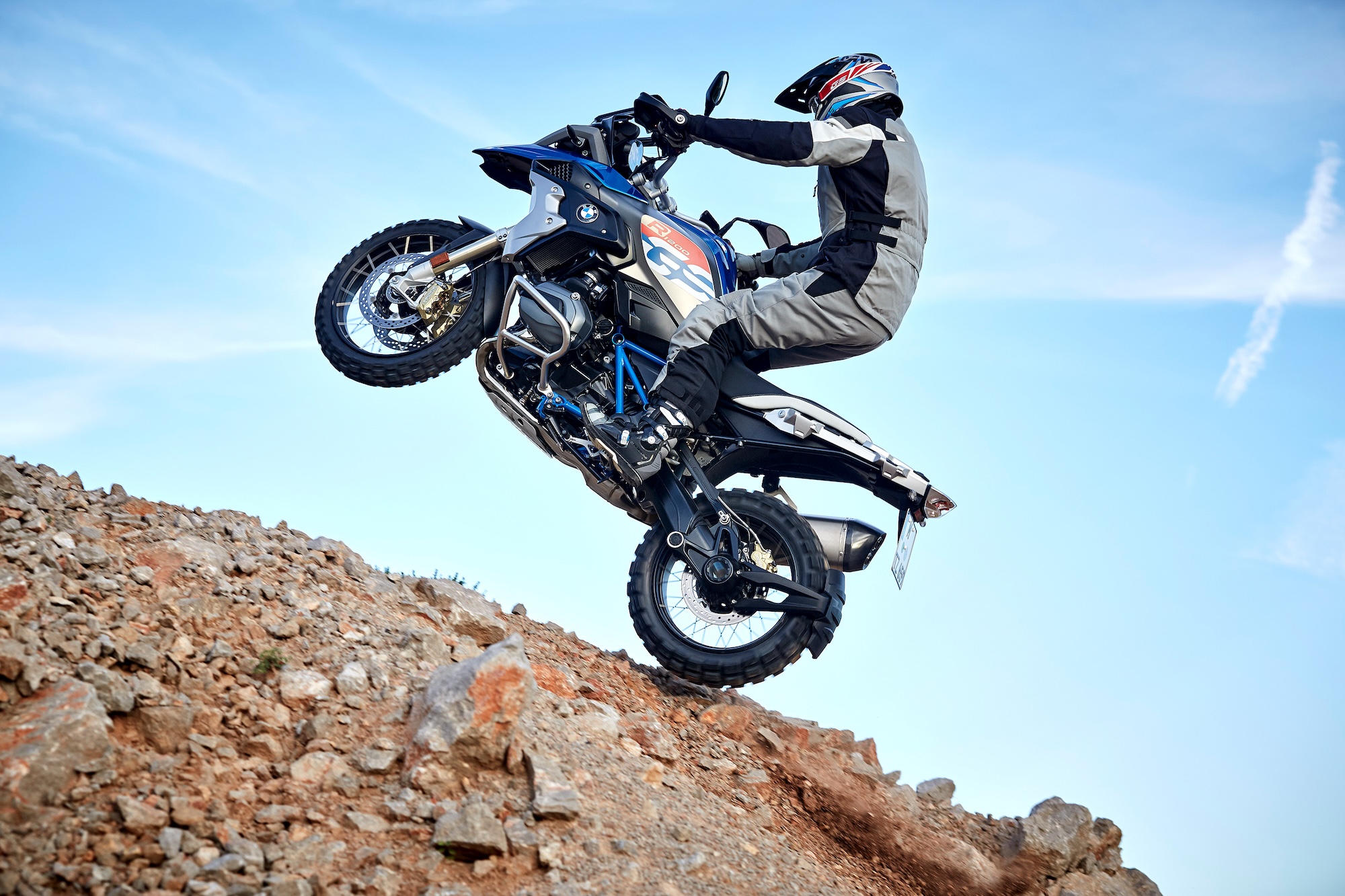
You cannot talk about adventure-touring motorcycles without paying respect to BMW’s GS platform.
Way back in 1980, BMW effectively created the adventure bike category with the introduction of its R80 G/S (The ‘G’ standing for Gelände, which is German for “offroad,” and the ‘S’ standing for Straße, or “street”). In the United Kingdom, most people credit the Long Way Round series for popularizing the GS platform.
It’s definitely a stretch to give all the kudos to Ewan McGregor and Charley Boorman, but whatever the case, the GS has dominated European sales ever since. It is the bike that inspired most of the other bikes on this list (Suzuki even uses German in the name of its offering).
Popularity breeds resentment, however. GS owners have a reputation. If you buy one of these, you may feel legally obligated to also buy a high-vis jacket and flip-front helmet.

Powered by an 1170cc boxer twin engine, there were three different generations of R 1200 GS. Because of their incredible popularity, they are bikes that hold their value well, so finding one for £5,000 or less will probably limit your search to the first-gen Hexhead models (2004-2012), so called because of the hexagonal shape of their cylinder heads.
The 2004-2012 R 1200 GS engine was air- and oil-cooled, and claimed peak outputs of 108 bhp at 7750 rpm and 89 lb-ft of torque at 6000 rpm. Blessed with shaft drive, it was a heavy ol’ thing, weighing in around 200 kg – more if you bedecked it with farkles, of which there are many to be found in the aftermarket.
Why you want it:
50 million Elvis fans can’t be wrong, nor can the literally hundreds of thousands of motorcyclists who shelled out big money for the R 1200 GS over the years.
Despite the stereotypes around its riders, it is a very, very, very good motorcycle. The engine is characterful and the exhaust note rorty. The six-speed gearbox is a little agricultural, but in a good way. As I have said many times before, tractors are awesome.

Some people don’t love the Telelever front suspension – which separates braking forces from suspension travel, meaning the front end doesn’t dive as much in braking – but I find it to be brilliant and confidence-inspiring.
Thanks to the positioning of its boxer engine, the R 1200 GS carries its weight low and feels more manageable than many lighter motorcycles. It is surprisingly easy to maneuver.
It’s all-day, round-the-world comfortable. And most importantly for a secondhand bike, aftermarket support is huge.
Why you don’t want it:
BMW sells its GS as a bike to be ridden far and often. Many owners take BMW at its word: low-mileage examples are extremely hard to find.

Parts aren’t hard to find, but the older and more high-mileage the bike, the more likely you’ll be needing to find (and pay for) those parts on a regular basis. If you’re not one for wrenching your own bike, BMW servicing costs are notoriously high.
On the earliest Hexheads (2004-2006) the servo-assisted ABS brakes could be problematic. When the ABS pump fails (and it often does), you lose most of your braking power. You will find that many owners have simply bypassed the ABS system entirely.
There are also potential issues with the shaft drive. Check the rear wheel for any lateral play and look for oil weeping around the rear hub.
Yamaha XT1200Z Super Tenere (2010-2021)

What is it?
Yamaha’s shaft-driven two-wheel tank never really got the love it deserved. Initially regarded as ugly, heavy, and slow by many it is now seen as brilliant, brilliant, and brilliant by those in the know.
Powered by a 1199cc liquid-cooled parallel twin engine, the Super Tenere – or Ténéré if you want to be accurate and annoying – boasted peak outputs of 109 bhp at 7250 rpm, and 86 lb-ft of torque at 6000 rpm.
Thanks in part to shaft drive and a generous 23-litre tank, it tipped the scales at 261 kg – living up to the old “Yama-heavy” brand stereotype. But it benefitted from a low center of gravity that kept things manageable.
Yamaha offered an abundance of fancy tech, including electronic suspension on some versions.

The bike was hurt somewhat by its name, the Tenere moniker evoking visions of hardcore Dakar-type stuff to which the Super Tenere was obviously not suited. But its Achilles heel was the cost. When it was launched its starting price exceeded that of a kitted-out BMW R 1200 GS.
Why you want it:
Reliability. The Super Tenere was/is pretty much bulletproof. It may be a bad choice for more aggressive off-roading, but if you’re keen to ride from Key West to Deadhorse it’s the one you want.
Outside of spokes that have a habit of getting rusty, the Super Tenere is known for being a bike that can go a long while with just basic maintenance: oil, filters, that sort of thing.
On top of that, the bike is luxuriously comfy. Just look at the seat: it’s about the size and thickness of a mattress. And if you find one that’s packed with all the technowhizbangery that was available, it’s kind of a Mad Max FJR1300.

With hindsight, people are increasingly changing their mind about the Super Tenere. Riding around on it will set you out as one of the good ones: a rider who knows quality and isn’t just following the GS crowd.
Why you don’t want it:
As mentioned, it’s a heavy ol’ thing. That 261kg wet weight figure doesn’t include bits and bobs that you or a previous owner might add, such as crash bars, lights, luggage, etc. Add your own lovely self to the mix and it’s a lot of mass to handle.
Early models (2010-2013) suffered from snatchy throttle response, and some people feel the engine overall lacks any real character. Plus there’s the sometimes rusty spokes (on wheels that take tubeless tires, by the way).

The biggest problem with the Super Tenere is availability. Since not a lot of them were sold, not a lot of them are available in the secondhand market. Additionally, because it’s a ‘if you know you know’ kind of bike, sellers tend to ask quite a lot of money for them. As when they were new, you’ll often find comparable BMW R 12100 GS models for less.
Somewhat less concerning is the fact that secondhand examples tend to have high mileage. It’s a bike that’s made to be ridden.
Suzuki V-Strom 1000 (2014-2019)

What is it?
Strom is the German word for “stream” or “current.” Japanese manufacturer Suzuki has never been entirely clear why it gave its adventure tourer that name, but it’s pretty easy to guess that it was trying to ride BMW’s GS coat tails.
The first iteration of the V-Strom 1000 came in 2002. Built around a detuned V-twin taken from the infamous TL1000 (a bike known as The Widowmaker), it was very much a road machine. Likeable but not necessarily endearing, the bike remained in production until 2008. Every example I can find of this first-gen V-Strom costs less than £5,000. Some are in surprisingly good condition.
But that’s not the bike I’m recommending.
In 2014, Suzuki relaunched the V-Strom 1000 with new adventure bike styling that paid homage to the iconic (according to Suzuki, at least) DR800S – aka the DR Big – of the 1990s. The engine could still trace its roots directly to the TL1000 but capacity was boosted to 1037 cc. Peak claimed outputs were 99.2 bhp at 8000 rpm, and 76 lb-ft of torque at 4000 rpm.

Bike magazine rode one from Suzuki’s UK headquarters in Milton Keynes to its global headquarters in Hamamatsu, Shizuoka, Japan. I was so enamoured with the series of articles that came from that adventure that I became a Bike subscriber (which I still am), and – in 2015 – went out and bought a V-Strom 1000 of my own.
I rode that bike to Tuscany (in an example of things coming full circle, I wrote an article about that trip, which was ultimately published in Bike), did an Iron Butt ride (1,000 miles in < 24 hours) on it, and undertook countless other adventures. It never let me down.
Read my long-term review of the 2015 V-Strom 1000
Easy to work on and stupidly reliable, the V-Strom 1000 never really set the world on fire in terms of sales but it managed to be one of Suzuki’s most consistent sellers. Actually, no need for use of the past tense there. These days it lives on in the form of the V-Strom 1050: exact same engine with different styling and the addition of cruise control.

Why you want it:
Do you like bikes that are reliable – bikes that start? Every time? In sub-zero temperatures or blistering heat, just always working? Get yourself a Suzuki.
The V-Strom 1000 is incredibly well-balanced. It remains one of the easiest bikes to keep upright that I have ever ridden. And its massive rider and passenger accommodation make long days in the saddle a breeze. I hated doing an Iron Butt, but there aren’t many other bikes that I could have even survived sitting on for 22 straight hours.
Adorn the V-Strom 1000 with a Givi AirFlow windscreen and its weather protection puts it on par with big touring bikes.
Suspension, brakes, and handling exceed expectations, and the V-twin engine can be a hell of a lot of fun – if you know how to get the most of it.

Why you don’t want it:
There is an art to riding the V-Strom 1000 that I didn’t really figure out until after I had sold mine. The bike is so completely and totally functional below 3000 rpm that you can get tricked into thinking that there’s no need or reason to venture anywhere near its 9000rpm limit.
The problem is: if you only ever ride the bike in this manner you will get bored and ultimately trade it in for a bike that is heavier, more expensive, and perhaps surplus to your requirements (see below).
But, in fact, the V-Strom can be playful and downright hooligan-esque if you keep revs above 4000 rpm (4500-6500 is the sweet spot). The bike is making a hell of a lot of noise at these revs, however, and its slightly snatchy throttle response becomes even more so.
In other words, the V-Strom 1000 can be a very boring motorcycle unless you put real effort into forcing it to be fun. Other bikes don’t make you try so hard.

Washing the bike is a bit of a pain (there are lots of nooks and crannies) and the stock screen is borderline useless. It’s physically one of the smallest and lightest bikes on this list, but it’s still big and can be tricky to move around in tight spaces. The OEM handguards and bash plate are just plastic. The OEM panniers are too small. Center stands did not come standard, so make sure you have one for chain maintenance/cleaning; the V-Strom 1000 is the only bike on this list that’s chain-driven.
Early versions were subject to a wiring loom recall; make sure yours has been dealt with. Suzuki placed the exhaust valve in a stupid place, making it susceptible to road grime. The easiest solution is to buy a £27 exhaust valve cover on Amazon.
Side note: The internet will tell you that the V-Strom 1000 succumbs to rust and corrosion more easily than other bikes. This was definitely not my experience. Wash your bike properly and apply generous amounts of ACF-50 or XCP and you’ll be fine.
Triumph Tiger 1200 Explorer 1200 (2012–2018)

What is it?
Triumph spent most of the 2010s copying BMW, both in terms of how it tried to present itself as a premium brand, and in the vehicles it offered. Consider the Trophy SE, which would be at risk of legal action if it was any more like an R 1200 RT, and this: the UK-based brand’s take on the R 1200 GS.
Powered by a 1215 three-cylinder engine, the shaft-driven Tiger 1200 Explorer – also known simply as the Tiger Explorer – claimed peak outputs of 135.4 bhp at 9300, and 89 lb-ft of torque at 6400 rpm.
There were two generations of Tiger Explorer: 2012-2015 and 2016-2018. The latter generation was subjected to Triumph’s confusing XR and XC letter-code system, which then splintered into the XR, XRx, XRt, XC, XCx, and XCt.
In 2017, charmed by output figures, the promise of cruise control, and a seasonal deal offering free luggage, I traded in my V-Strom 1000 for a second-gen Tiger Explorer XRx. You can read my long-term review of the 2017 Triumph Tiger Explorer XRx here.

Realistically, for £5,000 or less you will need to limit your search to first-gen models. That’s OK. First-gen bikes offer pretty much everything that the second (and third) generation did, just a little less refined.
Read my review of the (first generation) 2014 Triumph Tiger Explorer
Why you want it:
The engine, the engine, the engine. Digressing a little here, Triumph completely screwed the pooch in 2022 when it overhauled the Tiger 1200 platform to make it feel more like a V-twin. No one asked for such a thing, and consistently low sales figures since then are proof of that.
Before Triumph shot itself in its own foot, its inline triple was one of the most delightful engines you could hope for. Syrupy smooth and addictively torquey. I loved it.
Shaft drive made things easy, and an incredibly spacious cockpit made the bike a very nice place to be on long, two-up adventures. My wife and I made several cross-country trips on my second-gen model.

Build quality was generally good, and because Triumph didn’t actually change much foundation-wise from 2012-2022, finding spares shouldn’t be quite as difficult as it can be with some historic Triumph models.
Why you don’t want it:
Bike magazine described the Triumph Tiger Explorer as “a bit British Leyland compared to the GS,” and I think that’s about the most accurate summary I’ve seen. It was good, but definitely not better than its competition.
At 259 kg (before you add bits like crash bars, luggage, etc), the Tiger Explorer is a heavy ol’ thing, and you don’t half feel it due to the fact that the bike is unnervingly top heavy. Rage- and anxiety-inducingly top heavy.
So, you end up hating the thought of having to push it around in your garage, or riding in the wet, or having a passenger climb aboard (sidestand down and mount from the left for that maneuver), or tackling anything but the smoothest of tarmac.

None of these bikes are particularly suited to real off-road use, but the Tiger Explorer is particularly garbage in the dirt. Learning this the hard way turned me against the bike so aggressively that I traded mine in, even though it meant suffering a financial hit on the PCP deal (on a related note: buying your bike via PCP financing is a bad idea).
On the road, the Tiger Explorer has the most power on this list but lacks the suspension to handle it. Above 90 mph the bike can feel unsteady.
Ride by wire on the first-gen models was a bit sensitive, meaning it was easy to whiskey throttle the thing. The shaft drive delivered noticeable drive lash. And the very first Tiger Explorers (2012-2013) had to have their cylinder heads replaced; make sure that work was done.
Honda VFR1200X Crosstourer (2012-2021)

What is it?
Honda has a long, proud history of occasionally releasing perplexing bikes. Its V4-powered adventure tourer is one of them. It’s a mesh of good ideas that perhaps creates something that isn’t as good. It’s like chocolate and barbecue sauce; both tasty on their own, but together?
Nonetheless, it offered a stark alternative to the GS-chasing tactic of other manufacturers. Many of the examples you’ll find are equipped with Honda’s Dual Clutch Transmission (DCT) system (the manufacturer’s groundbreaking automatic transmission set-up), which, along with shaft drive, made it one of the most long-distance-friendly bikes you can find.
Powered by a 1237cc V4 engine, the VFR1200X claimed peak outputs of 127.4 bhp at 7750 rpm, and 92 lb-ft of torque at 6500 rpm.
Why you want it:
To paraphrase former President of the United States Bill Clinton, it’s the engine, stupid. Honda’s V4 engine was lauded by all who encountered her. MCN described the experience as “a stupendously broad spread of sheer, smooth urge – yet all flavoured with the characteristically V4 rumbly drone.”

On top of this, you get Honda-level build quality, Honda-level reliability, all-day comfort, and a decent amount of technowhizzbangery (though, not as cutting-edge as that found on the GS). Pick up a DCT-equipped model, and you also get the mind-freeing ease of clutchless riding.
If I needed to get to Bratislava fast, this would be my choice.
Why you don’t want it:
“As soon as you mention ‘adventure bike’ the Crosstourer struggles,” observes BikeSocial’s Steve Rose. “Because it isn’t one. What it is is a Pan European for ex sports bike riders who aren’t ready to accept that they have reached the ‘Pan’ stage of life.”
At 275 kg wet, the VFR1200X is best kept on paved ground, and its slight top heaviness (not as bad as the Triumph Tiger Explorer, though) can make for a few “squeaky bum” moments in tricky situations.

The suspension of the VFR1200X wasn’t great, with many feeling it was under-sprung and under-damped for a bike of this mass. A previous owner may have fixed this for you if you’re lucky.
The biggest issue with the VFR1200X, and indeed, the whole VFR1200 platform, however, was the fact that it was wallet-stingingly thirsty. It may be the bike to get you to Bratislava quickly, but it won’t do so cheaply.
Riding like a normal person means getting only about 130 miles from the bike’s 21.3-liter tank. Riding in a way that explores the virtues of the V4 will see you stopping even more frequently.
Honorable mention: Moto Guzzi Stelvio 1200 (2008-2016)

What is it?
Not to be confused with the 1042cc Stelvio that Moto Guzzi introduced in 2024, the Stelvio 1200 was an 1151cc transverse V-twin-powered beauty claiming – in its second and third generations – 103 bhp at 7250 rpm, and 83.3 lb-ft of torque at 5800 rpm. A first-gen model (2008-2009) produced just 76 bhp and 80 lb-ft of torque.
Named after a famous Alpine pass, the Stelvio 1200 is the characterful, romantic alternative to a GS.
Why you want one:
(Raises hands and affects ridiculous Italian accent) It’s a Moto Guzzi, no? Of course you want a Moto Guzzi; it’s a Moto Guzzi.
One of my long-standing complaints about the Harley-Davidson Pan America 1250 platform is the fact that it doesn’t really have Harley-Davidson engine character. Moto Guzzi did not make this mistake. The Stelvio 1200 is a motorcycle with soul: it vibrates, it grumbles, and it sounds glorious.
It also handles pretty well. Thanks to a low center of gravity, its 231kg weight isn’t overwhelming. And many versions came standard with goodies like heated grips, traction control, and a sat-nav.
Why you don’t want one:
Rarely has the word “reliability” been synonymous with an Italian marque. Electrical gremlins are a thing. Pre-2012 models suffered from an issue that placed undue wear on the camshaft. And because the Stelvio 1200 was always a bit niche, finding parts and knowledge will be tricky.
The biggest challenge, however, is simply finding one. The bike wasn’t a huge seller, and Moto Guzzi owners tend to hold onto their machines for life.



Leave a Reply