

I will be honest that, in general, I prefer to wear leather jackets when riding. Their various inconveniences aren’t that inconvenient to me. But I’m unique, and I’ll concede that there are a lot of things to like about a textile jacket.
They can be more comfortable, more versatile, more functional, and, of course, they look more appropriate when riding an adventure bike.
The curse of any textile jacket is that it naturally wears out faster than leather. This is true no matter how high up the price range you go. A £1,549 Rukka Kingsley jacket, for example, is really only guaranteed to last for five years. That’s probably a 10th of the useful lifespan of my Hideout Touring jacket. So, when it comes to textile, there is a strong incentive to focus on the affordable end of things, trying to find the sweet spot on the Venn diagram of Cheap, Stylish, and Safe.
The Weise Navigator is one of the few jackets that sits pretty much dead center in that diagram. I’ve been wearing one for about 6 months now, clocking up thousands of miles in almost every weather condition. Here’s what I’ve learned:
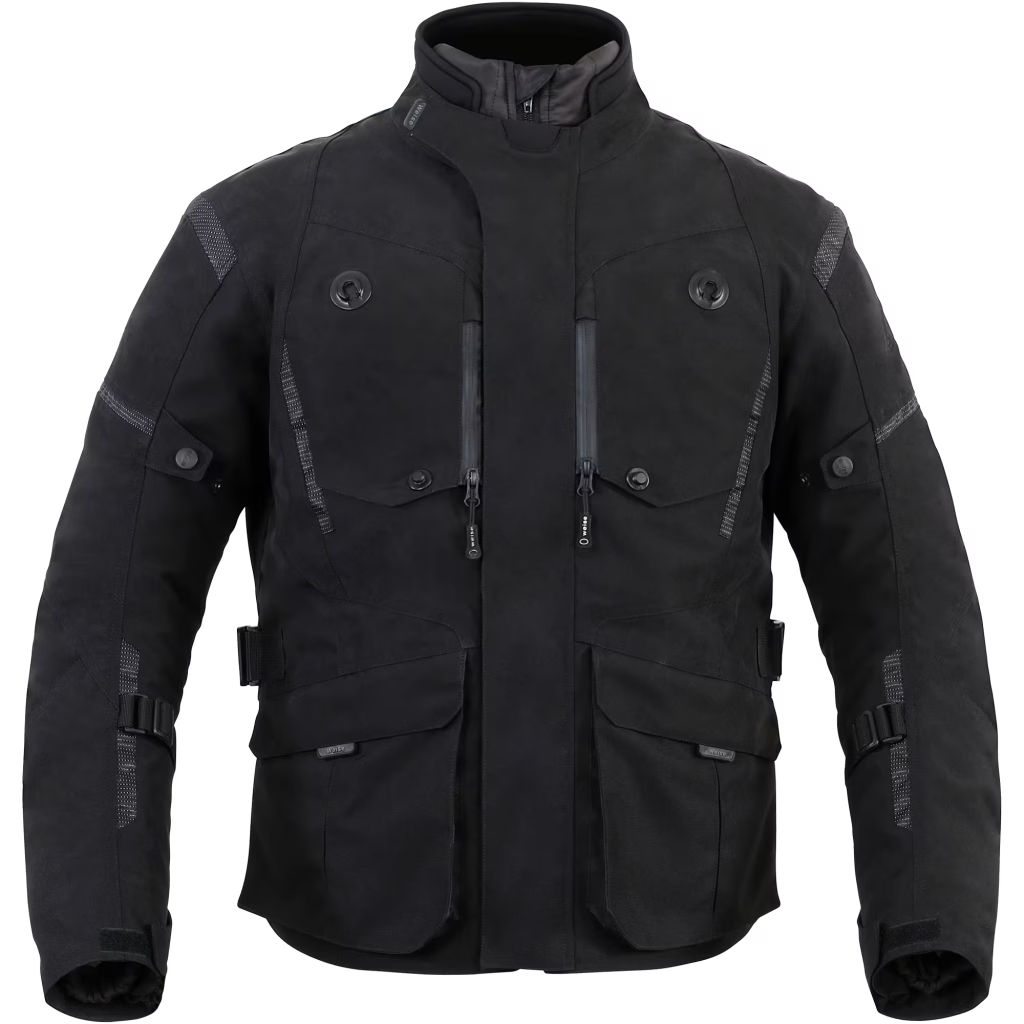
Weise Navigator specs
| PRICE | £369.99 |
| MADE IN | Unknown. Weise does not say. Safe to assume it’s not in the UK. |
| SIZING | S-5XL |
| MATERIAL: | Outer shell: 100-percent polyester Lining: 100-percent polyesterThermal liner: 100-percent polyester |
| ARMOR: | Shoulder, elbow, back |
| TLDR REVIEW | If you get one that fits it’s worth the price. |
Features
Class AA safety rating: AA is the second highest classification within the EN 17092 safety testing system. It means that the jacket has a good level of abrasion resistance and, by definition, comes with certified shoulder and elbow protection. According to an excellent and thorough guide to CE ratings by journalist John Millbank. AA is best suited to touring gear.
Waterproofing: The jacket is laminated with a DWR (durable water repellent) coating. This means you don’t have a drop-liner. See below for an explanation of the difference.
Armor: The Navigator is equipped with CE Level 2 armor in the shoulders and elbows, while the back protector is Level 1. Once again drawing from the knowledge of Señor Millbank, armor ratings are broken into two categories: Level 1 and Level 2. Level 2 is the highest. The presence of a back protector is noteworthy here; most competitors won’t give you a back protector at this price.

Visibility: The jacket is only available in black, which does you no favors at night, but there are small strips of reflective material dotted about the jacket – each about a centimeter wide and ranging from 14-20 centimeters in length. There are two such strips on the chest, three on each arm, and one on the back. There is definitely not enough reflective material here that I would rely on it for being seen. Especially since the majority of it is facing forward. When you are on a motorcycle, there is a headlight in front of you – arguably more visible than a bit of reflective material.
Pockets: The Navigator has seven pockets in total, if the thermal liner is attached. There are two large (ostensibly) waterproof cargo pockets on the front of the jacket. Each large enough to hold a copy of The Extra Mile: Delicious Alternatives to Motorway Services, the pockets are closed via ‘hook and loop’ fastener – also known as Velcro to you and me. At your tail end is a map pocket that is accessible via waterproof zips on either side. Inside the jacket there is a zippered waterproof breast pocket large enough to hold a Google Pixel 7. The quilted thermal liner, meanwhile, has two zippered handwarmer pockets and an inside patch pocket that is large enough to hold a passport.
Adjustability: There is a (useless) sliding button adjuster at the neck, snap-button adjustment at the bicep, strap adjustment at the forearm, Velcro adjustment at the cuffs, and strap adjustment at the waist.

Ventilation: There are two large flaps (roughly 10×10 cm) on the chest that can be zipped open and buttoned back to allow in air. There is also a smallish (20 cm) zippered vent at the jacket’s yoke.
Removable 100gsm thermal liner: The removable thermal liner is one of the Navigator jacket’s highlights. It is effectively just a lightweight puffer jacket that can be worn independently of the outer shell.
Laminated vs drop liner: What’s the difference and which is better?
In the world of textile riding gear there are two ways to make a garment waterproof: a waterproof membrane – or drop liner – that’s worn inside the jacket, or by physically bonding (ie, laminating) the waterproof membrane to the underside of the outer fabric.
The strength of a drop liner is that it can be removed, which helps in terms of breathability. Additionally, because they’re not exposed to the wind/rain/abuse that the outer fabric suffers, they tend to stay waterproof for longer. The downside is that when it rains, the outer fabric quickly becomes completely saturated (aka “wetting out”), making the garment heavier and colder.

I had a riding suit like this when I rode Scotland’s NC500 a decade ago and I was miserable for much of the time because my gear was always wet; it did not fully dry overnight.
On a laminated garment, water won’t really collect or saturate. This helps keep you warmer. Drawbacks come in the form of less breathability, the need to regularly refresh the waterproofing with things like Tech Wash and TX Direct, and cost. In the motorcycle world “laminated” traditionally means “very expensive.” The Weise Navigator stands out in being one of the very few laminated jackets that costs less than £500.
On the whole, I prefer laminated garments, with the understanding that, in fact, NO garment is actually waterproof. A laminated jacket like this is good for getting caught in the rain. If you’re facing an eight-hour slog through a named storm, though, you will need to compliment your laminated jacket with actual waterproofs. I personally recommend Scott Ergo Pro DP jacket and pants. They’re expensive but worth it.
YOU MIGHT ALSO LIKE TO READ: How to ride in the rain

Look, fit, and feel
The Navigator is a good-looking piece of kit and feels more sturdy and durable than I was expecting at this price point. I would happily have it as my go-to jacket of choice, ideal to pair with my Aerostich AD-1 pants, but there is one little problem. Or, should I say big…
It turns out that the fit of Weise garments is inconsistent. Whereas the size M Weise Outlast Houston jacket that I had some years ago was one of the better fitting jackets I’ve owned, this size M Navigator is far too big.
The fit is OK across the shoulders; ditto arm length. But the neck is almost big enough for two of me, a fact exacerbated by the fact that the slide-adjustable collar button pulls to its longest length so easily that it is effectively useless. And the belly/waist area is voluminous. My friend Morgan Gales sometimes rides with his dog harnessed to his chest; I could safely tuck that dog inside the jacket with me.
To the latter point, the Navigator would really benefit from adjustment at the bottom hem. The same is true of the otherwise excellent quilted thermal liner. Without a means of cinching it up things get pretty drafty.

So, my sizing advice is this: you might benefit from buying a Navigator that’s a size down from your usual. You’re better off trying the jacket on in a shop, obviously. If you can’t do that, buy it from a seller that has a good returns policy.
In terms of comfort, though, the jacket is excellent. Not too stiff. With the thermal liner in, it is cosy-comfy – the sort of thing you’re happy to wear all day – and warm (more on this below). With the liner out it is light and allows plenty of movement. In both set-ups I have found myself wearing the jacket all day, for multiple days in a row, and I’ve been reasonably content. A good choice for touring.
Function
Assuming you’re able to get one that fits properly, I would describe the Weise Navigator as a jacket that’s mostly good for most conditions.

The pockets are large enough to be useful, and the closure secure enough that I wouldn’t worry about stuff popping out while moving around (the exception being the inner pouch pocket of the thermal liner). Theoretically, all the outer-shell pockets are waterproof but I would be wary of placing particularly water-vulnerable stuff in the front cargo pockets. They’re going to be most exposed on a moving motorcycle and it’s not hard to imagine how water would be able to work its way inside.
I’ve mentioned that the sliding adjuster on the neck doesn’t work as it should. This is an issue that particularly comes up when riding in the rain (see below). That aside, the collar’s neoprene lining is comfortable against the skin.
Wet-weather performance
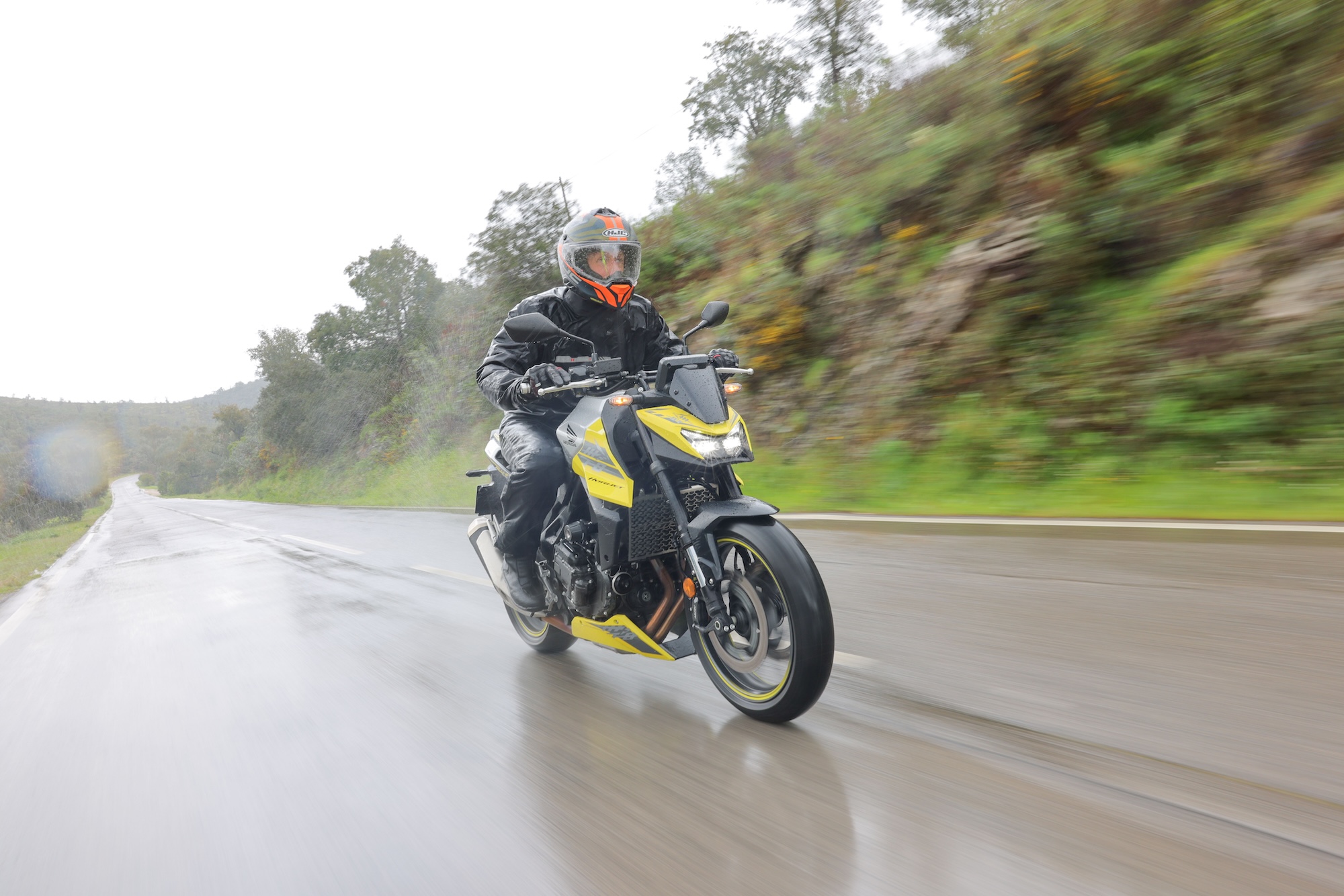
I think that the laminated fabric does what it’s supposed to do, but I don’t know. The reason I don’t know is the fact that – at the end of a 150-mile ride in the rain – the shoulders and upper arms were soaked through.
It could be that the waterproofing simply couldn’t stand up to several hours of abuse at motorway speeds. I wouldn’t necessarily fault Weise if that were the case. After all, that’s the equivalent of sitting in a tropical storm for several hours. I had made the mistake of not looking at the weather forecast before setting out; I should have had my Scott waterproofs with me.

But, as I say, I’m pretty sure the laminated fabric really does do what it’s supposed to do. Instead, I place the blame on the huge neck opening – especially since the area worst affected was my shoulders and upper arms. Contributing to this is the fact that the front part of the thermal liner – which is not waterproof – is exposed.
Meanwhile, although it didn’t fail me in that particular situation, I would also be concerned about the jacket’s main opening. The zipper there is not waterproof. There is a flap of fabric that folds over the zip and stays in place via Velcro, but that same sort of situation was the fatal flaw of the Weise Outlast Houston jacket I had some years ago.
It would be more of a concern if riding a naked bike, where that part of the jacket is more exposed. Equally, I’d be worried about water ingress through the flaps of fabric that cover the chest vents.
So, again, the moral of the story is: 1) be sure to put real effort into making sure this jacket fits you properly; 2) carry a set of Scott waterproofs.

Cold-weather performance
When not riding in the rain, the jacket has been pretty good at keeping me warm. I suspect that for other men it would be excellent – possibly even too effective. I tend to get very cold on a bike. I have only once been in a situation where I felt too hot: about 11 years ago, when I rode to Tuscany. I got stuck standing on an autostrada for about two hours while an accident was being cleared. The temperature was 39ºC and there was no shade.
That was it; the only time I have ever been hot on a bike. And, really, that’s because I wasn’t actually on a bike; I was in full gear and not moving.
Point is: my concepts of cold and hot are probably different from yours. Within that context, the Navigator is, as I say, pretty good. The thermal lining is comfortable and warm; as stated above, it would benefit from adjustment at the bottom hem. The drawback to the thermal lining is that eats up a lot of space. You can’t wear too many additional layers without restricting movement.
At motorway speed, I am happy-comfortable for up to 45 minutes in cloudy, 9ºC weather wearing just the Navigator (with the thermal liner in), a T-shirt, and a sweater. I am ‘suffering it’-comfortable for another 10-15 minutes after that.

Hot-weather performance
Most of the pictures in this article come from the week I spent riding the 2026 Royal Enfield Himalayan 450 Mana Black in India. Temperatures there ranged between 30ºC-35ºC.
Packing my gear for the trip, I was concerned about the wisdom of wearing a black jacket in such a warm place. But the Navigator turned out to be fine. For me. It’s worth taking note of what I said above about how I respond to heat.
Others may not have been as cheerful. They may have also wished for vents in the arms of the jacket. But, the huge, lung-sized vents on the chest – exposed by unzipping and buttoning back a large flap of fabric – seemed to be good at getting air into the jacket. Especially when paired with the enormous neck opening, cuffs that I left zipped open to catch air, and the overall roominess of the jacket when the thermal liner is removed. Whether the tiny vent at the yoke of the jacket did anything, I cannot say.

One flaw comes in the fact there isn’t a means of holding the storm collar open. Or, at least, there isn’t one that was intended by the jacket’s makers. I found that a workaround was to hook the Fidlock button of the collar to the Fidlock connector of the left vent flap.
All in all, though, I feel it would function just fine in British summer.
Verdict
You can find ‘better’ jackets than the Weise Navigator, but they are more expensive. In most cases, they are markedly so. Probably the most direct competitor to the Weise Navigator, in terms of features and price, would be something like the £399.99 Oxford Stormland Dry2Dry. It’s got a few additional features, but not a back protector. For the most part, the difference is down to taste: which affordable jacket from a British company that gets its stuff made elsewhere do you prefer?
For the price, the Navigator is a very good choice. Especially if it happens to fit you properly. Be realistic about what it can and can’t do in terms of weather protection, and it will serve you well for a number of years. The construction of the jacket is good; all the materials appear durable.

It’s an excellent touring jacket, with the removable thermal liner serving as an off-the-bike jacket that can go with normal clothes. I’ve had plenty of scenarios over the years where I’ve finished my day’s riding, get cleaned up, then walk from my accommodation to a pub for dinner. The thermal liner is great for that sort of scenario, allowing you to arrive without announcing to the room: “I’m a grubby biker.”
The Weise Navigator jacket looks good and is comfortable. Within reason, it is waterproof. Within reason, it is a four-season piece of kit. If you get one that fits it’s worth the price.
Other gear seen in photos
Helmet: HJC RPHA 60
Backpack: Richa CRGO Niagara
Gloves: Aerostich Elkskin Competition Ropers
Pants: Some random pair of Hein Gericke leather jeans that i bought on eBay for £5
Boots: Sidi Taurus GTX



Leave a Reply to JesseCancel reply