
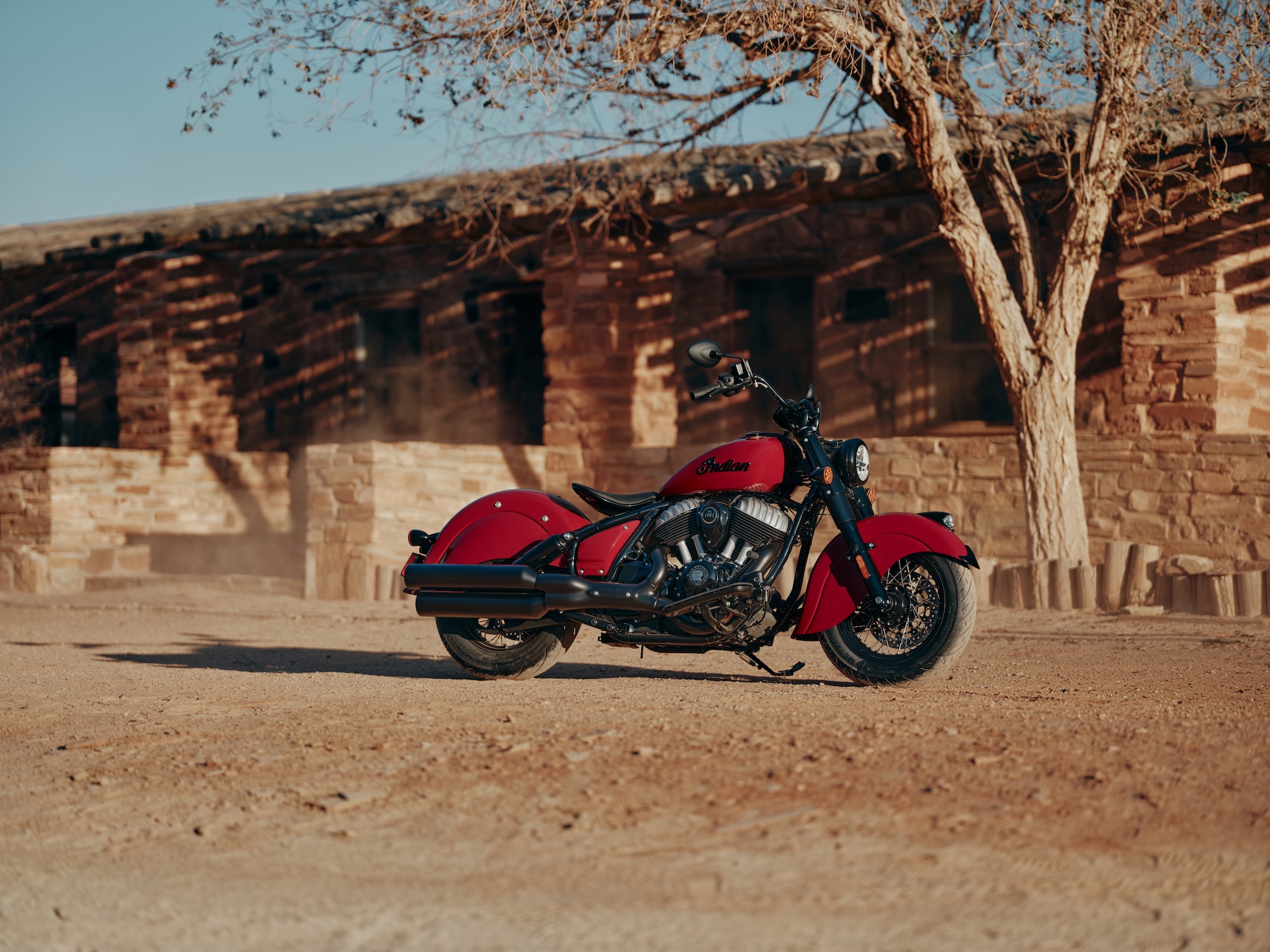
OK, I was not expecting this. Indian Motorcycle has just revealed the new 2026 Indian Chief Vintage – driven by an air-cooled V-twin.
“Inspired by the 1940s Chief, its flowing valanced fenders and unmistakable silhouette pay tribute to Indian Motorcycle’s roots,” declares a media release. “Built with thoughtful, American craftsmanship and obsessive attention to detail, Chief Vintage reflects Indian Motorcycle’s Never Finished spirit, defined by fearlessness, purpose, and an unwavering commitment to provide riders the choice they’ve always deserved in American motorcycling.”
Driven by the brand’s 1890cc Thunderstroke 116 V-twin, the bike claims 115 lb-ft of torque at 3300 and a peak horsepower of “Shhh, we won’t tell you.” Cruiser manufacturers have an infuriating habit of failing to disclose horsepower figures because they aren’t impressive relative to engine capacity.
Thankfully, there is an equation for determining horsepower based on torque figures (Horsepower = Torque x RPM / 5,252), and plenty of internet calculators that will do the math for you. Using one such tool, I’ve come up with a peak output of 71.3 bhp – roughly the same amount of ‘go’ as a late-model V-Strom 650.

But a bike like this isn’t about high-level performance. The smallish single front brake disc and limited rear suspension travel (2.9 inches) are testament to that fact. Not to mention the air-cooled engine.
Indeed, that latter aspect speaks to the fact that this is a machine designed to elicit emotion, exude spirit, and, more broadly, tell a story.
“The Indian Chief from the 1940s remains one of the most recognisable and celebrated motorcycles in American history,” Indian’s media release quotes Ola Stenegärd, Design Director for Indian Motorcycle, as saying. “With its iconic V-Twin engine, valanced fenders, and unparalleled reliability, the Chief set a standard for performance and design that resonates today. It represents the spirit of Indian Motorcycle.”
The valanced fenders, retroesque solo seat, and old-school handlebars – along with non-machined black cylinders and silver-painted cylinder heads and pushrod tubes – make for a bike that looks far more authentically vintage than the Chief Vintage model that Indian first introduced more than a decade ago.

That bike was a bloated, fringe-infested, chrome-plagued beast that cost way too much. (Although, in fairness, it was still a lot of fun to ride) Starting price when I test rode one in 2015 was £19,700 – some £745 more than the new Chief Vintage in numerical terms. Adjust for inflation, however, and the previous Chief Vintage would actually cost an eye-watering £27,559 in today’s money.
So, although the 2026 Chief Vintage starting price of £18,955 is still a hell of a lot of money, Indian is arguably doing right by fans in both financial and aesthetic terms.
Despite its old-school feel, however, the 2026 Chief Vintage has a surprising amount of tech hidden beneath its vintage exterior. You get three different ride modes, for example: Tour, Standard, and Sport.
And there’s a 4-inch touchscreen display, which runs a new version of the brand’s Ride Command software that Indian says is 25 percent faster in terms of start-up and loading. Tediously, the new software also now accommodates Indian’s “App Enhanced Navigation” phone app. Regular readers will know that I hate these kinds of systems because they never function as they should. Manufacturers need to give up on these apps.

Speaking of ways to ruin a perfectly good motorcycle, Indian would also like you to know that it has “curated [a] selection of premium accessories” for the Chief Vintage. As is so often the case with Indian, however, these accessories don’t actually fit the look/feel of the bike. The vinyl panniers, for example, strike me as particularly terrible. Aesthetically, they’re not that far from a Givi top box.
Here’s why this bike is important
“Uhm, Chris, I know you’re a big Indian fanboy,” you might be saying to yourself. “But I’m missing the part of this that’s particularly groundbreaking or shocking.”
Yeah, I can see how you might say that. An American cruiser company releasing a bike that is styled to look like it’s 80+ years old is hardly unbroken ground. Nor is the use of an air-cooled pushrod V-twin – even within the context of Indian Motorcycle; it first revealed the Thunderstroke platform back in 2013. Outside of capacity very little has changed.
But this is kind of a big deal exactly because that’s what it’s doing.

A year ago, Indian introduced the Chieftain PowerPlus, which, as the name indicates, houses the company’s liquid-cooled PowerPlus V-twin engine. At the same time, Indian quietly removed all of its Thunderstroke-driven (ie, air-cooled V-twin) tourers and baggers from its European line-up, including the excellent Springfield.
The bikes were not dropped from the US line-up, so, ostensibly it was an action taken to avoid the challenges of the EU’s strict emissions regulations. But I felt, too, that it was the first step in a broader plan.
I reckoned that the days of Indian’s 13-year-old air-cooled powerplant were numbered. It was only a matter of time, I thought, before Indian’s Chief line-up also adopted the (liquid-cooled) PowerPlus platform. After that, I assumed, the (air-cooled) Thunderstroke platform would be quietly discontinued.
I felt it was a course of action that not only made sense regulatorily and financially (reducing the line-up to two engine platforms instead of three, and not having to invest in updating the Thunderstroke to meet emissions standards), but one that also fit with the apparent ethos of Indian in recent years.

Ever since Indian dropped valanced fenders from the Chieftain back in 2018, simultaneously deciding to make the bagger look like a Victory Cross Country, it’s felt more and more that Indian wanted to pick up and run with the flag that Victory dropped in 2017.
Backing up here for a second, you may be aware that up until quite recently Indian was owned by Polaris. A Minnesota-based powersports company, Polaris bought the Indian Motorcycle name in 2011 and fully resurrected it alongside its own in-house brand, Victory Motorcycles.
Victory, launched in 1999, made very good motorcycles but the company struggled to find the success that Polaris was clearly hoping for. Turns out, the market for bikes that are like a Harley-Davidson but 10-percent better isn’t really that big. Especially when your company doesn’t have great name recognition with riders (most of Victory’s lifespan existed in the pre-social media era, when it was very hard to communicate to riders outside of motorcycle media).
In trying to set itself apart from Harley, Victory adopted the “American Muscle” tagline and ethos. Effectively, it sought to produce the motorcycle equivalents of Ford Mustangs and Dodge Challengers. Not necessarily the very, very fastest or best-handling when placed against European thinking, but big and bold and loud and powerful enough to get you killed in glorious and fiery ways.

Three years after saying that it was totally committed to running two separate brands (“When we acquired Indian, that allowed Victory to really go all out,” then-Polaris Vice President Steve Menneto said in 2013), Polaris decided that it was no longer committed to running two separate brands. It unceremoniously pulled the plug on Victory in early 2017, saying it wanted to focus solely on Indian – the brand with nominally 116 years of history (at the time) and, by extension, far more name recognition and emotional connection with buyers.
Almost all of Victory’s people moved over to Indian, and pretty soon afterward we started to see Victory-like thinking showing up in Indian’s products and marketing. So many dudes in flat-brimmed baseball caps…
Because I think that both Harley and Indian should be making more effort to move forward, I won’t say that I absolutely hated Indian’s ‘Chasin’ the Bros’ tactic, but arguably it did not work. Late last year, Polaris unceremoniously announced that it was no longer committed to running any motorcycle brands.
Which brings us back to why the 2026 Indian Chief Vintage is kind of a big deal: this is the first bike that Indian has delivered since breaking with Polaris.

Yes, there’s a whole hell of a lot of Polaris in it. Almost certainly, it was designed when Indian was fully part of Polaris and no one was outwardly talking about cutting ties. But this ‘new’ version of Indian – now under the majority ownership of private equity company Carolwood LP – is running with this bike. It’s choosing, on the 125th anniversary of the brand being established, to have this bike be the first that it reveals.
We already know that Indian has some other things in the works. It didn’t have to release the Chief Vintage first. Doing so is a statement. It’s a declaration of intent, signalling how it sees itself and where it wants to go.
In the 2026 Chief Vintage, Indian is going back to its roots – in two senses. Obviously there is the desire to connect with the glorious period of Indian’s history in the early 20th century, before everything fell apart (the original Indian Motorcycle Company went bankrupt in 1953 after years of bad decisions and bad luck). But it is also going back to 2013, when a Polaris-revived Indian revealed its first three models at the Sturgis Motorcycle Rally. Those three models were the Chief, Chief Vintage, and Chieftain.
All of them had valanced fenders and spoke very much to Indian’s stylistic heritage. They carried the chrome-drenched excess that had been popular in the cruiser world throughout the 2000s, but they were more aesthetically ‘true’ to the Indian Motorcycle of old than, say, a Challenger.

Indian seemed to abandon its ‘vintage’ spirit when Polaris killed Victory. Now, perhaps, it is keen to rekindle that side of itself. And, arguably, it is a statement that is right for the time. What better way to embrace the rising AI-backlash than with an air-cooled motorcycle?
The painted components and non-machined fins “pay tribute to the raw aluminium finishes found on the original Chief models,” states Indian’s media release. “The finish on the Chief Vintage’s Thunderstroke engine captures the spirit of 1940s craftsmanship.”
Exactly where Indian wants to go from here is uncertain, But you get the sense that you can now leave your flat-brimmed baseball cap at home.
Declarations and statements aside, I love the look of this bike. It is completely beyond the reach of my budget, but, man, I’d love to have one.

2026 Indian Chief Vintage specs
| STARTING PRICE | £18,955 |
| ENGINE | 1890cc AIR-COOLED Thunderstroke 116 V-twin |
| TRANSMISSION | 6-speed manual |
| POWER | 71.3 bhp (calculated) |
| TORQUE | 115 lb-ft at 3300 rpm |
| TOP SPEED | n/a |
| SEAT HEIGHT | 686 mm |
| GROUND CLEARANCE | 125 mm |
| WEIGHT | 327 kg |
| FUEL CAPACITY | 15.1 liters |
| FRONT TIRE | 130/90 B16 |
| REAR TIRE | 150/80B16 |
| FRONT BRAKE | Single 298mm disc, four-piston caliper |
| REAR BRAKE | Single 298mm disc, two-piston caliper |
| FRONT SUSPENSION | 46mm telescopic fork, 132 mm travel |
| REAR SUSPENSION | Dual shocks, 75 mm travel |



Leave a Reply