
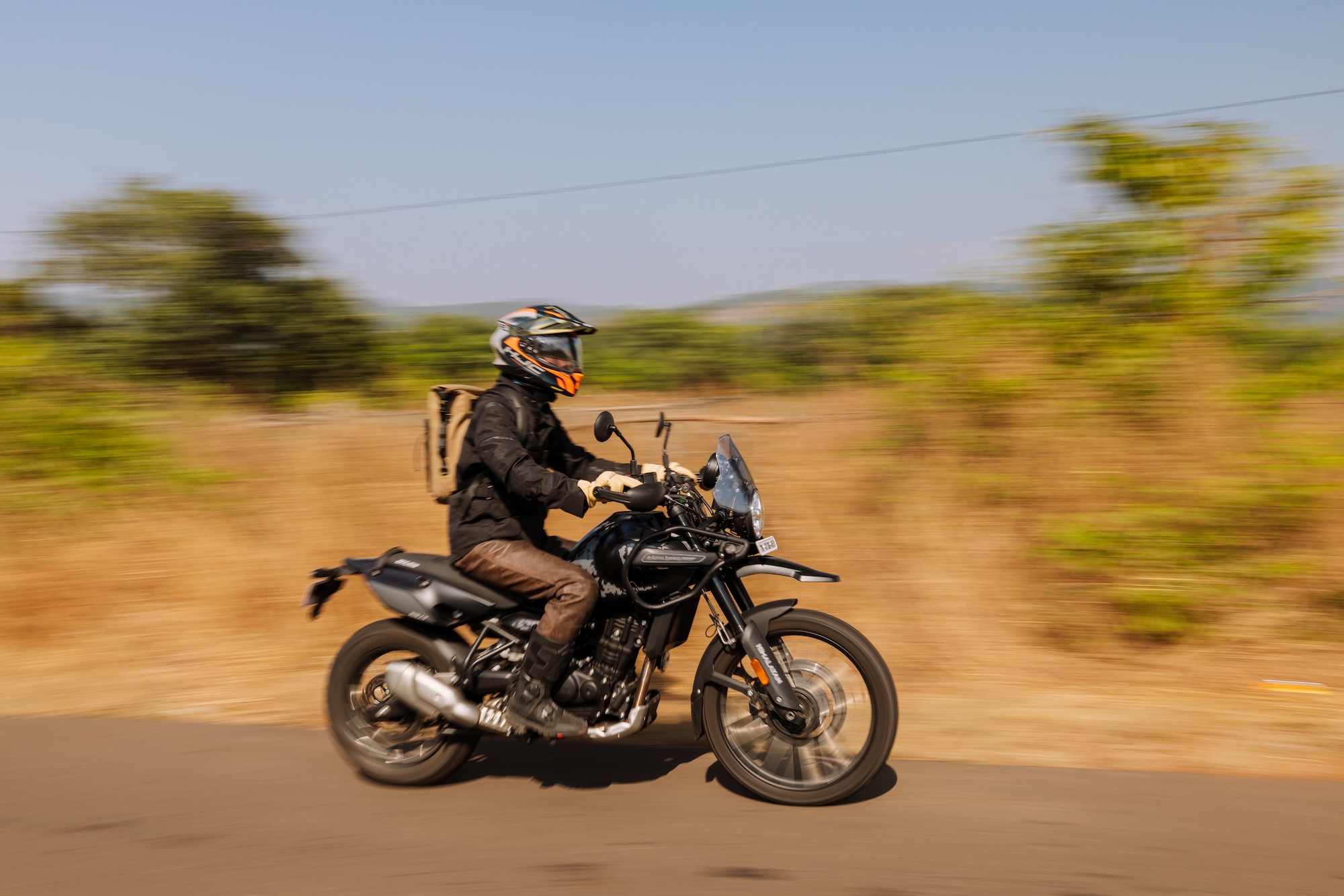
It was the surprise tree that convinced me.
On a two-day ride from Mumbai to Vagator, Goa, there had been plenty of opportunities to put the 2026 Royal Enfield Himalayan 450 Mana Black to the test – too many, one might argue – but it was in this moment that I started to believe the hype.
I had wandered off on my own, down a little dirt trail that ran through some forest. Nothing big or clever: some stones here and there, some uneven bits, some little bumps. The trail was narrow, but even then not really a test for someone of my limited off-road ability.
To my left and through the trees, about 20 metres away, I could see a sandy beach, waves crashing on the shore, and the blue expanse of the Arabian Sea beyond. It was beautiful. And distracting. I didn’t see the fallen pine tree until I was about 3 feet away.
It wasn’t a massive tree – probably only about 8 inches in diameter – but big enough. I would have avoided it in normal circumstances. There was no time for that now.

In the limitless space of the mind, in the millisecond before the front tire made contact with the tree, I was able to imagine how it was going to turn out:
I would lose the front end. I would fly over the handlebars. I would hit the tree just to my left. The bike would slam into me, breaking my femur. I would lie in excruciating pain, honking the bike’s horn, until help arrived. It would take at least an hour to get to medical help, being transported down bumpy roads. I would wait another hour in suffocating heat to see a doctor. Then, I would have a torturous flight home, with nothing but paracetamol and the constant fear of DVT to distract me from the pain.
Back home, I’d follow up at my local hospital and they’d tell me the leg had been set wrong, that it needed to be rebroken. I would spend 8 months recovering. A riding season would be lost. The whole experience would weigh heavy on me, until I eventually decided I was too afraid of crashing to work in moto-journalism anymore. I would end up selling shoes. My wife and kids would abandon me. And somehow, inexplicably, I would get deported…

“Duh-thib.”
The Royal Enfield’s 21-inch tire rolled over the fallen tree, assisted by the bike’s Showa forks. The 17-inch rear tire followed without fuss. Not the slightest hint of drama. So little, in fact, that I had to stop, get off the bike, walk back to the tree, and kick at it to make sure that it was real.
It was. And I was sold.
Royal Enfield has made a motorcycle that can do the things that the company says it can do. In fact, it can do them over and over again, as I would learn over the coming days. No, it’s not an enduro machine by any stretch, but it will take abuse – more than most users will ever think to subject it to.
SOME NUMBERS
| PRICE | £6,400 |
| ENGINE | 452cc liquid-cooled single cylinder, DOHC |
| TRANSMISSION | 6 speed |
| POWER | 40 bhp at 8000 rpm |
| TORQUE | 29.5 lb-ft at 5500 rpm |
| SEAT HEIGHT | 860 mm |
| GROUND CLEARANCE | 230 mm |
| WEIGHT | 196 kg |
| FUEL CAPACITY | 17 liters |
| FRONT TIRES | 90/90 21-inch |
| REAR TIRES | 140/80 17-inch |
| FRONT BRAKES | 320mm single disc, double piston ByBre caliper |
| REAR BRAKES | 270mm disc, single piston ByBre caliper |
| FRONT SUSPENSION | 43mm Upside down fork, 200 mm travel |
| REAR SUSPENSION | Linkage-type mono shock with adjustable preload, 200 mm travel |

SOME BACKGROUND
Royal Enfield first introduced the Himalayan 450 for the 2024 model year. Driven by a 452cc liquid-cooled single-cylinder engine, it was a marked step up – in terms of peak outputs and quality – from the air-cooled Himalayan 411 that had been around since 2018.
The Himalayan 450 has earned reasonably positive reviews from journalists, and even better responses from owners. MCN describes it as “an unintimidating real world adventure and travel bike for the masses.” That sounds like a back-handed compliment, but it’s not wrong,
Now, perhaps spotting the popularity of the CFMoto 450MT and similar bikes, Royal Enfield has decided to offer a more off-roady-looking version of its Himalayan 450. Cue the 2026 Royal Enfield Himalayan 450 Mana Black, first introduced at EICMA 2025.
Named after the Mana Pass, one of the highest vehicle-accessible mountain passes in the world – located in Royal Enfield’s self-declared spiritual home of the Himalayas – the Mana Black is mechanically and technologically identical to the standard 450. Its chassis, too, is unchanged.

For the most part, the differences are cosmetic. The so-called Black Rally rear mudguard, for example, has a different aesthetic than that of the standard bike. And it looks to me like it might do a better job of keeping mud off the rider.
You also get the Mana Black livery, which – between you and me – isn’t that impressive.
I mean, one of Royal Enfield’s strengths is the effort that usually goes into paintwork. The styling of the Mana Black, though, is on par with what you’d get from a Chinese bike: black tank with a kind of dark camo decal. It’s not bad. It’s just that Royal Enfield has set my expectations so high with machines like the gorgeous Classic 650. Were this to come from almost any other manufacturer, I wouldn’t care.
The Mana Black’s “Black Rally” seat has the biggest impact on the look and feel of the bike. It is a single unit that is thinner and taller (860mm seat height, as opposed to 825 mm) than the two-seat set-up on the standard Himalayan 450.

Lastly, the Mana Black comes with tubeless spoked wheels and handguards. You have to pay extra if you want those things on the standard Himalayan 450.
I spent five days in India with the 2026 Royal Enfield Himalayan 450 Mana Black. It was an experience that changed my way of thinking somewhat, sending me back to the UK with a strong desire to get hold of a cheap, low-capacity machine with which to explore local trails and lanes.
FIRST IMPRESSIONS
As mentioned above, I don’t love the Mana Black’s paint and graphics scheme, but certainly I don’t hate it. And, to give it credit, it’s a look that contributes to an overall approachability. A lot of brands seem to want their adventure bikes to look dangerous. Royal Enfield has chosen to make its adventure machine look functional. Usable, rather than competitive.
Royal Enfield’s claim that it has everything you need for a round-the-world adventure right out of the box should obviously be taken with a grain of salt. The bash plate is plastic, after all. But certainly I see where the brand is coming from and for the most part I buy it. The bike looks and feels capable of being abused.

Seat height on the Mana Black is 1.3 inches higher than the standard Himalayan 450. The narrow rally seat means that most riders who can handle the standard bike won’t be put off here. It certainly wasn’t an issue for this 6-foot-1 rider; I was able to stand with both feet on the ground.
The seat’s comfort, or lack thereof, was a point of contention for the moto-journalists on my adventure. I certainly wouldn’t argue that it is the most comfortable saddle I’ve ever been in, but it didn’t bother me. Others absolutely hated it, feeling it is too firm and narrow to support multi-day all-day riding.
The bike’s ergonomics are relaxed, with feet and hands landing naturally on pedals and ‘bars. Looking straight ahead, the Mana Black’s dash is pretty bare bones: a circular TFT screen that’s easy to read in any light. More on this below.
Beyond the dash is a small, non-adjustable windscreen that likely wouldn’t offer much defense against British winter. Some people ride year-round on naked bikes, though, so to each their own.
Contrary to what you might expect from a motorcycle costing less than £7,000, all of the levers, pedals, and fixings are robust and sturdy.

ENGINE AND TRANSMISSION
The Mana Black’s liquid-cooled 452cc single-cylinder engine pumps out a claimed 40 bhp at 8000 rpm and 29.5 lb-ft of torque at 5500 rpm. With a lot of straight and the wind at your back, the bike’s tachometer will claim 163 km/h. That’s 101 mph for those of us dealing in freedom and crumpets. Anyone expecting more out of a 450 single is being unrealistic.
As you can probably guess, things at that speed are chaotic. At legal speeds, though, the engine isn’t too vibey. That becomes more true below 60 mph. In fact, I would say that below 60 mph, the Himalayan 450 is one of the overall best motorcycles I’ve ridden in a very long while.
A large part of that is thanks to the fact that roughly 90 percent of the Himalayan 450’s torque arrives below 3000 rpm. The ride-by-wire throttle response isn’t jerky and power delivery is smooth.
Clutch pull is light, and the six-speed transmission is slick and easy to get along with. Though gearing is such that the whole show favors lower-speed riding. You’ll be inclined to click into fourth gear at 30 mph, for example. Excellent for off-road or city work, less great for long motorway hauls.

BRAKES AND CHASSIS
One of the first things I’d do as an owner is replace the tires. The Himalayan 450 Mana Black’s standard CEAT Gripp tires are not awful, but they’re equally far from great.
Contrary to the name, they lack grip (and feel) on road and off. They’re durable, I’ll give them that. But I’d much rather have a pair of Michelins or Metzelers to help improve confidence – especially in cornering.
The Showa suspension is surprisingly good. People who like to push hard through corners will find it too soft, but if you’re the sort who really wants to go nuts in the twisties, what the hell are you doing buying a 40bhp adventure motorcycle?

The suspension is ideal for the UK’s oft-neglected road surfaces. Councils not wanting to spend the money to actually fix their roads could just offer subsidies on the purchase of a new Himalayan 450.
Also commendable is the quality of the bike’s brakes. Well, for the most part. The discs that the ByBre calipers grip are a little larger than you might find on competitors’ models, and, according to Royal Enfield, that helps deliver more stopping power.
However, the Himalayan 450 Mana Black’s so-called “Performance ABS” system can be disappointing when the pace picks up. It has a habit of allowing the rear tire to lock up a little bit before engaging. I’m sure somebody somewhere could explain how this might be beneficial in certain situations, but I didn’t like it. I found it rudimentary, and detrimental to my confidence.
The CEAT tires obviously didn’t help things, though. Nor did the moto-journalist pace at which we were riding when I observed issues with the system.

FANCY BITS
Royal Enfield’s tagline for the Himalayan 450 is “Everything you need. Nothing you don’t.” And it clearly feels you don’t need a great deal of technowhizzbangery.
The primary bit of fancy tech comes in the form of the 4-inch TFT dash. It offers all kinds of useful info… if you can figure out how to navigate the bike’s far-from-intuitive switches. There’s a button on the right grip, a joystick on the left, and you pretty much need to be a Royal Enfield employee to know the order in which to press them.
One of the key selling points of the dash is its Tripper feature. This is Royal Enfield’s proprietary phone connectivity software, claiming to work in partnership with a phone app to deliver maps and other info to the dash. Regular readers will know that I despise these sort of set-ups, which are offered by a number of manufacturers. I have never found one that actually works as it should.
Royal Enfield will tell you that the system is easy and useful, and I will concede that multiple Royal Enfield employees were apparently able to get maps to work on the bikes they were using. Or, they were convincing liars. My personal experience was that the whole thing is a ball ache. After spending 30 minutes setting everything up, the app just crashed when I tried to use it.
Outside of the dash, the only real fancy stuff comes in the presence of four rider modes. Or, well, Royal Enfield says there are four. Actually, there are two: Eco and Performance. Each of those are available with ABS on or ABS off, which is where Royal Enfield gets its claim of four modes.

BASIC MAINTENANCE
Basic service intervals are every 6,000 miles. While replacing the spark plug is recommended every 9,000 miles. The presence of a center stand means that chain cleaning/lubing is easy. Chain adjustment is straightforward, with the swingarm metric bolts needing no specialist tools.
All the tools you need to carry out regular maintenance on the bike can be found underneath the seat. Royal Enfield claims that the Himalayan 450 is designed to be easy to work on roadside. At lunch one day, I decided to put this to the test.
“The air filter’s underneath the tank, right?” I asked one of Royal Enfield’s team. “Mind if I remove the tank, just to see how easy it is?”

Normally, this is the sort of question that would send PR folk into a shouty, hand-swatting panic. Royal Enfield’s man, however, was nonplussed: “If you want to stand out here in the sun doing that, go ahead.”
It took me less than five minutes to get to the air filter. That’s having never worked on a Himalayan 450 before. The engine was hot, so I didn’t try to access the sump plug and oil filter, but removing the bash plate that protects them looks easy enough.
WHAT IT’S LIKE TO RIDE
From the get-go, the bike feels well-balanced and manageable. Curb weight is 196 kg, but you certainly don’t feel it. Even when pushing the bike around. Royal Enfield, by the way, would like you to know that its weight figure is for a fully fuelled bike and inclusive of items like the center stand, which other manufacturers might ignore in their claims.
Meanwhile, the easy-access torque means the Mana Black is excellent for both urban and off-road situations, where you often want power from a dead stop. And as I say, that power arrives pretty smoothly below 60 mph. No buzzy mirrors, no tingling hands.

Paired with the good suspension, everything works so well that the experience very quickly becomes symbiotic. You’re not really thinking about being on a motorcycle, you’re just moving and flowing through the world at pace.
When that pace quickens to extra-legal speeds, the bike is still planted and confidence inspiring, but the traits of a single-cylinder engine become more obvious. Objects in your mirrors become ideas rather than identifiable things, and buzzing in the ‘bars is undeniable. Spend an hour or two cruising at 85 mph and you’ll be clapping your hands together to get feeling back into them when you stop.
Even so, you’ll still be happy. There is something about the straight-forwardness of the Himalayan 450 Mana Black that inspires joy and confidence.
The bike’s headlight, meanwhile, is surprisingly effective. I got caught riding in the dark on multiple occasions. The headlight throws plenty of light, ensuring that you see the pack of sleeping dogs that’s decided to curl up in the middle of the road.

COMPETITION
The segment in which the Himalayan 450 Mana Black exists seems to be exploding at the moment, although there’s not really anything exactly like it. But here are some of the alternatives that I’d consider:
| PRICE | ENGINE | POWER / TORQUE | |
| CFMoto 450MT | £5,699 | 449cc parallel twin | 41.5 bhp / 31 lb-ft |
| KTM 390 Enduro R | £5,699 | 398cc single | 44.3 bhp / 28.7 lb-ft |
| Kawasaki KLE 500 | £5,999 | 451cc parallel twin | 44.7 bhp / 31.4 lb-ft |
| Triumph Scrambler 400 XC | £6,545 | 398cc single | 39.5 bhp / 27.6 lb-ft |
| BMW 450 GS | £6,990 | 420cc parallel twin | 47 bhp / 31.7 lb-ft |
| Suzuki DRZ-4S | £7,999 | 398cc single | 37.4 bhp / 27.2 lb-ft |
Can someone explain to me why the Suzuki costs so damn much? Anyhoo, on paper the Kawasaki, KTM, and CFMoto beat the Royal Enfield in terms of peak outputs and price. I personally wouldn’t trust a KTM right now, though. Whereas the ground clearance on the Kawasaki is infamously disappointing. Perhaps you’ve seen the viral video of a moto-journalist demonstrating that it wouldn’t be able to clear his iPhone.
The CFMoto 450MT has more tech and has earned high praise from riders around the world but it lacks the Royal Enfield’s amenable spirit.
VERDICT
The Royal Enfield Himalayan 450 Mana Black isn’t perfect, but no bike is. And all of its positives, and its attractive price point, are more than enough to encourage you to overlook the weaker points.
It wouldn’t be my first choice for a track day, nor an all-motorway trip to Austria. But as an everyday takes-abuse commuting all-rounder? Definitely. Solo touring on the narrow, broken roads of the Scottish Highlands? Ideal. Light green-laning? No problem (although, I would replace the stock plastic bash plate). Bimbling exploration of local lanes and B roads? Perfect.
At £6,400, the Mana Black isn’t the most affordable in its class. But it’s not outrageous. And if you’re not a fan of the look or feel of the Mana Black’s rally seat, you can get the Mana Black’s other stand-out feature – tubeless tires – on the standard Himalayan 450 for a little less: as little as £6,250. Although, you’ll also need to buy handguards.

All in all, I’d argue that the bike is worth what Royal Enfield is asking. Indeed, it’s a motorcycle that surprised me, which is something that Royal Enfield seems to do often.
No matter how many times I encounter Royal Enfield bikes, I still find their value for money to be impressive. Sure, you may need to be a little more liberal in your use of ACF-50, but on the whole, the company delivers well-made, desirable motorcycles – motorcycles you want to hold on to for years – at affordable prices.
And you can ride this one over a fallen tree.
THE THREE QUESTIONS
Does the 2026 Royal Enfield Himalayan 450 Mana Black suit my current lifestyle?
Yes. There are some times when I’m called upon to spend all day on the motorway, but they are infrequent enough that I’d be willing to suffer tingling hands from time to time. What surprised me most about this bike, however, is how much it does suit my typical riding. It also provides opportunity for a kind of riding (light off-road) that I’d like to get into.
Did the 2026 Royal Enfield Himalayan 450 Mana Black put a smile on my face?
Definitely. I’ll be honest that when the Himalayan 450 came out a few years ago I wasn’t terribly interested. Not enough power, I thought. Not my sort of thing. But I was wrong. I love how accessible the bike is, while also being practical/relevant to my kind of riding.
Is the 2026 Royal Enfield Himalayan 450 Mana Black better than my current motorcycle, a 2012 Kawasaki Versys 1000?
Yes and no. The Kawasaki obviously wins in terms of power, comfort, and long-haul functionality. If I were riding to the Carpathian Mountains, my Kawasaki would be the bike I’d choose. But I’d want the Royal Enfield once I got there. It’s just so damned agreeable and fun. I mean, I wouldn’t try to navigate through a herd of goats on my Kawasaki. And I sure as hell wouldn’t explore forest trails with it; I get stressed when I have to ride that 240kg behemoth across a gravel parking lot.
Here’s the gear I’m wearing in photos
Helmet: HJC RPHA 60
Jacket: Weise Navigator
Backpack: Richa CRGO Niagara
Gloves: Aerostich Elkskin Competition Ropers
Pants: Some random pair of Hein Gericke leather jeans that i bought on eBay for £5
Boots: Sidi Taurus GTX

Leave a Reply