
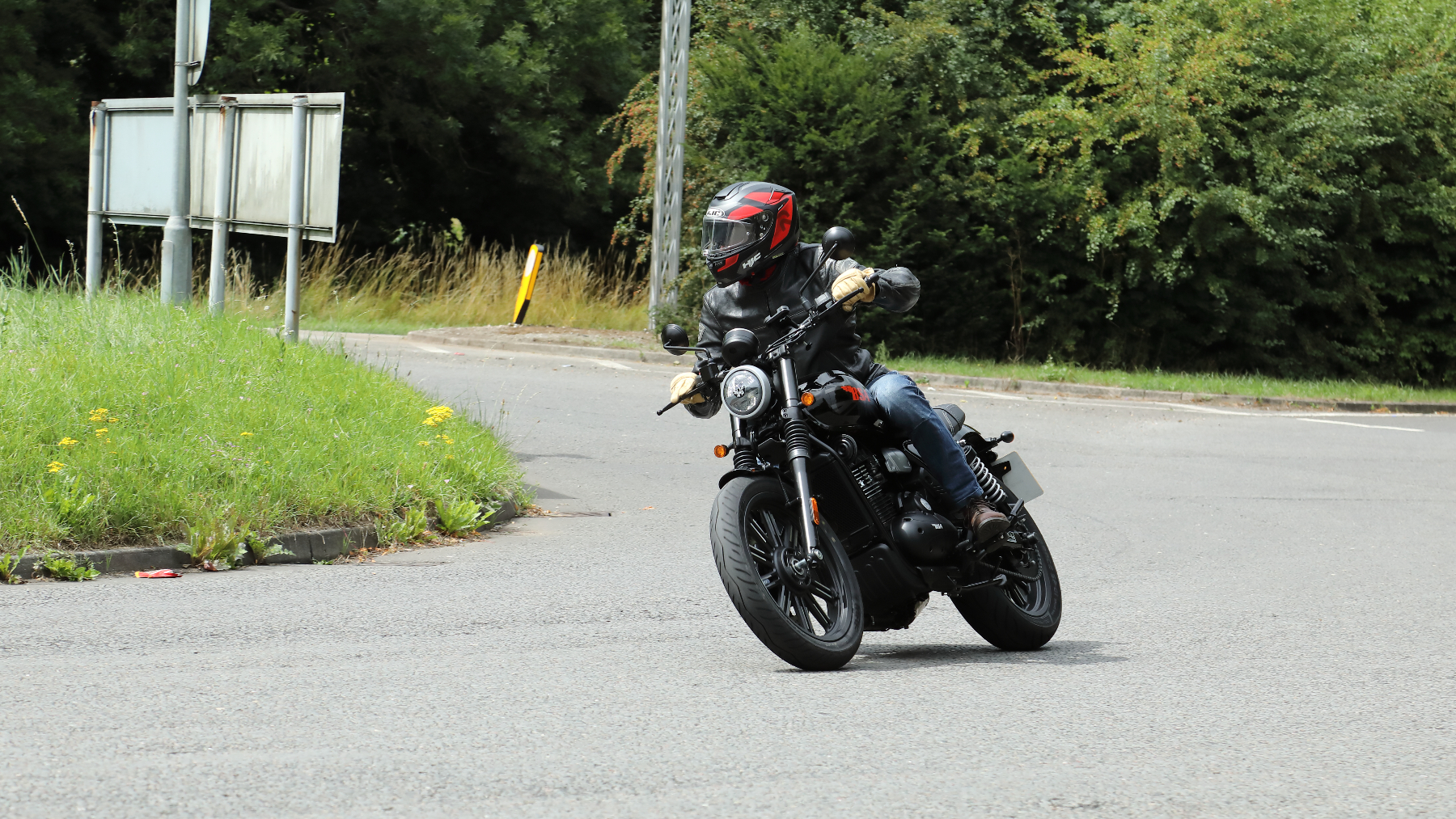
Yes, it’s good enough. Pushing to the side whether the return of the Bantam is “historic,” “game changing,” or any of the other hyperbole put forward by BSA’s public relations team, the question that most riders will have about this new competitor in the sub-400cc market is: “Is it good enough?”
That’s the question I always have, at least. I’ll see something like, say, the Honda GB350S, and think: “Ooh, I like the look and the price, but would it really be enough?”
Kinda depends where and who you are, I suppose. If you are someone who lives in one of the many overcrowded, speed-camera-infested regions of the UK, yes, it is good enough.
Good enough for a relaxed Sunday ride to a biker cafe or the seaside. Good enough for a commute that involves both city riding and (some) dual carriageway. Good enough for someone who wants to have fun, obey the law, and not break the bank.
Exactly how good is it? And what are the drawbacks? Let’s get into that.
SOME NUMBERS
Starting price: £3,499
Engine: 334cc liquid-cooled single cylinder DOHC
Power: 21.3 kW @ 7750 rpm (29 hp)
Torque: 29.62 Nm @ 6000 rpm (21.8 lb-ft)
Fuel capacity: 13 liters (3.4 US gal)
Seat height: 800 mm (31.5 in)
Weight: 185 kg (407 lbs)
SOME CONTEXT
“Bantam” isn’t a word that gets used a lot these days – especially outside of chicken and boxing circles. I admit, I had to look it up.
“A person of diminutive stature and often combative disposition” says Merriam-Webster.
OK. Expectations set.

In a motorcycling context, the Bantam was possibly BSA’s most iconic model. It was certainly the company’s best-selling. According to some sources, BSA sold 500,000 Bantams over the course of its 21-year run.
If you are under the age of 60, you may need a quick refresher on who BSA was. The acronym stands for Birmingham Small Arms. Founded in 1861, BSA was one of the original mega-companies, starting with a focus in the defense industry and soon turning its hand to pretty much everything.
Exactly when it turned its hand to motorcycles is up for debate. According to the UK’s National Motorcycle Museum, the first BSA motorcycle was made in 1910. Whereas BSA’s current owners adorn their bikes with badges claiming 1903. Discuss.
Whatever the case, BSA quickly became a dominant force in British motorcycling. So much so that it bought out Triumph in 1951. Hunter S. Thompson rode a BSA, as did Boris Johnson’s dad, and maybe your grandad. Or, perhaps your grandad really WANTED to ride a BSA – it’s a brand that sparked a lot of emotional connection.
Unfortunately, woeful mismanagement reversed the company’s fortunes through the late ‘50s and ‘60s. In 1971, it went belly-up and BSA motorcycles largely became the purview of misty-eyed old men.
Almost 50 years later, India’s Mahindra Group – a multinational conglomerate that’s turned its hand to everything from the arms industry to real estate – bought the BSA name, and rolled out the retro-styled Gold Star 650 in 2021.

The brand is still finding its feet in terms of distributors, dealerships, and, arguably, identity, but it recently made two very large steps forward with the reveal of the Scrambler 650 and this, the Bantam 350.
As mentioned, the Bantam was one of BSA’s best-known and best-selling models in the company’s 20th century heyday. Back then, it was a 125cc single-cylinder machine derived from a German-designed bike that Allies gained the rights to after the Second World War (“Hey, you killed millions of people, so we’re taking this motorcycle”). Later versions were boosted to 148cc, then 175cc.
The new Bantam 350 is powered by a single-cylinder engine, but that’s pretty much where the similarities stop.
FIRST IMPRESSIONS
As any of those misty-eyed BSA aficionados will be quick to tell you, the new Bantam 350 looks nothing like the Bantam of old. At the bike’s UK launch and press ride in late July, I ran into a number of folks who own and regularly ride original Bantams. They all quietly admitted disappointment in the bike’s lack of true classic styling.
They had hoped that BSA would do something similar to what Royal Enfield has done with its Classic 350 and Classic 650 models – make a modern machine with authentic old-school styling.
But one assumes that BSA thinks the target audience for this bike will be less disappointed in its looks. Light, manageable, and equipped with an incredibly attractive starting price, this is a machine that seems aimed at riders who just want a decent bike – people with no real emotional connection to the original. Not so much the grandchildren and great-grandchildren of people who rode Bantams back in the day.

It has a round headlight, but otherwise the styling reflects what this bike is: a modern motorcycle. Internet sleuths will observe that whereas it doesn’t look like an old Bantam, it does look a hell of a lot like the current Jawa 42 FJ. Jawa is another old-school brand now owned by Mahindra. Both the Bantam and the 42 FJ rely on the same 334cc liquid-cooled DOHC single-cylinder engine.
The general fit and finish is good. Generally. But, if you’re comparing this bike to offerings from another British-Indian brand, Royal Enfield, you’ll observe a greater willingness to use plastic here, and less attention to detail. But perhaps it makes sense to remember the bike’s price when assessing things like clutch levers, paint, the obvious use of decals in some places, suspension components, tires, etc. Not great, but, realistically good enough.
As a whole, the bike has a solid presence. It’s a compact machine but it doesn’t look or feel too small, even for a 6-foot-1 rider like myself. Seat height is an agreeable 800 mm. Throw a leg over, and the seat is reasonably comfortable. There’s potentially room for two – depending on who you are – and pegs to accommodate such an endeavour.
Hands and feet fall comfortably to the controls. A digital clock/display sits slightly offset to the right. Turn the bike’s key, and the display greets you with “Hi” before showing you a digital speedometer, tachometer, odometer/trip meter, clock, and gear indicator.
There is no USB connectivity on this bike, which seems like a real oversight, considering the target demographic. Or perhaps it is just a pre-production mistake. Maybe when the bike hits UK dealers in September it will have the USB C connector that comes with the Scrambler 650. Maybe it will also be the case that the switchcube on the left grip will actually have a purpose.
LET’S STOP FOR A SECOND, AND GO DOWN THE SWITCHCUBE RABBIT HOLE
I’m pretty sure nobody cares about the Bantam’s switchcube. But, for me it is a baffling inclusion that raises larger questions and creates a broader uncertainty about the brand.

The switchcube in question is innocuous in terms of aesthetic – it doesn’t distract from or enhance the look of the bike. My issue is that it doesn’t do anything. Or, at least, it doesn’t do what it clearly should do.
It has four buttons: one labeled “M,” one labeled “S,” and two arrows – up and down. Just looking at such a configuration, one might assume that these buttons are there for the sake of navigating a digital menu, or possibly a connectivity feature. “M” might stand for Menu, and “S” might stand for Set.
But it doesn’t. Pressing M only switches between the odometer and the two trip meters. Holding S resets the trip meters. It was my experience that the two arrows did nothing at all.
On the press ride, I asked the BSA folks about this and no one seemed to know. A day later, they got back in touch: pressing the up arrow changes the format of the clock, between 12-hour and 24-hour. Pressing the down arrow does nothing; the button is “not functional, dummy,” they say.
So, let’s stop and think about this. BSA has taken a part that’s clearly not intended for the Bantam 350 – perhaps a part that Mahindra had a surplus of from one of its other motorcycle brands – slapped it onto this bike, and jerry-rigged it to achieve a purpose that fewer, less-obtrusive buttons could have done.
Why? How did this happen? Who made this decision? Who signed off on that decision?

In BSA’s media release for this bike, company head Anupam Thareja is quoted as saying: “Our promise to you: every BSA will honour the craftsmanship, character and ‘built-to-last’ beauty that made this brand famous from Birmingham to every corner of the world.”
Would we say this switchcube is an example of that craftsmanship?
ENGINE, TRANSMISSION, BRAKES, AND SUSPENSION
The 334cc unit driving the Bantam 350 claims peak power outputs of 29 hp at 7750 rpm, and 21.8 lb-ft of torque at 6000 rpm. Fire it up, and the bike delivers a lovely, deep exhaust note at idle that’s more substantial than what I was expecting.
There is just enough jiggle and thump at idle to remind you that you are sitting on a metal box of explosions, but the standout experience with this engine is one of smoothness. This is true even on the go. Surprisingly so. The shimmy of the mirrors confirms that the single cylinder is working hard but you don’t feel it in your hands, feet, or butt. Magic.
This means that light dual carriageway work is legitimately possible. The engine is screaming at 75 mph, so you might not want to spend all day on the motorway, but there is enough on tap to keep up with traffic and even overtake big trucks with confidence.
The six-speed transmission is smooth and reliable – no false neutrals. Clutch pull is light.
In terms of stopping power, you’ve got a 320 mm single disc up front, and a 240 mm disc at the rear. Brakes are by Bybre, Brembo’s budget subsidiary aimed at smaller-capacity machines. The brakes are effective but not particularly nuanced – a little off/on for my tastes.

This is a characteristic that exacerbates the cheap-o nature of the suspension, which doesn’t take bumps particularly well and dives when making anything but the gentlest of stops.
Tires, lastly are MRF, of which I have no previous experience. In dry conditions, they held to the road without complaint and offered enough confidence to lean naturally into corners. The conditions and route of the ride didn’t offer much opportunity to put them to the test. Once again: good enough.
WHAT IT’S LIKE TO RIDE
Pulling back the moto-journalism curtain a little: normally, there’s a lot of hand-holding on a press ride. Every little facet of the event is meticulously planned and told to you no less than 8,000 times.
This was not the BSA way. We started at Bike Shed, in London’s Shoreditch, and were just sort of let loose – told to meet back up at Ryka’s cafe, about 30 miles south.
“This is a TERRIBLE idea,” I thought to myself as we roared onto Old Street in a massive, disorganized pack. “There are riders from Spain and Japan and all over on this ride. They’re going to get completely lost and show up six days from now in the Outer Hebrides or some such thing.”
To my surprise, no one got (too) lost, and it turned out to be a lucky cunning move on BSA’s part.

Almost instantly, the pack dissipated into the London bustle and I found myself riding on my own – quite happily making my own way, and riding the bike like a normal person in the sort of setting for which the Bantam 350 is perfectly suited. Sure, I didn’t end up with any cool photos – as I would have on a normal press ride – but I got a genuine sense of how this bike handles in the most urban of situations. And it handles brilliantly.
Its 21.8 lb-ft of torque may not sound like a lot, but it’s available pretty much from the get-go and is more than enough to ensure you can jump ahead of cars at traffic lights and roundabouts. The exhaust note sounds fantastic bouncing off buildings and underpass walls. The transmission handles the constant up-down, stop-start gear changing of traffic with ease. And thanks in part to a 185 kg wet weight, only the cyclists will be able to outmanoeuvre you when filtering through traffic. It’s wonderfully nimble.
You’ll want to lift yourself up on the pegs a little when hitting bumps (there’s that budget suspension again), but otherwise, the Bantam 350 is the perfect urban weapon.
Usually, a bike that’s really good in the heart of a city becomes notably less so as you ride out of town. The Bantam 350, however, is substantial enough that you still feel confident as roads open up and speeds increase. The mirrors are, unquestionably, the worst I have ever experienced – so you’ll have to keep your head on a swivel – but it’s otherwise a solid machine at speeds below 60 mph.
The engine delivers plenty of punch, handling remains confident, and the seat is comfortable enough to spend roughly an hour in the saddle. As such, the Bantam 350 is happy to take on (single carriageway) A- and B-road adventures, especially if you’re the sort of rider who has a clean license.
Move onto the motorway and you won’t be winning any races, but you also won’t be feeling completely outgunned. Don’t spend too much time in the passing lane and you’ll be fine.

Obviously, it’s not going to be your first choice for touring or track days. And commuters may be frustrated by the lack of bungee points (you can just strap stuff to the passenger pegs, of course). Tourists won’t be stopping you to take pictures of the thing. But it really is good enough to serve as the only bike for a large swathe of riders. As long as ‘looking cool’ isn’t at the top of your wish list.
THE COMPETITION
The Bantam’s up against a lot of good bikes in this very competitive segment. The aforementioned Royal Enfield Classic 350, does a much better job of ticking all the nostalgia/classic bike boxes. Honda’s GB350S is better put together. Triumph’s Speed 400 is markedly more powerful (but also quite a bit more expensive).
I’d be inclined to say that where the BSA legitimately competes is against equally ‘good enough’ bikes from Chinese manufacturers. Aesthetically uninspired. Questionable build decisions. Budget parts.
Actually, come to think of it, Chinese manufacturers are increasingly moving away from that sort of thing…
VERDICT
BSA goes hard on emotive language when it speaks about this bike. Really, really hard. I personally think they overdo it. Especially in light of what’s being delivered.
It’s a good enough bike – and certainly one that’s worth its £3,499 starting price (that undercuts the Honda GB350S by £500 and the Royal Enfield HNTR 350 by £400). But it’s also a bike that could be – and, in fact, is – rebadged as something else in a different country.

To that end, it’s a bike that lacks uniqueness for me. I have no complaints about its aesthetics, but there’s nothing that makes me sit and stare. I appreciate the overall smoothness of its engine, but that means it lacks character somewhat. There’s nothing here that makes me want to run out and get a BSA tattoo.
And the switchcube thing really sticks in my craw.
But the excesses of BSA’s marketing prose shouldn’t count against the Bantam 350. It is, as I said at the very start, a motorcycle that’s suitable for most of what a leisure or commuter motorcyclist would want to do.
It isn’t perfect, but look at the price tag. It’s good enough.
THE THREE QUESTIONS
Does the BSA Bantam 350 suit my current lifestyle?
Not really. Although, if I had no choice but to ride the BSA I could stretch it to suit my needs.
Does the BSA Bantam 350 put a smile on my face?
Yes, but mostly in the way that any motorcycle makes me smile. There’s no feeling of excitement/interest that lingers beyond the ride, however.
Is the BSA Bantam 350 better than my current motorcycle, a 2012 Kawasaki Versys 1000?
Not really. My bike is in such rough shape these days. Having two kids under the age of 2 really eats into your maintenance schedule. And yet, I’d still go with the Kawasaki.



Leave a Reply to Mad ManCancel reply