
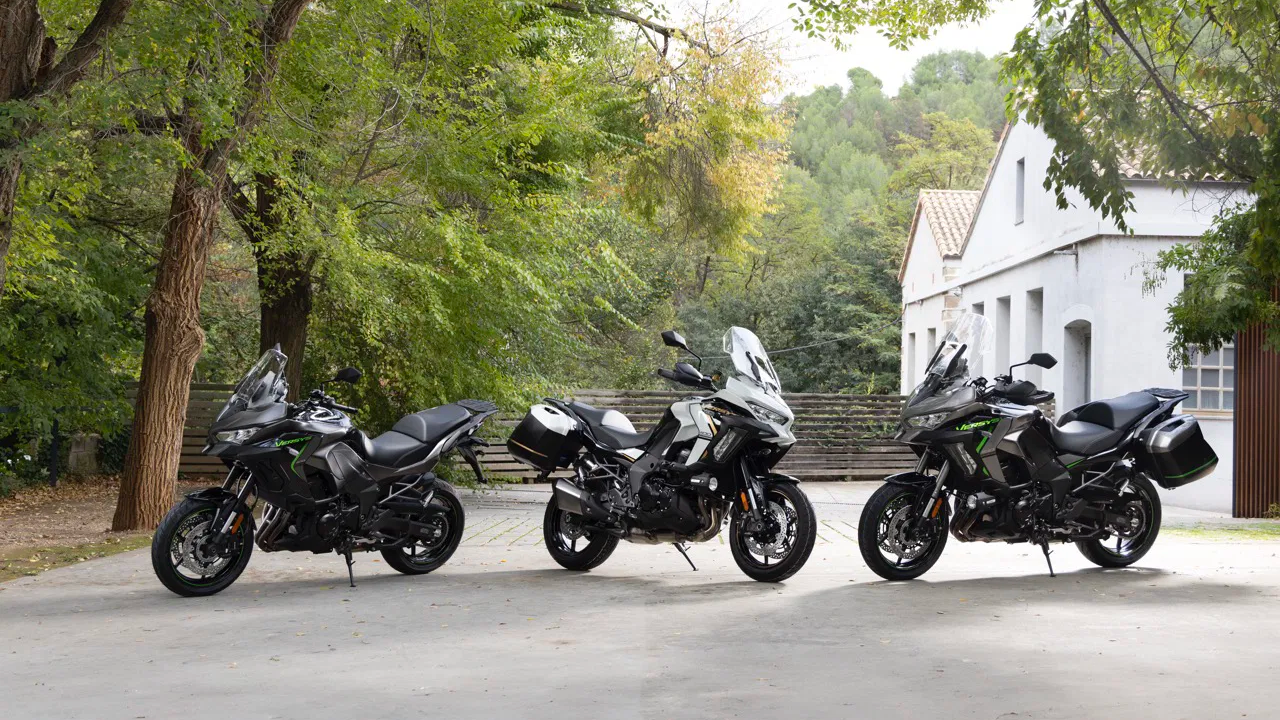
I really like my first-gen Kawasaki Versys 1000. Therein you have the reason for my going to the trouble to write a review round-up for a model that could largely be described as lightly updated rather than new.
Bike magazine dedicated less than 100 words to its initial review of the 2025 Versys 1100, observing: “Is the smooth, strong motor improved? Hard to tell.” (January 2025 issue, p. 93).
But, as I say, I really like the Versys platform. Possibly more so than most. Last Autumn, when rumors first started flying that an 1100 version of the Versys was on the way, I was so excited that I ended up writing not one but two follow-up stories. So, this is yet another example of me writing an article for the probably-not-that-many people who are like me.
If you’re not like me, the TLDR version of this review round-up is: “The new Versys 1100 is the same as the three generations of Versys 1000 that came before it, but a little different in mostly good or irrelevant ways.”

Meanwhile, if you are like me and want to know every little thing about this consistently underrated touring platform, dig in. Your reviewers this time ’round are: Michael Neeves of MCN, John Westlake of Bike, Simon Hancocks of Visordown, and Martin Bauer of 1000ps.com.
SOME NUMBERS
Starting price: £11,899
Engine: 1099cc liquid-cooled 16-valve DOHC inline four
Power: 99 kW at 9000 rpm (132.7 bhp) *claimed*
Torque: 112 Nm at 7600 (82.6 lb-ft) *claimed*
Fuel capacity: 21 liters (5.5 US gallons)
Seat height: 840 mm (33 inches)
Weight: 255 kg wet (562 lbs)
NOTE: All of the above numbers are for the base model. Weight and price increase for the S and SE versions but all other specs are the same.
SOME CONTEXT
The Versys 1000 was introduced in 2012, seeking to build upon the success of the Versys 650, which had been around since 2008. The name is a portmanteau of “versatile system,” Kawasaki’s quirky way of saying “multistrada,” I suppose. And certainly one can sense the ideological and even partial aesthetic influence of the original Ducati Multistrada 1000DS (2004-2009) in the early iterations of the Versys 650/1000 platforms.
The 1000 was refreshed in 2015 and again in 2019. In all cases, it was driven by a 1043cc liquid-cooled inline four-cylinder engine, producing peak outputs of 116-118 brake horsepower and 75 pound-feet of torque.
Within the above there were numerous S/SE/GT variations on the theme, none of which were dramatically different. This one might have come with luggage, that one might have had an electronic suspension, but overall, each bike within a given generation was exactly the same as the other. More generally, each generation was pretty much the same, too. For example, I’ve ridden a 2024 Versys 1000 SE and the core experience was indistinguishable from what I get on my own 2012 Versys 1000.

The website Philhamonicmoto is a brilliant tool for comparing motorcycles. Take a look at this chart and you’ll see that surprisingly little has changed across the four generations of this bike.
The differences over the generations come, for the most part, in the presence of technowhizzbangery and overall fit and finish. Slowly, slowly, Kawasaki has sought to move its big Versys away from its budget bike roots.
The new-for-2025 Versys 1100 continues the bike’s evolution by moderately increasing capacity and – Kawasaki claims – power and punch. But, for the most part, Team Green has chosen not to tamper too much with a winning formula.

As with past generations, the 2025 Versys 1100 is available in three versions: Versys 1100, Versys 1100 S, and Versys 1100 SE. And, as with past generations, those three versions are very, very, very similar. There are no differences in terms of engine, transmission, brakes, performance, frame, swingarm, etc. Where they vary (slightly) is in tech and aesthetics.
The S weighs a kilogram more than the base model thanks to an enhanced electronics package (more on that later), and costs £13,649. The SE version weighs 3 kg more than the base model, thanks to the aforementioned electronics package and an electronically adjustable suspension. Its starting price is £15,649. If you go all out and buy the Versys 1100 SE Grand Tourer – with full luggage (including inner bags), LED fog lights, frame sliders, tank pad, and GPS bracket – it will set you back £17,349.
FIRST IMPRESSIONS
Place the three versions of the new Versys 1100 side by side and the only visual differences are to be found with the base model. Its windscreen isn’t as fancy, it doesn’t come with handguards, it doesn’t have cornering lights, and its dash is LCD rather than TFT.

Either way, the first thing you notice about the Versys 1100 is that this is a full-fat beefy cheddar of a motorcycle. You’ll need to be reasonably tall and reasonably flexible to swing your leg over its enormous saddle and settle into its spacious riding area.
“What immediately stands out is the relaxed seating position,” observes Bauer.
Hands fall very comfortably to the bike’s wide ‘bars; feet find the pegs with ease. If you are a taller rider, or the sort of person who likes the spacious nature of a cruiser, this is the bike for you. It is also at the heart of why I shy away from Kawasaki’s description of the bike as an “adventure tourer.” It’s a tourer, full stop. Yes, you can have all kinds of adventures on this bike, but you will want all of them to be on paved roads.

Reinforcing that is the fact that, as Bauer points out, “the nearly 260 kg [of the SE model] is noticeable when stationary.” It is also noticeable when pushing the bike around. It all feels manageable and – as we’ll get to – is pretty much irrelevant on the go, but it’s definitely there.
Facing forward, the bike’s display sits comfortably but unobtrusively in view. In both cases, the display features a circular, analogue tachometer alongside a rectangular display: LCD on the base model and TFT on the S/SE. This is the same set-up as the 2019-2024 Versys platform had.
The seat is úber-comfy and the passenger accommodation is equally plush. Whereas some bikes appear to only offer accommodation for 12-year-old girls, this bike is built to carry two actual humans. Supporting that is a maximum load capacity of 220 kg (485 lbs).

“The Versys is everything you need from a long-distance tourer,” says Hancocks. “Roomy up top and below, and with one of the biggest and comfiest pillion seats this side of a DFS sale.”
(For those of you playing along outside the UK, DFS is a company that sells sofas)
ENGINE, TRANSMISSION, AND BRAKES
According to Kawasaki, the new Versys 1100 delivers peak outputs of 132.7 bhp and 82.6 lb-ft of torque. According to the most recent issue of Bike magazine, however (April 2025, p. 62), Kawasaki is fibbing. The magazine got the bike dyno-tested and there is “only 1 bhp and 1 lb-ft separating the old and new models.” So, the actual output of the latest Versys is 119 bhp and 74 lb-ft of torque.
This is important information for anyone thinking of buying new, but Kawasaki’s stretching of the truth on numbers does nothing to dampen the actual riding experience. The Versys 1100’s 1099cc inline four is delightfully powerful.

“It’s smooth, never lacks grunt and pulls hard from low revs even in the taller gears,” Neeves reports. “It doesn’t hang around when you up the ante, either. Acceleration is superbike-strong in the lower gears and it bellows angrily through its airbox with the throttle against the stop.”
The S and SE versions both come with quickshifters. Most journos tested the SE version.
“The gearbox is as before (longer final drive and taller 5th and 6th gears aside),” says Hancocks. “But the quickshifter feels much more willing to shift smoothly at lower revs.”

All three versions feature non-adjustable cornering ABS and unified braking – relying on the same set-up as in previous versions: 310mm dual front discs and a 260mm disc at the rear. I usually feel that the sign of a good braking set-up comes when it doesn’t get mentioned. Neither Hancocks, Bauer, or Westlake said a word about the Versys 1100’s stoppers.
Neeves, meanwhile, offers this: “brakes are well up to scratch with lots of power, feel and zero fade.”
WHAT IT’S LIKE TO RIDE
“The ride quality on this is absolutely superb,” says Neeves. “The word I’d use is ‘velvety,’ Everything from the way the power is delivered, to the ride quality, to the throttle response – it’s just really, really velvety.”
Although you can feel the Versys 1100’s chunkiness at a stop, all reviewers agreed that the bike is excellent on the move. The bike’s engine is never unsettled.

“The Versys is hilariously competent as the pace picks up,” says Westlake. “Steering accurately into bends and seemingly deploying the majority of its 120ish bhp on the way out.”
Comfort and ease were concepts mentioned again and again by the reviewers, with the caveat that the bike might feel unwieldy for shorter riders
“It’s a massive touring unit… which is great if you’re lanky – there’s loads of room to shuffle about,” says Westlake. “But getting your feet down is hard if you’re under 5-foot-10.”

All the reviewers commented on the quality of the windscreen that’s on the S and SE versions. Checking Givi’s website, it doesn’t appear that its Airflow windscreen is available for this generation of Versys, but maybe that doesn’t matter.
“The crowning glory on the comfort front… is the screen,” says Hancocks. “It’s adjustable… but sadly can’t be changed on the fly. Once you’re behind it, though, you could as well be sat in a car.”
Interestingly, three of the reviewers suggested this bike would be their choice for a trip to the south of France. It’s that kind of bike, I suppose: putting sunny destinations mentally in reach.
BELLS, WHISTLES, AND HOW THE THREE VERSIONS DIFFER
All three versions come with cornering ABS, three levels of cornering traction control, assist and slipper clutch, power modes, and cruise control. The TFT screen on the S and SE models clues you into the presence of a few additional fancy thingamagubbins.

The only difference between the S and SE is the Skyhook electronically adjustable suspension on the latter. The suspension has three pre-set modes – Road, Sport, and Rain – and can apparently be tweaked further with custom settings.
Meanwhile, in addition to the aforementioned windscreen, handguards, cornering lights, TFT dash, and quickshifter, the S and SE also differ from the base model in the presence of smartphone connectivity, heated grips, and a USB-C port.
CRITICISMS
That USB-C port looks very much like an afterthought and reviewers described it as flimsy. Personally, it reminds me of the gear indicator on the 2015-2018 Versys 1000 that looked like a cheap aftermarket part bought on Amazon. Meanwhile, Bauer pointed out that the heated grip switch is also wobbly.

Beyond that, the only criticism was the obvious one that any heavy, tall bike is going to have. The Versys 1100 is quite heavy and tall. There’s no getting around that.
“You need confidence and, ideally, long legs to handle the Versys at low speeds,” says Westlake.
COMPETITION
Neeves describes the Versys 1100 as a “tall-rounder” and there are plenty of alternatives to choose from in this field. If we define a tall-rounder as a bike with adventure styling that has 17-inch wheels and zero ambition of going off road, the Kawasaki faces competition from – to name a few – the Suzuki GSX-S1000GX, Honda NT1100, Yamaha Tracer 9 GT, Harley-Davidson Pan America 1250 ST, BMW S 1000 XR, KTM 1290 Super Duke GT, and, Ducati Multistrada V4 RS.

Financially speaking, though, it’s probably best to leave out the latter four. The Harley’s starting price isn’t too far off the cost of the all-bells-and-whistles Versys 1100 SE Grand Tourer; the BMW’s starting price is actually above it. The KTM is, well, a KTM, which may be problematic at the moment, and has a base price of £18,999. The Ducati, meanwhile, costs in excess of £32,000!
Closer to Earth, a base model GSX-S1000GX will set you back £14,799, the newly updated Tracer 9 GT starts at £14,350, and Big Red’s NT1100 comes in at £12,679. Going strictly by numbers, Kawasaki’s the winner here. But that ignores all the things that come standard with the NT1100. To get a Versys 1100 of similar spec to the Honda you have to go all out and buy the £17,349 Versys 1100 SE GT. The trade-off in that battle comes in power; the Honda doesn’t have the sportbike heart of the Kawasaki.
The Suzuki does, offering power on par with the more expensive bikes. Reviews of it have been mixed, though. Neeves has described the GSX-S1000GX’s brakes as “shocking” and Westlake has lamented that its engine lacks refinement. Reviews are just starting to come out for the 2025 Tracer 9 GT, meanwhile, and it sounds like Yamaha has once again managed to impress with its thoroughly enjoyable three-cylinder platform.
RIDER VERDICTS
Michael Neeves: “Loads and loads of leg room, fantastic ‘bar position, great screen. It’s fast. It’s got a beautiful airbox growl. It’s really well made. It’s not going to win a beauty pageant, is it? But, it’s a fantastic bike. It’s the bike that I would choose to live with. If I were to take a trip down to the south of France, or Spain, I’d want to be on this.”

Simon Hancocks: “Because the changes to the bike are minimal aside from the engine, there’s really not a whole lot to say… it’s hard to argue that the new Versys doesn’t provide you with a lot of bike for a very competitive price… it’s not the most exotic of the bunch, but it’s not trying to be. It’s also one of the few bikes in the 1000cc adventure touring sector that doesn’t parade itself as some wannabe mud-plugger.”
John Westlake: “Kawasaki’s Versys 1100 aims squarely at the touring end of the [sport-touring] spectrum and scores a direct hit. It is fabulously comfortable, with by far the best saddle for rider and pillion – if you’re stuck for accommodation, you could shelter under the one-piece seat unit, it’s that big. And the screen renders your visor unnecessary… the engine is a powerful peach and the handling is good for a 259kg motorcycle.”
Martin Bauer: “Here you will find everything a modern motorcycle should have nowadays… What stands out positively at higher speeds is the excellent wind protection, even with the windshield in the lowest position. You feel no wind pressure from the front and hardly any turbulence… the engine is really fun.”
MY TAKE
I’d think that some of the biggest competition the 2025 Versys 1100 faces is from previous generations of the Versys 1000. Pending a test ride of the new Yamaha Tracer 9 GT, I’d be inclined to choose the Kawasaki over offerings from other brands, but I’m not sure I see a reason to choose a new Kawasaki over a lightly used one.

Bike magazine has uncovered that the reason reviewers didn’t feel much difference in engine performance is the fact that there isn’t much difference. And outside of that, the Versys 1100 is identical to its previous generation (2019-2024). If you want electronic suspension, it’s on SE models from 2019. If you want cruise control, it’s on SE models from 2019 and S models from 2021.
If you can live without those two things, the Versys 1000 engine was unchanged from 2015-2024.
My 13-year-old first-gen Versys 1000 was clearly not treated with a great deal of love and care before coming into my ownership. It’s rusty. It’s scratched. And, as I’ve taken on various maintenance tasks, it’s become clear that regular servicing was ignored by previous owners. Yet, it’s one of the more enjoyable and reliable motorcycles I’ve ever owned.
This suggests to me that a, say, 2019 Versys 1000 SE with reasonable mileage and a service history would be as solid a bet as a brand new bike. The internet tells me I can find one of those for as little as £7,000.
So, the Versys 1100 is an excellent touring machine that’s very much worth your time, but possibly not worth your money when so little has changed. Buy secondhand and use the savings to follow all those moto-journos to the south of France.

Leave a Reply