
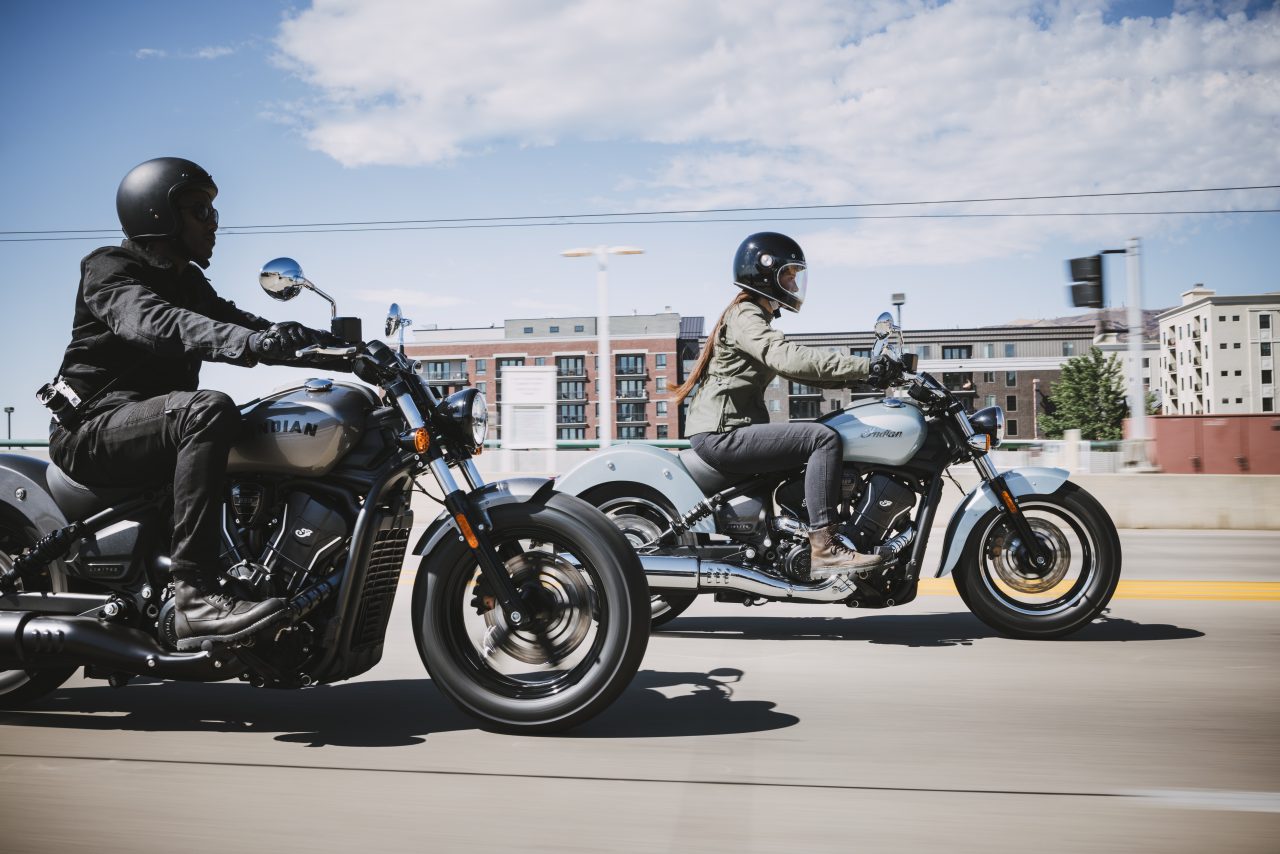
“Is it just the comical bazooka exhaust? No, it’s more than that,” is what I found myself thinking last night as I clicked through images of the new Indian Scout Sixty Bobber. “It looks more squished, too.”
Actually, there are a lot of differences between the 2020 Indian Scout Sixty Bobber and the one revealed this week. Just as there are quite a few differences between the Scout Sixty Classic revealed this week, and the one that I rode around Ireland back in 2016. But you really do have to stare to spot those differences.
There’s the exhaust, as mentioned; instead of two massive pipes you get one even more massiver pipe. But also, there’s the fact the radiator is less obtrusive. The tank follows the lines of those on the ‘bigger’ Scout lineup, announced earlier this year. Similarly, the engine looks a little more blobby and less ‘designed by a robot.’ And the headlight is set an inch or two lower, contributing to an overall stubbier look, akin to that of the Honda CMX1100.

The two new models (re)introduced by Indian this week are indeed different from the ones that disappeared from European line-ups a few years ago, due to emissions regulations ─ but subtly so. If they were all riding past you at once, it might be tricky to spot which is which.
A cornerstone…
“The Indian Scout is a cornerstone of the Indian Motorcycle family and its most successful platform,” states a media release from Indian. “Drawn to its iconic design, over 90 percent of Scout buyers are new to the brand… the new Scout Sixty expands that reach by offering its timeless American style and legendary combination of balance and control at a more attainable price point.”
The Scout Sixty Bobber is the one that draws my attention most, but the whole of the new Scout Sixty platform (which, in the United States also includes the impossible-to-say-quickly Sport Scout Sixty) is driven by a 999cc liquid-cooled V-twin engine, which promises 85 horsepower. That’s up a good chunk from the previous generation Scout Sixty, which claimed 78 hp. Torque remains pretty much the same, at 87 Nm.

Weight also remains about the same, with the new models hitting the scales at 241 kg for the Scout Sixty Classic and 243 kg for the Scout Sixty Bobber (Wait. How does having less fender result in the Bobber weighing more?!). And, as with the previous-generation Scout Sixty platform, the transmission only has five gears.
The whole set-up is about as low-tech as is legally possible (ie, there’s ABS and LED lighting but not much else), but if you want to throw down extra dough you can get a “Limited” version, which has cruise control, traction control, ride modes, a USB charging port, and “exclusive 999cc engine and frame badging.”

Indian’s version of an “attainable price point” is a starting price of £10,995 for the Scout Sixty Bobber and £11,695 for the Scout Sixty Classic. Compare that against the sub-£9,000 price of the 2024 Honda CMX1100. Big updates for that bike were announced at EICMA 2024, though, and new pricing is not yet available. And, if I’m being fair, it may be that Indian is cleverly pricing in the cost of anticipated tariffs against American goods.
I’d definitely have one
Requisite old-man complaining about money aside, though, I’m pretty keen on these bikes. Indian makes good motorcycles. They’re well-built, attractive, and fun to ride. I’ve loved every one that I’ve ever ridden. That is especially true about the Scout platform. It doesn’t surprise me that Scouts are Indian’s best-selling products; they’re more powerful, more manageable, and more affordable than the brand’s big twins.
Meanwhile, the Scout Sixty platform offers most of what you want from a Scout for less money. And it’s still nominally more powerful than an Indian big twin (though it has markedly less torque). The truth is: with cruisers, anything above 70 horsepower is kinda just there for show. I mean, it’s nice to have ─ as KTM CEO Stefan Pierer often says, “Why wouldn’t you want more power?” ─ but 95 percent of the time, you won’t need or even notice a want for 85 hp on a cruiser.

I don’t really understand the five-speed transmission thing, though. Surely, creating an entirely different transmission for the Scout Sixty platform costs Indian more money. I have to think it does this to discourage people from buying only Scout Sixtys. But with Indian’s parent company Polaris reporting that on-road sales (that includes Indian and Slingshot) are currently down more than 22 percent, I’d reckon it would be eager to sell whatever it can.

Leave a Reply