
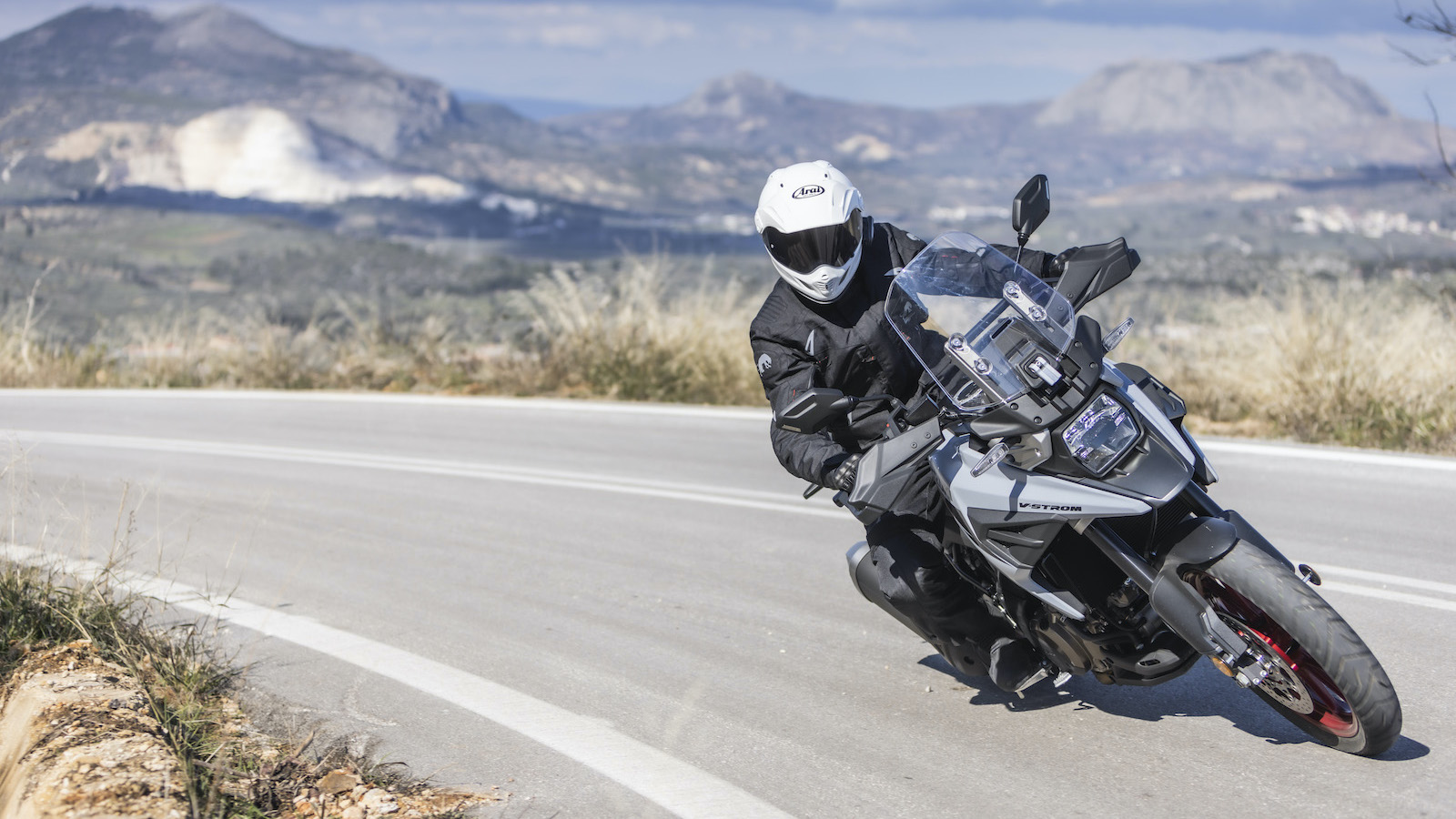
Once upon a time, I owned a second-generation V-Strom 1000. I rode it to Italy and back, and liked it.
I didn’t love it, though, ultimately choosing to replace it with a top-heavy Triumph that had more power than I needed and an unhelpful attraction to the ground when off pavement. With the benefit of hindsight, my criticisms of the V-Strom 1000 – chiefly that it lacked character – may have been the result of owner misuse and lack of creativity. I suspect that my being more heavy handed on the throttle, along with the sound of an aftermarket exhaust, would have eliminated most of my complaints.
As such, when Suzuki introduced a new version of the big V-Strom in late 2019, my interest was piqued. Sure, the new 1050 was effectively the same as my old 1000, save restyled bodywork and the addition of cruise control, but, I wrote: “I am actually considering (buying) this machine.”
Then 2020-2022 happened. A lot happened. And I stopped paying attention to motorcycles for a while.

In March of this year, I finally started reading motorcycle magazines again and discovered that Suzuki had rolled out yet another version of the big V-Strom: out with the V-Strom 1050/1050XT, in with the V-Strom 1050/1050DE.
Seeing that this new V-Strom 1050 is seemingly powered by the same 1037cc V-twin engine that drove my 2015 machine, I found myself thinking: “Hmm, I’d still consider buying one, if I had any money, but how is this bike different from the bike that wasn’t all that different from the bike that I had?”
To answer that and other questions, let’s turn to the professionals. Your reviewers for this round-up are Llel Pavey, Adam Child, Simon Hargreaves, Michael Guy and Zane Dobie, with additional research by Dennis Chung.
SOME NUMBERS
Starting price: £12,999 / £13,699 for V-Strom 1050DE
Engine: 1037cc liquid-cooled DOHC 90-degree V-twin
Power: 79 kW @ 8500 rpm (107.4 hp)
Torque: 100 Nm @6,000 rpm (73.76 lb-ft)
Seat height: 855 mm / 880 mm for V-Strom 1050DE
Fuel capacity: 20 liters
Weight: 242 kg / 252 kg for V-Strom 1050DE
FIRST IMPRESSIONS
When I worked for Harley-Davidson, we would always hammer the point that a different configuration creates a different bike. Yes, a Low Rider S has the same engine as a Sport Glide and a similar chassis, but they are noticeably different machines. It would be inaccurate and unfair to ride only one and write a review about the other.
So, I realize I’m committing something of a sin in looping together reviews for the V-Strom 1050 and the V-Strom 1050DE. Mea culpa.

But, come on, they are pretty much the same bike. The DE (which stands for Dual Explorer) version varies primarily in the sense that it has a 21-inch front wheel, compared with the standard version’s 19-inch front (both still rock a 17-inch rear wheel). Its wheels are spoked, of course, whereas the standard version uses cast wheels.
The DE also has 25mm more travel than the standard version (a stunning 0.984 inches for those of you playing along in Imperial measurement land), has slightly wider handlebars, carries more armor as standard (namely, a bashplate and crash bars), and it’s equipped with an additional ‘Gravel’ riding mode.
The DE’s 21-inch front wheel and greater travel inherently change rake/trail/wheelbase figures but not by much.
As with the short-lived iteration that was introduced in 2020, the new V-Strom 1050’s design is intended to be reminiscent of Suzuki’s DR800 BIG dual-sport machine of the 1990s. Away from the front, roughly three fourths of the bike retains the aesthetic of the 2014-2019 V-Strom 1000s.
“The build quality is what you’d expect from a mass-produced Japanese brand,” says Michael Guy. “It’s largely logical, but not always pretty.”

Adventure bikes are supposed to be ugly, of course, but it has often been the case that the V-Strom is particularly so. Adam Child argues, however, that minor changes to the DE version have helped.
“Styling-wise it’s similar to the previous model but the extra travel on the suspension, those spoked wheels and crash protection have made the ‘beaky’ Strom visually more appealing,” he says. “It might not have the desirability of, say, the Multistrada but it’s not bad looking.”
ENGINE, PERFORMANCE AND HANDLING
The V-Strom 1050 is driven by a 1037cc V-twin engine producing 107 hp and a little more than 73 ft-lb of torque. Those are exactly the same numbers as were claimed for the 2020-2022 V-Strom 1050, and not too far off the numbers claimed by the 2014-2019 bikes (which promised 100 hp and 75 ft-lb of torque).
Suzuki has tweaked this version’s performance oh-so slightly, though, by modifying its gear ratios. The rear sprocket now has 45 teeth, whereas previous generations carried a 41-tooth sprocket.
“This has two effects,” explains Simon Hargreaves. “It should make the V-Strom motor feel much more lively and responsive in the lower gears, trading off against higher revs at cruising speed and lowering fuel consumption slightly.”
It’s a clever trick to breathe new life into an engine that’s been around – in some form or another – for roughly 30 years. But for the most part, this remains the V-Strom we’ve come to know and love: smooth and touring-friendly when you want it to be; capable of pointing the front wheel skyward when you’re hard on the throttle. The latter task, though, is apparently now a little easier.
Both versions come with three riding modes: A, B and C. Suzuki says these stand for Active, Basic and Comfort. A mode delivers the sharpest throttle response; C mode provides the softest throttle response. The aforementioned Gravel mode on the DE dulls things even more, mixing it with light traction control. Many of the reviewers were critical of this third option, saying it wasn’t a true off-road-focused mode and that putting the bike into B or C mode was largely just as effective.

Most reviewers were complimentary of the bike’s throttle response, though, with Simon Hargreaves favorably comparing it to bikes from the days before ride-by-wire. So, it seems that the snatchy throttle that was a character feature of my 2015 V-Strom is no longer an issue.
“Articulating how the bike handles… it doesn’t really do a ton,” observes Llel Pavey. “It’s quite light; it’s easy to turn; it mostly does what you want it to do – it doesn’t do anything unpredictable. And that’s it.”
Having said that, Llel is complimentary of the V-Strom 1050’s ability in the sort of conditions that are annoyingly common in the United Kingdom (especially in West Sussex, where I live).
“It deals with those bumpy, shitty backroads like a total dream,” he says. “And for me, it really bred confidence to be able to ride without thinking about it.”
That’s a consistent compliment from all the reviewers: this bike is all-day comfortable and possesses a classic Japanese ‘just get on and go’ rideability. Several reviewers identified it as an ideal workhorse for long-haul journeys.
Most reviewers took issue, however, with the bike’s considerable weight: 252 kg for the DE version. You wouldn’t really want that resting on your leg.
BELLS AND WHISTLES
Both versions come equipped with cruise control and a up-and-down quickshifter, as well as the standard stuff we’ve come to expect on modern machines, including:
- The aforementioned riding modes
- Three traction control settings (four on the DE)
- Slipper clutch
- Hill start
- Suzuki’s ‘Easy Start system: A somewhat pointless feature that means you don’t have to hold down the starter button until the engine fires (Because, you know, holding down starter buttons was giving riders such intense fatigue…)
- Suzuki’s Low RPM Assist’ feature, which is said to alleviate stalling
- Lean-sensitive ABS
- Combined brakes (A certain amount of rear will be applied automatically when you squeeze the front)
One feature that stood out to me is the so-called Load Dependent Control System. The fact that this is on a Suzuki suggests it’s something that’s been around for a while, but I clocked out for a few years; I must have missed it. The system adjusts braking pressure based on how much weight the bike is carrying. For example, it learns whether it’s applying the brakes for just you or you and a passenger, and adjusts accordingly.

That’s sort of the same thing as the automatic suspension that’s been on bikes for more than a decade, but here it’s not really a suspension feature. Who knows whether it’s noticeable or useful.
You also get a 5-inch TFT dash, which all the reviewers praised as easy to read and intuitive.
“Everything on the dash is right in-front of you, it’s not confusing and you don’t have to muck around trying to set up before your ride,” says Zane Dobie. “Simply click up and down on the assists you want to change.”
You get a USB port next to the dash and a good ol’ 12V DC outlet under the seat. And the adjustable windscreen comes with an accessories bar, so you don’t have to come up with a white trash solution like I did on my ’15 Strom.
VERDICTS
Adam Child: “The V-Strom… is without question the unsung hero of the adventure market… In the real world, away from the sales brochure and the spec sheet, the Suzuki has consistently offered an uncomplicated ride, as the pricier competition became ever more festooned with electronic technology and luxury. Lacking a little glamour and desirability, perhaps, the V-Strom has been a bike you’re happy to ride all winter without worrying about returning to pristine condition before placing it back underneath a silky indoor cover.”
Michael Guy: “In some ways, it’s a case of ‘keeping up with the Joneses’, but credit where it’s due: Suzuki have done a good job without trying to overcomplicate the overall package or reinvent the wheel.”

Simon Hargreaves: “As the last, and longest-serving, and most widely-used Japanese V-twin (the V-strom’s engine) has earned a place in history. It is still a refreshingly potent, charismatic, enjoyable, flexible – not to mention plenty fast – engine. It does have an old-school vibe about it, in both senses, and it’s not the most compact or efficient unit. But I’m glad it’s still here, one of motorcycling life’s constants. And the new lowered gearing breathes a bit more life into the old beast.”
Llel Pavey: “The V-Strom is a bike that fills a gap that I don’t think really exists in the adventure bike market anymore… This is its own thing and it should be respected for being that. In a market where everything trends in the direction that everyone else is going, Suzuki have stood still – but they’ve stood still on something good. It is not an exciting bike, but it is very flattering to your ability. And sometimes that might be perfect.”
Zane Dobie: “The comfort levels from the tall seat, roomy seating position, high handlebars and plush suspension made for one of the nicest rides through traffic I’ve had in a long time. The suspension is spectacular. I’m not sure what else performs this well for the price in this category. It’s damn good value for money”
All the UK-based reviewers disagreed with Zane on the point of the Suzuki’s value. Indeed, they seemed to feel the bike is tarnished by its cost. For example, the DE’s nearly £14,000 asking price puts it in the company of the Honda Africa Twin, Triumph Tiger 900 Rally Pro and Ducati DesertX – all of which are higher spec and more off-road capable. The consensus seemed to be that although the V-Strom 1050 is a good bike, it is not so good that it justifies such a weighty price tag.
MY TAKE
I’m also not in love with the V-Strom 1050’s UK price tag. As best I can tell, the new standard version of the bike is just the 2020-2022 XT version (ie, it has a 19-inch front wheel and cruise control). A quick look at AutoTrader suggests one can be had for as little as £7,500.
That issue aside, I’ll admit that writing this review round-up has only deepened my soft spot for the big Strom. No, it wouldn’t be my first choice for navigating the steppe of Kazakhstan, but, you know, that’s not where I live. Nor is it where I want to go. For the sort of ‘almost always on the road unless I’m terribly lost or navigating a National Trust car park’ riding that I enjoy, the V-Strom 1050 is well-suited.

It his review, Simon Hargreaves observed: “You’d never see a V-Strom 1000 off-road, or with a rider wearing a peaky lid and a Gore-Tex rally suit – but two-up with panniers and topbox touring Scotland, or battering through wind, rain and traffic on the M25 in February? All day long.”
I tend to agree with that view. The V-Strom is a bike that looks strangely cool when loaded with a hodgepodge of gear and luggage. I’m not talking about the lovely color-coordinated and prominently branded stuff that manufacturers charge thousands of pounds for. I mean piles of Kriega bags, tents stuffed into cheapo dry bags from Amazon, ribbons of ROK straps, and, inevitably, a teddy bear, all burgeoning from the passenger seat and tail rack.
It’s a bike for people who wear Aerostich Roadcrafter suits and Shoei Neotec II helmets. It’s a bike for people who are honest with themselves. And no, that’s not cool; but within that truth is something really cool. I love cool bikes and cool gear but there’s a certain point at which being cool becomes tiresome (and prohibitively expensive).
So, in the DE version, Suzuki does itself a disservice in trying to pretend that the V-Strom 1050 is something more exotic than it is. To my mind, the DE version is a waste of time and money. Also, I am baffled by the DE’s tire set-up; that narrow 21-inch front tire is tubed, whereas the rear wheel is tubeless.
That leaves you with the standard version, which, in terms of function, arguably competes (and loses) against another Suzuki machine in the game of being a reliable, on-road, long-haul machine: the GSX-S1000GT presently costs £500 less.
I like the V-Strom 1050, and I’d like to own one, but if I were in the market for a brand new bike I think I’d be holding off just for the moment. My feeling is that competition and the cost of living crisis will force Suzuki to be a little more realistic in its asking price. Perhaps in September/October when dealerships find themselves with a lot of unsold stock. Maybe next February/March, when Suzuki often announces incentive deals.
Or, as I say, by an old V-Strom. They haven’t changed much in the past nine years. Because, as they say: if it ain’t broke, why fix it?



Leave a Reply to MiklósCancel reply