

Editor’s note: This long-term review was originally written in 2015. However, because this generation of the V-Strom 1000 is now incredibly affordable on the used market, it remains one of the smartest adventure touring purchases you can make today. Here is how I viewed it back then…
One of the many things the Suzuki V-Strom 1000 has going in its favor is the fact it has 7,500-mile service intervals. This is a vast improvement over the 4,000-mile intervals I had with my Honda CBF600SA.
Honest and authentic writing like this needs support. Here’s how you can help

Engine Performance: The Soul of the TL1000S
Indeed, at that speed the tachometer showed I was still south of the bike’s 10,000-rpm red line. She had plenty more to give, and that was with roughly 40 kg (88 lbs) of luggage and its corresponding aerodynamic resistance.
Meanwhile, at more sane speeds the engine hums without effort. As far as fuel economy is concerned it is happiest at roughly 60 mph, but higher cruising speeds are achieved just as easily and without it getting too thirsty. When Jenn and I travel down to Devon on the bike I tend to keep my speed somewhere in the 80-mph range, which puts the engine at a comfortable 4,500 rpm.

Gearbox and Transmission: Clunky but Bulletproof
The presence of the slipper clutch, of course, also helps smooth out the act of engine braking. And as a result you’ll find you use this technique quite often when bringing the ‘Strom to a stop. Lightly tapping the front brake lever just to light up the tail light, shifting down through the gears, and applying only a modicum of pressure on front and rear brakes to bring things to a complete stop. At this rate, I won’t need new brake pads for quite some time.

Handling, Suspension, and Brakes: A Tower of Stability
I’ve mentioned before that the ‘Strom has fantastic balance, which means that despite its height and wide ‘bars it is a great tool for moving through traffic. It maintains this composure even with a passenger, to such an extent that Jenn will now let me filter with her on the back –– something she wasn’t comfortable with on the Honda.
Off-road handling, meanwhile, is far better than I would have expected. On my massive trip to Italy this past summer I stayed at a villa in Tuscany that was located about two miles down a hilly dirt road. With traction control on, the bike was sure-footed and confidence-inspiring. Once I had dumped my luggage at the villa, I clicked off the traction control and found the dirt road to be all kinds of fun.
It doesn’t make sense to attempt anything more rugged on such a large, heavy bike. If you actually want to climb over rocks or ford rivers you should be on a Honda CRF250L.
The Strom’s brakes, meanwhile, are pretty much all you need. The over-sharp bite I experienced from the dual front discs when I first got the bike has softened just a little. Or, perhaps I have developed more finesse. The single rear disc brake is arguably a teency bit soft but not so much that I have ever cared or wished for more.
As I said above, I try to think ahead enough that I mostly use engine braking when bringing the ‘Strom to a halt, but there have been one or two Yikes! moments that demanded more urgent slowing and I’ve never been left wanting.

Electronics: Traction Control, ABS, and That Touchy Throttle
The only time I’ve ever had unwanted traction control intrusion is when riding the famously bumpity-bumpity roads of Norfolk. The system became unsettled and offered its “Hurngh” action despite dry roads on a sunny day. The simple answer was to just shut the system off, which can be done on the move (although, you do need to pull in the clutch).
OK, maybe that’s not the only time. I have found that you can unsettle the traction control if you quickly open the throttle, quickly close it and quickly open it again when the bike is in first gear. This causes a rodeo bull sensation that, if you’re suffering from the mental fog of having ridden all day, may cause you to prolong the sensation by stupidly opening and closing the throttle a few more times.
The above is a particularly unique scenario that only occurs when the rider has his head up his ass. However, that it is able to happen is partially due to the V-Strom 1000’s famously sensitive throttle.
Also frequently lamented in reviews of the Suzuki GSX-S1000 and GSX-S1000FA, the V-Strom 1000’s jumpy throttle hasn’t gotten a lot of love from moto-journalists. I will admit that it was a little annoying in the first 400 miles or so, but I have gotten used to it now to the point that when I ride other bikes I’ll think they’re a little odd for not being hyper-responsive.
I’ve had no problems with the electronics but for a single incident in Baden-Baden, Germany. The weather was particularly warm (approaching 105ºF) and I had been riding several hours on the autobahn, cruising at upward of 100 mph. Hot, tired and frustrated, I managed to stall the bike, then started it up and threw it into gear all in a single action. Somehow the combination of these factors led to the bike’s “FI” light appearing on the dash, and the hazard lights flashing any time I used the indicator.
The problem went away after I had stopped, shut off the bike and allowed it to sit for a few minutes. I still chalk this incident up to my own bad karma (I had shouted at a disabled man) rather than any actual problem with the bike.

Touring Comfort: Is This the Best Pillion Bike on the Market?
At 6-foot-1, I find the bike’s riding position to be just about perfect for me. I am able to flat foot both feet at a stop.
I think the levers are adjustable but haven’t needed to, as they fit comfortably to my hands. There are times I have thought about adding ‘bar risers to ease occasional shoulder tension on long hauls, but, then, it’s cheaper to just shift around a little more whilst on the move.
The too-short-for-me adjustable screen still annoys me, but clearly not so much that I’ve bothered to replace it over the last 7,000 miles. Mirrors are fantastic, offering a clear and steady view of what’s behind. The headlight is, quite literally, brilliant. Though the switch to set to high beam is located a little too close to my left forefinger and has occasionally been activated by accident.
If you ride the ‘Strom hard in very hot weather –– say, several hours at 100 mph in 105ºF –– you will find the bike dumping a whole lot of heat onto you. However, at the speeds that are legal in every other country I’ve ridden, and in heat that isn’t extreme, I have not experienced so much discomfort. Certainly when I’ve wished the bike would spit heat, i.e., in the winter, I have found the Suzuki to be frustratingly too efficient for hand warming.
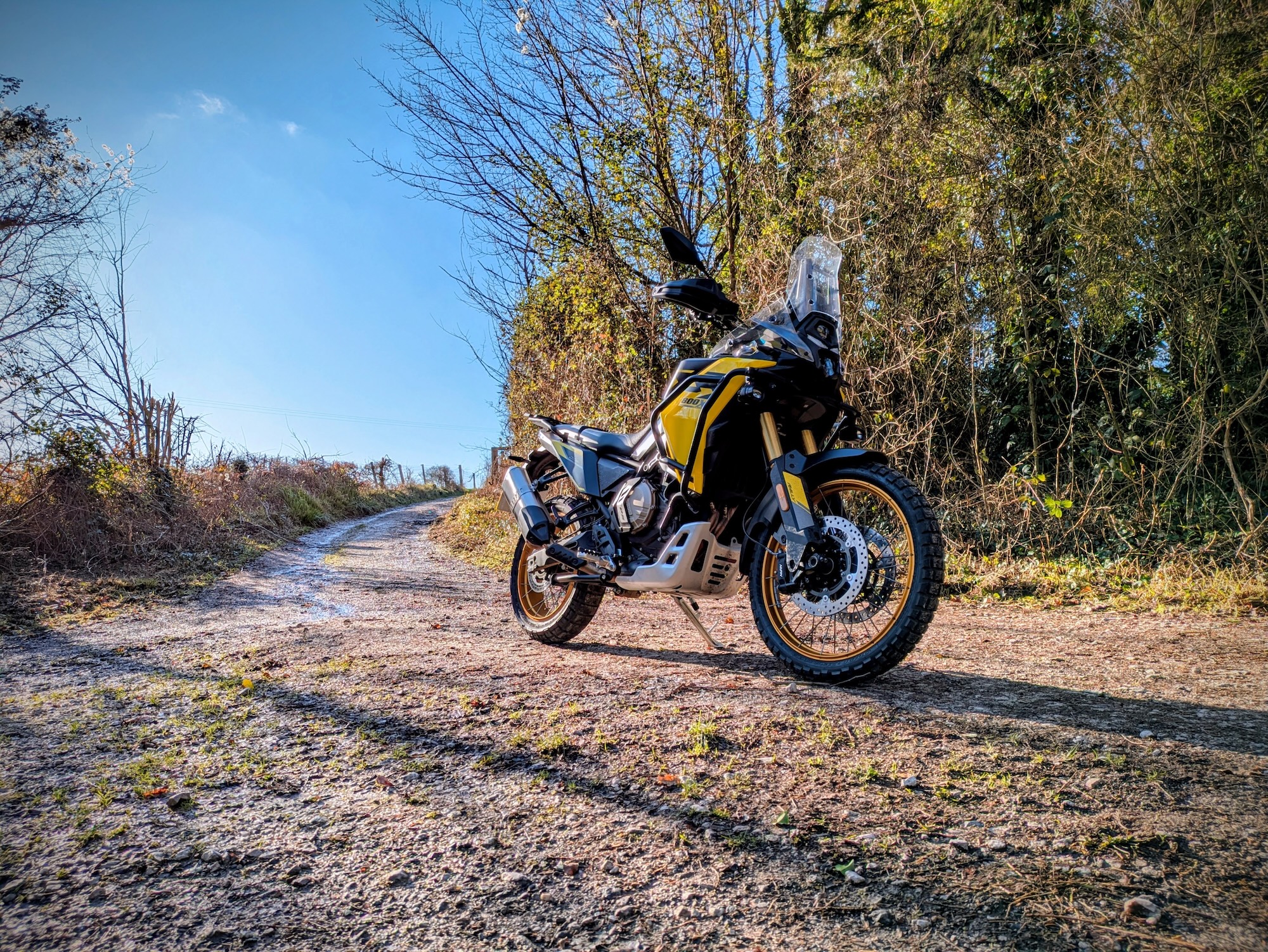
To that end, I strongly recommend hand guards and heated grips. Suzuki’s heated grips are generic-looking things, so there’s no advantage to getting OEM stuff here; Oxford heated grips are less expensive and offer more settings. The Suzuki hand guards are reasonably inexpensive (they came standard as part of the Adventure package, in my case) but you should accept that they are really just wind blocks. If you want actual protection, a number of aftermarket options are available.
The Suzuki panniers help the bike keep a narrow profile, to the extent they don’t affect my filtering, but the downside is that they don’t hold much stuff. When I rode to Italy, most of the luggage duty was shared by two Kriega bags and a lovely, large Oxford Aqua 50 (thanks again, Cam!)
A luggage rack comes standard, but you may find it a little difficult to actually use said rack. This is because the nature of the rack, and how close it sits to the tail bodywork (a gap of only a few milimeters exists between) means that bungee cords are not easily attached. Equally, there are no bungee points elsewhere on the bike. I got around this by using straps that were able to slip under the rack, but others might find that they would want to buy aftermarket rack accessories (I know SW Motech sells some) to improve its usability.
The dashboard is loaded with useful information –– including gear indicator and a pretty accurate “miles to empty” fuel readout –– and I will never stop cheering Suzuki for being so intelligent as to place a 12v plug up front, exactly where it is needed. Other manufacturers, if they have such a plug, tend to bury it under the seat or, worse yet, inside luggage, making it difficult if not impossible to use that plug to power a GPS.

Practicality and Fuel Economy: The True All-Rounder
I’ve not needed to adjust the chain, perhaps in part because I am pretty meticulous about keeping it clean and oiled. I sometimes look longingly at larger adventure touring bikes with shaft drives (e.g. the BMW R 1200 GS), but then you have the extra cost and weight to consider.
Everything else has been fuss-free. Changing the oil was a piece of cake. According to the owner’s manual I didn’t really need to do that, but I’m fastidious about such things.

Fit, Finish, and Wear at 7,000 Miles
I mentioned above that the hand guards aren’t for anything other than wind blocking, and that is obvious in the fact that bug strikes have caused a number of tiny scratches and nicks. Similar marks can be found on the panniers and the purely aesthetic sump guard.
No bolts have loosened, all the wires and fiddly bits remain secure, as you would expect from a Japanese motorcycle. Everything is solidly put together and feels of good quality.
Although I like the look of them and they do seem sturdy, I often wonder what, exactly, the crash bars are protecting. The vast majority of the engine is located below them. But, I guess that if the bike were to tip over on solid ground they would be the first thing to hit and no part of the engine would actually touch the pavement. Maybe. Hopefully I’ll never find out.

Running Costs: Servicing and Tire Wear

Verdict: Why It Ruins Other Motorcycles For You
Some moto-journalists tend to dismiss the ‘Strom because it will not make your bowels loosen with its unholy speed, but press them and they’ll admit it’s a damn good bike and that more expensive competitors may not actually be worth the additional money.
It is a do-all machine. It goes everywhere, it’s utterly reliable, it’s affordable, and it’s fun. I tend to agree with Wes Siler that the V-Strom 1000 is the type of bike that manufacturers should be making if they actually want to expand motorcycling. Because it’s not very niche; something this practical doesn’t slot as easily into the “hobby” category as, say, a Harley-Davidson Sportster, or Kawasaki ZX-10R.
It’s not a bike for staring at or breaking the sound barrier. It’s a bike for riding everywhere, all the time.





Leave a Reply to MooseCancel reply