
The most confusing thing about Honda’s E-Clutch technology is that it exists.
In application, the technology offers an experience somewhere between that of a quickshifter and an automatic transmission. A splitting of hairs that I can’t imagine anyone was really clamoring for.
Even more confusing are the responses you get from Honda’s people when you try to nail down their reasoning for sinking so much time, effort, and – I’m sure – money into developing the E-Clutch. You had quickshifters. You had Dual Clutch Transmission (DCT). Why add this?
The engineers and marketing folk alike just sort of shrug and give slightly non-committal answers that make it clear there is no company line on this. It just is.

The growing presence of E-Clutch on Honda models makes me think of the guitar amps that go to 11 in This is Spinal Tap. Why does Nigel Tufnel play at 11? Because his amp goes to 11. Why did Honda develop E-Clutch technology? Because it has engineers clever enough to develop E-Clutch technology.
And why is Honda now adding that E-Clutch technology to so many of its models? Because it has E-Clutch technology.
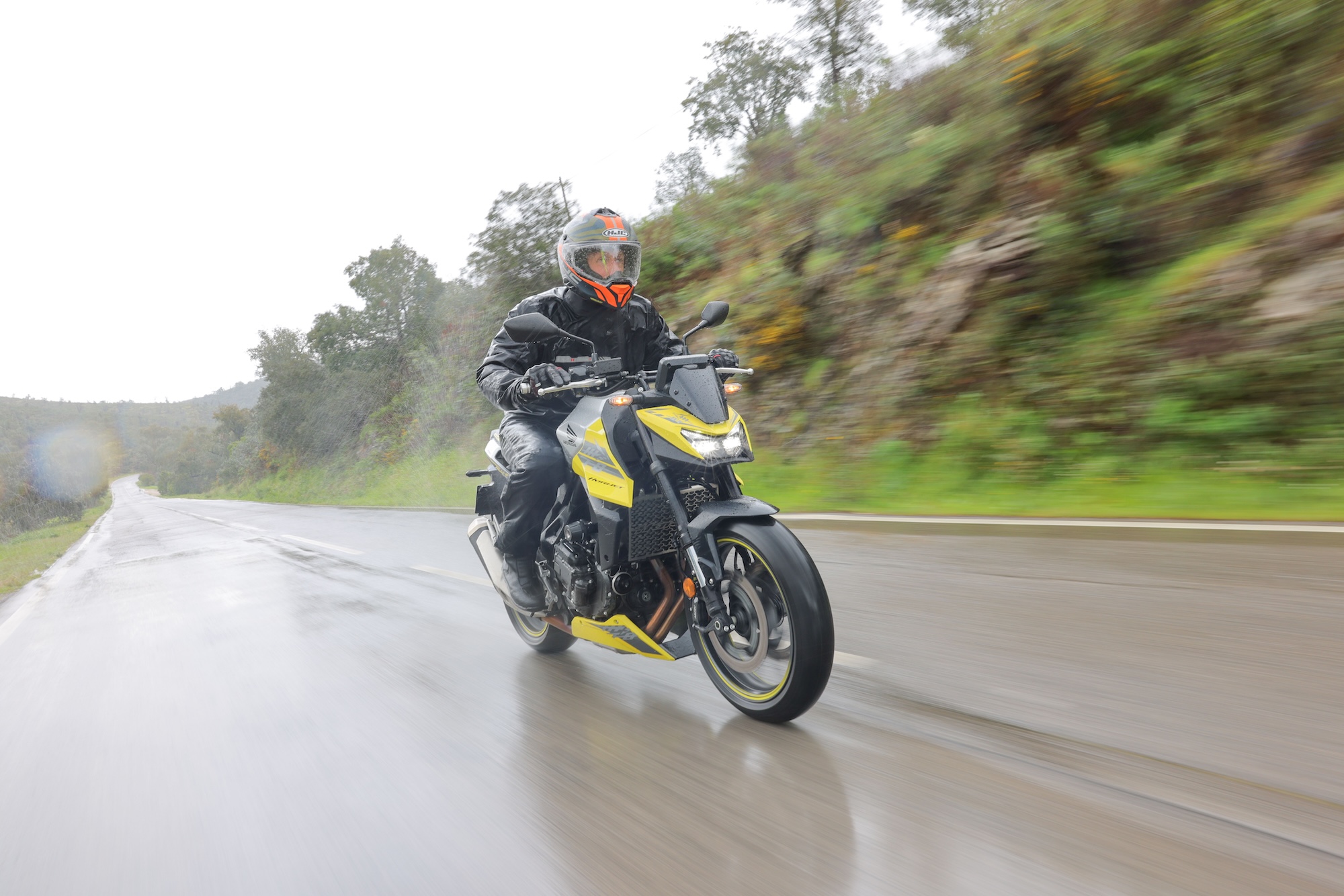
The 2026 CB750 Hornet is one of the latest machines to get the E-Clutch treatment. I got an opportunity to ride it in the very wet hills of Southern Portugal recently. Here’s what I learned.

How we got here
The Hornet name stretches back to the late 1990s, when it was applied to the fruity CB600F – not to be confused with the much duller CBF600 of roughly the same era and same powerplant. Bafflingly, the two bikes share the same Haynes Manual, but the Hornet was so much better, offering up 97bhp from a 599cc inline four pulled from the CBR600. The bike was the perfect mix of cheap, fun, and reliable – managing to earn a special place in many motorcyclists’ hearts.
In 2023, Honda brought the Hornet name back – this time in the form of a fizzy 755cc parallel twin promising 90.5 bhp at 9500 rpm, and 55.3 lb-ft of torque at 7250 rpm. The CB750 Hornet sticks to the ‘cheap, fun, and reliable’ formula and has been pretty successful as a result. Across Europe, Honda’s sold upward of 42,000 units so far, and the bike has consistently been one of Europe’s top three best-selling mid-size nakeds.
Meanwhile, Honda introduced the E-Clutch system in 2024, attaching it first to the CBR650R and the CB650R.
I’ll be honest: until I actually rode the Hornet 750 with E-Clutch I didn’t have much interest in either thing. Naked bikes aren’t usually on my Dream Bike list. While E-Clutch just didn’t sound like something I was desperate to experience; I couldn’t (and kinda still can’t) see what need it is fulfilling.

But, as I mentioned in my review of the WN7, Honda has a habit of working toward a future that no one else is able to see. And spoiler alert: I was wrong in my dismissal of both the Hornet 750 and E-Clutch technology.
Look, fit, and feel
Aesthetically, not much has changed about the Hornet 750 since it was launched three years ago. In 2025 the headlight housing was tweaked to make it look more insect-like, replete with pointy bits designed to look like mandibles. Outside of that, there have been minor ergonomic tweaks, light suspension improvements, and new paint.
As such, I’ll admit that the Hornet 750 continues to underwhelm at 20 paces. That’s my opinion; plenty of people would disagree with it. Deimanté of the Tomboy a Bit YouTube channel was far more enthusiastic about its look.
The particular bike I was riding wore the Goldfinch Yellow paint scheme and Design Pack accessory package. At pretty much every stop, she would roll up next to me and shout: “This motorcycle is so beautiful!”

Meanwhile, one thing everyone can agree on is that build quality is top tier. Exactly what you’d expect from Honda. When it comes to fit and finish there’s nothing to criticize. Well.. almost.
Honda has placed the mirrors too close to one another, so you end up seeing a whole lot of you and not enough of what’s behind you. But, at least the mirrors are well built and offer a very clear and steady view of you.
Throw a leg over the 795mm seat and the bike is oh so Honda: instantly comfortable – immediately ‘right.’ Feet are able to find pegs without awkward stretching; hands fall naturally to the ‘bar. The riding position is not spacious or roomy, but not at all the cramped experience I was expecting. If you are the sort who likes to tour on naked bikes, the Hornet 750 is relaxed enough for big-mile days.
Switchgear is uncluttered and relatively easy to understand, pairing with an easy-to-read 5-inch TFT screen that sits in the lower periphery of your vision when riding. Easy to look at, easy to ignore.

Engine
As mentioned above, the bike’s 755cc parallel twin engine claims 90.5 bhp and 55.3 lb-ft of torque. Those aren’t “clutch your pearls and call to Jesus” numbers, but Honda makes the most of them. The engine is punchy and willing to play.
Power delivery is smooth, linear, and feels more torquey than the specs sheet would suggest. Perhaps credit for that comes from the 270-degree firing order, which gives the bike a V-twin feel.
There are five different riding modes to choose from, each impacting engine performance in different ways: Sport, Standard, Rain, and two user modes, allowing you to adjust power delivery, engine braking, and traction control intensity.
The big new thing (the E-Clutch system)
Finally we get to the main event. Perhaps the easiest way to think of E-Clutch is as a really fancy up-and-down quickshifter. But a really fancy quickshifter that actually works; a really fancy quickshifter that you can use from a dead stop.

You choose the gear. You choose when that gear is applied. Your foot does the work. You just never squeeze anything with your left hand. That’s it. It’s not an automatic transmission, just clutchless shifting. Honda equips the Hornet 750 with a clutch lever, and you can use it if so inclined, but the point is that you don’t need to.
The physical E-Clutch system is contained in a smallish box that sits – looking slightly retrofitted – on the right side of the engine, just ahead of your foot. It contains two tiny motors and roughly half a dozen sprockets that work in tandem with the bike’s electronics to make your clutch lever redundant.
How it works
Where all this gets impressive is in how smooth, reliable, and easy it is. The system is unlike a quickshifter in the sense that it works in any RPM – no need to find a rev range sweet spot, just click the shifter pedal up or down as you see fit. When you do this, the E-Clutch system coordinates with the ride-by-wire system and HSTC traction control system to apply the gear change in such a way that the bike doesn’t jerk or stutter.
In 90 percent of the situations I encountered, those gear changes were as smooth as they would have been had I been operating the clutch myself. Sure, once or twice, there were changes that an experienced hand would have made more smoothly. But there were also times when the E-Clutch was slicker than I might have been.

We’ve all had that moment of coming into a corner fast, focusing so much on all the other things – lane position, body position, throttle, brakes application, etc. – that we flub the downshift, clunking down a gear and letting out the clutch like a clod, thereby unsettling the whole show.
E-Clutch takes your idiot downshift in stride, smooths it out, and allows you to enter the corner better and with one less thing on your mind.
Another key advantage of E-Clutch comes when taking off from a standstill. At a traffic light, for example. The technology allows you to be in first gear at a stop. You’re not holding the clutch in, nor using the brakes – just sitting there – calm and still – waiting for the light to change. When it does, you just twist the throttle and go. No Hendon Shuffle, no accidentally stalling with a white van breathing down your neck, just go.
In that same scenario (taking off from a light), E-Clutch also means that your left hand remains free to bring your visor down even as you’re accelerating into second gear.

Who is this for?
Outside of the above situations, however, for an experienced motorcyclist the E-Clutch experience largely falls into the category of “Things That Are Kinda Cool.” There’s nothing bad about it. Nothing bad at all. In fact, it’s… well… kinda cool. But it doesn’t feel game-changing.
And the budding home mechanic in me recoils at the idea of having to fiddle with those two motors and roughly half a dozen sprockets – and who knows what other various gubbins – before I can even access the clutch plates. Transmissions wear out. Even on Hondas. At some point you (or your mechanic) will be forced to work on it, and I can’t imagine it will be fun.
But who buys a bike based on how easy it is to replace the clutch plates? And arguably, E-Clutch isn’t a technology that’s necessarily aimed at experienced riders. Instead, I’d assume the target audience is the roughly 30 percent of UK drivers who last year took their driving exams in cars with automatic transmissions. Or people of their mindset.
In Western countries, most people get car licences before they get bike licenses. If the gap between transferable skills and knowledge grows too wide, fewer and fewer people will take up motorcycling. So, if drivers are losing an innate understanding of manual transmissions it makes sense for manufacturers to be offering alternatives.

Honda’s DCT offers one answer, but that system is heavy and expensive. For example, the difference between an Africa Twin Adventure Sports ES with DCT and without is 10 kg and £1,300. Whereas equipping the Hornet 750 with E-Clutch adds just 4 kg to the bike’s wet weight and only £100 to its price tag.
That’s tolerable. So much so, you could even imagine Honda eventually choosing to abandon strictly manual transmission motorcycles. And certainly Honda has hinted strongly that it intends to bring E-Clutch technology to several more models.
But for everyone who hates such an idea, remember: you don’t have to use it. As mentioned, Honda still attaches a clutch lever. By using it as normal, you are able to override the E-Clutch system. You can also turn it off completely if so inclined.
Chassis and brakes
Back in the territory of things you already knew, the Hornet 750 handles brilliantly. The bike is flickable – wearing its 196 kg well – but not skittish or aggressive. The 41mm Showa front fork is non-adjustable. The rear shock has seven-stage preload adjustability. It all worked well, as far as I was concerned.

I suspect that particularly aggressive riders might ask for brakes with a smidge more bite but I was very happy with the Nissin set-up, which allows for nuanced braking.
Fancy bits
Outside of the E-Clutch system, the rider aids and electronics are standard fare for a modern Japanese motorcycle. Honda’s never really been one to go completely over the top in its technowhizzbangery, but everything here works and makes sense.
The 5-inch TFT screen is controlled by a backlit four-way switch on the left grip. The bike menu largely relies on icons, meaning you’re not stuck reading a novel on the M6. Phone connectivity comes via Honda’s RideSync app, which Honda says “allows straightforward, on-screen turn-by-turn navigation as well as the option… for the rider to make calls or listen to music.”
I didn’t test this feature because I hate connectivity apps.

Basic maintenance
The bike comes with a tool kit under the seat that (theoretically) provides you with all the items you need for regular servicing. Far too few manufacturers do this anymore.
Recommended oil changes come every 8,000 miles. Oddly, Honda suggests only changing the oil filter every 16,000 miles. But, hey, oil filters don’t cost that much. If you’re already draining the oil you might as well replace the filter.
Honda suggests inspecting the air filter every 8,000 miles but leaves it to you as to when it should be replaced. You probably won’t inspect it that often because getting at the filter is apparently a pain in the caboose.
One of the joys of the old Hornet 600 was the fact its air filter could be replaced simply by removing a side panel. It was super easy. Unfortunately, that is not the case with the Hornet 750. Now you have to lift the tank, as well as remove a bunch of little bits that block access to the filter panel.
Lastly, spark plugs should be replaced every 32,000 miles.

What it’s like to ride
The Hornet 750 massively exceeded my (admittedly low) expectations. It is just so much fun. And so right. I’ve been test riding a lot of Chinese motorcycles in recent months and that’s a situation that can result in kind of forgetting just how good a good bike can be.
Cranking the throttle out of a corner or roundabout is addictive and made all the more fun – and easy – by the E-Clutch technology.
What I particularly loved was the bike’s ridability and accessible nature. All are welcome. That doesn’t mean it’s tame or too soft, simply that it’s not overwhelming.
‘Confidence-boosting’ is a term that applies here. I was more willing to move around, shifting weight and body position to facilitate better cornering. As a result, I found myself willing to be a little more daring than usual.

Well, as daring as one can be on wet roads. The weather in Portugal was terrible (note that I am wearing waterproof gear in the photos), so I was only able to push so hard. This is definitely a bike I’d like to come back to on a sunny day.
Competition
The CB750 Hornet exists in a very, very crowded field. Honda says its machine boasts a class-leading power-to-weight ratio, but it’s probably the combination of excellent build quality and relatively low price that have helped keep the bike in the top three sellers of the class so far.
And, of course, none of the Hornet 750’s rivals have E-Clutch technology. The Yamaha MT-07 offers something kinda (but not really) similar, though, in the form of Y-AMT.
| ENGINE | OUTPUT | STARTING PRICE | |
| Honda CB750 Hornet E-Clutch | 755cc parallel twin | 90.5 bhp 55.3 lb-ft | £7,549 |
| Aprilia Tuono 660 | 660cc parallel twin | 105 bhp 51.6 lb-ft | £11,495 |
| CFMoto 800 NK | 799cc parallel twin | 94 bhp 59.7 lb-ft | £5,999 |
| Kawasaki Z650 S | 649cc parallel twin | 67.3 bhp 47.2 lb-ft | £7,199 |
| KTM Duke 790 | 799cc parallel twin | 94 bhp 59.7 lb-ft | £7,999 |
| QJMotor SRK 800 | 778cc parallel twin | 95 bhp 55.3 lb-ft | £6,699 |
| Suzuki GSX-8S | 776cc parallel twin | 82 bhp 57.5 lb-ft | £7,999 |
| Triumph Trident 660 | 660cc triple | 81 bhp 47 lb-ft | £8,095 |
| Yamaha MT-07 w/ Y-AMT | 689cc parallel twin | 73.4 bhp 50.1 lb-ft | £7,854 |

Verdict
The CB750 Hornet E-Clutch is a good bike. Well built, comfortable, instantly easy to get on with, and a whole lot more fun than I was expecting. That said, it’s still not a motorcycle that set my heart on fire.
That may be largely down to my tastes. Few modern nakeds really catch my eye. But the Honda in particular looks a bit… Honda.
I’ve owned two Hondas over the years and both suffered from the curse of being utterly reliable but not terribly exciting to look at. As such, their reliability was often tested by long stints in the garage. There was nothing about them that lingered in my heart and memory, to make me desperate to get out in less-than-perfect conditions. I suspect that in my hands, a Hornet 750 would suffer the same fate.
Or maybe not. The overall package is so good that I wonder whether that would actually be true. And E-Clutch adds to that package – enhances it.
There are so many things to think about when riding a motorcycle. E-Clutch removes one element, freeing up mental space for the others, without really affecting the riding experience. It’s still motorcycling as you know it, just without a clutch lever.

The three questions
Does the 2026 Honda CB750 Hornet with E-Clutch fit my current lifestyle?
Yes. It is just a little small for someone of my height, and I don’t love touring on naked motorcycles, but there is no question that this bike could serve as my everyday, everywhere bike.
Does the 2026 Honda CB750 Hornet with E-Clutch put a smile on my face?
Yup. I was pleasantly surprised by how fun this bike can be.
Is the 2026 CB750 Hornet with E-Clutch better than my current motorcycle, a Kawasaki Versys 1000?
Yes. My Kawasaki is more comfortable and better suited to long hauls. It also has roughly 25 more horsepower. But in all the ways that matter the Hornet 750 is the superior machine.
Gear worn in photos
Helmet: HJC RPHA 60
Jacket: LS2 X-Master
Pants: LS2 X-Master
Gloves: Richa Atlantic GTX
Boots: Richa Oberon WP
2026 Honda CB750 Hornet E-Clutch specs
| PRICE | £7,549 |
| ENGINE | 755cc liquid-cooled parallel twin with 270-degree crank |
| TRANSMISSION | Six-speed w/ E-Clutch |
| POWER | 90.5 bhp at 9500 rpm |
| TORQUE | 55.3 lb-ft at 7250 rpm |
| TOP SPEED | 127 mph |
| SEAT HEIGHT | 795 mm |
| GROUND CLEARANCE | 140 mm |
| WEIGHT | 196 kg |
| FUEL CAPACITY | 15.2 liters |
| FRONT TIRE | 120/70 R17 |
| REAR TIRE | 160/60 R17 |
| FRONT BRAKES | Radial mounted four-piston Nissin brake caliper, 296 mm floating double disc |
| REAR BRAKE | Single piston caliper, 240 mm single disc |
| FRONT SUSPENSION | Showa 41 mm SFF-BP USD, 130 mm travel |
| REAR SUSPENSION | Monoshock damper, Prolink swingarm, 150 mm travel |


Leave a Reply