
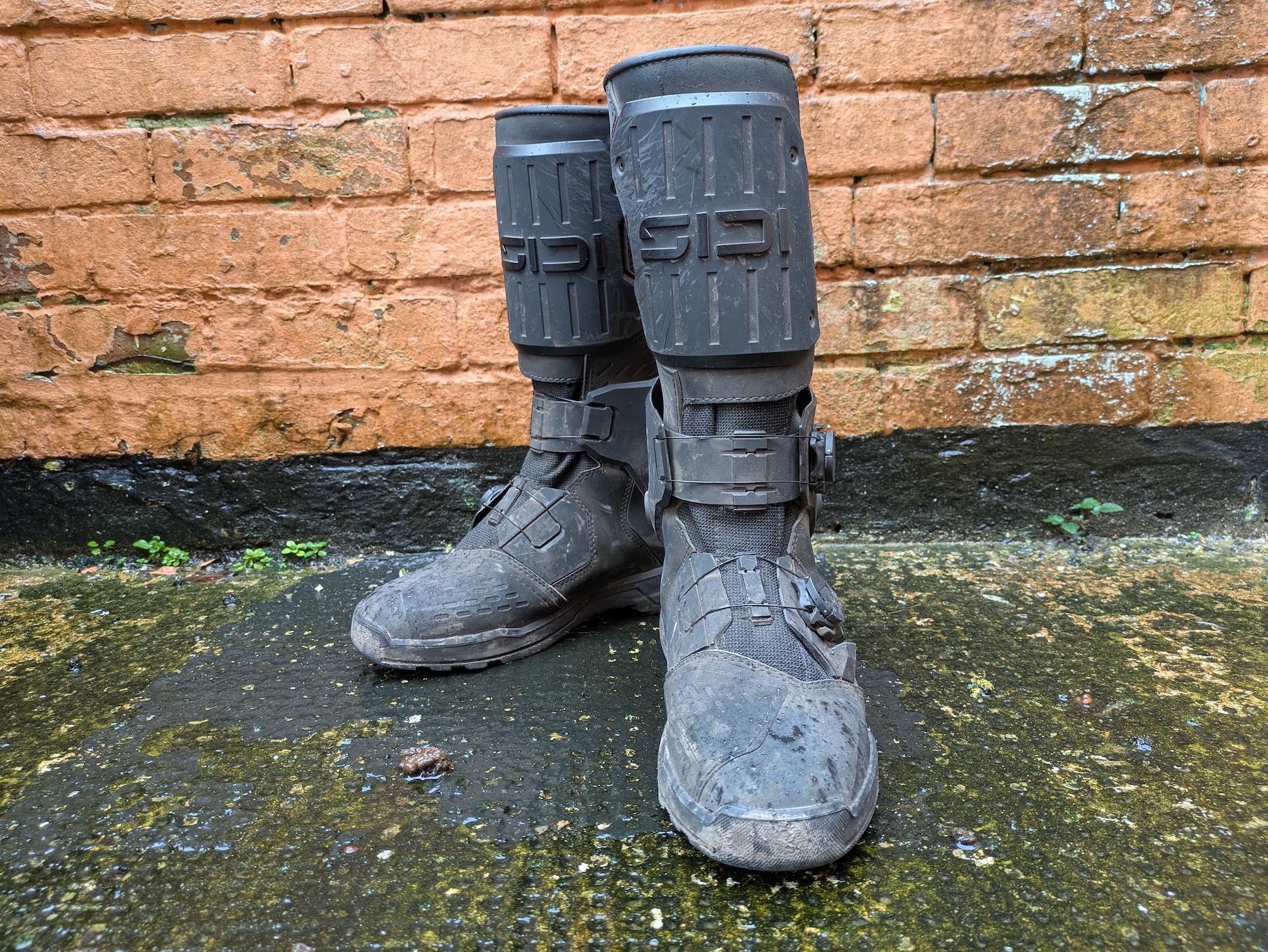
“If you can hear a piano fall you can hear me coming down the hall,” I’m singing to myself as I make my way noisily through a hotel corridor.
SQUEAK SQUEAK SQUEAK SQUEAK
These Taurus GTX boots may not be leather, their buckles may have been ditched for a fancy new retention system, but the squeak means they are definitely Sidi boots. Launched at last year’s EICMA show in Milan, the Taurus GTX is an adventure-touring model: rugged enough for some off-road work, light and comfortable enough to wear all day.
I’ve been wearing the boots pretty regularly for about four months, in all conditions: good days, typical British winter days (Would you like some more wet with your wet?), and steamy southern India days. On the whole, I really like them. Do I like them enough that I think they’re worth their £489.99 asking price? Read on to find out.

Sidi Taurus GTX in a nutshell
| RECOMMENDED RETAIL PRICE | £489.99 |
| MADE IN | Italy (No. 37 on the Democracy Index) |
| MADE OF | Technomicro microfiber outer; Thermoplastic polyurethane (TPU) protection; Gore-Tex liner; Materiis sole |
| SIZING | EU39 – EU50 |
| PROTECTION | CE CERTIFIED LEVEL 2222 (Level 2 rating in four different areas) |
| TLDR REVIEW | Recommended |
Some background
Sidi – or, as they like to write it, SiDI – was founded in Maser, Italy, in 1960. It gets its name from founder Dino Signori (the first two letters of his first and last name reversed) and started life as the maker of cycling shoes, which it still does. In fact, it’s possible that more people know it as a maker of cycling shoes than motorcycling footwear.
I’m not sure when it expanded to the world of motorsport, but the company’s racing boots are particularly well-regarded – worn by a number of MotoGP riders.
The Taurus GTX sits at the top end – in terms of price and features – of Sidi’s ‘Touring’ category. That’s worth noting. The company makes far more rugged offroad-focused boots, like the Crossair X; the Taurus GTX is pitched at a different kind of riding. Sidi’s own marketing team describes them thus: “Whether you’re planning a trans-European adventure or just need boots that’ll handle British weather and weekend green lanes, the Taurus GTX delivers.”

Features and construction
Like most Sidi boots, the Taurus GTX are constructed of so-called “Techomicro microfiber,” which feels a bit like leather but, according to Sidi, is built to be more reliable and last longer.
“Technomicro is a composite microfiber material created from strands that are so fine, each one is less than one-thousandth the thickness of silk,” according to Sidi. “These fibers act like natural leather skin, but with the advantage of better strength, softer texture and lighter weight.”
It doesn’t feel as luxurious as leather, but I don’t suppose I care much. Leather requires a lot of effort to keep in good condition. If I don’t have to spend Sunday evenings meticulously cleaning the boots and working in Leder-Gris, I’m happy.
Elsewhere on the boot there is a rubbery material that Sidi calls Materiis running along the bike-facing part of the shank – presumably to help with grip. You’ll find the material again on the shifter guard and on the boot’s outsole.

A large TPU protector covers the tibia, and connection areas for the NUUN dials are also made of rugged TPU, with the straps that run over the talus of the foot (that’s the top bit where your foot connects with your ankle) part of an impressive three-point structure designed to provide ankle support and impact stability. You also get a steel shank and a box toe. The whole show is CE Level 2 – the highest level of protection available – for shin coverage, impact abrasion resistance, impact cut resistance, and rigidity. Hence Sidi describing them as Level 2222.
We’ll get to the NUUN dials in more detail below, but basically they are Sidi’s version of a BOA system: no laces, just twist to tighten and push a button to release. There are two of the dials to secure a good fit. The tibia section of the boot (shank) opens completely to facilitate fit – securing via hook and loop (what the rest of us call Velcro).
Across the tongue of the boot and at the back of the ankle there is a stretchy microfiber fabric that allows for some ventilation. Inside there is a Gore-Tex membrane liner.
Living with the Taurus GTX boot
Fit and feel
The guys over at Revzilla will tell you to buy a half-size up in these boots. That’s not my experience; I normally wear a size 44 and these size-44 Taurus GTX boots fit perfectly.

I found them to be instantly comfortable – no need for break-in. The NUUN dials help to ensure a nice, precise fit that buckles don’t quite offer. And that fit is easy to adjust/tweak as the day wears on. As mentioned above, the shaft of the boot closes with Velcro, which, again, ensures a good fit and is easy to adjust. A hide-away strap at the very top of the shank makes it easier for you to pull the boot on.
Once your foot is strapped in, it definitely feels secure. But comfortable. Whether tackling multiple 15-hour days in India, or up-and-back hauls to Chorley (600 miles roundtrip), these boots have performed brilliantly – never feeling heavy or too restrictive.
That said, they wouldn’t be my choice for a romantic evening stroll. The boots are so sturdy that they enforce the heel-lead kind of walking that one adopts in ski boots or proper motocross boots.
They are comfortable enough that I could imagine a scenario in which you might meander half a mile down a footpath while out exploring in the woods, or wander around a village looking for a cafe, but the ankle support is too robust to facilitate long hikes.

Plus, you know, there’s the squeaking. You might not want to suffer mile after mile of that. It doesn’t really bother me; I think it sounds cool. It’s kinda the motorcycle rider’s equivalent of boots with spurs. But I can see how it might be annoying for some, and I’ll admit it can be a little embarrassing when walking through otherwise quiet hotel hallways.
One final note on fit: the boots are pretty robust, so you may have difficulty fitting a trouser leg over them. The legs on my Aerostich AD-1 pants and Aerostich R3 Roadcrafter are big enough. The legs on my LS2 X-Master pants are not.
Hot weather performance
I spent multiple 15-hour days wearing this boot in India without any complaints. Temperatures hit 34ºC but my feet never felt hot or sweaty. The caveat to that statement is to remember that I may be different from you.
The boots have rugged strips of microfiber on the tongue, and above the heel in the back – ostensibly to offer ventilation. But there is not so much of it that I’d really expect it to do much. It is entirely likely that my being content wearing the boots in the heat has more to do with me than the boots.

As I pointed out in my review of the Weise Navigator jacket, I am the sort of person who really likes being hot. By extension, I don’t tend to notice the discomforts of heat as quickly as others.
Cold weather performance
A strong indication that the strips of microfiber cloth don’t offer much in terms of ventilation is the fact that I’ve been equally happy to wear the boots in winter weather. They are not as cosy as my Altberg Hogg boots (still going strong even after 10 years) but warm enough.
That’s a little less true if those cloth strips get soaked through. Your feet don’t get wet – the Gore-Tex makes sure your tootsies are dry – but obviously anything that’s sopping wet and hanging in the wind is going to have a cooling effect.
Wet weather performance
Gore-Tex is expensive (which is a big part of why the Taurus GTX costs so much), and lately I’ve heard some rumblings that the material may no longer be as good as it once was now that it’s PFAS-free. But it’s still the gold standard of waterproofing. In my experience, it works. Over and over and over. Year after year.

No surprises, then, that it works here, too. Feel free to stomp through puddles, clock up 600-mile days riding through named storms (so far, I’ve suffered through Bram and Chandra), or simply ride to work everyday in Wales. The Taurus GTX will take it.
As mentioned above, when the microfiber cloth part of the tongue gets really wet there may be a cooling effect (I’m not entirely sure; it may just be my naturally cold toes), but your feet will remain dry.
The possible catch comes in what I mentioned about the modern state of Gore-Tex. It has always been the case that Gore-Tex garments have needed occasional refreshing via something like Nikwax TX.DIRECT. Apparently – and this is anecdotal rather than something that any representative is willing to say – the PFAS-free stuff needs this a little more often.
The question I have is: how do you do this effectively with the inside of a boot? I don’t (yet) have an answer to that question.

The NUUN dials: pros and cons
One of the USPs of the Taurus GTX is its use of BOA-like NUUN dials. This kind of system is fast becoming commonplace in skiing and cycling but hitherto most adventure bootmakers have stuck to good old-fashioned buckles.
It’s all pretty simple, imagine a laced shoe, but instead of a bunny ears knot holding together cloth laces, you’ve got small pieces of coated wire running into a dial with a lift-up flap that facilitates twisting. To loosen the laces you simply push a button on the dial.
What’s good
In terms of encouraging perfect fit and removing the number of bulky things that might scratch your bike’s paint, the NUUN system is excellent. It’s straightforward and easy to use. For the most part (see below).
One of the selling points of Sidi boots is that many of their parts are replaceable. So, if the laces snap or the dial breaks, you should be able to buy spares. I say “should” because I presently cannot find Taurus GTX replacement parts online, Based on the cost of similar parts, however, you’re looking at £40-£50 for all-new dials and laces.

That’s if you need to replace them at all. There’s nothing about the retention system that makes me think it would break anytime soon. Everything seems robust.
Oh, and I’ve seen a few comments from ADV riders worrying about the laces catching on brush or twigs. I think that’s an unfounded concern. You’d have to be wearing the boots really loosely for there to be enough slack for the laces to catch anything.
Reasons for concern
I’m not 100-percent convinced the NUUN dials are 100-percent fit for purpose. The red dust of India is famous for getting into clothing and staying there forever. After multiple days of all-day riding, said dust had worked its way into the dial mechanisms and was preventing it from loosening properly. I had to tug and tug and tug at the dial to free the laces enough for me to squeeze my foot out.
Back home, several helpings of British rain and a little trombone slide oil have loosened things up enough that I now simply have to pull firmly to loosen the laces, rather than ponder the use of wire cutters. The dial mechanism still does not release as smoothly as it did when I first got the boots, though.

I can’t decide whether I think this is a big deal. Should it be this easy to gum up a retention system aimed at people who will be riding in dirt and mud? Dunno. Also, it might just be my bad luck. BikeSocial’s John Millbank also has a pair of Taurus GTX boots and has gone green-laning with them. He says that he has not experienced the dial mechanism gumming up.
In that case, it’s worth noting that all Sidi boots come with a two-year warranty. If you end up with sticky dials you may be able to get them replaced for free.
My only other quibble is minor. On the tongue of the boot are pieces of plastic with grooves for the laces. The laces ALWAYS pop out of these grooves when you loosen the boot, forcing you to guide them back into place when fastening. It’s minor, it wouldn’t stop me from buying the boot, but it’s still annoying.
Verdict
On the whole, I would recommend Sidi Taurus GTX boots. They are very comfortable, very protective, and keep your feet very dry. They’re also very expensive. And I’m not completely-completely sold on the NUUN system.

But good stuff costs money; especially if that good stuff isn’t made in China (Taurus GTX are made in Italy). And I’m willing to accept that my oh-so-tiny doubts over the NUUN system may be founded in bad luck and old-man anxiety about new things.
I suppose my only piece of advice to someone considering these boots is: make sure you’re really going to use them. Your riding really should send you out among the streams and tall brush if you choose these. The price demands as much.
If all you’re ever really going to do is ride Kielder Forest Drive, you can probably get by with something far less expensive, like a pair of Forma Adventure Dry boots.
Other gear seen in photos
Jacket: Weise Navigator
Helmet: HJC RPHA 60
Backpack: Richa CRGO Niagara
Gloves: Aerostich Elkskin Competition Ropers
Pants: Some random pair of Hein Gericke leather jeans that i bought on eBay for £5



Leave a Reply