
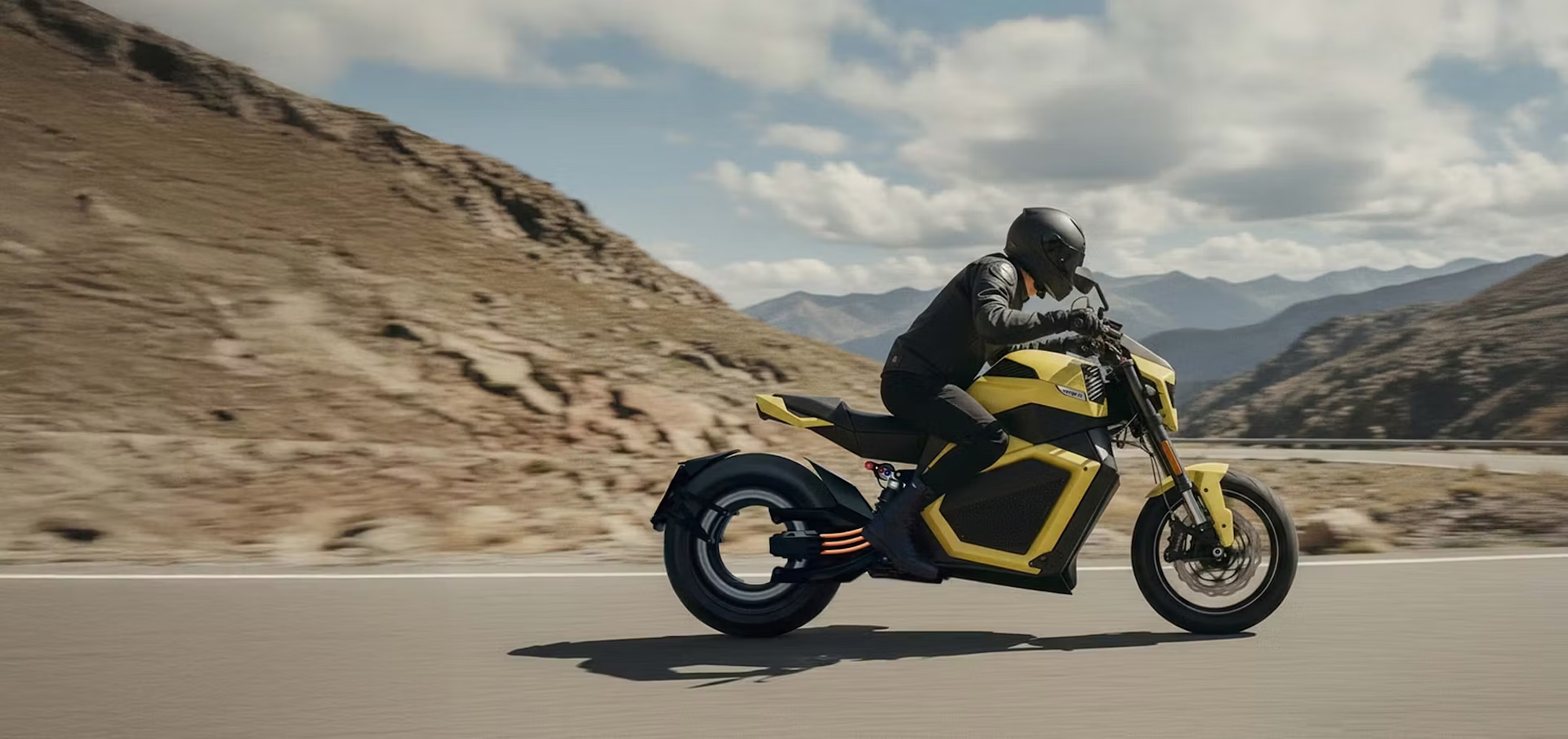
Up to 370 miles on a single charge and a peak power outputs of 201 bhp and 885 lb-ft of torque. These are the insane claims of the new Verge Motorcycles TS Ultra, which was revealed this week at the Consumer Electronics Show in Las Vegas.
Launched alongside the similarly platformed TS Pro and TS Pro California Edition, the bikes’ headline feature is the presence of a solid-state battery, the holy grail of electric vehicle tech for the past several years.
Most of the electric vehicles currently in production – be they cars, motorcycles, or tuk-tuks – are powered by lithium-ion batteries. In the last half decade or so, that technology has pretty much plateaued, with the challenges increasingly outweighing benefits as expectations of electric vehicles rise.
That is to say, 20 years ago, we didn’t expect as much out of electric cars. Now we want EVs not only to compete against petrol-driven vehicles but, often, to surpass them.

Solid-state batteries are a step toward that glorious imagined future and the Verge TS Pro and TS Ultra will, according to InsideEVs, be the first production vehicle to house them.
A solid-state battery, in addition to sounding like the name of an early 2000s alt-rock/post-grunge band, reportedly offers a number of benefits over lithium-ion batteries – chief among them being capacity, range and safety.
Solid-state batteries have higher energy density, but they are also smaller and lighter, meaning manufacturers can pack more of them into a vehicle. In terms of safety, they are less likely to explode, which is always a nice feature.
Solid-state batteries also charge more quickly and use fewer materials, which is of benefit in a world where trade wars are creating concerns about access to the necessary minerals and metals needed to make batteries.

Verge’s new bikes will be driven by a solid-state battery developed by UK-based (but Finnish-run) Donut Lab. Not to be confused with The Donut Lab, which is also UK-based but simply makes donuts.
According to Inside EVs, Donut Lab’s all-solid-state battery has an “energy density of 400 watt-hours/kilogram and can be fully charged in as little as five minutes for as many as 100,000 cycles… By comparison, some of the top-tier traditional Li-ion batteries available today have an energy density of around 250-300 Wh/kg and can last for up to 5,000 full cycles.”
The battery powering the TS Pro/TS Ultra takes a little longer than 5 minutes. Verge says 80-percent charge is achievable in “less than 10 minutes.” Apparently the company tweaked charging time deliberately, “so that riders can enjoy a coffee while waiting.”
Uhm, sure…

A few grains of salt
A number of manufacturers have been working toward using solid-state batteries in their electric vehicles. In MCN’s coverage of the Verge TS Pro, it observed that this is “a breakthrough that many would’ve likely expected to come from a vastly bigger organisation such as Honda.” But if you think about it, this makes sense.
Verge Motorcycles is a start-up. Start-ups are allowed – indeed, partially expected – to fail spectacularly. Solid-state has benefits over lithium-ion, but there are also drawbacks. From a big manufacturer perspective, it makes sense to let start-ups learn exactly how big and bad those drawbacks are.
One drawback, for example, is that solid-state batteries are reportedly more prone to suffering dendrites – little crystal-like formations that grow over time and destroy the battery. Secondly, there are questions about the batteries’ ability to suffer the cold. Although, that’s arguably less of a concern when used in a motorcycle. I’ve also read that solid-state batteries may be more susceptible to the adverse effects of constant and regular vibration.
But another major issue is cost. Solid-state batteries, like any new technology, are markedly more expensive than the (already pretty expensive) thing they’re trying to replace. In terms of range and charging time, Verge Motorcycles seems to have answered two of the three big concerns that riders have about electric motorcycles, but the asking prices of these bikes are eye-watering.

The TS Pro, which promises ‘only’ 136.7 bhp and 737.5 lb-ft of torque, has a starting price of £31,980. Whereas the full-fat TS Ultra will set you back at least £47,580. That is more than I earned in the whole of 2024 and 2025 combined (these have been some lean years – please support the blog).
In addition, although solid-state technology is lighter than lithium-ion, it still ain’t feathery. The TS Pro weighs in at 225 kilograms, while the TS Ultra claims a weight of 235 kg. Kinda hefty for a naked bike.
Lastly, of course, it’s almost a given that no one is ever going to manage to eke 370 miles out of this bike on a single charge. That’s a theoretical “city estimate” number. Verge says that the maximum highway range is closer to 196 miles. That’s usually the number you want to look at, then reduce it by roughly 20 percent to get a sense of what may actually be possible when riding like a normal person.
So, probably best to round down to 150 miles. Still better than any other electric bike in production today, though. And not much of an issue if charging really is around 10 minutes.

Oh, and that’s one final concern: Verge Motorcycles says the <10-minute charging time is only possible with chargers that have a 200kW charging speed. Looking at Zapmap, it appears that there aren’t that many of those. For example, in the county where I live (West Sussex) there is only one such charging point. And there appear to be no such charging points anywhere north of York.
Pre-orders are currently being taken on the Verge TS Pro and TS Ultra, with delivery expected sometime in late spring or early summer.


Leave a Reply